

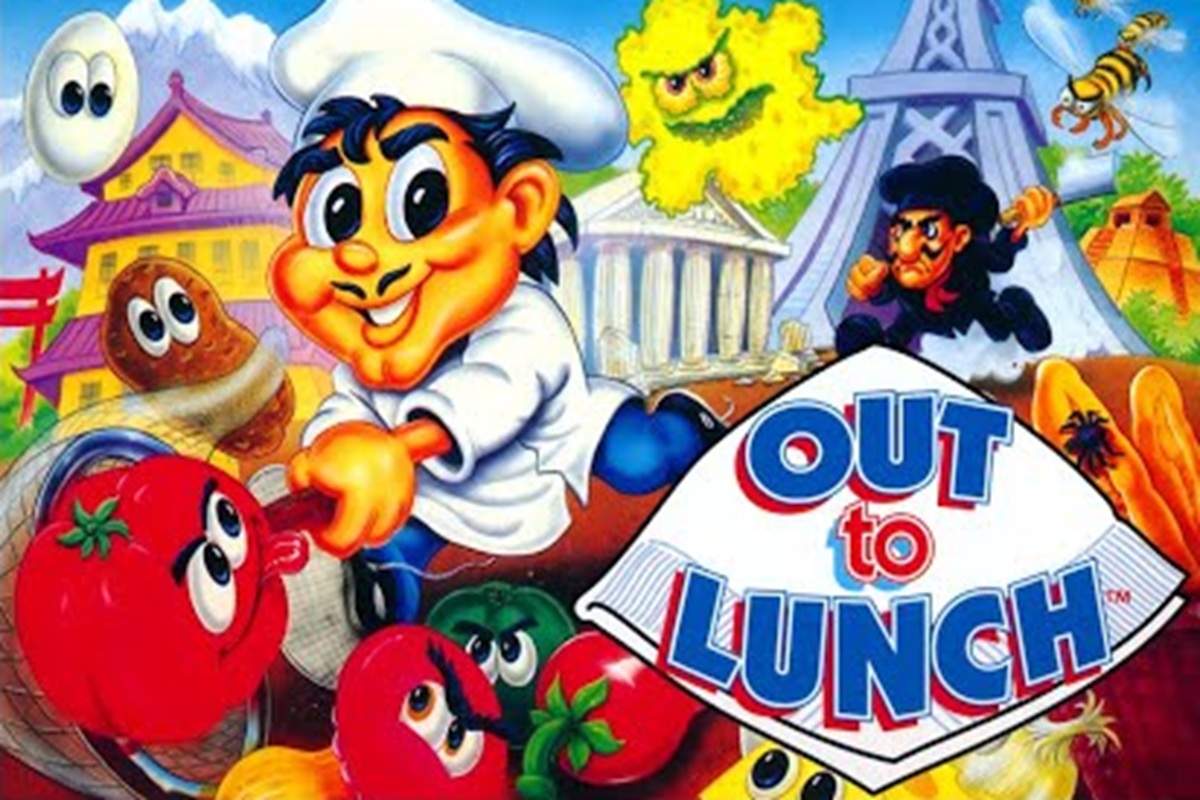
Out to Lunch is one of those wonderfully unusual 16-bit platformers built around a concept that sounds almost too strange to work: a chef travelling around the world trying to capture runaway ingredients. Instead of rescuing a princess, defeating an evil empire, or collecting magical artifacts, players control Pierre le Chef as he searches for escaped vegetables and other food items that have scattered across a series of increasingly challenging stages. Released during the early 1990s, the game combines traditional platforming with timed objectives, enemy avoidance, item management, and a surprising amount of strategy. Its cheerful presentation hides a game that can become demanding very quickly once multiple ingredients, hazards, and troublesome enemies begin moving around at the same time.
What gives Out to Lunch its personality is the way nearly every mechanic connects back to its bizarre cooking theme. Pierre must first locate his net, then chase ingredients through the level, capture them, and return them safely to a cage before time runs out. Germs and bacteria wander through the stages and can cause additional problems, while Pierre's rival Chef Le Noir appears to interfere with the collection process. Instead of simply reaching an exit, players need to understand the entire stage layout and repeatedly move between ingredients and the cage until enough food has been recovered.
Now playable online through Lemon Web Games, Out to Lunch brings this distinctive platforming adventure directly into modern web browsers without requiring the original console. Players can guide Pierre through stages inspired by Switzerland, Greece, the West Indies, Mexico, China, and France while chasing escaped ingredients and dealing with increasingly chaotic obstacles. The browser-based version provides a convenient way to experience one of the more unusual platformers of the 16-bit era, especially for players who enjoy games built around objectives rather than straightforward left-to-right movement. Whether you remember Pierre from years ago or are discovering him for the first time, Out to Lunch remains a charmingly strange challenge.
Pierre le Chef and the Great Ingredient Escape
Pierre le Chef is not the usual kind of platforming hero. His mission begins when the ingredients intended for his cooking somehow escape, forcing him to travel across several countries in an attempt to recover them. Rather than carrying a sword or magical weapon, Pierre relies on a net and a collection of food-themed items to bring the situation under control. The entire adventure embraces its culinary theme rather than treating it as simple decoration.
The runaway ingredients behave almost like creatures rather than ordinary collectibles. They move around the level, change direction, fall from platforms, and sometimes become much harder to catch than their harmless appearance suggests. Pierre must approach them carefully, use the net at the correct moment, and then make sure they are delivered to the cage. Capturing something is therefore only half the objective.
Chef Le Noir provides a rival presence throughout the adventure and frequently makes Pierre's job more difficult. Instead of allowing the player to focus entirely on platforming and collection, his interference introduces another unpredictable element. The result is a game where even a well-planned route can suddenly become complicated. That sense of controlled chaos becomes one of Out to Lunch's defining qualities.
The Net Comes First
Every stage begins with an important problem: Pierre cannot simply start capturing ingredients immediately. He first needs to locate his net somewhere within the level. Until he finds it, the runaway food can be chased but not properly collected. This simple requirement immediately encourages exploration before the main objective can even begin.
The net is usually positioned somewhere that requires at least a little navigation to reach. Players need to understand the platforms, ladders, hazards, and moving objects surrounding Pierre before they can begin the real collection process. Once the net is acquired, the stage changes from exploration into a mixture of pursuit and route planning. That shift gives each level a small sense of progression.
Finding the net quickly can make a noticeable difference because the clock is constantly working against the player. Spending too long searching wastes valuable time that could have been used capturing ingredients. Experienced players therefore begin learning efficient routes through each level rather than wandering randomly. The game rewards familiarity just as much as reflexes.
Capturing Runaway Ingredients
Once Pierre has the net, the central challenge begins. Ingredients move independently around the stage, often bouncing, falling, or wandering into awkward positions. Pierre needs to get close enough to capture them without being damaged by enemies or losing too much time. The simple act of catching food becomes surprisingly complicated when several ingredients are moving in different directions at once.
Different levels contain varying numbers of ingredients, and later stages become much more crowded. Chasing one item can easily lead Pierre away from another, while returning to the cage may require navigating back through dangerous sections. Players need to decide whether to concentrate on the nearest ingredient or travel toward one that may soon become difficult to reach. This creates a mild strategic layer beyond ordinary platforming.
The ingredients also contribute to the game's humor. Watching pieces of food escape from a professional chef creates an intentionally absurd situation, especially when Pierre needs to chase them across entire countries. The animation and movement give the ingredients personality even though they are essentially the player's objectives. Their unpredictability keeps the stages from feeling static.
Returning Food to the Cage
Capturing an ingredient does not automatically remove it from the stage. Pierre must bring it back to the cage, which functions as the collection point for everything he has recovered. This means every successful capture is followed by another navigation challenge. The player frequently travels through the same sections multiple times while gradually clearing the level.
This structure is important because it prevents Out to Lunch from becoming a simple collectible hunt. The player cannot simply touch every item once and continue toward the exit. Each ingredient creates a round trip, forcing Pierre to move between distant parts of the environment while avoiding enemies and watching the timer. Efficient routes become increasingly valuable in larger stages.
The cage also becomes a natural landmark within each level. Players quickly learn how different platforms connect back to it and which paths provide the safest return. Memorizing these routes can dramatically improve performance during later attempts. The repeated movement gives the stages an almost puzzle-like structure despite the action-platforming controls.
Germs Make Everything More Difficult
Germs are among the most troublesome enemies in Out to Lunch because they directly interfere with Pierre's objective. Rather than simply damaging the player, they can interact with the runaway ingredients and make them more dangerous or difficult to capture. This means Pierre cannot always ignore an enemy simply because it is not blocking the immediate path. A germ wandering toward an ingredient can create a much larger problem.
Infected ingredients may behave more aggressively, turning what should have been a simple capture into another hazard. Players therefore need to pay attention to what is happening across the stage rather than focusing entirely on Pierre's immediate surroundings. Preventing a germ from reaching food can sometimes be more important than chasing another ingredient. This introduces an unusual form of threat management.
The mechanic also fits the food theme surprisingly well. Germs contaminating ingredients makes sense within the game's exaggerated culinary logic, and the idea gives enemies a purpose beyond ordinary platforming danger. They actively disrupt the player's objective rather than simply serving as moving obstacles. That helps Out to Lunch feel more distinctive.
Chef Le Noir Creates Extra Chaos
Chef Le Noir acts as Pierre's rival and appears throughout the adventure to make the collection process even more difficult. He can interfere with ingredients and disrupt the player's plans, forcing Pierre to react quickly. Instead of functioning as a traditional boss who appears only at the end of a world, he contributes to the moment-to-moment chaos of ordinary stages. His presence makes the environment feel less predictable.
Players need to watch both the ingredients and Chef Le Noir's movements. A carefully planned route can become inefficient if he changes the situation while Pierre is elsewhere. This means the player occasionally has to abandon one target and deal with a more immediate problem. The additional pressure keeps later stages from becoming routine.
The rivalry also gives the adventure some personality beyond simple food collection. Pierre is not only trying to complete a job; he is doing so while another chef actively complicates the mission. The competition between the two characters creates a playful tone that matches the game's cartoon presentation. It reinforces the idea that Out to Lunch is deliberately lighthearted even when the gameplay becomes challenging.
Food-Themed Items Help Pierre Fight Back
Pierre is not completely defenseless. Several items scattered around the stages can be used to temporarily control enemies or ingredients, giving players valuable time to complete objectives. Flour bags and hot sauce are among the more memorable tools available, continuing the game's commitment to using culinary objects as gameplay mechanics. These items give Pierre alternatives to simply running away from danger.
Using an item at the right moment can dramatically simplify a difficult situation. A troublesome enemy may be stunned long enough for Pierre to collect nearby food, while an aggressive ingredient can sometimes be made easier to handle. Because these resources are limited, players need to decide when using one is actually worthwhile. Wasting an item early can make a later section significantly more difficult.
The item system also encourages experimentation. Players gradually learn which tools work best against particular threats and when conserving an item is more useful than using it immediately. Although the mechanics are simple, they add a meaningful layer of resource management. The combination of platforming, collection, and item use gives Out to Lunch more depth than its cheerful visuals initially suggest.
A Race Against the Clock
Time pressure plays an important role throughout the adventure. Pierre cannot wander indefinitely while searching for ingredients because each stage has a timer. This changes the way players approach exploration, especially when the level layout is unfamiliar. Every wrong turn reduces the amount of time available for actually completing the objective.
The timer encourages players to learn efficient routes. During an early attempt, much of the clock may be spent simply discovering where the net, cage, and ingredients are located. Later attempts become more deliberate, with players heading directly toward important positions and minimizing unnecessary backtracking. Knowledge becomes one of the strongest advantages available.
Time pressure also combines with the moving ingredients to create tension. An item that is easy to catch now may wander into a much more dangerous section later. Players therefore need to prioritize targets rather than treating every ingredient equally. The best route may depend on what is currently happening rather than simply following a fixed pattern.
Switzerland Begins the World Tour
Pierre's journey takes him across several international locations, beginning with Switzerland. These early stages introduce the basic collection system while giving players enough room to understand how the net, ingredients, cage, and enemies interact. The environment establishes the colorful cartoon style that remains throughout the adventure. It also provides a relatively manageable introduction before later countries become more demanding.
Platforms, ladders, and moving ingredients encourage players to explore vertically as well as horizontally. The cage may be positioned some distance from the food, forcing repeated trips through the same terrain. These early stages teach players the importance of memorizing routes. By the time the difficulty increases, the basic objective should already feel familiar.
Switzerland also establishes the world-travel structure. Instead of remaining inside one kitchen or restaurant, Pierre's search expands into an international adventure. Each new country becomes another exaggerated playground built around local scenery and themed hazards. The journey feels much larger than the simple premise might suggest.
Greece Introduces New Challenges
Greece continues Pierre's journey with a different visual theme and more complicated stage layouts. By this point, the game expects players to understand the basic collection loop and begins placing ingredients in positions that demand more careful movement. Enemies are also more difficult to ignore, particularly when they threaten the food Pierre is trying to recover. The increase in complexity is gradual but noticeable.
Stage layouts become increasingly important because simple mistakes can waste large amounts of time. Falling to a lower platform may require climbing all the way back to a previous area. Ingredients can also wander away while Pierre is taking a longer route. Understanding how different parts of the stage connect becomes essential.
The changing environment helps prevent the repeated objective from becoming visually repetitive. Although Pierre is always collecting food, the surrounding architecture and scenery continue to change. The world-tour concept gives the developers freedom to introduce new backgrounds without abandoning the same core mechanics. This variety helps maintain interest across the adventure.
The West Indies Add a Tropical Setting
The West Indies bring a tropical atmosphere to Pierre's search, giving the game another major visual change. Bright scenery and island-inspired environments create a lighter appearance even as the gameplay becomes increasingly demanding. Platforms and hazards continue to revolve around the same collection mechanics, but their arrangement becomes more elaborate. Players who have not learned efficient movement may begin struggling with the timer.
Tropical environments also suit the game's playful personality. Out to Lunch never attempts realistic geography, instead presenting each country as a colorful caricature designed around platforming. The result feels closer to a cartoon world tour than an actual journey. This exaggerated presentation works well with the runaway-food premise.
By this stage, managing several moving ingredients becomes increasingly important. Pierre may need to make decisions about which target to pursue first and which can safely be ignored temporarily. The greater number of moving elements creates more opportunities for unexpected problems. Successful play becomes increasingly about controlling the entire stage rather than reacting to one ingredient at a time.
Mexico Keeps the Pressure Rising
Mexico continues the international adventure with another set of increasingly complex stages. The basic rules remain unchanged, but the layouts become more demanding and the number of threats increases. Players need to move efficiently while watching ingredients, enemies, and the timer simultaneously. A single distraction can result in losing valuable progress.
Items become particularly useful during these later sections. Using flour or hot sauce strategically can create enough breathing room to recover food that would otherwise be difficult to approach. Experienced players begin treating items as part of a larger plan rather than emergency tools. This makes the stage objectives feel more tactical.
The country-by-country progression also provides a satisfying sense of advancement. Reaching Mexico means Pierre has already survived several sets of increasingly complicated levels. The game continues to build on previously introduced mechanics rather than replacing them completely. Each region acts as another layer of difficulty.
China Brings More Complicated Layouts
China pushes the level design further, with increasingly elaborate routes and more opportunities for ingredients to escape into inconvenient areas. Players who have relied mainly on improvisation may find these stages significantly harder. Understanding how platforms connect and where the cage is positioned becomes essential. The timer leaves less room for unnecessary exploration.
The game's movement mechanics remain relatively simple, but the stage design makes those same actions more demanding. Pierre must climb, jump, and navigate around enemies while constantly reconsidering the safest route. Because ingredients continue moving independently, the ideal path can change from one attempt to another. This unpredictability keeps later stages challenging.
The international theme remains one of the game's strongest visual qualities. Even though each country is presented through broad cartoon imagery, the changing scenery gives Pierre's journey a genuine sense of progression. The player always knows they have reached a new chapter. By the time China appears, the adventure feels far removed from the introductory stages.
France Brings Pierre's Journey Full Circle
France serves as the final destination of Pierre's globe-trotting search. Thematically, it is an appropriate conclusion for a character presented as a traditional French chef. Reaching these stages means the player has already mastered the basic systems and survived the increasingly difficult collection challenges of the previous countries. The game therefore has little reason to remain forgiving.
Later stages can demand careful route planning, efficient item use, and strong awareness of enemy movement. Ingredients may be spread across distant sections, forcing Pierre to travel repeatedly between different parts of the environment. The timer becomes particularly threatening when players make unnecessary mistakes. Success depends heavily on everything learned throughout the journey.
The return to a French setting also gives the adventure a satisfying sense of closure. Pierre has travelled across the world chasing ingredients only to finish the journey in a location closely associated with his own culinary identity. It is a simple narrative structure, but it works well for such a lighthearted platformer. The world tour ends where Pierre feels most at home.
Platforming Is Only Half the Challenge
Out to Lunch may look like a traditional platformer, but ordinary jumping is only one part of the gameplay. Players also need to track moving ingredients, avoid contamination, manage items, understand stage layouts, and constantly watch the timer. This combination creates a very different rhythm from games where reaching the right side of the screen automatically completes the level. The objective remains active throughout the entire stage.
The game frequently rewards planning more than reflexes. Knowing where the cage is located, identifying safe routes, and deciding which ingredients to capture first can save more time than simply moving quickly. Experienced players begin viewing each stage almost like a puzzle. The platforming becomes a means of executing the plan.
This objective-based design is one of the biggest reasons Out to Lunch remains memorable. Many platformers from the same period can be understood immediately as variations on the same familiar structure. Pierre's adventure asks players to think about movement differently. That unusual structure gives the game a personality beyond its cooking theme.
Colorful Graphics Match the Playful Premise
The visual presentation uses bright, cartoon-style graphics that suit the game's deliberately silly concept. Pierre is animated with exaggerated movements, while the ingredients bounce around stages with enough personality to look almost alive. Enemies are equally colorful, making even the more dangerous stages feel playful rather than threatening. The overall presentation never takes the adventure too seriously.
Each country uses different backgrounds and environmental details to establish its theme. These settings are intentionally exaggerated rather than realistic, allowing the game to communicate location quickly without complicated visual storytelling. Switzerland, Greece, the West Indies, Mexico, China, and France each provide a different atmosphere. The changing scenery helps break up the repetitive nature of collecting ingredients.
Animation also plays an important gameplay role. Watching how an ingredient moves makes it easier to predict where Pierre should position himself with the net. Enemy movement similarly provides clues about when it is safe to pass. The cheerful visuals therefore support the mechanics rather than existing only for decoration.
A Surprisingly Strategic Platformer
The more time players spend with Out to Lunch, the clearer it becomes that the game contains a stronger strategic element than its appearance suggests. Ingredients move independently, enemies interfere with them, and Pierre needs to make repeated trips back to the cage. The player is constantly deciding what to prioritize. Moving efficiently matters as much as executing precise jumps.
Resource management adds another layer. Flour bags and hot sauce can simplify difficult situations, but using them carelessly may leave Pierre without help when something more dangerous appears. Players need to understand whether an immediate problem deserves an item or can be handled through movement alone. This creates small tactical decisions throughout each stage.
The timer connects all of these systems together. Every decision has a cost in seconds, so hesitation can become just as dangerous as an enemy. A player who understands the stage can make difficult levels look surprisingly controlled. Someone encountering the same level for the first time may experience complete chaos.
Difficulty Increases Through Complexity Rather Than New Controls
Out to Lunch does not continually introduce new abilities or complicated commands. Pierre's basic controls remain relatively straightforward throughout the adventure. Instead, difficulty increases by placing the same mechanics into increasingly demanding situations. More ingredients, tougher enemies, longer routes, and tighter time limits gradually make the familiar objective harder to complete.
This approach keeps the game accessible while still providing substantial challenge. Players do not need to memorize new combinations every few stages. Improvement comes from becoming more efficient with the tools already available. The learning curve is based primarily on understanding level design and managing several moving elements simultaneously.
Later stages can become frustrating when ingredients wander into awkward locations or enemies interfere at exactly the wrong moment. However, repeated attempts usually reveal better routes and priorities. The game rewards persistence and familiarity. What initially looks impossible can become manageable once the player understands the stage.
Why Out to Lunch Still Feels Different
Even among the many unusual platformers released during the 16-bit era, Out to Lunch stands out because of its objective structure. Most mascot games ask players to reach the end of a stage while collecting optional items along the way. Pierre cannot finish until he has actively captured enough moving ingredients and returned them to the cage. This makes the entire level feel dynamic.
The culinary theme reinforces that uniqueness. Nets, flour, hot sauce, germs, and runaway vegetables are not ordinary platforming concepts. The developers could have replaced them with conventional fantasy objects, but doing so would have removed much of the game's personality. The strange theme makes the mechanics easier to remember.
Its globe-trotting structure adds another layer of charm. Travelling through six different countries gives the adventure a broader identity than a game confined to one kitchen. The combination of international settings and escaping food is strange, but it works because the game fully commits to the idea. Out to Lunch never feels embarrassed about being unusual.
Playing Out to Lunch Online Today
Through Lemon Web Games, Out to Lunch can now be played directly in your web browser with no downloads or setup required. Features of the web-based version include:
Playing Out to Lunch through a browser makes it easy to experience one of the stranger platformers of its era without searching for original hardware. The basic controls are straightforward, but understanding how the objectives work may take a few attempts. Once players realize that the stage is built around repeatedly capturing ingredients and returning them to the cage, the level design becomes much easier to read. The challenge then shifts toward completing those routes efficiently before time expires.
For returning players, the browser-based version provides an opportunity to revisit an adventure that can easily be forgotten among more famous 16-bit platformers. Newcomers may be surprised by how much planning is involved beneath the cheerful visuals. The game can become hectic, but its unusual structure is exactly what gives it lasting character. Few other platformers turn runaway food into such a demanding challenge.
Who Should Play Out to Lunch
Out to Lunch is particularly suitable for players who enjoy learning stage layouts and gradually becoming more efficient. The first attempt through a level may feel chaotic because ingredients are moving everywhere and enemies are constantly interfering. Later attempts become far more controlled once the player remembers where the net, cage, hazards, and useful items are positioned. That improvement creates a satisfying sense of mastery.
The game also appeals to players who enjoy unusual concepts. Pierre's world is filled with walking food, dangerous germs, rival chefs, and culinary items used like weapons. None of it makes much sense outside the game's cartoon logic, but that is exactly what gives the adventure its personality. It remains far more memorable than a generic platformer built around conventional enemies and collectibles.
Play Out to Lunch Online Now
Out to Lunch offers a platforming experience built around an objective that remains unusual even decades after its original release. Pierre must locate his net, chase runaway ingredients, protect them from contamination, return them to the cage, and complete everything before the timer expires. Enemies and Chef Le Noir constantly interfere with that process, while items such as flour and hot sauce provide temporary ways to regain control. The result is a game where success depends on understanding the entire stage rather than simply reaching an exit.
Through Lemon Web Games, players can experience Pierre's world tour directly through a modern browser and discover how demanding food collection can become when everything refuses to stay still. Returning fans can revisit the international stages, while newcomers can experience a lesser-known platformer with a genuinely different structure. The mechanics are easy to understand but increasingly difficult to execute efficiently. For anyone tired of conventional mascot adventures, Out to Lunch provides a refreshing change of pace.
Final Thoughts
Out to Lunch remains memorable because it takes a simple idea and builds an entire platforming game around it without losing sight of the joke. Pierre le Chef is travelling around the world chasing ingredients that should have remained inside his kitchen, yet the game treats that ridiculous situation with complete commitment. The net, cage, germs, food-themed items, and rival chef all contribute directly to the gameplay rather than serving as decorative references. That integration gives the game a clear identity.
The objective-based stage design also deserves more credit than it often receives. Capturing moving ingredients and returning them to the cage forces players to think about routes, timing, and enemy positions rather than simply moving in one direction. The timer adds pressure, while the international environments keep the presentation varied as the difficulty increases. Even though the controls remain simple, the surrounding systems create plenty of strategic decisions.
More than three decades after its original release, Out to Lunch still feels unusual enough to stand apart from the crowded field of 16-bit platformers. Its colorful graphics, strange culinary theme, globe-trotting stages, and constantly escaping ingredients create an experience that is difficult to confuse with anything else. Through Lemon Web Games, players can once again help Pierre recover his runaway food directly in their browsers and discover why this quirky adventure remains one of the more distinctive platforming curiosities of its era.











Comments 0