

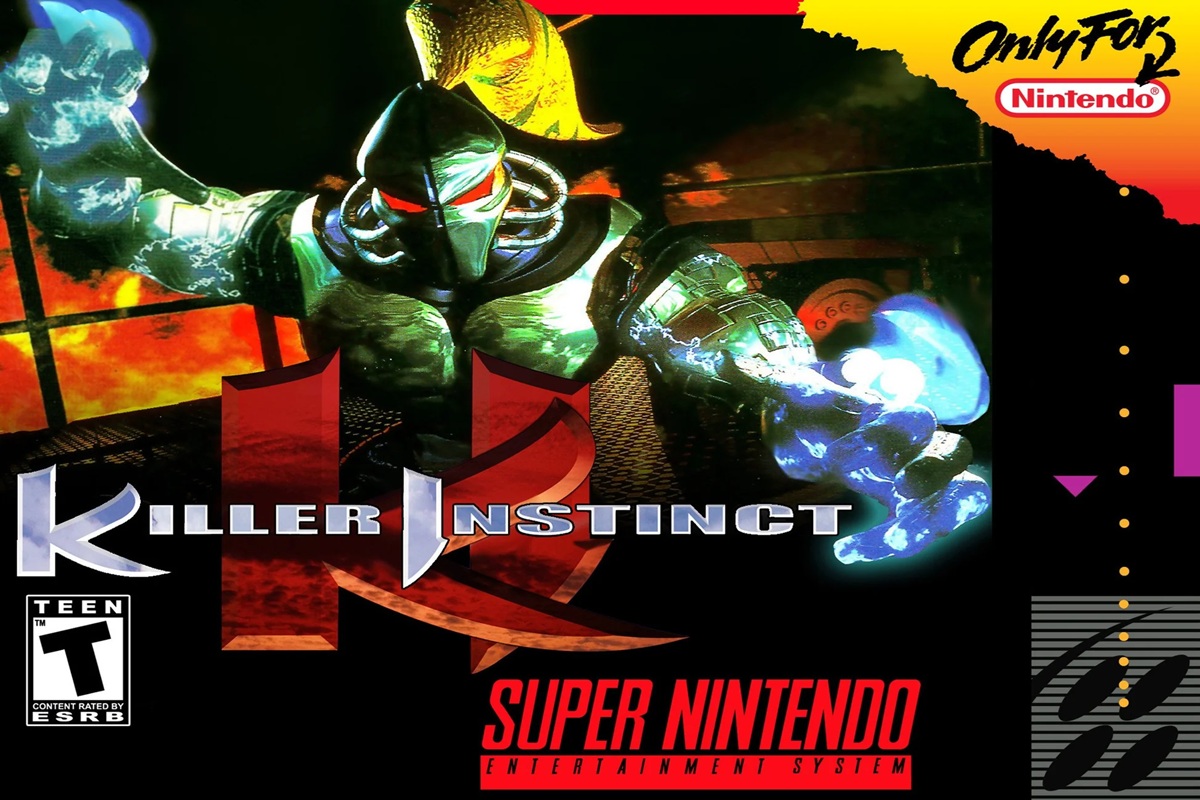
Killer Instinct arrived during one of the most competitive periods in fighting game history, when arcades and home consoles were filled with players mastering special moves, memorizing matchups, and looking for the next major challenger to Street Fighter and Mortal Kombat. Developed by Rare, Killer Instinct distinguished itself through aggressive combat, unusually long combo sequences, digitized-style visual presentation, dramatic finishing moves, and a roster filled with characters that looked unlike almost anything else in the genre. The Super Nintendo version brought that experience into homes in 1995, translating the arcade game's demanding combat system onto 16-bit hardware. Although compromises were inevitable, the conversion retained the mechanics and personality that made Killer Instinct instantly recognizable.
The game is built around ten main fighters, including Jago, Orchid, Fulgore, Sabrewulf, Glacius, Spinal, Thunder, Riptor, Cinder, and T.J. Combo. Each character has a distinctive fighting style, special moves, combo routes, and finishing techniques, encouraging players to spend time learning how individual attacks connect together rather than simply relying on isolated punches and kicks. The final boss, Eyedol, waits at the end of the single-player challenge and adds another memorable opponent to the game's already unusual cast. What truly separates Killer Instinct from many other fighters of its era, however, is the way it turns combos into the central language of combat.
Now playable online through Lemon Web Games, Killer Instinct brings its fast-paced fighting, Combo Breakers, Ultra Combos, and memorable cast directly into modern web browsers. Players can choose a favorite fighter, learn increasingly complex attack sequences, interrupt an opponent's momentum, and experience the distinctive rhythm that made Killer Instinct one of the defining fighting games of the mid-1990s. The browser-based experience provides a convenient way to revisit the Super Nintendo adaptation without needing the original cartridge or console. Whether you remember practicing combos decades ago or are discovering the series for the first time, Killer Instinct still offers a very different style of 2D fighting.
A Fighting Game Built Around Combos
The defining mechanic of Killer Instinct is its unusually elaborate combo system. While other fighting games already allowed players to connect several attacks together, Killer Instinct turned long combinations into a central feature rather than an advanced technique used only by expert players. Successful attacks can flow through specific sequences involving openers, automatic double attacks, linkers, and finishing moves. Learning how these pieces connect is essential for understanding the game beyond basic button presses.
This system creates a combat rhythm that feels more aggressive than many traditional fighters. Once a player successfully starts a combination, the goal is often to keep that sequence going for as long as possible without giving the opponent an opportunity to recover. Longer combos are acknowledged dramatically by the game, with escalating announcements that make successful sequences feel like major events. This energetic presentation helped make Killer Instinct especially exciting in competitive environments.
The combo system also creates a strong distinction between casual and experienced play. Beginners can still enjoy straightforward attacks and special moves, but experienced players quickly begin looking for reliable openers and ways to extend their damage. Understanding how one move connects into another becomes just as important as memorizing special move commands. That learning curve gives Killer Instinct considerable depth despite its relatively accessible basic controls.
Combo Breakers Change the Momentum of a Fight
Long combos would become frustrating very quickly if the defending player had no way to respond, which is where the Combo Breaker system becomes important. A properly timed Combo Breaker interrupts an opponent's attack sequence and immediately ends their momentum. This mechanic prevents successful combos from becoming completely automatic and forces attacking players to think about how predictable their sequences have become. It also gives defenders a reason to keep concentrating even while taking damage.
Executing a Combo Breaker requires understanding which attacks are being used and responding correctly. Random button presses are not enough against experienced opponents, making knowledge of the combo system valuable on both offense and defense. Players who repeatedly rely on the same predictable sequences become easier to interrupt. This creates an additional strategic layer beyond simply landing the first hit.
The psychological element becomes especially interesting during competitive matches. An attacker may deliberately vary combo patterns to make a breaker harder to predict, while the defender tries to recognize the sequence before too much damage is inflicted. A successful Combo Breaker can completely reverse the flow of a match and create an opportunity for retaliation. Few mechanics are more closely associated with Killer Instinct than the dramatic announcement of "Combo Breaker!"
Ultra Combos Deliver Spectacular Finishes
Ultra Combos are among the most recognizable features of Killer Instinct. When an opponent's health is nearly exhausted, skilled players can trigger an extended finishing combination that continues long after an ordinary attack would have ended the match. The resulting sequence can contain a huge number of hits, turning the closing moments into an exaggerated display of dominance. These finishers quickly became one of the game's defining attractions.
Performing an Ultra Combo requires more than simply pressing a single button at the end of a match. Players need to understand the correct setup and know when the opponent is vulnerable to the sequence. Successfully landing one therefore feels like a reward for learning a character's combo structure. The dramatic announcer and rapid succession of attacks make the moment feel intentionally excessive.
Ultra Combos also contributed heavily to Killer Instinct's arcade personality. Spectators could immediately recognize when someone was about to end a fight in spectacular fashion, making strong players particularly entertaining to watch. The mechanic gave matches a memorable climax without relying entirely on graphic violence. Even decades later, Ultra Combos remain closely associated with the Killer Instinct name.
No Mercy Finishers Add Another Layer of Style
Killer Instinct also includes character-specific finishing moves commonly known as No Mercy techniques. These function differently from Ultra Combos because they are designed as dramatic finishing actions rather than extended attack chains. Each fighter has their own methods for ending a defeated opponent, adding personality and humor to the roster. Some are serious and destructive, while others lean into the exaggerated style of the game.
These finishing moves reflect the mid-1990s fighting game obsession with spectacular conclusions. Players were no longer satisfied with simply seeing an opponent fall to the ground after losing the final round. Games competed to provide increasingly distinctive ways of celebrating victory, and Killer Instinct developed its own approach. The result adds another reason to learn character-specific commands.
Humiliation moves provide an even more playful variation on this concept. Rather than destroying the opponent, these sequences embarrass the defeated fighter and emphasize the winner's dominance in a less violent way. Their inclusion demonstrates that Killer Instinct was willing to mix serious combat with deliberately ridiculous moments. That combination of intensity and humor remains part of the game's personality.
Jago Offers a Balanced Starting Point
Jago is one of the most recognizable fighters in the series and serves as a relatively balanced introduction to Killer Instinct's mechanics. His martial arts style combines fast physical attacks with useful special techniques, giving him tools for both close-range pressure and ranged combat. Players familiar with traditional fighting game archetypes can usually understand his basic strengths quickly. This makes him an approachable character for learning how Killer Instinct's combo system works.
His moves are particularly useful for practicing the transition between special attacks and longer combinations. Once players understand how to open a combo safely, Jago provides numerous opportunities to continue the sequence. His mobility and balanced offensive options make him useful against a wide variety of opponents. He is straightforward without being simplistic.
Jago's popularity also comes from his visual design and personality. The masked martial artist immediately stands apart from the more monstrous members of the roster while still looking perfectly at home within Killer Instinct's exaggerated universe. His disciplined fighting style provides an effective contrast to characters such as Riptor, Sabrewulf, and Spinal. For many players, he remains one of the most natural entry points into the game.
Orchid Brings Speed and Mobility
Orchid is another iconic member of the roster, relying heavily on speed, mobility, and rapid attack sequences. Her moves allow experienced players to pressure opponents quickly and transition into dangerous combinations before the defender can regain control. She can be extremely effective in the hands of someone comfortable with Killer Instinct's aggressive tempo. Her fast style also makes her visually exciting to watch.
Learning Orchid requires becoming comfortable with constant movement. Remaining passive for too long wastes many of her strengths, particularly against slower opponents. Her special attacks can help control distance or create openings for larger sequences. Once those opportunities appear, the combo system allows her to convert relatively small mistakes into substantial damage.
Her design and distinctive finishing techniques helped make her one of the series' most recognizable characters. Alongside Jago and Fulgore, she became closely associated with Killer Instinct throughout the 1990s. Her combination of speed and style remains appealing to players who prefer aggressive characters. She is particularly enjoyable once the player becomes comfortable maintaining offensive pressure.
Fulgore Represents Killer Instinct's Mechanical Threat
Fulgore is one of the game's most memorable visual designs, presenting a heavily armed cybernetic warrior built specifically for combat. His appearance immediately communicates strength and danger, with mechanical armor, glowing features, and powerful attacks that reinforce his artificial nature. He combines strong physical offense with energy-based techniques, allowing him to fight effectively at different ranges. This makes him one of the most intimidating characters in the roster.
His move set provides tools for controlling space while still supporting long combo sequences. Energy projectiles can pressure opponents from a distance, while close-range attacks allow him to convert openings into substantial damage. Understanding when to switch between these approaches is important because predictable patterns can still be punished. Fulgore's power does not eliminate the need for timing and positioning.
The character also reflects the game's broader fascination with exaggerated archetypes. Killer Instinct contains martial artists, monsters, aliens, undead warriors, dinosaurs, and machines within the same tournament. Fulgore fits naturally into that unusual world while remaining visually distinctive. His popularity would ensure that he became one of the central faces of the franchise.
Sabrewulf Turns Combat into a Savage Rush
Sabrewulf offers a completely different fighting style built around speed, aggression, and animalistic movement. His werewolf appearance is matched by rapid claw attacks and charging techniques that make him particularly dangerous at close range. Players who enjoy rushing opponents and maintaining constant offensive pressure may find him especially appealing. His animations also give his attacks a deliberately savage quality.
The character is most effective when the opponent is denied enough space to establish their own strategy. Closing distance quickly and maintaining pressure can force defenders into mistakes that become combo opportunities. However, reckless aggression can be punished if the opponent anticipates the approach. Successful Sabrewulf players therefore need to balance speed with careful timing.
His presence contributes significantly to the roster's unusual variety. Rather than simply creating another human martial artist, Rare built a fighter whose entire identity revolves around being a supernatural creature. This makes matchups visually distinctive before the fight even begins. Sabrewulf remains one of the clearest examples of Killer Instinct's willingness to embrace exaggerated character concepts.
Glacius Brings an Alien Fighting Style
Glacius stands apart from the rest of the roster as an alien composed of unusual icy material. His attacks take advantage of this supernatural biology, allowing his body to stretch, transform, and produce freezing techniques. This gives him a fighting style that would be impossible for a conventional human character. His design reinforces the idea that almost anything can enter the Killer Instinct tournament.
His unusual reach can make positioning particularly important. Attacks that extend across significant distances allow Glacius to threaten opponents without always standing directly beside them. Ice-based techniques add further variety to his offensive options. Players need to understand these ranges to make full use of his unusual abilities.
Facing Glacius can also require adjustments because some of his attacks do not resemble those of more traditional fighters. Familiar expectations about distance may not always apply when his limbs can stretch toward an opponent. This makes him an interesting matchup even for experienced players. His design and mechanics remain among the most creative aspects of the original roster.
Spinal Combines Humor and the Supernatural
Spinal is an undead skeleton warrior whose appearance immediately makes him one of the game's most memorable characters. Armed with a sword and shield, he combines traditional weapon attacks with supernatural abilities. His exaggerated animations and skeletal design give him a slightly humorous personality despite the darker visual style surrounding the tournament. Few fighting game characters from the era looked quite like him.
His attacks provide a mixture of close-range weapon strikes and unusual magical options. Learning how these tools interact with the combo system makes Spinal much more dangerous than his comedic appearance might suggest. He can create awkward situations for opponents who are unfamiliar with his movement and attack patterns. Experienced players can use that unpredictability to build offensive momentum.
Spinal demonstrates how Killer Instinct balances serious competition with intentionally strange character concepts. A cyborg, dinosaur, werewolf, alien, and skeleton can all fight within the same tournament without the game attempting to make the combination seem realistic. The exaggerated roster is part of the attraction. Spinal may be absurd, but he fits perfectly within Killer Instinct's world.
Thunder Fights with Strength and Reach
Thunder is a powerful close-range fighter who relies on strength, heavy attacks, and strong pressure. His larger physical presence gives many of his moves a noticeable sense of impact. Players who prefer direct offense over constant projectile exchanges may find his style particularly satisfying. Once he closes the distance, he can make mistakes extremely costly.
His effectiveness depends on controlling space carefully. Slower fighters can struggle if they are repeatedly kept away by ranged attacks, so approaching safely becomes an important skill. Once Thunder reaches the correct range, his physical attacks and combo options allow him to apply considerable pressure. Understanding that transition between approach and offense is central to using him well.
Thunder also contributes another recognizable silhouette to an already diverse roster. Killer Instinct's characters were designed to be immediately distinguishable from one another, and Thunder's appearance accomplishes that effectively. His straightforward strength provides a useful contrast to more technical or supernatural fighters. He remains a strong option for players who enjoy powerful close-range combat.
Riptor Introduces a Fighting Dinosaur
Perhaps nothing demonstrates Killer Instinct's attitude toward character design better than Riptor, a genetically engineered dinosaur entering a fighting tournament against humans, aliens, monsters, and machines. Riptor attacks using claws, bites, tail strikes, and rapid movement, creating a style very different from conventional martial artists. The character moves with an animalistic posture that changes the visual rhythm of the fight. Simply seeing Riptor standing opposite someone like Jago immediately communicates how strange Killer Instinct is willing to become.
Speed is one of Riptor's strongest qualities. Quick movement allows the character to close distance rapidly and pressure opponents before they can establish a comfortable rhythm. Low attacks and unusual animations can also make defensive reactions more difficult. Learning how to maintain that pressure is essential.
Riptor became memorable because the concept is both ridiculous and surprisingly effective. Fighting games often rely on recognizable martial arts archetypes, but a genetically engineered dinosaur ignores almost every traditional expectation. Killer Instinct embraces that unpredictability throughout its roster. Riptor remains one of the clearest examples of the game's creativity.
Cinder Turns Fire into an Offensive Weapon
Cinder is another supernatural fighter, appearing as a human transformed into a living flame. His entire design revolves around speed, heat, and fiery energy attacks. Bright animation effects make his movements stand out strongly against the darker stages. He is visually one of the most distinctive fighters in the game.
His abilities allow him to move quickly and attack from unusual angles. Fire-based projectiles and aggressive movement can create strong pressure, particularly against opponents who struggle to control distance. However, the player still needs to understand how his attacks fit into the combo system. Raw speed alone is not enough against experienced defenders.
Cinder also reflects the game's fascination with characters transformed by technology or experimentation. Fulgore is a machine, Riptor is genetically engineered, and Cinder is physically altered into something beyond an ordinary human. These backgrounds reinforce Killer Instinct's science-fiction elements alongside its supernatural themes. The result is a roster that feels deliberately unpredictable.
T.J. Combo Brings Boxing into the Tournament
T.J. Combo provides a more grounded fighting style built around boxing. Unlike characters armed with blades, claws, energy projectiles, or supernatural powers, Combo relies primarily on speed, strength, and powerful punches. His attacks emphasize forward momentum and close-range pressure. This makes him particularly satisfying for players who enjoy straightforward physical offense.
The boxing style still fits naturally into Killer Instinct's combo-focused mechanics. Rapid punches can flow into longer sequences, while powerful strikes provide opportunities to punish defensive mistakes. Because Combo lacks some of the bizarre abilities available to other characters, positioning becomes especially important. He needs to establish the correct range before his offense becomes most effective.
His comparatively realistic fighting style also makes the surrounding roster seem even stranger. Watching a boxer face an alien or genetically engineered dinosaur highlights just how broad the game's character concepts are. Yet the combat system allows every fighter to operate within the same fundamental rules. This gives Killer Instinct variety without making the roster feel mechanically disconnected.
A Tournament Controlled by Ultratech
The story of Killer Instinct revolves around Ultratech, an enormous corporation powerful enough to operate its own combat tournament. Fighters enter for different reasons, ranging from personal objectives to circumstances directly connected to Ultratech's experiments and technology. The tournament framework provides a straightforward reason for such wildly different characters to confront one another. It also establishes the darker science-fiction atmosphere surrounding much of the game.
Several fighters have direct connections to the corporation. Fulgore represents Ultratech's advanced military technology, while other characters have histories involving experimentation, captivity, or corporate manipulation. This gives the tournament slightly more context than a simple sports competition. The matches exist within a world where technological power has grown far beyond ordinary control.
The story remains relatively light during actual gameplay, with fighting clearly taking priority over lengthy narrative sequences. Character endings provide additional information and help explain individual motivations. This approach was common during the era, when players were expected to discover much of a fighting game's world through manuals, endings, and character details rather than extended cinematics. The atmosphere does much of the storytelling.
Eyedol Waits at the End
Eyedol serves as the game's final boss and provides an appropriately bizarre conclusion to the tournament. The enormous two-headed warrior is physically imposing and considerably stronger than the ordinary roster. His attacks can inflict heavy damage, while his unusual design makes the battle visually memorable. Reaching him requires surviving the preceding sequence of opponents.
Like many fighting game bosses from the era, Eyedol is intentionally difficult. Players cannot expect the same tactics that worked against weaker computer-controlled opponents to succeed automatically. Understanding spacing, blocking, and opportunities for punishment becomes particularly important. The final encounter is designed to feel like a genuine escalation.
Eyedol can also be accessed as a playable character through a special code, adding another secret for players willing to experiment. His inclusion reflects the era's fascination with hidden characters and unusual unlockable content. Discovering these secrets was often part of the conversation surrounding fighting games before information became instantly available online. For many players, simply learning that the boss could be controlled was exciting.
Arcade Ambition on 16-Bit Hardware
The original arcade version of Killer Instinct ran on much more powerful hardware than the Super Nintendo could reproduce directly. Bringing the game home therefore required substantial technical compromises. Character animation was reduced, backgrounds were simplified, and many visual effects could not match the arcade presentation. Despite these limitations, Rare managed to preserve the essential combat systems remarkably well.
The SNES conversion still feels recognizably like Killer Instinct because the speed, combo structure, characters, special moves, and major finishing mechanics remain intact. This was more important than reproducing every graphical detail perfectly. Players could practice the same fundamental strategies at home and become familiar with each fighter's move set. For many people who did not have regular access to an arcade machine, this became their primary version of the game.
The conversion was also impressive simply because of how ambitious the source material was. Killer Instinct's arcade graphics were frequently promoted as an example of advanced rendering technology, making the idea of a 16-bit adaptation seem difficult. The home version obviously looked different, but it captured enough of the experience to become successful on its own terms. It remains an interesting example of developers adapting technically demanding arcade games to limited hardware.
The Famous Black Cartridge
The North American Super Nintendo release became especially recognizable because it was shipped on a black cartridge rather than the standard gray plastic associated with most SNES games. This immediately made Killer Instinct stand out physically before the console was even turned on. The unusual cartridge reinforced the darker visual identity of the game and helped the release feel like a special event. It remains one of the most recognizable cartridge designs from the system's library.
Packaging also played an important role in presenting Killer Instinct as a premium fighting game. The darker colors, aggressive character artwork, and unusual cartridge created a strong contrast with many other releases. This marketing reinforced the game's identity as something intense and different. For players browsing store shelves during the mid-1990s, it was difficult to ignore.
The cartridge has since become part of the game's nostalgia. Retro collectors often remember the physical presentation almost as clearly as the game itself. It is a reminder of an era when publishers frequently used unusual packaging to make major releases stand out. Killer Instinct's black cartridge remains closely associated with the SNES version.
Killer Cuts and an Unforgettable Soundtrack
Music is another important part of Killer Instinct's identity. The soundtrack combines energetic electronic rhythms, aggressive percussion, atmospheric themes, and character-specific musical ideas that help give each stage personality. The compositions complement the rapid combat particularly well. Even players concentrating intensely on combos are likely to remember several of the game's themes.
The Super Nintendo release became especially notable because certain editions included Killer Cuts, a soundtrack CD featuring arranged music inspired by the game. Including a music CD with a console fighting game was unusual and helped reinforce the importance of the soundtrack. For many players, Killer Cuts became almost as memorable as the cartridge itself. Tracks from the game continued to develop a following long after the original release.
Audio also contributes directly to combat through the announcer. Combo names, Ultra announcements, and the famous Combo Breaker call make successful actions feel significantly more dramatic. Without that voice presentation, the same mechanics would lose much of their personality. Killer Instinct understands that a fighting game should sound exciting as well as play well.
Stages Give Every Fighter a Distinct Atmosphere
Each fighter is associated with stages that reflect different parts of Killer Instinct's world. Industrial environments, ancient locations, frozen landscapes, technological facilities, and supernatural settings provide significant visual contrast. The arcade original used elaborate rendered backgrounds, while the Super Nintendo conversion simplifies these environments to fit the hardware. Even with those compromises, the stages remain recognizable and varied.
Some arenas feature environmental details that reinforce a fighter's background or personality. Fulgore naturally fits technological surroundings, while characters such as Spinal and Glacius are associated with very different visual themes. This helps individual matchups feel more distinctive. Fighting the same opponent on every stage would have made the experience far less memorable.
The backgrounds also contribute to the game's darker tone. Killer Instinct is colorful, but it rarely feels cheerful. Industrial machinery, dramatic lighting, dangerous landscapes, and strange environments create a world that feels harsh and competitive. This visual identity helps distinguish the game from other fighting franchises of the same era.
Learning Combos Rewards Practice
Killer Instinct can initially seem chaotic because experienced players are capable of producing extremely long attack sequences. The best way to learn is to start with a small number of reliable techniques rather than attempting an enormous Ultra Combo immediately. Understanding one opener, a simple continuation, and a safe finishing attack provides a foundation for everything that follows. Once those pieces become comfortable, longer combinations begin to make more sense.
Practice also helps players recognize when a combo has become predictable. Performing the same sequence repeatedly may work against inexperienced opponents but becomes dangerous against someone comfortable with Combo Breakers. Varying attacks and learning alternative linkers becomes increasingly important. Offensive creativity and defensive recognition develop together.
This creates a satisfying improvement curve. A newcomer may initially celebrate landing a short three- or four-hit sequence, while an experienced player can eventually produce combinations containing dozens of attacks. The game makes those milestones obvious through its dramatic announcements. Progress feels visible and immediately rewarding.
Competitive Matches Become Psychological Battles
Two-player competition is where Killer Instinct's systems become especially interesting. Fighting against another person introduces unpredictability that computer-controlled opponents cannot fully reproduce. Players begin observing habits, identifying favorite combo patterns, anticipating special moves, and attempting to bait defensive reactions. The mechanical combat becomes a psychological contest.
Combo Breakers contribute heavily to this dynamic. Using the same sequence repeatedly teaches the opponent exactly how to interrupt it. Players must therefore vary their timing and attack choices to remain unpredictable. Even a technically powerful combo becomes less useful if the opponent knows exactly what is coming.
Defensive players also need to resist becoming too passive. Killer Instinct rewards aggressive momentum, and allowing an opponent to dictate the pace can quickly become dangerous. Successful play involves alternating between pressure and caution depending on the situation. This constant tension gives competitive matches considerable replayability.
Why Killer Instinct Stood Out in the 1990s Fighting Boom
The mid-1990s produced an enormous number of fighting games, making it difficult for new franchises to attract attention. Killer Instinct succeeded because it did not simply imitate the biggest names in the genre. Its combo system, rendered visual style, announcer, character roster, and finishing mechanics gave it an immediately recognizable personality. Players could identify Killer Instinct after only a few seconds of watching a match.
Its visual ambition also helped generate excitement. The arcade version was promoted heavily for its pre-rendered character graphics and impressive presentation, creating expectations that felt closer to emerging 3D technology than conventional sprite art. The SNES conversion could not reproduce that presentation fully, but the association remained powerful. Owning the home version felt like bringing a major arcade attraction into the living room.
The characters strengthened that identity further. Few fighting games offered a lineup where a ninja, cyborg, werewolf, alien, skeleton, dinosaur, flaming criminal, boxer, warrior, and secret agent could all appear naturally within the same tournament. Killer Instinct did not attempt subtle realism. Its willingness to embrace exaggerated ideas helped it survive in an extremely crowded genre.
Playing Killer Instinct Online Today
Through Lemon Web Games, Killer Instinct can now be played directly in your web browser with no downloads or setup required. Features of the web-based version include:
Playing Killer Instinct through a browser provides a convenient way to return to its distinctive combat system without relying on original hardware. Basic attacks are easy to understand, but learning how openers, automatic doubles, linkers, Combo Breakers, and finishers interact can provide hours of practice. Players can concentrate on a single character and gradually expand their available strategies rather than attempting to memorize the entire roster immediately. The mechanics reward repetition in a way that makes visible improvement especially satisfying.
For returning players, the browser-based experience can immediately bring back memories of learning combos and attempting increasingly elaborate Ultra finishes. Newcomers may initially be surprised by how quickly matches can change once a successful combination begins. The presentation is naturally simpler than modern fighting games, but the central combo system remains unusual enough to feel distinctive. It is easy to understand why Killer Instinct developed such a dedicated following.
Who Should Play Killer Instinct
Killer Instinct is particularly suitable for players who enjoy practicing mechanical sequences and gradually improving execution. The combo system gives players clear goals, whether that means learning a simple reliable chain, successfully performing a Combo Breaker, or eventually completing a lengthy Ultra Combo. Each character offers different routes and attack patterns, creating plenty of opportunities for experimentation. Players who enjoy repetition as a path toward mastery will find the system especially rewarding.
The game is also worth experiencing for anyone interested in the history of fighting games. Killer Instinct emerged during a period when developers were experimenting aggressively with graphics, violence, finishing moves, and increasingly complicated combat mechanics. Its approach to combos would become one of its defining contributions to the genre. Even modern players unfamiliar with the original release can quickly understand why it attracted so much attention.
Play Killer Instinct Online Now
Killer Instinct remains an energetic fighting game built around momentum, execution, and the constant threat of a devastating combo. Each fighter offers a distinctive approach, ranging from Jago's balanced martial arts and Orchid's speed to Fulgore's technology, Sabrewulf's aggression, Glacius' unusual reach, and Riptor's animalistic attacks. The ability to interrupt combinations through Combo Breakers prevents offense from becoming completely one-sided, while Ultra Combos reward players who master their chosen character. These systems create a fighting game that remains immediately recognizable even decades after its release.
Through Lemon Web Games, players can step back into the tournament directly through a modern browser and experience one of the most distinctive fighters of the 16-bit era. Returning fans can attempt the combos they remember, while newcomers can explore a combat system where successful sequences are celebrated as loudly as the final victory. The game requires practice to appreciate fully, but the learning process is part of its appeal. Every longer combo and successful breaker feels like another step toward understanding what makes Killer Instinct different.
Final Thoughts
Killer Instinct earned its place among the defining fighting games of the 1990s by refusing to behave like an ordinary tournament fighter. Its focus on long combos, dramatic announcer calls, Combo Breakers, Ultra Combos, unusual finishing moves, and an eccentric roster created an identity that was instantly recognizable. The Super Nintendo version naturally sacrifices some of the arcade game's graphical spectacle, but it preserves the combat ideas that matter most. That is why the home conversion remains enjoyable rather than functioning merely as a historical curiosity.
The roster contributes just as much to the experience as the mechanics. Jago, Orchid, Fulgore, Sabrewulf, Glacius, Spinal, Thunder, Riptor, Cinder, and T.J. Combo each bring different visual personalities and offensive styles to the tournament. Fighting as a cybernetic warrior feels very different from controlling an alien or genetically engineered dinosaur, yet every character still operates within the same combo-focused system. This combination of mechanical consistency and visual variety gives the game enormous personality.
More than three decades after Killer Instinct first became an arcade phenomenon, its core ideas remain remarkably easy to recognize. Few fighting games celebrate a long combo with quite the same energy, and few defensive moments are as satisfying as correctly reading an opponent and hearing the unmistakable call of a Combo Breaker. Through Lemon Web Games, players can revisit this classic combat system directly in their browsers, practice increasingly elaborate combinations, and rediscover why Killer Instinct became one of the most memorable fighting games of its era.











Comments 0