

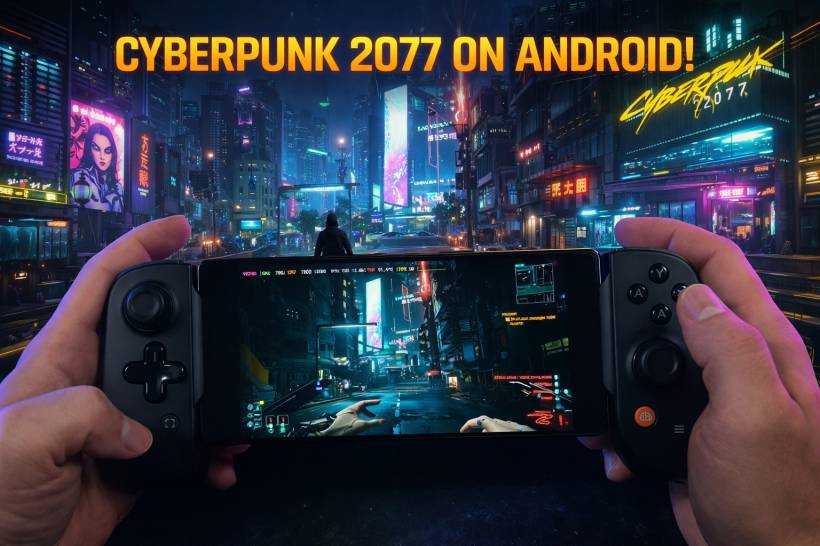
Back in 2020, the idea of running the PC version of Cyberpunk 2077 on a smartphone would've sounded like pure chaos. Not "maybe one day" chaos. More like "that's a meme" chaos. Fast forward about six years, and we're officially living in the "wait… what?" era of mobile gaming. A YouTuber known for handheld and small-form-factor testing, ETA Prime, managed to get Cyberpunk 2077 (PC) running on an Android gaming phone at playable frame rates, using PC emulation.
And yes… it's Night City. On a phone.
The setup: a gaming phone, PC emulation, and a lot of ambition
ETA Prime used the Red Magic 11 Pro, which isn't your typical Android phone. It's one of those "this is basically a handheld gaming rig disguised as a phone" devices.
What makes it especially interesting is that it's built to survive sustained performance:
• It includes active cooling (an internal fan)
• It even has an internal liquid cooling system
• It packs 16GB LPDDR5T RAM, which matters a lot for heavy workloads like emulation
To actually run the PC game, ETA Prime paired the device with GameSir's GameHub platform, which is designed to make PC game emulation on Android more viable. This isn't cloud gaming. The goal here is to brute-force compatibility and performance directly on the phone.
The "playable" baseline: 720p, low settings, and surprisingly steady performance
To keep things realistic, the test settings weren't trying to show off graphics. They were trying to make the game run smoothly.
So the baseline was:
• Low settings
• FSR 2.1 set to Balanced
With that setup, the Red Magic 11 Pro reportedly held around 30 FPS in most scenarios, with dips into the high 20s in heavier moments. Importantly, it didn't fall into the "this is a slideshow" territory. ETA Prime described it as smooth for what those frame rates are capable of delivering.
That's the key point: it's not just "it booted." It's "you could actually play this."
Turning on frame generation: the big FPS jump
Then comes the trick that makes the numbers look much better: FSR frame generation.
With frame generation enabled, performance jumped noticeably:
• More common results in the 40s
ETA Prime also tried the Steam Deck preset, which pushes some settings higher than the low baseline. Surprisingly, the phone still held up:
• With frame generation: roughly 40–50 FPS
This is the part that makes the whole demonstration feel like a "line in the sand" moment. Steam Deck-like settings on a phone, running the PC version through emulation, and still staying playable? That's not supposed to sound normal.
The downside: heat, RAM pressure, and the cost of pushing a phone this hard
Of course, there's a reason phones didn't do this earlier, and it's not just raw power. It's heat and sustained load.
According to the on-screen monitoring:
• GPU usage hovered around 50–60%
• RAM usage was very high, around the 80% range
And temperatures? They reportedly climbed up to around 100°C, even with that built-in cooler and fan. That's the reality of smartphone silicon: you can hit big numbers briefly, but staying there is the hard part.
This is also why gaming phones are the ones doing these stunts first. Regular flagship phones might have strong chips, but without aggressive cooling, they'll throttle faster when you keep them pinned.
Why this matters: it's not just "one YouTuber did a thing"
The bigger story isn't Cyberpunk specifically. It's what this says about where mobile hardware and emulation are heading.
A few years ago, running a modern AAA PC game through emulation on Android would've been:
• technically possible but completely unplayable
Now we're seeing something closer to a "rough but usable" experience, and that's a huge shift.
Part of that progress comes from improvements in emulation tooling and compatibility layers. GameHub reportedly uses Valve's Proton layer as part of the process, and Valve has had a meaningful influence on compatibility tech through Proton and related work. The smartphone scene is basically benefiting from a wave that originally accelerated PC gaming on Linux and handhelds.
And then there's the simple truth: mobile chips keep getting faster, and software keeps getting smarter about squeezing performance out of them.
So… are we heading toward 60 FPS Cyberpunk on phones?
If this trend continues, it's not unrealistic to imagine phones getting closer to a stable 60 FPS experience for demanding PC titles through emulation. The two big "but" factors are obvious:
• silicon priorities (AI workloads are fighting for the same power and efficiency budget)
Still, even with those limits, the fact that we've reached "Cyberpunk runs on a phone at 30–40 FPS" is already wild.
Final thoughts
This isn't the end of the story, but it's definitely a milestone. Cyberpunk 2077 has become one of those benchmark games that exposes whether a system is truly powerful or just pretending. Seeing it run at playable frame rates on an Android phone through PC emulation is a clear sign that mobile hardware has crossed into a new tier.
Not long ago, the conversation was "phones can't do real PC gaming." Now it's turning into "phones can do it… if you're willing to manage the heat, accept some compromises, and lean on modern upscaling tricks."
And honestly, that's still an impressive place to be.











Comments 0