


Samsung's latest Galaxy Unpacked event may have been dominated by the Galaxy Z Fold8 series, but one of the more interesting announcements was sitting quietly beyond the smartphone spotlight. The company offered a closer look at its upcoming intelligent eyewear—a pair of AI-powered glasses designed to bring Gemini, photography, translation and hands-free assistance into an everyday wearable.
Although the product has frequently been referred to online as the "Galaxy Glasses," Samsung has not officially confirmed that as its retail name. For now, the company simply calls it "intelligent eyewear," suggesting that branding, pricing and final product details may still be decided before release.
Samsung introduced the eyewear during Galaxy Unpacked in London on July 22, 2026, following an earlier preview at Google I/O in May. The first models are scheduled to arrive during autumn 2026 in selected markets, although an exact release date has not been announced.
Samsung Is Trying to Make Smart Glasses Look Normal
One of the biggest challenges facing smart glasses is not necessarily the technology—it is convincing people to wear them in public.
Many previous attempts at connected eyewear looked more like experimental gadgets than normal glasses. Thick frames, visible cameras, limited battery life and unusual designs made them difficult to integrate into everyday life.
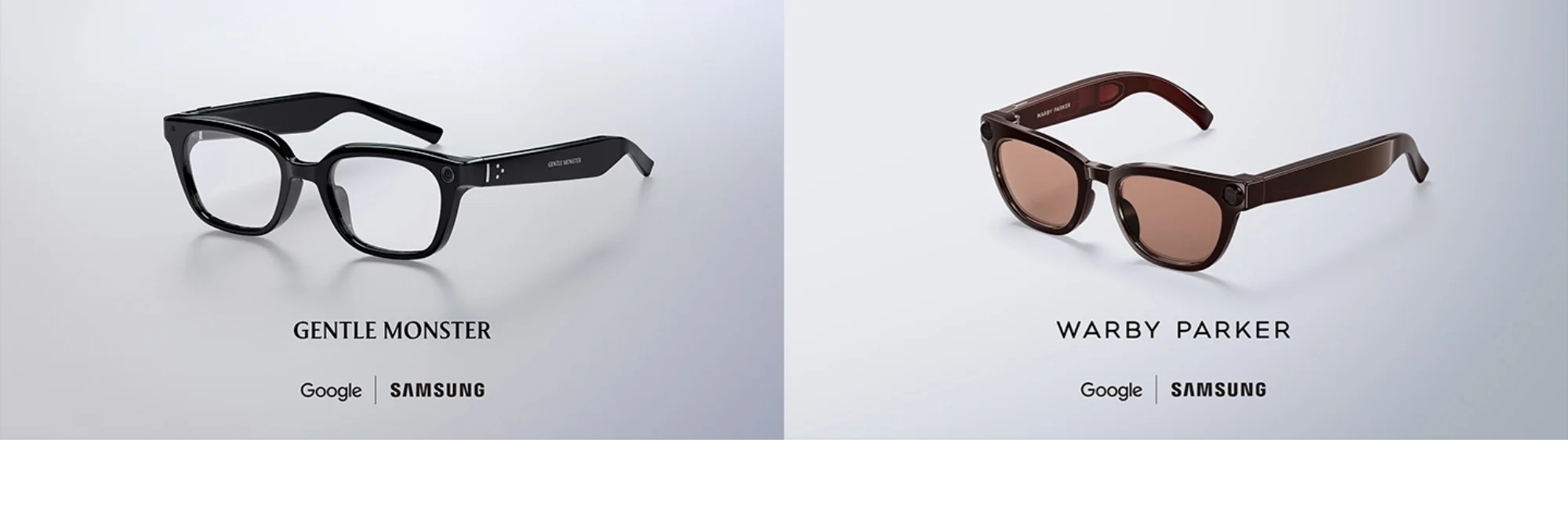
Samsung is trying to avoid that problem by working with established eyewear companies Gentle Monster and Warby Parker. Instead of designing a single frame and expecting everyone to accept it, the partnership is intended to offer different frame styles, colours and lens options for various preferences.
The Gentle Monster edition uses a slim black frame with a straighter upper section and softly rounded lower edges, giving it a more fashionable and slightly futuristic appearance. The Warby Parker design takes a more conventional approach, with a brown frame and a subtle upward curve around the brow.
Samsung says it worked with both companies to improve the fit around important pressure points such as the forehead and ears. This matters because even a technically impressive pair of smart glasses will struggle to gain acceptance if it becomes uncomfortable after an hour of use.
An Audio-First Experience Without a Display
Despite being built on Google's Android XR platform, this first generation is not intended to place floating apps, maps or messages directly in front of the wearer's eyes.
The initial models are audio-focused smart glasses without an integrated display. Information is delivered through speakers built into the frame, allowing the wearer to hear directions, translations, notifications and responses from Gemini.
Users can activate the assistant using a voice command or by tapping the side of the frame. Google has described two categories of Android XR eyewear: audio glasses that provide spoken assistance and more advanced display glasses that can show information visually. The audio version will arrive first, while display-equipped models are expected later.
This approach is less dramatic than full augmented reality, but it may be more practical. Removing the display helps keep the glasses slimmer, lighter and more power-efficient. It also allows Samsung to introduce AI eyewear without expecting consumers to immediately adapt to digital information constantly appearing within their field of vision.
Gemini Can Understand What the Wearer Is Looking At
The built-in camera is central to how the glasses interact with Gemini. Instead of only processing spoken questions, the AI can use visual context to understand what the wearer is seeing.
A user could look at an unfamiliar building, object, sign or product and ask Gemini for more information. While walking through an unfamiliar area, the glasses could provide spoken navigation without requiring the user to repeatedly check a phone.
Samsung also demonstrated how the camera could capture a whiteboard or meeting discussion, extract the important information and organise it inside Samsung Notes. This could be useful during meetings, lectures or brainstorming sessions where users want to remain involved in the conversation rather than concentrating on manually copying everything.
Other planned features include summarising lengthy messages, reading important information aloud, translating spoken conversations, interpreting text on signs or menus and helping users continue tasks across compatible services.
Hands-Free Communication and Visual Sharing
The glasses are also being positioned as an extension of the smartphone rather than a replacement for it.
Users will be able to manage calls, send messages, listen to notifications and access supported mobile applications without constantly taking their phones out. During a call, the wearer may also share what they are currently seeing, making it possible to show another person a problem, location or object from a first-person perspective.
This could have practical uses beyond ordinary video calls. A technician could show equipment to a remote colleague, a traveller could share their surroundings with family members, or someone shopping could request a second opinion without having to hold a phone in front of them.
However, the availability of live visual sharing and recording functions may depend on the application, service, country and local consent requirements.
Snapdragon AR1 Gen 1 Powers the AI Experience
Inside the frame is Qualcomm's Snapdragon AR1 Gen 1 platform, a processor developed specifically for lightweight smart glasses.
Unlike smartphone processors, a chipset for eyewear must operate inside a much smaller enclosure with limited battery capacity and very little room for cooling. It needs to manage the camera, microphones, wireless connectivity, touch controls and AI-related workloads without making the frame excessively warm or bulky.
Samsung says the platform has been optimised for real-time AI assistance, connectivity, power efficiency and thermal management. Some processing will still rely on a connected phone and cloud-based services, meaning the glasses are best understood as part of a wider connected ecosystem rather than a fully independent computer worn on the face.
Nine Hours of Battery Life Could Be a Major Advantage
Battery life has often been one of the weakest areas of wearable technology, particularly with devices that must remain small and lightweight.
Samsung claims its intelligent eyewear can operate for up to nine hours on a single charge. The accompanying charging case can then provide as many as seven additional full charges.
In theory, that could allow the glasses to last through a normal working day before being returned to the case. The case also reduces the need to find a wall socket every evening, particularly while travelling.
Actual performance will naturally depend on how the glasses are used. Continuous photography, video recording, navigation, translation and mobile connectivity will probably consume more power than occasional voice commands or message summaries. Samsung itself notes that battery life will vary according to network conditions, applications, settings and charging history.
The Galaxy Ecosystem Is Becoming More Important
Samsung does not appear to be treating the glasses as an isolated accessory. Instead, they are being positioned as another component of the Galaxy ecosystem alongside smartphones, tablets, earbuds and smartwatches.
Certain features will require a compatible Galaxy phone, while gesture-based interactions are currently tied to the Galaxy Watch9. By connecting information across these devices, Samsung wants the eyewear to understand more about the user's current situation and provide assistance without requiring the same information to be entered repeatedly.
This could make the glasses especially attractive to existing Galaxy users. At the same time, Google says its broader audio-glasses platform will pair with both Android and iOS phones, although Samsung-specific integrations may remain exclusive to Galaxy devices.
Privacy Will Be the Bigger Test
A camera that is always positioned near someone's eyes will inevitably raise privacy concerns.
People nearby need to understand when photographs or videos are being captured, while users will need clear control over what information is being recorded, uploaded or analysed by AI. Samsung says the eyewear will include controls and safeguards, but the company has not yet provided a complete explanation of its privacy indicators or data-handling settings.
Reports from the Unpacked demonstration indicate that the glasses include a recording indicator near the camera, but the real test will be whether that indicator is noticeable enough to reassure people nearby.
Samsung will also need to clearly explain how visual information is processed, when recordings are stored and which features require cloud access. These questions could ultimately influence public acceptance just as much as battery life, design or AI performance.
What About Pricing and Malaysian Availability?
Samsung has not announced an official price for the intelligent eyewear. Earlier reports and leaks have suggested possible figures, but these should not be treated as confirmed until the company publishes its final retail details.
The company has only stated that the first collections will launch in selected markets during autumn 2026. Samsung Malaysia has published information about the product through its local Newsroom, but that does not necessarily confirm that Malaysian retail availability will begin at the same time as larger launch markets.
For Malaysian consumers, factors such as language support, prescription-lens availability, after-sales service and compatibility with locally available Galaxy devices could be just as important as the final price.
Final Thoughts
Samsung's intelligent eyewear is not trying to deliver a science-fiction augmented-reality experience immediately. Instead, it takes a more cautious and potentially more practical route: familiar-looking glasses with a camera, speakers, touch controls and an AI assistant that can understand the wearer's surroundings.
The nine-hour claimed battery life and charging case address one of the most common limitations of smart glasses, while the partnerships with Gentle Monster and Warby Parker show that Samsung understands how important appearance and comfort will be.
The technology still has several questions to answer, particularly around privacy, pricing, regional availability and how well Gemini performs during real-world use. Nevertheless, these glasses provide a clear indication of where Samsung sees personal computing heading next.
The smartphone will probably remain the centre of the experience for some time. However, Samsung is preparing for a future in which users may not need to look at it nearly as often.











Comments 0