

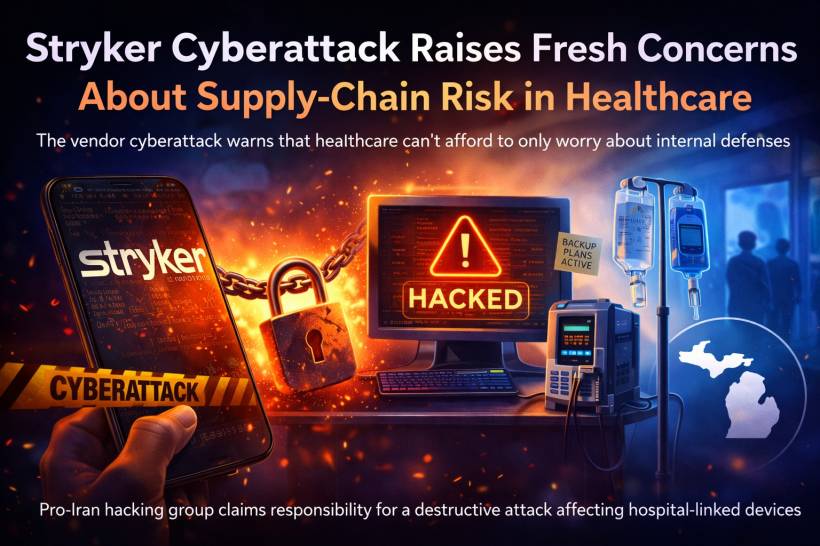
A recent cyberattack involving medical technology giant Stryker has sent a wave of concern through the healthcare sector, especially among hospitals that rely on its equipment and digital systems. Reports suggest the incident disrupted parts of Stryker's Microsoft-based environment, prompting some Michigan health systems to take precautionary steps, including limiting the use of certain devices and turning to backup communication methods while the situation is assessed.
What makes this incident especially unsettling is not just the scale of the disruption, but what it represents. In healthcare, a cyberattack on a major vendor does not stay neatly contained within that vendor. The effects can spread quickly across hospitals, clinics, and care teams that depend on the company's products and support systems every day.
Why This Incident Matters Beyond One Company
Stryker is not a small or isolated player. It is one of the best-known medical device and healthcare technology companies in the world, and its products are used widely across health systems. That means any serious operational issue tied to its digital infrastructure has the potential to create ripple effects far beyond its own offices.
According to reports, the attack may have involved remote wiping through Microsoft Intune, which is used to manage connected systems and devices. More than 200,000 devices, servers, and mobile endpoints were reportedly affected. If accurate, that points to a destructive operation rather than a routine intrusion or a simple attempt to steal data.
That distinction matters. Many healthcare leaders have become familiar with ransomware attacks, where threat actors encrypt systems and demand payment. But this case appears to be more focused on disruption and destruction, which can be even harder to manage in the short term because the goal is not negotiation. The goal is damage.
Reports Point to a Politically Motivated Threat Actor
The incident has been linked in reporting to Handala, a pro-Iranian hacktivist group that allegedly claimed responsibility. The attack has been described as a response tied to broader geopolitical tensions involving Iran. If that connection holds, it adds another layer of seriousness to the event.
Healthcare organizations are already dealing with growing cyber pressure from financially motivated attackers, but politically driven groups can behave differently. They may be less interested in profit and more interested in causing chaos, making a statement, or undermining critical infrastructure. That kind of threat can be more unpredictable and harder to deter through traditional cyber defense measures.
This is one reason the Stryker case is drawing so much attention. It is not just about one vendor going offline. It raises the possibility that geopolitical conflict can directly affect healthcare operations through third-party technology providers.
Disruptions Were Felt Quickly
Stryker said it had no indication of ransomware or malware and believed the incident was contained, but it also acknowledged in a regulatory filing that the attack caused disruptions and was expected to continue affecting access to certain internal systems and business applications.
That alone shows how serious the event was. When a company has to tell employees to stay off the network, avoid using computers, and disconnect from WiFi until restoration work is underway, it is dealing with something far beyond a minor technical issue. Reports also suggested staff were advised to remove management profiles from work phones, which points to concern about how far the remote impact might reach across managed devices.
For hospitals and clinical users, even temporary uncertainty around vendor systems can be a major problem. Medical environments depend on reliability, speed, and clarity. If a supplier's support channels, communications, or connected services become unstable, clinical teams may have to make fast decisions about whether to isolate equipment, switch to manual processes, or fall back to backup workflows.
Why Hospitals Are Taking Precautions
Michigan hospitals reportedly began taking precautionary measures soon after the incident came to light. That response makes sense. In healthcare, waiting for perfect clarity is often not an option. If a vendor that supports critical systems is under attack, hospitals have to assume there may be downstream effects until proven otherwise.
This does not necessarily mean every Stryker device is compromised or unsafe. It means hospitals are doing what they are supposed to do: reducing risk while more information becomes available. That may involve backup communication plans, temporary workflow changes, closer monitoring of equipment, and tighter review of vendor-linked systems.
The reality is that modern hospitals are deeply interconnected environments. Devices, support software, vendor portals, remote maintenance channels, and identity systems often interact in ways that are not always obvious during normal operations. When one link in that chain is disrupted, even indirectly, caution becomes essential.
A Supply-Chain Cyber Risk Wake-Up Call
One of the most important takeaways from this incident is that healthcare organizations can no longer think about cybersecurity only in terms of their own internal environment. A hospital may have solid defenses, but if a key technology vendor suffers a destructive cyberattack, the hospital can still feel the impact almost immediately.
That is why security experts are framing this event as a supply-chain cyber risk issue. In other industries, supply-chain attacks have already shown how a single trusted provider can become the path through which widespread disruption unfolds. In healthcare, the stakes are even higher because interruptions can affect patient care, clinical decision-making, and day-to-day operations.
The Stryker incident is a reminder that vendor relationships are not just procurement decisions. They are also security decisions. Every external system that connects into a healthcare environment becomes part of the hospital's overall risk picture.
What Healthcare Organizations Should Be Thinking About Now
Cybersecurity experts say healthcare teams should focus on a few practical areas while incidents like this are being investigated. One major priority is vendor access management. Hospitals need to understand exactly how external vendors connect into their environment, what systems those connections touch, and how quickly that access can be restricted if needed.
Another key issue is network segmentation, especially for medical devices. If clinical technology is too broadly connected, a problem involving one vendor environment can create far wider exposure than expected. Segmentation helps contain risk and reduces the chance of a single disruption affecting multiple systems at once.
Continuity planning is just as important. Hospitals should not assume a vendor will always be reachable or fully operational during a cyber event. Backup procedures, downtime playbooks, and fallback communication methods need to be tested in advance, not improvised during a crisis.
There is also the human factor. Whenever a major cyber incident becomes public, threat actors often try to take advantage of the confusion with phishing emails, fake updates, credential theft attempts, or bogus support messages. Security teams need to stay alert for follow-on activity that uses the disruption as cover.
Government Agencies Are Now Involved
The Cybersecurity and Infrastructure Security Agency has said it opened an investigation into the Stryker incident and is working with public- and private-sector partners to gather information and provide support. That is an important step, especially given the role that companies like Stryker play in critical infrastructure tied to healthcare delivery.
Still, at the time of reporting, there did not appear to be detailed healthcare-specific mitigation guidance available for particular devices, operating systems, or software components. That leaves hospitals in a familiar position: they may need to act quickly based on incomplete information, using their own internal risk teams and incident response processes while waiting for fuller guidance.
This gap between early warning and detailed technical advice is one of the biggest challenges in healthcare cybersecurity. Organizations often know there is a problem before they know exactly what the operational impact will be.
The Political Debate Around Cyber Readiness
The attack has also triggered political reaction, particularly in Michigan. Some officials have pointed to the incident as evidence of the real-world consequences of geopolitical conflict and the need for stronger national cyber defense capabilities. There has also been criticism of reductions in federal cybersecurity funding and concern that weakened cyber programs leave essential sectors more exposed.
That debate will likely continue, but the practical lesson for healthcare organizations is more immediate. Whether the threat comes from financially motivated criminals, nation-state affiliates, or ideological hacktivists, the healthcare sector remains a high-value and highly vulnerable target. Hospitals cannot afford to treat cyber resilience as a background IT issue anymore. It has become part of operational resilience and patient safety.
Stryker's Response
Stryker CEO Kevin Lobo said the company had prepared for moments like this and activated mitigation protocols quickly to protect employees, facilities, customers, and patients. That message is clearly meant to reassure staff and healthcare partners that response measures were put into motion as soon as the incident was identified.
Even so, the true test will be how quickly the company can restore confidence, communicate clearly with customers, and demonstrate that the threat has been contained. In incidents like this, technical recovery is only part of the picture. Transparency and trust matter just as much.
Final Thoughts
The Stryker cyberattack is more than a corporate security story. It is a warning about how fragile healthcare supply chains can become when digital dependencies are deeply woven into clinical operations. A single attack on a major vendor can force hospitals into precautionary mode, disrupt workflows, and create uncertainty across care environments that depend on stability.
For healthcare leaders, this is the kind of event that should prompt hard questions. How much vendor access exists today? Which clinical systems depend on third-party connectivity? Are fallback procedures ready if a supplier suddenly becomes unavailable? And are supply-chain risks being treated with the same seriousness as internal cyber threats?











Comments 0