

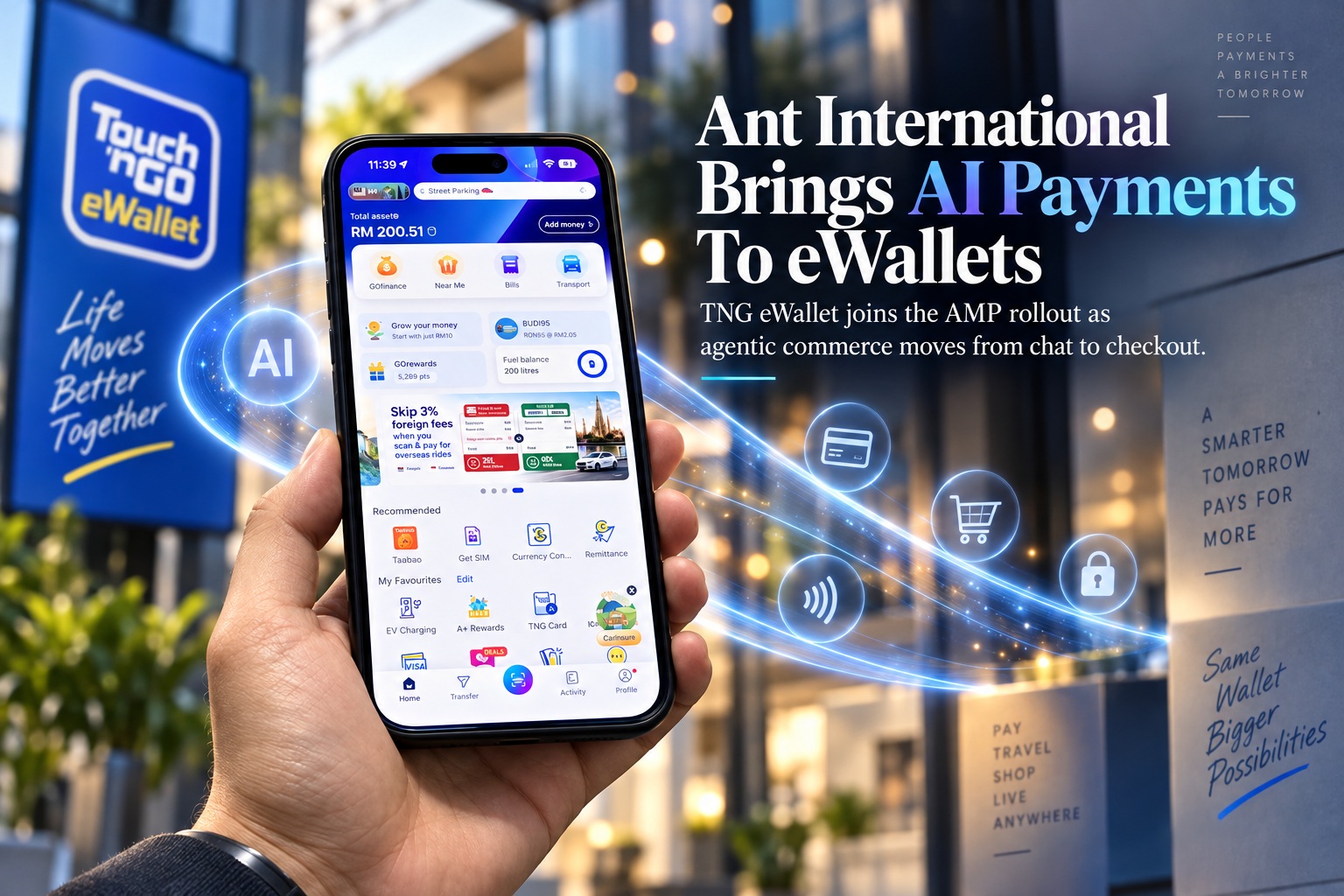
Artificial intelligence is moving beyond answering questions, writing text and helping with research. The next major step is giving AI the ability to act on a user's behalf, including making purchases, comparing prices and completing payments. Ant International is now pushing that idea further with the global rollout of its Agentic Mobile Protocol, or AMP, an open payment framework designed specifically for AI-driven commerce.
The protocol is being expanded across the Alipay+ ecosystem and will initially connect with 10 major digital wallets, including TNG eWallet in Malaysia. Ant International is also working with Mastercard and Visa on a new framework called Know-Your-Agent, or KYA, which aims to create a more consistent way to identify and verify AI agents before they are allowed to perform transactions. Together, these initiatives could lay some of the groundwork for a future where users tell an AI assistant what they want and let it handle much of the purchasing process automatically.
What Exactly Is Agentic Commerce?
Traditional digital payments still require users to perform most of the steps themselves. You might search for a product, compare prices across several websites, add an item to a cart, select a payment method and approve the final transaction. Even when AI helps with product recommendations, the actual purchase usually remains separate from the AI conversation.
Agentic commerce changes that model by allowing an AI system to perform a defined task on the user's behalf. A person could potentially tell an assistant to find the best-priced flight within a certain budget, reorder household supplies, purchase concert tickets or compare several products and buy the most suitable option. The AI agent would then carry out the necessary steps within the limits that the user has already authorised.
AMP is designed to provide the payment layer behind that experience. Instead of every AI platform, merchant and wallet developing its own way of handling automated purchases, Ant International wants to establish a common protocol that allows them to communicate and transact more consistently.
TNG eWallet Joins the First Global Rollout
The first phase of AMP includes 10 digital wallets across Asia, collectively representing around 1.5 billion user accounts. This gives Ant International a substantial initial network for testing how agent-based payments can work across different markets, currencies and payment environments.
The participating digital wallets include:
For Malaysian users, TNG eWallet's participation is particularly noteworthy. The wallet has already become deeply integrated into daily payments, transportation, retail and online transactions, so adding support for agentic commerce could eventually allow AI assistants to interact with a payment method that millions of Malaysians already use.
That does not necessarily mean users will immediately see a new "AI shopping" button inside TNG eWallet. The current phase is more about building the underlying infrastructure and testing how these systems should work safely before broader consumer-facing features are introduced.
AI Agents Could Handle More of the Shopping Journey
AMP is designed to support the entire purchasing process rather than simply the final payment. An AI agent could potentially search for a product, compare prices, evaluate merchant options and then complete checkout using an authorised wallet.
That could remove much of the repetitive work involved in online shopping. Instead of manually opening several apps and websites, users may eventually be able to provide instructions such as: find a pair of running shoes under RM300, compare several trusted sellers and purchase the option with the best combination of price and reviews.
The AI could then carry out those steps within predefined conditions. The important difference is that the agent would not simply recommend what to buy; it could potentially complete the transaction as well.
This creates significant convenience, but it also introduces a new security question: how much financial authority should an AI agent actually have?
Task Authorisation Is Designed to Keep Users in Control
One of the central security ideas behind AMP is that users should authorise a specific task rather than handing an AI agent unrestricted access to their wallet.
For example, a user could give an agent permission to spend up to RM200 on a particular category of products, purchase only from approved merchants or require additional confirmation if certain conditions are not met. The authorisation could also be reviewed, modified or revoked before the task is completed.
This is an important distinction. Giving an AI system permanent access to a payment account would create obvious security and accountability concerns. Task-based authorisation instead tries to limit the agent to exactly what the user intended.
In practice, that might mean approving a request such as "buy the lowest-priced return flight to Singapore under RM500" rather than simply giving the assistant unrestricted permission to spend from an eWallet whenever it wants.
Know-Your-Agent Could Become the AI Equivalent of Identity Verification
Ant International is also working with Mastercard and Visa on the Know-Your-Agent framework, which could become one of the more important pieces of the system if agentic commerce grows.
Financial institutions already use identity verification processes to determine who is opening an account or initiating certain transactions. AI agents introduce a new question: if software is making a purchase, how does the payment network know who authorised it and what it is allowed to do?
KYA is intended to address that issue by creating a verifiable identity for AI agents. The system would potentially identify which agent is making the request, who authorised it and what permissions were granted.
This could help merchants and payment networks distinguish between legitimate AI-driven purchases and malicious automated activity. It could also provide clearer accountability when something goes wrong, particularly when multiple AI systems, wallets and payment processors are involved in the same transaction.
Why Visa and Mastercard Matter to the Project
Bringing Visa and Mastercard into the discussion gives the initiative broader significance beyond the Alipay+ ecosystem. Both companies operate global payment networks used by banks, merchants and consumers around the world, so interoperability will be essential if agentic payments are expected to work beyond individual wallet ecosystems.
Without common standards, one AI platform might handle authorisation completely differently from another, forcing merchants and payment processors to integrate dozens of incompatible systems. A shared identity and permission framework could simplify that process considerably.
It is still early, and the industry has not yet settled on one universal standard for AI-driven payments. However, cooperation between wallet providers, card networks, merchants and AI developers suggests that companies are already preparing for agentic commerce to become a serious payment category rather than an experimental feature.
AgentSafePay Tries to Address AI-Specific Mistakes
Perhaps one of the most unusual parts of AMP is AgentSafePay, a protection mechanism designed around risks that are specific to artificial intelligence.
Traditional payment protection usually deals with fraud, unauthorised transactions or goods that were never delivered. An AI agent introduces additional possibilities. It might misunderstand an instruction, interpret a user's intent incorrectly or make an unexpected decision during a complicated multi-step task.
Ant International says AgentSafePay is intended to provide money-back protection for certain AI-related problems, including model hallucinations or deviations from the user's original intent.
This is an interesting acknowledgement that AI systems remain imperfect. Even highly capable models can misunderstand context or make incorrect assumptions, and those errors become far more serious once the AI has permission to spend real money.
Providing some form of financial protection could therefore become essential if users are expected to trust autonomous agents with increasingly important transactions.
Micro-Payments Could Open Up Completely New AI Business Models
AMP also includes an agent-to-agent settlement capability designed for extremely small transactions. Ant International says the system can support real-time clearing for payments as low as US$0.000001.
That may sound almost meaningless from a consumer perspective, but it could become important for AI systems communicating with each other. An agent might pay tiny amounts to access a specialised database, use another AI model, retrieve a piece of information or perform a small computational task.
Today, most payment infrastructure is poorly suited to transactions worth tiny fractions of a cent because processing costs would exceed the value of the transaction itself. If agentic systems start making thousands or millions of micro-transactions automatically, a different settlement model may be required.
This could eventually create machine-to-machine economies where AI services pay each other automatically for information, processing power or access to specialised tools.
Merchant Acceptance Is Just as Important as Wallet Support
A payment protocol is only useful if merchants can actually accept it. Ant International is therefore working with seven major payment acquirers to expand AMP support across a wider range of businesses.
These partners include:
Payment acquirers sit between merchants and payment networks, so their participation could help AMP reach businesses without requiring every merchant to build a completely new AI-specific payment system.
This is especially important if Ant International wants agentic commerce to work across different countries and merchant platforms. Consumers will only find AI-driven purchasing genuinely useful if the agent can complete transactions at a large number of businesses rather than within a small closed ecosystem.
Ant International Is Making AMP Open Source
Another important decision is Ant International's move to publish the core AMP protocol as open source. The framework is being made available through GitHub alongside software development kits and technical documentation.
Open sourcing the protocol could encourage AI developers, payment companies and merchants to experiment with it without being completely dependent on Ant International's own platforms. It also gives the broader industry an opportunity to review how the system works and potentially contribute to its development.
For a protocol intended to become widely interoperable, that approach makes sense. Closed payment systems can work effectively within one ecosystem, but agentic commerce will likely involve many different AI assistants, wallets, card networks and merchant platforms.
A common framework becomes far more valuable when multiple companies can implement it independently.
What This Could Mean for TNG eWallet Users
For TNG eWallet users in Malaysia, the immediate impact may be limited while the technology is still being developed and tested. However, TNG Digital's participation means the wallet is already positioning itself for a future in which AI assistants could play a larger role in everyday transactions.
TNG Digital CEO Alan Ni has highlighted the potential for agentic commerce to reduce the number of steps between a user's intention and the final payment. Instead of manually navigating a series of apps and checkout screens, users could eventually describe what they want and allow an authorised AI agent to complete much of the process.
At the same time, TNG Digital has stressed that any future implementation would need to maintain clear user authorisation, transparency and strong safety controls. That cautious approach is important because payment automation will only succeed if users remain confident that they still control when, where and how their money is spent.
Convenience Will Need to Be Balanced Against Trust
The appeal of agentic commerce is easy to understand. Many online purchases involve repetitive tasks that software could potentially perform faster than a person. Price comparison, booking, replenishment and routine purchases are obvious candidates for automation.
However, allowing AI to spend money creates a much higher level of responsibility than allowing it to draft an email or summarise a document. A bad recommendation is inconvenient; an incorrect transaction can result in an immediate financial loss.
That means successful agentic payment systems will need clear permission boundaries, transaction records and ways for users to intervene. People need to understand exactly what an agent has been authorised to do and be able to stop or modify that task easily.
The technology may therefore evolve gradually. Users could initially rely on AI for low-risk purchases with strict spending limits before becoming comfortable allowing agents to handle more complicated transactions.
Agentic Commerce Could Change How We Think About Payments
If systems such as AMP become widely adopted, payments may eventually become less visible to users. Today, checkout is a deliberate stage of almost every online purchase. You choose a payment method, review the amount and confirm the transaction.
With agentic commerce, payment could become part of a broader authorised task. The user defines the objective and limits at the beginning, and the AI handles the smaller decisions required to achieve it.
That could significantly change the role of eWallets. Instead of being apps that users manually open whenever they need to pay, wallets could become secure payment engines working behind AI assistants and automated services.
The challenge will be ensuring that convenience does not reduce transparency. Users still need to know what was purchased, how much was spent and why the AI made particular decisions.
Final Thoughts
Ant International's AMP rollout offers an early look at how payments may evolve as AI assistants become capable of doing more than simply giving advice. By connecting AI agents with major digital wallets such as TNG eWallet, payment processors and global card networks, the company is building infrastructure for a world where software can potentially shop, compare and pay on behalf of users.
The technology is promising, but the security model may ultimately be more important than the automation itself. Features such as task-based authorisation, Know-Your-Agent verification and AgentSafePay show that the industry understands the risks of giving autonomous systems access to real money.
For Malaysian TNG eWallet users, the changes are unlikely to transform everyday payments overnight. However, participation in AMP's first phase puts TNG Digital directly inside one of the more interesting developments emerging from the intersection of AI and financial technology.
The long-term question is no longer simply whether AI can help us decide what to buy. Increasingly, it is whether we will trust AI enough to buy it for us.











Comments 0