

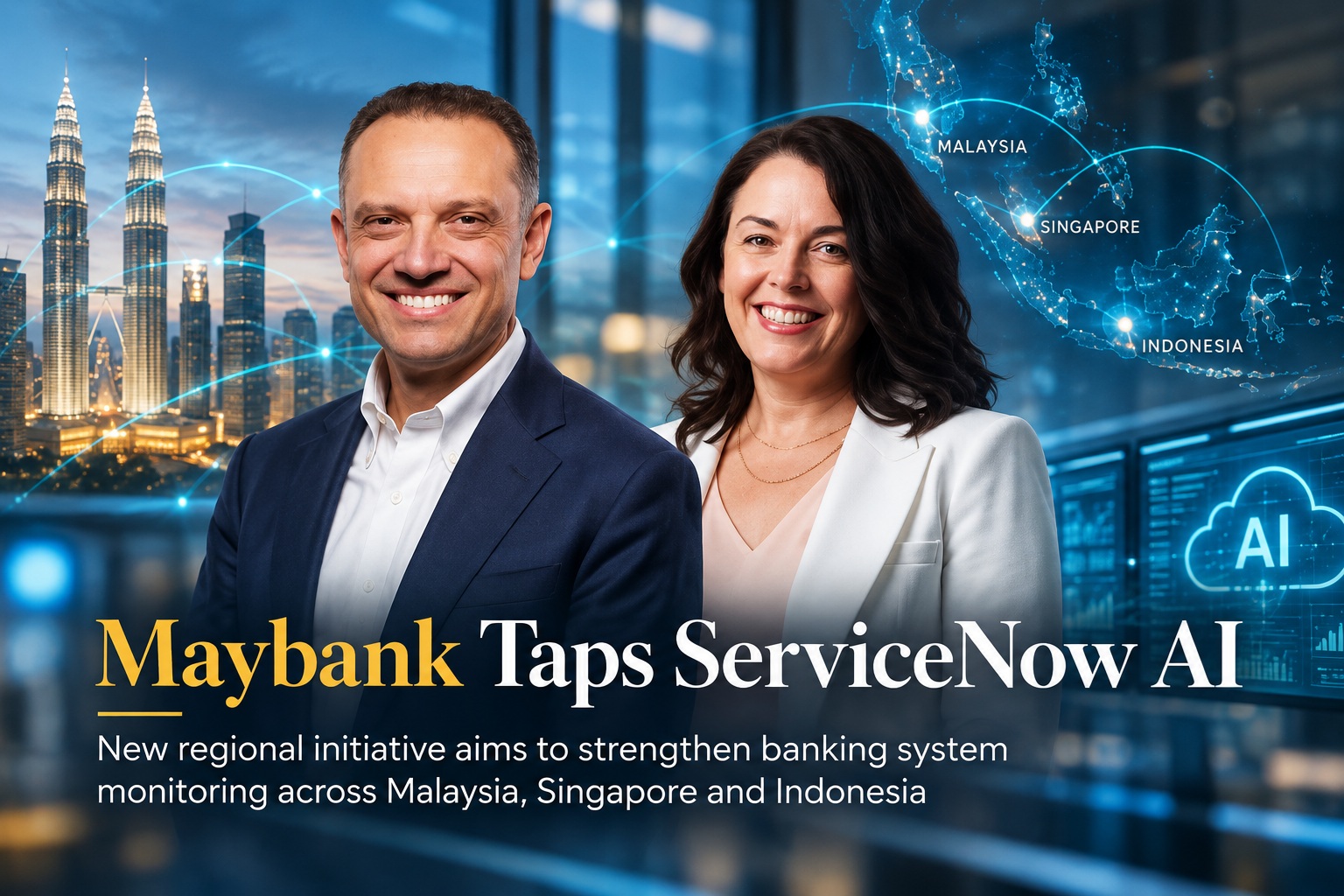
Maybank is strengthening the resilience of its regional banking operations through a new five-year agreement with ServiceNow, using the company's AI platform to improve how technology systems are monitored and how potential disruptions are identified and addressed. The initiative will span Malaysia, Singapore and Indonesia, giving Maybank's technology teams greater visibility across applications, infrastructure, technology assets and the complex dependencies connecting them.
The project forms part of Maybank's broader ROAR30 strategy and reflects the growing importance of AI-powered operational intelligence in modern banking. Rather than waiting for a system failure to affect customers before responding, Maybank wants to use consolidated operational data, automation and predictive analysis to identify potential risks earlier and help keep banking services available around the clock.
Expanding Maybank's Regional Resilience Operations Centre
At the centre of the initiative is an expansion of Maybank's regional Resilience Operations Centre, or ROC. The objective is to give technology teams a more complete picture of the systems supporting the bank's operations across multiple countries.
Large banks depend on thousands of interconnected applications, servers, network components, databases and digital services. A problem affecting one seemingly minor component can quickly influence several other systems if those dependencies are not properly understood.
By consolidating information from across the technology environment, Maybank expects its teams to identify relationships between systems more easily and understand where a developing problem could have a wider operational impact.
ServiceNow AI Will Bring Operational Data Together
Maybank plans to use ServiceNow's AI platform to bring operational information and analytics into a more unified environment. Instead of teams relying on separate monitoring platforms and fragmented datasets, the system is intended to provide a broader view of what is happening across the bank's technology estate.
This becomes increasingly important as banking services expand across mobile apps, internet banking, payment systems, internal platforms and other digital channels. Every new service introduces additional infrastructure and dependencies that need to remain available.
A more connected operational view should allow technology teams to identify unusual behaviour and investigate problems without manually piecing together information from numerous systems.
The Goal Is To Detect Problems Before Customers Feel Them
One of the most important elements of the partnership is the focus on proactive monitoring. Maybank wants to identify potential risks before they become customer-facing outages or service disruptions.
Traditional IT operations can sometimes become reactive. A system fails, users report problems and engineers begin investigating what happened. AI-assisted monitoring can potentially shift part of that work earlier by detecting unusual patterns that may indicate something is starting to go wrong.
For a regional bank serving millions of customers, even a short interruption to mobile banking, payments or other digital services can have a significant impact. Detecting those issues earlier could therefore become an important part of maintaining service reliability.
ServiceNow's Super Intelligence Control Tower Will Play A Key Role
The agreement will also make use of ServiceNow's Super Intelligence Control Tower, which will support areas including operational monitoring, technology asset management and workflow automation.
A control-tower approach is intended to provide teams with a centralised view of technology operations rather than treating each system independently. This can be particularly useful in large organisations where different departments may manage infrastructure, applications, cybersecurity and service operations separately.
Bringing those areas into a more connected operational model can make it easier to understand the wider implications of an incident and coordinate the appropriate response.
Asset Management Becomes More Important At Maybank's Scale
Knowing exactly what technology exists across the organisation is fundamental to maintaining resilient banking operations. Servers, applications, cloud resources, network devices and other assets all need to be tracked throughout their lifecycle.
An incomplete inventory makes troubleshooting significantly harder because teams may not immediately understand which applications depend on a particular component. It can also create cybersecurity risks if older or forgotten systems remain connected without appropriate maintenance.
Using ServiceNow's platform for technology asset management should help Maybank maintain a clearer understanding of its infrastructure across the three markets involved in the programme.
Automation Could Reduce Routine Operational Work
Workflow automation is another major component of the initiative. Banking technology teams frequently perform repetitive tasks when responding to incidents, updating systems, assigning support cases and collecting diagnostic information.
Automating some of those processes can reduce the amount of manual work required and help incidents move to the appropriate teams faster. Instead of engineers spending valuable time transferring information between tools or repeating standard procedures, workflows can potentially handle much of the coordination automatically.
That gives technical specialists more time to concentrate on the problems that genuinely require human investigation and judgement.
Malaysia And Singapore Will Receive The Platform First
The rollout will begin in Malaysia and Singapore before eventually expanding to Indonesia during the five-year agreement.
A phased deployment makes sense for a project of this scale. Maybank can establish the operational model across its initial markets, refine processes and learn from early deployments before extending the platform further.
Once Indonesia is included, the bank should have a much more consistent operational intelligence environment across three of its major Southeast Asian markets.
Supporting Maybank's ROAR30 Strategy
The partnership forms part of Maybank's ROAR30 ambitions, which include strengthening the technology foundations required for the next generation of banking services.
Group Chief Technology and Digital Officer Giorgio Migliarina said the agreement should strengthen Maybank's ability to operate at scale across multiple markets while developing AI-powered operational intelligence.
The bank sees greater visibility, automation and predictive insights as important foundations for providing secure, seamless and continuously available banking experiences.
That is becoming increasingly important as customers expect digital banking services to function at virtually any time of the day.
Always-On Banking Creates Higher Technology Expectations
Digital banking has fundamentally changed what customers expect from financial institutions. A physical bank branch can close for the evening, but a mobile banking application is expected to remain available 24 hours a day.
Customers may need to transfer money, pay bills or check their accounts at any time. Businesses increasingly rely on digital banking services as part of their everyday operations as well.
This means resilience is no longer simply an internal IT metric. It directly influences customer experience and trust.
A technical disruption that may once have affected only internal systems can now immediately become visible to thousands or millions of customers.
AI Could Help Technology Teams Spot Patterns Humans Miss
Modern banking infrastructure produces enormous quantities of operational data. Logs, alerts, performance metrics and asset information are generated continuously across thousands of systems.
Human teams cannot realistically examine every signal manually.
AI can potentially help by analysing patterns across this information and highlighting conditions that deserve attention. A small performance anomaly in one system may mean very little on its own, but when combined with unusual behaviour elsewhere, it could indicate a larger developing issue.
The value therefore comes from connecting information rather than simply generating more alerts.
Reducing Alert Fatigue Will Be Important
One of the biggest challenges facing IT operations and cybersecurity teams is alert fatigue. Monitoring platforms can generate enormous numbers of warnings, many of which ultimately require no action.
If AI simply produces even more alerts, it will not necessarily improve operations.
The more useful approach is to help determine which events are genuinely significant and provide enough context for teams to understand why they matter. Automation can then help route those issues towards the right specialists.
This is where AI-powered operational intelligence could provide more meaningful value than traditional monitoring alone.
Security And Regulatory Requirements Remain Central
As a major financial institution operating across several jurisdictions, Maybank also needs to ensure that its technology operations continue meeting strict security, governance and regulatory requirements.
Malaysia, Singapore and Indonesia each maintain their own financial and cybersecurity regulations. A regional operational platform therefore needs to provide consistency while still allowing the bank to satisfy local requirements.
Better visibility into technology systems can support compliance by helping teams understand asset ownership, operational dependencies and how incidents are managed.
This is particularly important as regulators increasingly expect financial institutions to demonstrate strong operational resilience rather than simply responding after major outages occur.
Resilience Is About More Than Preventing Outages
Operational resilience does not mean systems will never fail. Hardware faults, software bugs, cyber incidents and network problems will still happen.
The real question is how quickly an organisation can understand what has happened, contain the impact and restore affected services.
A resilient banking environment should be able to absorb disruptions without allowing one technical issue to escalate unnecessarily across multiple systems.
Maybank's expanded ROC is intended to strengthen that capability by giving teams better information when incidents occur.
Maybank Will Establish An Internal Centre Of Excellence
The agreement also goes beyond implementing software. Maybank plans to establish an internal Centre of Excellence supported by ServiceNow University to build expertise among its own employees.
The programme will focus on areas such as:
• Platform engineering
• Workflow automation
• Artificial intelligence
• Operational intelligence
Developing these capabilities internally is important because long-term success cannot depend entirely on external consultants or technology vendors.
Maybank needs employees who understand the platform deeply enough to adapt it as the bank's requirements evolve.
Internal Skills Development Could Be Just As Important As The Technology
Technology platforms inevitably change over time. New banking services will appear, infrastructure architectures will evolve and new AI capabilities will become available.
An internal Centre of Excellence gives Maybank a group capable of continuously improving how the platform is used rather than treating the implementation as a one-time project.
This can also help establish consistent standards across the organisation.
Instead of individual departments building their own automation independently, common practices can be developed and reused throughout the group.
That creates a stronger foundation for scaling AI and automation across different banking operations.
Maybank Joins ServiceNow's NowNext AI Programme
Maybank will also participate in ServiceNow's invite-only NowNext AI programme.
Through the programme, specialised engineers will work alongside Maybank's teams to identify and develop AI and agentic AI use cases for banking operations.
This is particularly interesting because agentic AI goes beyond conventional analytics. Rather than simply identifying a problem or generating a recommendation, AI agents can potentially carry out sequences of approved actions across operational workflows.
That could significantly change how technology incidents are managed in the future.
Agentic AI Could Eventually Help Coordinate Incident Response
Consider a situation where monitoring systems detect unusual behaviour affecting an application. A conventional system may generate an alert and wait for an engineer to investigate it.
An agentic system could potentially gather relevant logs, identify affected infrastructure, check recent changes, open an incident, notify the responsible team and begin approved diagnostic procedures automatically.
Humans would still remain responsible for critical decisions, but much of the repetitive investigation and coordination could happen before an engineer even begins working on the incident.
For large banking environments, reducing those early response times could become extremely valuable.
Human Oversight Will Still Remain Essential
Banking systems are too critical for completely autonomous AI decision-making to be introduced without appropriate controls. Automation needs clear boundaries, audit trails and human oversight, particularly when actions could affect live customer services.
Agentic AI should therefore be viewed as a way to augment operational teams rather than simply replace them.
AI can gather information and execute approved routine actions quickly. Experienced engineers still need to determine when more significant intervention is appropriate.
Maintaining that balance will be especially important as autonomous technologies become more capable.
ServiceNow Wants To Provide One Operational View
ServiceNow Asia Group Vice President and Managing Director Melissa Ries said business leaders increasingly want a single platform capable of providing visibility across their entire operational portfolio and across every market in which they operate.
That visibility can help strengthen security while allowing technical teams to spend less time coordinating fragmented systems.
For Maybank, the regional scale of the organisation makes this particularly relevant. A single operational model across Malaysia, Singapore and Indonesia could reduce the complexity created when different markets rely on completely separate processes and technologies.
The objective is ultimately to keep teams focused on ensuring customers can continue accessing banking services without interruption.
Banking Infrastructure Is Becoming Increasingly Complex
Modern banks are no longer operating traditional core banking systems alone. They now depend on mobile applications, cloud platforms, APIs, data analytics, cybersecurity services, payment infrastructure and increasingly artificial intelligence.
Every additional technology creates another relationship that operations teams need to understand.
A failure within one cloud service could affect an application that depends on an API connected to another backend system. Without good dependency mapping, identifying the real source of the problem can consume valuable time.
This is precisely the sort of complexity a regional control tower is intended to address.
Predictive Operations Could Become A Major Banking Advantage
The long-term goal is moving away from purely reactive IT operations towards a more predictive model.
If AI can identify signs of deteriorating performance early enough, engineers may be able to intervene before customers notice anything.
That might mean reallocating infrastructure capacity, investigating abnormal behaviour or correcting a configuration problem before it becomes a full outage.
Preventing a disruption is almost always less expensive than recovering from one after millions of customers have been affected.
Predictive intelligence could therefore become an important competitive capability for banks.
Customers May Never Notice The Technology — And That Is The Point
Most Maybank customers will probably never interact directly with the ServiceNow platform.
Ideally, they should not need to.
Operational technology is successful when banking applications simply work whenever customers need them. If AI and automation help prevent outages or shorten disruption times, the benefit appears indirectly through a more reliable banking experience.
Customers do not necessarily care which monitoring platform a bank uses.
They care whether they can access their money when they need it.
Final Thoughts
Maybank's five-year agreement with ServiceNow represents a significant investment in the technology foundations supporting its regional banking operations. By expanding its Resilience Operations Centre across Malaysia, Singapore and Indonesia, the bank aims to gain better visibility into applications, infrastructure, assets and the dependencies connecting them.
ServiceNow's AI platform and Super Intelligence Control Tower will help consolidate operational information, automate workflows and identify potential risks before they become customer-facing disruptions. At the same time, Maybank's new Centre of Excellence and participation in the NowNext AI programme will help develop internal expertise in platform engineering, automation and increasingly agentic AI.
The most important part of the initiative may ultimately be its shift towards predictive operations. Modern banking customers expect digital services to remain available constantly, and that requires technology teams to identify problems increasingly early rather than simply reacting after something fails.
If implemented effectively, much of this AI investment may remain invisible to customers — which is probably exactly what Maybank wants. The best operational technology is often the technology customers never notice because their banking simply keeps working.











Comments 0