

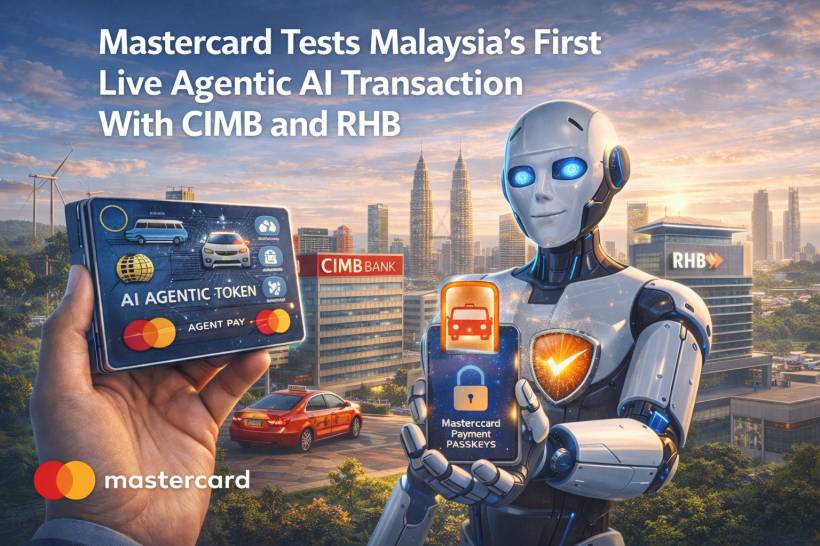
Artificial intelligence is already changing how people search, write, analyse, and automate tasks. Now it is starting to move into something even more sensitive: actual payments. That is what makes Mastercard's latest announcement in Malaysia especially interesting. The company says it has completed its first live pilot involving an agentic AI transaction in the country, working together with CIMB and RHB in a controlled test environment. On the surface, it may sound like just another fintech experiment, but it actually points to a much bigger shift in how digital payments could work in the future.
Instead of a person manually tapping through every step, the idea here is that an AI-powered agent can help carry out a transaction on the user's behalf, while still operating within security controls, approval flows, and consumer protections.
A Small Pilot With Big Implications
According to Mastercard, the pilot involved AI agents initiating authenticated transactions in Malaysia under a controlled setup. This was not an open public rollout, and that distinction matters. Financial transactions are highly regulated and deeply tied to trust, so any move involving autonomous or semi-autonomous AI needs to be tested very carefully before it can be introduced more broadly.
In this case, Mastercard framed the pilot as a proof of concept for how agentic AI could support everyday tasks in a secure and transparent way. The emphasis was not just on automation, but on making sure the transaction still stayed within a system where the consumer remained in control.
That is an important point because people tend to get nervous whenever AI and money appear in the same sentence. Understandably so. Nobody wants a rogue bot making purchases without permission. So the real value of this pilot is not just that the transaction happened, but that it happened with safeguards built around it.
What Happened During the Pilot
For its first test case, the AI agent handled a transportation booking.
The example shared by Mastercard involved an AI agent arranging a ride from Kuala Lumpur International Airport to KL Sentral through hoppa, a global mobility provider. The booking and payment flow were facilitated by CardInfoLink's AI agent, which connects into hoppa's taxi and airport limousine network.
That may sound simple, but that is actually why it is a smart starting point. Transport is familiar, practical, and time-sensitive. It is also the kind of routine task that many people would realistically want an AI assistant to help with in the future. A traveller landing at the airport could, in theory, rely on an AI assistant to compare options, book the ride, confirm the details, and complete the payment flow with the user's approval.
In other words, this was not a flashy demo built around some unrealistic use case. It was grounded in a real-world scenario that ordinary users can easily understand.
How Mastercard Says Security Was Handled
The security side is where Mastercard is clearly trying to reassure both consumers and the industry.
The company says its Mastercard Agent Pay framework provides the protections needed for AI-initiated purchases. Each transaction uses what it calls a Mastercard Agentic Token, which is uniquely issued to each AI agent. The purpose of this token is to improve security by making the agent identifiable and limiting how transactions are authorised within the ecosystem.
Mastercard also said that consumer consent is explicitly captured, while purchase confirmation is secured through Mastercard Payment Passkeys.
That combination is important because it suggests the company is not treating AI as a free-roaming actor that can spend on its own without limits. Instead, the model being presented is one where the AI can assist and initiate, but the human still retains approval authority and visibility over what is happening.
That is likely to be the only way this kind of system gains public acceptance. Automation is attractive, but only when people feel that control has not quietly been taken away from them.
So What Exactly Is Agentic AI?
Agentic AI is one of those terms that is starting to show up more often, but many people still are not entirely clear on what it means.
In simple terms, it refers to AI systems that can act more independently than traditional generative AI tools. A normal chatbot or text generator usually waits for instructions step by step. You give it a prompt, it gives you a response, and then it waits again. Agentic AI is different because it can handle multi-step tasks with less constant input from the user.
Once given a goal, the AI agent can work through the steps more autonomously. That might involve gathering information, evaluating options, making intermediate decisions, and preparing an outcome before asking for final approval where needed.
That does not mean it should operate without boundaries. In fact, the entire concept only becomes practical when strong limits, permissions, and review mechanisms are built in. The most sensible implementations are the ones where the AI can do the heavy lifting but still needs a clear green light before anything important is finalised.
So in a payments context, agentic AI is less about "letting AI spend your money freely" and more about "letting AI help manage the process, while you stay in charge."
Why Malaysia Is A Noteworthy Test Ground
Malaysia has been seeing steady momentum in digital banking, cashless payments, and AI-related experimentation, so it is not surprising that a pilot like this would happen here.
The market is already comfortable with e-wallets, online banking apps, QR payments, and digital-first financial services. That makes it a practical environment for testing the next layer of fintech innovation. At the same time, Malaysian consumers are also increasingly aware of fraud risks, scams, and security concerns, which means any AI payment solution introduced here will need to prove itself on trust just as much as convenience.
That is why the involvement of major local banking names like CIMB and RHB matters. Their participation gives the pilot a stronger sense of practical relevance rather than making it feel like a purely theoretical lab exercise.
Commercial Rollout Will Not Happen Overnight
Mastercard says commercial deployment of agentic AI-initiated transactions in Malaysia will be rolled out in phases. That is the sensible approach.
A technology like this cannot be dropped into the mass market overnight and expected to work smoothly. There are too many questions that still need careful answers. How much autonomy should an AI agent have? What spending limits should apply? How should disputes be handled? What happens if an AI agent makes the wrong choice, even within approved boundaries? How should banks explain this to ordinary users who are still getting used to generative AI in the first place?
Mastercard has indicated that it will continue working not just with CIMB and RHB, but also with other banks and partners. It also plans to educate the public on the technology, which will be essential if this is going to move beyond niche pilots.
Because honestly, the technology itself may be the easy part. Public understanding and trust will probably be the harder challenge.
Convenience Is The Selling Point, But Trust Will Decide Everything
The appeal of agentic AI in payments is obvious. In theory, it could remove friction from many small but repetitive tasks. Booking transport, paying bills, reordering essentials, managing subscriptions, or helping with travel logistics could become smoother and faster when an AI assistant is able to take care of the process on the user's behalf.
But payments are different from content generation or scheduling reminders. Once money is involved, people become much more cautious. They want to know exactly what the AI is doing, what it is allowed to do, and how easily they can stop or override it.
That means the future of agentic commerce will depend on more than clever demos. It will depend on strong user controls, transparent permissions, reliable authentication, and a clear sense that the AI is acting as an assistant rather than a replacement for human judgment.
Final Thoughts
Mastercard's first live agentic AI transaction pilot in Malaysia may sound like an early experiment, but it hints at a larger direction for digital commerce. The idea that AI agents could one day help consumers handle bookings and payments is no longer just futuristic talk. It is already being tested in controlled real-world scenarios.
For now, this remains an early-stage development, and that is probably exactly where it should be. The concept is promising, especially for routine tasks where convenience matters. But financial transactions demand more than innovation. They demand clarity, security, and trust.
If Mastercard and its partners can show that agentic AI can make life easier without making payments feel risky or unpredictable, then this pilot may end up being remembered as an important first step in Malaysia's next phase of fintech evolution.











Comments 0