

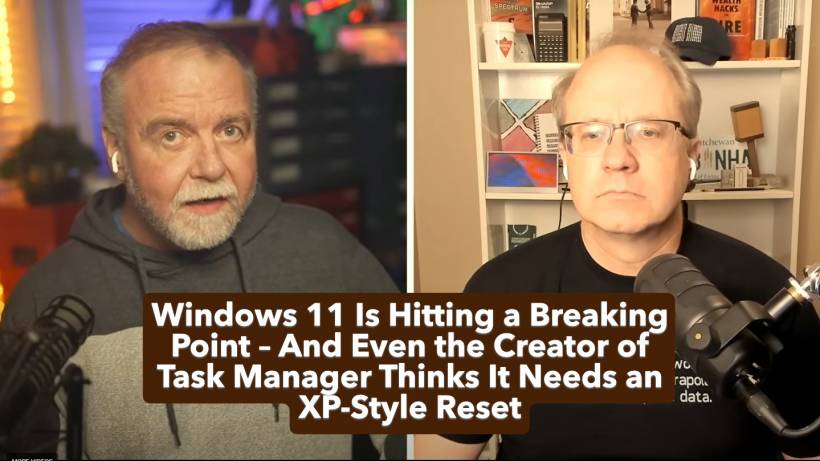
Windows 11 has had a rough few years. Between AI experiments nobody asked for, performance hiccups, and a user base that stubbornly refuses to leave Windows 10 behind, Microsoft's flagship operating system is clearly struggling to win hearts. Now, a well-respected former Microsoft engineer – the man who built the iconic Task Manager – says it's time for the company to stop chasing shiny new features and go back to the basics.
A Veteran Developer Sounds the Alarm
Dave Plummer, who worked on key Windows components during the classic Microsoft era, recently took to his podcast with a blunt message: Windows 11 needs its own "Windows XP Service Pack 2 moment."
For those who weren't around then, XP SP2 wasn't just a routine patch. It was a dramatic course correction after Windows XP became a magnet for malware and rampant security issues. Instead of shipping new features, Microsoft hit the brakes and spent months tightening security, fixing deep-rooted bugs, and rebuilding user trust.
According to Plummer, the situation today mirrors that era more than Microsoft would like to admit.
Why Windows XP SP2 Was Such a Big Deal
When XP launched, it was beloved for its clean interface and smooth performance. But the honeymoon didn't last. Once threats like the Blaster worm started sweeping the globe, Microsoft realised the OS needed a major structural rethink.
The company paused feature development and focused entirely on stability. SP2 brought:
It wasn't flashy, but it saved Windows XP. The OS went on to become one of the most successful versions of Windows ever released.
Plummer's point? Windows 11 is now at the same crossroads.
The AI Rush Is Creating Real Problems
Microsoft has gone all-in on generative AI. In an attempt to position Windows as the first true "Agentic OS," the company has injected AI into nearly everything: Paint, Notepad, the Start menu, the taskbar, File Explorer, and especially the Copilot assistant.
But many of these integrations feel rushed – and users are noticing.
Recent Windows 11 updates have:
These issues, stacked on top of constant UI changes and unwanted features, have created a sense of instability. Even though Microsoft officially ended support for Windows 10, nearly a billion devices refuse to move to Windows 11. And half a billion machines can't upgrade at all due to hardware restrictions.
Users Don't Want More AI – They Want a Reliable Windows Again
Plummer's argument is simple: before Microsoft keeps rolling out neural networks, assistants, and "smart" features, it needs to focus on the fundamentals. Security. Performance. Compatibility. Predictability.
Much like XP SP2 restored confidence when trust was slipping, a stability-focused Windows 11 update could show that Microsoft still values the core PC experience.
Because right now, the gap between what Microsoft wants Windows to become – an AI-driven, cloud-connected productivity hub – and what ordinary users need – a fast, dependable OS – has never been wider.
A Turning Point Microsoft Can't Ignore
The message from the community is loud and clear:
Windows doesn't need more assistants, pop-ups, or algorithmic enhancements. It needs a solid foundation.
If Microsoft listens, Windows 11 could still turn things around, much like XP did two decades ago.
If not, the company risks pushing even more people to hold onto Windows 10—or explore other platforms entirely.











Comments 0