

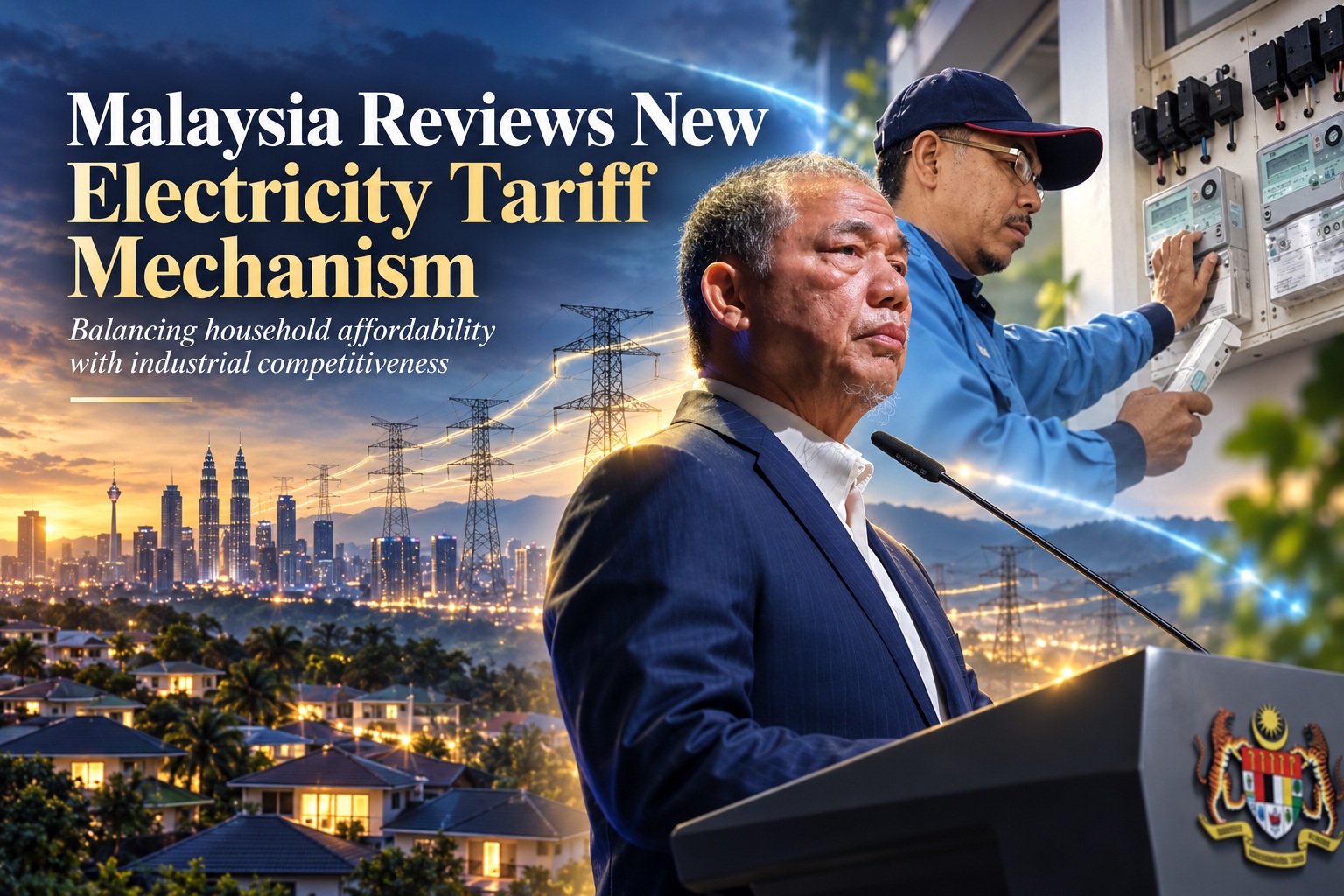
The government is considering changes to Malaysia's electricity tariff mechanism next year as it looks for a fairer way to distribute energy costs between households, businesses and high-consumption users. The proposed approach is intended to keep electricity affordable for domestic consumers while ensuring that industrial users remain competitive, particularly as fuel costs and national power demand continue to rise.
Malaysia Reviews New Electricity Tariff Mechanism For 2027
The government is considering changes to Malaysia's electricity tariff mechanism next year as it looks for a fairer way to distribute energy costs between households, businesses and high-consumption users. The proposed approach is intended to keep electricity affordable for domestic consumers while ensuring that industrial users remain competitive, particularly as fuel costs and national power demand continue to rise.
Deputy Prime Minister and Energy Transition and Water Transformation Minister Datuk Seri Fadillah Yusof said the Energy Commission has been instructed to conduct an in-depth study into possible measures. The review will examine consumer protection, electricity affordability, energy efficiency and how different categories of users should contribute towards increasingly expensive generation costs.
Energy Commission Tasked With Studying A New Tariff Structure
The Energy Commission, or EC, will assess how Malaysia's electricity tariff structure can be improved before any new mechanism is introduced. One of the main objectives is to avoid placing excessive financial pressure on ordinary households while still ensuring the electricity sector can recover the real cost of supplying power.
The study will also look at how tariff design can encourage more efficient electricity usage. Rather than treating every unit of electricity consumption exactly the same, the government is considering whether different consumer categories should contribute differently depending on how much power they use and the nature of their operations.
Any revised structure could potentially be introduced from next year, although the government has not yet confirmed a final model or implementation date.
Global Fuel Prices Are Putting Pressure On Electricity Costs
One of the biggest challenges is the rising cost of fuel used for electricity generation. Fadillah said geopolitical tensions in West Asia have contributed to higher global energy prices, particularly for crude oil and liquefied natural gas, or LNG.
The Strait of Hormuz is especially important because it is a major global energy route. Approximately 20% of the world's crude oil and LNG trade passes through the waterway, making any disruption there capable of affecting international fuel prices very quickly.
Malaysia is particularly exposed because around 40% of the fuel used by the country reportedly passes through the same route. Supply disruptions therefore have a direct impact on the cost of procuring fuel for electricity generation.
Imported LNG Has Become More Important
Malaysia's electricity system relies on a mix of fuel sources, including natural gas, coal and hydroelectric generation. When one part of the system produces less electricity than expected, other generation sources need to compensate.
Recent reductions in hydroelectric output and scheduled outages at coal-fired power stations have increased dependence on imported LNG. Unfortunately, LNG is particularly sensitive to international market conditions, making generation costs more vulnerable when global prices rise.
Fadillah said fuel procurement costs during the current crisis have already exceeded the projections made under Regulatory Period 4. This gap between projected and actual costs is one of the reasons electricity tariffs are coming under renewed pressure.
Hotter Weather Is Also Driving Up Demand
Fuel prices are only one side of the issue. Malaysia has also experienced prolonged periods of hot weather, which naturally increases electricity consumption.
Air conditioners are often used for longer periods and at lower temperatures when daytime and nighttime conditions remain unusually warm. Across millions of homes, offices, shopping centres and commercial buildings, that additional usage quickly adds up.
Higher demand means more electricity needs to be generated, which in turn increases fuel consumption. When that happens at the same time as global fuel prices are rising, pressure on the electricity system becomes much greater.
The 800kWh Subsidy Threshold Is Under Review
One of the most important questions for household users is what happens to the current 800kWh subsidy threshold after 31 December 2026.
The issue was raised in Parliament when Shah Alam MP Azli Yusof asked whether the government intended to extend the threshold for domestic consumers in Peninsular Malaysia beyond the end of the year.
Originally, the government had provided protection against higher generation costs for households using less than 600kWh per month. That threshold was later increased to 800kWh, allowing more households to remain protected from higher electricity costs.
Whether that protection continues into 2027 has not yet been decided.
Household Protection Remains A Priority
Fadillah said the government continues to study additional measures to protect consumers from rising electricity costs. The challenge is finding a system that targets assistance towards households that need it most without creating unsustainable subsidies across all consumption levels.
A household using relatively little electricity has very different consumption patterns from one running multiple air conditioners, electric vehicles and other high-power equipment throughout the day.
A more targeted mechanism could potentially preserve affordability for ordinary users while gradually reducing subsidies for households with substantially higher consumption.
That would be consistent with the government's broader approach of moving towards more targeted subsidies rather than providing the same level of assistance to every consumer.
A User-Pay Model Is One Option Being Considered
One of the approaches currently being studied is a user-pay mechanism.
The idea is relatively straightforward: users that consume significantly more electricity would contribute more towards the cost of generating and maintaining that supply.
This could result in different tariff structures for households, industries and particularly electricity-intensive operations such as data centres.
Rather than distributing higher generation costs evenly across every customer, the system could place more of the burden on users responsible for much larger levels of demand.
Data Centres Could Face Different Electricity Rates
Data centres are expected to be one of the most closely watched categories under any future tariff restructuring.
Malaysia has attracted significant investment in data centre development, driven by demand for cloud services, artificial intelligence and regional digital infrastructure. These facilities can consume enormous amounts of electricity because servers need power continuously while cooling systems operate around the clock.
The government has already approved 27 data centre projects across the country.
As more facilities come online, their combined electricity requirements could become increasingly significant for Malaysia's national grid.
Why Data Centres Are Different From Typical Businesses
A normal office may use more electricity during working hours and significantly less overnight. Data centres behave very differently.
Servers operate continuously, often at high utilisation levels, while cooling equipment needs to maintain tightly controlled temperatures 24 hours a day.
A large data centre can therefore consume electricity at a scale closer to industrial infrastructure than a conventional commercial building.
The government is now considering whether users with this type of sustained demand should be treated differently under the tariff structure.
Industrial Users Could Also See A Different Mechanism
Data centres are not the only businesses that may be affected. Large industrial users could also be placed under different electricity rates depending on the final structure recommended by the Energy Commission.
Factories, manufacturing plants and other industrial operations often consume far more electricity than households, but electricity pricing also plays a major role in determining their competitiveness.
If industrial tariffs rise too much, production costs increase and Malaysian companies may become less competitive against manufacturers operating in countries with cheaper energy.
The government therefore faces a difficult balancing act.
Electricity Must Remain Competitive For Industry
Fadillah stressed that industrial electricity tariffs still need to remain competitive compared with other countries.
Malaysia has spent years attracting investment in manufacturing, technology, semiconductor production, data centres and other energy-intensive industries. Electricity cost is one of the factors companies examine when deciding where to locate major operations.
A tariff structure that becomes significantly more expensive than neighbouring countries could weaken Malaysia's attractiveness as an investment destination.
The government therefore needs to recover rising generation costs without undermining industrial competitiveness.
Fairness Does Not Necessarily Mean Everyone Pays The Same
One of the central ideas behind the proposed tariff review is that fairness does not always mean charging every consumer category the same rate.
A household using electricity primarily for lighting, refrigeration and moderate air-conditioning has very different economic circumstances from a hyperscale data centre consuming enormous amounts of power around the clock.
A more targeted system could recognise those differences.
Lower-consumption households could remain protected, while heavy users contribute more towards generation costs and infrastructure expansion.
Energy Efficiency Could Become More Important
The new mechanism may also be designed to encourage consumers to use electricity more efficiently.
Electricity pricing can influence behaviour. When heavy consumption becomes more expensive, users have a stronger incentive to invest in efficient air conditioners, insulation, smart energy management systems or renewable generation.
Businesses may similarly look towards energy-efficient machinery, solar installations or better cooling technologies.
For data centres, improvements in server efficiency and cooling design could become increasingly valuable if electricity tariffs become more closely linked to consumption levels.
Renewable Energy Could Reduce Long-Term Exposure
Malaysia's dependence on imported fuel is one reason global events can quickly affect electricity prices.
Expanding renewable energy such as solar generation could reduce some of that exposure over time. Renewable projects still require investment and grid infrastructure, but they are not affected by daily movements in global LNG or coal prices in the same way conventional generation is.
Malaysia is already pursuing broader energy-transition initiatives, but increasing renewable capacity will take time.
Until then, global fuel prices will continue influencing the cost of electricity generation.
Grid Reliability Must Remain Part Of The Equation
Electricity pricing is not only about the fuel used to produce power. The country also needs to invest continuously in the national grid.
More renewable generation, electric vehicles, data centres and industrial facilities all create new demands on transmission and distribution infrastructure.
Building new substations, strengthening transmission lines and modernising grid management systems requires significant capital.
A sustainable tariff structure must therefore support both current electricity generation and the long-term investments needed to keep the power system reliable.
Subsidies Cannot Completely Ignore Actual Generation Costs
Electricity subsidies can shield consumers from short-term price increases, but they do not make the underlying generation cost disappear.
Someone ultimately has to absorb the difference between what consumers pay and what electricity costs to produce.
That burden can fall on the government, utility operators or other categories of consumers.
As generation costs increase, maintaining broad subsidies becomes increasingly expensive, which is why the government is looking towards more targeted protection instead.
Consumers Should Watch The EC Study Closely
The Energy Commission's findings will therefore be important for both households and businesses.
The study is expected to determine how Malaysia can balance several competing objectives:
• Protecting lower and moderate users
• Encouraging energy efficiency
• Recovering higher generation costs
• Supporting grid investment
• Keeping industrial tariffs competitive
• Managing electricity demand from data centres
Finding one mechanism that satisfies all of these goals will not be easy.
No Final Decision Has Been Announced Yet
For now, the government has not confirmed whether the 800kWh domestic subsidy threshold will be extended into 2027.
Likewise, no final tariff rates for data centres, industries or other high-consumption users have been announced.
The user-pay model remains one of several approaches being considered rather than a confirmed policy.
Consumers should therefore avoid assuming that major electricity tariff changes have already been finalised.
More concrete details are likely to emerge once the Energy Commission completes its study and the government decides which recommendations to adopt.
Final Thoughts
Malaysia's electricity tariff review comes at a difficult time. Global fuel prices are rising, the country is relying more heavily on imported LNG, prolonged hot weather is pushing electricity consumption higher and rapidly expanding sectors such as data centres are adding significant new demand to the grid.
The government is therefore looking for a tariff system that can protect households without forcing the wider electricity sector to absorb increasingly high generation costs. A user-pay mechanism, where larger consumers such as data centres and industrial users face different rates, could become part of that solution.
The biggest question for ordinary Malaysians is whether the existing 800kWh subsidy threshold will continue beyond 31 December 2026. That decision has not yet been made.
Whatever mechanism eventually emerges, the challenge will be finding the right balance: affordable electricity for households, competitive pricing for industry and enough revenue to maintain a reliable, increasingly modern power system for Malaysia's future.











Comments 0