

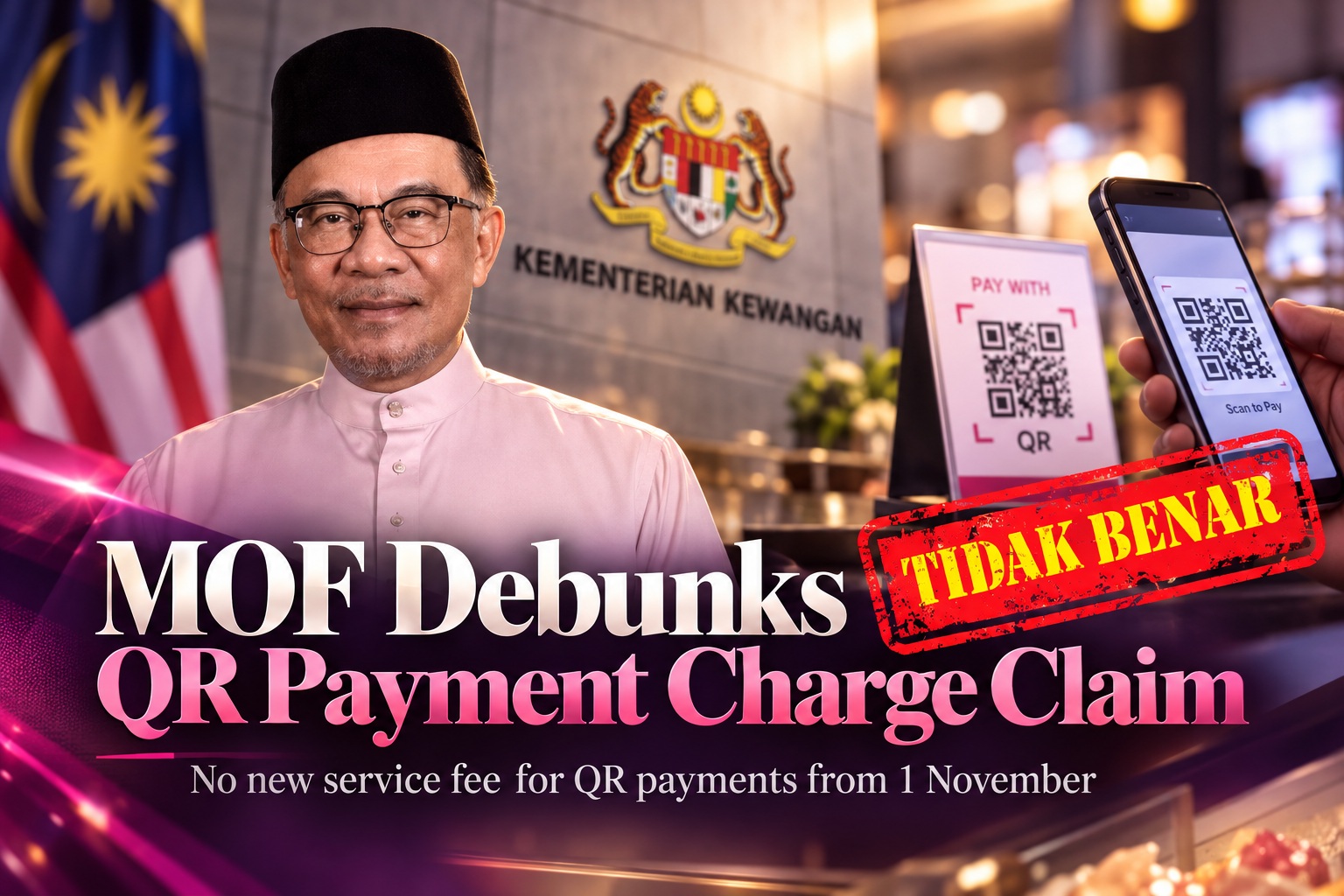
The Ministry of Finance has dismissed a viral social media claim alleging that Malaysians will soon have to pay a service charge when making payments through QR codes. According to the ministry, no such charge has been announced and the information currently circulating online is false.
The clarification comes after a poster claiming that QR payment service charges would begin on 1 November 2026 started spreading widely across platforms including Facebook and Threads. Given how commonly Malaysians now use DuitNow QR for everything from restaurants and convenience stores to pasar malam stalls and small businesses, it is understandable that the claim quickly attracted attention.
Viral Poster Is Not An Official Government Announcement
The misleading poster was designed to resemble a legitimate news update and carried the branding "Vyra News". It claimed that a new service charge would apply to QR code payments beginning next month.
MOF has now made it clear that the information is inaccurate.
No new consumer QR payment charge has been officially announced by the government, and Malaysians should therefore not treat the viral graphic as an authentic policy announcement.
The ministry also urged the public not to continue sharing the poster.
MOF Reminds Malaysians To Verify Information
In responding to the viral claim, MOF encouraged people to verify financial and government-related announcements through official channels before forwarding them.
This is particularly important when information concerns changes that could affect millions of consumers.
Claims involving taxes, subsidies, banking fees or payment charges can spread extremely quickly because they immediately affect people's wallets. A convincing-looking graphic can therefore create unnecessary concern even when the information behind it is completely false.
Checking whether the announcement appears on an official government platform only takes a few moments and can prevent misinformation from spreading further.
QR Payments Have Become Part Of Everyday Life In Malaysia
The reaction to the claim also shows just how deeply QR payments have become integrated into Malaysian daily life.
DuitNow QR is now accepted across a huge variety of businesses. Consumers can use it at supermarkets, restaurants, cafes, petrol stations, pharmacies and retail stores, but its biggest impact may have been among smaller merchants.
Even roadside stalls and independent sellers can accept cashless payments without installing conventional card terminals.
For many Malaysians, scanning a QR code has effectively become as normal as paying with cash.
That makes any suggestion of a new consumer service fee particularly noticeable.
Consumers Are Not Charged For DuitNow QR Payments
For consumers, the important point is simple: DuitNow QR payments remain free.
PayNet, which operates the DuitNow QR infrastructure, states that consumers are not charged an additional fee simply for making a payment using the system.
If you purchase something for RM20 and pay through DuitNow QR, there is no newly announced government service charge that suddenly increases the transaction because you chose QR payment.
That remains the case despite what the viral poster claims.
There Is A Merchant Fee, But It Is Something Different
Part of the confusion may come from the existence of the Merchant Discount Rate, commonly known as MDR.
An MDR can be charged to merchants for processing transactions through payment infrastructure. This is a business-side fee rather than an additional charge imposed directly on consumers whenever they scan a QR code.
More importantly, MDR is not some new fee being introduced on 1 November.
It has existed within the payment ecosystem for years.
The viral claim therefore appears to confuse or misrepresent existing merchant transaction arrangements as a new consumer service charge.
What Is A Merchant Discount Rate?
The Merchant Discount Rate is essentially a fee that may be charged to a merchant by the relevant financial or payment service provider when a transaction is processed.
The exact arrangement can depend on the acquiring bank, merchant category, payment service and commercial agreement involved.
This is similar in principle to processing fees that merchants may encounter when accepting certain other forms of electronic payment.
It is therefore important to distinguish between:
• A merchant paying transaction-related processing costs
• A customer being charged extra for scanning a DuitNow QR code
Those are not the same thing.
The viral poster suggested the second situation was about to happen, which MOF says is false.
Why The Distinction Matters
Without understanding the difference between consumer charges and merchant fees, people could easily assume that QR payments are about to become more expensive.
That could discourage users from making digital payments or cause unnecessary confusion at retail outlets.
Some consumers might even begin asking merchants whether they need to pay additional fees before scanning a QR code.
Clear information is therefore important for maintaining confidence in Malaysia's cashless payment infrastructure.
Fake Financial News Can Spread Very Quickly
Financial misinformation is particularly effective because people tend to react immediately when something appears likely to increase their cost of living.
A claim that QR payments will suddenly attract service charges naturally creates concern.
People may share the information with family and friends as a warning without checking whether the announcement is genuine.
Unfortunately, every additional share makes the false information appear more credible.
Once a poster has been reposted hundreds or thousands of times, people may assume someone else has already verified it.
That is exactly how misinformation can become difficult to contain.
Professional-Looking Graphics Do Not Guarantee Authenticity
Modern misinformation does not always look obviously fake.
A misleading poster can include professional typography, logos, official-looking colours and carefully written headlines. Generative AI and modern design tools have also made it much easier to create graphics that resemble legitimate news or government announcements.
The appearance of professionalism should therefore never be treated as proof that something is genuine.
Before accepting a major policy announcement, check whether the organisation supposedly responsible has published the same information through its official website or verified social media channels.
QR Payment Users Should Not Change Anything
For ordinary users, there is currently nothing that needs to be changed.
Consumers can continue making QR payments normally.
There is no officially announced new service charge beginning on 1 November 2026.
Users also do not need to register for a different payment service, disable DuitNow QR or return to cash because of the circulating claim.
The safest response is simply to ignore the misleading poster and avoid forwarding it to others.
Merchants Should Also Avoid Unnecessary Confusion
Businesses accepting QR payments may also encounter questions from customers after seeing the viral claim.
Merchants should distinguish their own payment-processing arrangements from any supposed consumer fee.
Existing MDR arrangements should not be presented as evidence that customers will automatically be charged extra when making QR payments.
Clear communication at the merchant level can help prevent misinformation from creating unnecessary friction during transactions.
Malaysia's Cashless Ecosystem Depends On Trust
Digital payments work because consumers trust the system enough to use it repeatedly.
People need confidence that the amount shown at checkout is the amount they are expected to pay, that transactions are processed securely and that unexpected fees will not suddenly appear without proper explanation.
False claims about new charges can damage that trust even when they are quickly debunked.
This is why government agencies and payment operators increasingly need to respond quickly when misleading information begins spreading online.
Always Check Major Financial Claims
The broader lesson extends well beyond this particular QR payment story.
Whenever a social media post claims that the government is introducing a new tax, payment fee, subsidy rule or banking requirement, it is worth checking the information before reacting.
Look for the announcement through the relevant ministry, regulator, bank or official service provider.
If a change is significant enough to affect millions of Malaysians, there will almost certainly be a proper announcement explaining how it works, when it begins and who is affected.
A single viral poster should never be the only evidence.
Misinformation Can Cause Real-World Confusion
Fake news about payment systems may seem harmless compared with other forms of misinformation, but it can still create genuine disruption.
If enough consumers believe QR payments will attract additional fees, some may stop using them.
Merchants could face questions or arguments at checkout.
False rumours could also undermine confidence in government policies or Malaysia's digital-payment infrastructure.
The effects therefore extend beyond one misleading social media graphic.
DuitNow QR Remains An Important Payment Platform
DuitNow QR has played a major role in making cashless payments accessible across Malaysia.
The system allows participating banks and e-wallets to operate through a common QR standard, reducing the need for merchants to display numerous separate payment codes.
That interoperability is one of the reasons QR payments have become so widespread.
For smaller businesses especially, QR acceptance can provide a relatively straightforward way to accept electronic payments without the additional hardware traditionally associated with card transactions.
Maintaining public confidence in the system is therefore important for Malaysia's wider digital economy.
Final Thoughts
The Ministry of Finance has clearly denied the viral claim that Malaysians will be charged a new service fee for QR code payments beginning 1 November 2026. No such consumer charge has been officially announced, and DuitNow QR payments remain free for customers.
The confusion should also not be mixed up with the Merchant Discount Rate that may apply to merchants processing digital transactions. MDR is an existing business-side payment arrangement and is completely separate from the supposed new consumer charge described in the viral poster.
More importantly, this is another reminder of why financial information circulating through social media should always be verified before being shared. QR payments have become an everyday part of Malaysian life, which makes false claims surrounding them particularly easy to spread.
For now, there is no need to worry about an additional QR payment service charge on 1 November. Scan, pay and carry on as usual.











Comments 0