

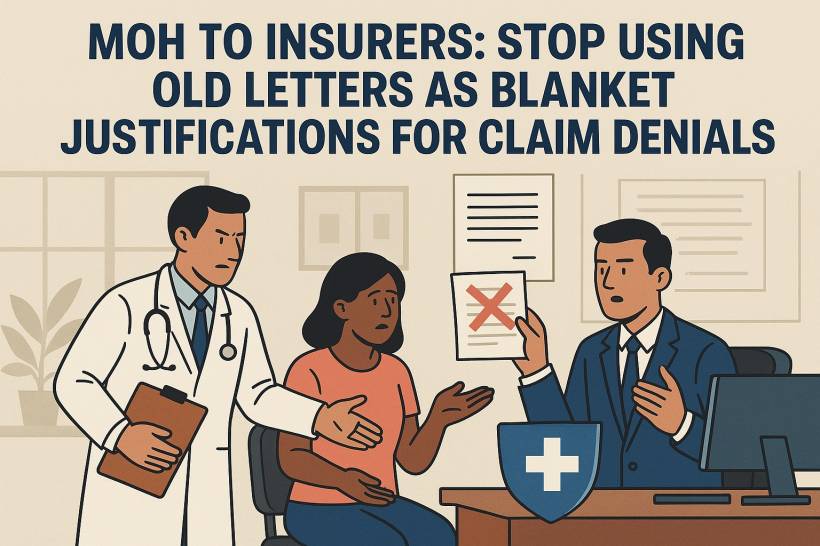
Malaysia's healthcare financing landscape has been tense lately, and a new directive from the Ministry of Health (MOH) has added fresh clarity to an ongoing debate: insurers and managed care organisations (MCOs) can no longer rely on old MOH letters to justify rejecting or reducing medical claims.
This isn't just administrative housekeeping. It marks a significant step in how medical claims should be assessed, how doctors' clinical decisions should be respected, and how transparent insurers need to be.
Let's break down what's happening, why MOH had to intervene, and what this means for patients, insurers, and healthcare providers.
Why MOH Stepped In
For years, insurers, takaful operators, and MCOs (or TPAs – third-party administrators) have been referring to previous letters issued by MOH when deciding whether a claim should be approved. These letters were usually responses to very specific cases, not overarching policy statements.
However, many insurers began using them as if they were permanent, universal rules. Over time, this "copy-and-paste" interpretation created real-world consequences:
valid claims were being denied simply because insurers cited an MOH letter that had nothing to do with the new case at hand.
This prompted MOH's medical practice division director, Dr Hirman Ismail, to issue a formal clarification on October 31.
The Key Message: Context Matters
In his letter, Dr Hirman made MOH's stance extremely clear:
Previously issued letters were meant only for the specific cases being reviewed at that time. They cannot be used as general policy.
He emphasised that each of those letters addressed unique circumstances, often tied to individual patient cases, billing disputes, or isolated clinical situations.
Using these past letters as a universal benchmark, he said, is "inappropriate and inaccurate," and has directly contributed to unjustified claim denials.
Who Received This Directive?
MOH didn't send this clarification quietly. The letter went out to major industry bodies on both sides of the healthcare ecosystem:
The wide circulation indicates the scale of the problem—this issue impacts the entire private healthcare sector, from hospitals to specialists to policyholders.
A Bigger Issue: Interference With Medical Decisions
This isn't the first time MOH has raised concerns.
Just weeks earlier, on October 7, Health director-general Dr Mahathar Abd Wahab cautioned insurers and TPAs against meddling in what should be purely medical decisions. He even highlighted the possibility that such interference could be illegal under the Private Healthcare Facilities and Services Act 1998 (Act 586).
Examples of such interference include:
These practices, MOH argued, could compromise patient care and undermine doctors' professional autonomy.
The Growing Tug-of-War Between Payers and Providers
What's unfolding now isn't just a bureaucratic disagreement—it's part of a larger conflict in Malaysia's healthcare ecosystem.
Doctors and hospitals say insurers have increasingly tightened reimbursement rules, leading to unnecessary claim denials and delayed treatment.
Insurers argue they are trying to curb overcharging and maintain consistency, often claiming they rely on "MOH standards."
MOH's new letter effectively sides with the medical profession.
Meanwhile, the Ministry of Finance (MOF) and Bank Negara Malaysia (BNM), who oversee the insurance industry, often align more with insurers' concerns about cost containment and fraud.
The result?
A widening gap between clinical judgement and financial approval, with patients caught in the middle.
What This New Clarification Means Going Forward
No more blanket policies masquerading as MOH guidelines.
MOH's stand reinforces that care should be determined by medical professionals, not administrative interpretations.
With insurers barred from misusing prior letters, claim assessments should become fairer and more contextual.
This development highlights the ongoing push-and-pull between cost control and clinical freedom. More policy discussions are almost certain to follow.
Final Thoughts
MOH's latest directive is a strong reminder that healthcare cannot be governed by shortcuts or outdated paperwork. Every patient's situation is unique, and every claim deserves to be assessed on its own merits—not through the lens of unrelated letters issued years ago.
By drawing a firm boundary, MOH is sending a clear message to the insurance industry:
Respect the context, respect clinical judgement, and ensure fairness for patients.











Comments 0