

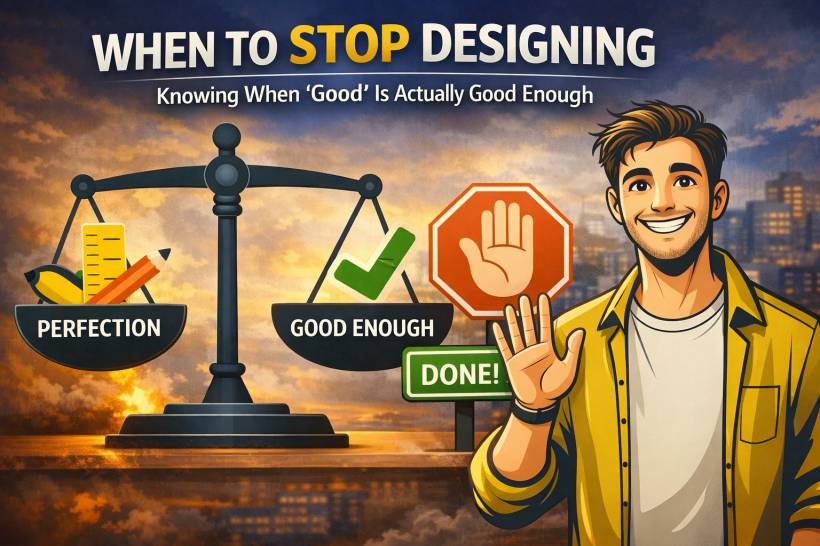
Designers don't struggle with starting. We struggle with stopping. Iteration is baked into the job: sketch, critique, refine, tweak, repeat. It feels productive. It looks productive. And honestly, it can be a very comfortable place to live. But stepping away from the canvas at the right moment, that's a skill most people only learn the hard way.
Because at some point, polishing stops being improvement and starts becoming avoidance.
The Real Question Isn't "Should I Iterate?"
Iteration is normal. It's how good work happens.
The real question is when iteration stops being useful. When does it shift from "this is getting better" to "we're just changing things because we can"?
Every design project has a point where it stops moving forward and starts moving sideways.
The Illusion Of "Better"
Design doesn't reach perfection. It reaches equilibrium.
Before that point, changes create obvious value. You're fixing real problems.
• Strengthening hierarchy
• Clarifying flow
• Matching the user's context better
• Removing friction
After equilibrium, changes still happen, but the gains are tiny and often subjective. That's when you enter the zone of diminishing returns.
The danger here is subtle. You're no longer solving a defined problem. You're chasing a feeling of "complete," which rarely arrives on schedule. You start comparing versions that are basically identical in function, and the project quietly burns time, energy, and confidence.
The Quiet Signals That You've Gone Too Far
The signs that it's time to stop are rarely dramatic. They show up as small whispers in the workflow.
Feedback Starts Going In Circles
You keep hearing the same notes again and again, just reworded. It's not new insight anymore. It's looping.
The Changes Are Taste, Not Function
You're debating things that won't change outcomes for users.
• Slightly different grey tones
• Micro-adjustments that don't affect clarity or usability
Taste matters, but taste-only iterations can become an endless treadmill.
You Can't Clearly Explain Why Version 25 Is Better Than Version 24
If your rationale becomes vague, that's a warning sign. When the justification turns into "it feels cleaner" without a concrete outcome attached, you're often past equilibrium.
The Biggest Signal: The Design Already Solves The Core Problem
If it meets the brief, works in context, and supports the user properly, then you're not improving the solution anymore. You're negotiating with your own discomfort about letting go.
Stopping Isn't Quitting. It's Responsibility
In a world that glorifies the "relentless optimizer," stopping can feel like surrender. But it's not.
Design doesn't exist in a vacuum. It exists next to constraints that don't care about your last 2% improvement.
• Budget
• Development effort
• Stakeholder needs
• Real-world usage
Saying "this is sufficient" is not weakness. It's maturity. It's accepting that the work has to leave your hands and start doing its job in the real world.
When Iteration Is Actually Hiding The Real Problem
Sometimes the urge to keep designing isn't about the design at all. It's a symptom.
You keep producing new versions because the real blocker is uncomfortable to face.
• A strategic decision hasn't been made
• The goalposts are moving
• You're anxious about shipping and being judged
In those cases, making more versions doesn't solve anything. It delays the conversation that actually matters. And the most valuable tool in that moment isn't your design software. It's one direct question:
The "Silent Skill" Nobody Teaches
There's no button for knowing when to stop.
You can't learn it from a tutorial. It comes from experience, shipped projects, and the painful memory of projects that got trapped in endless refinement.
Oddly, it's rarely celebrated. Portfolios love showing the final result, but they don't show the discipline it took to stop at the right time. Yet that discipline is one of the clearest signs of a seasoned designer.
Because "good enough" isn't lazy. It's ready.
Final Thoughts
A design is finished when it can do its job: communicate clearly, support the user, fit the constraints, and move the project forward.
Sometimes, the most decisive move you can make as a designer isn't one more tweak.
It's putting the pencil down and letting the work live.











Comments 0