

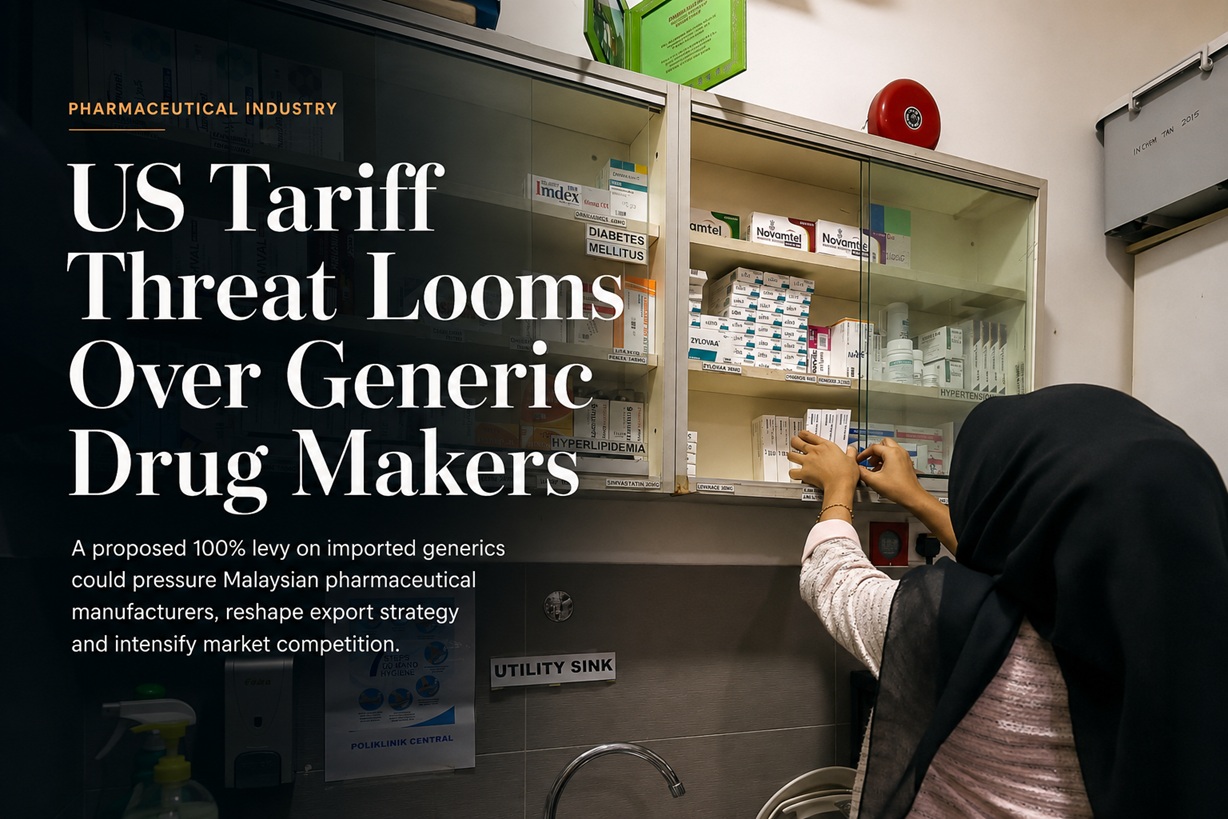
Malaysia's pharmaceutical industry may face a difficult adjustment as the United States prepares to introduce steep tariffs on imported generic medicines. Under the announced schedule, generic drugs entering the US would initially receive a two-year tariff-free period beginning on August 1. A 100% import duty would then take effect in August 2028, followed by a proposed increase to 200% one year later.
The policy is intended to encourage pharmaceutical companies to establish manufacturing facilities in the United States. However, for Malaysian manufacturers that rely on American buyers, the tariff could make their products substantially more expensive and far less competitive.
The effect may extend beyond companies that export directly to the US. It could influence manufacturing investment, production volumes, domestic competition and even Malaysia's long-term medicine-security strategy.
Why the US Market Matters to Malaysia
The United States is Malaysia's second-largest pharmaceutical export destination, accounting for approximately 15% of the country's pharmaceutical exports.
Malaysia's pharmaceutical exports reportedly grew by 22% year-on-year to US$1.3 billion in 2025, suggesting that overseas markets are becoming increasingly important to the industry.
While 15% may not appear overwhelming at a national level, the impact will not be evenly distributed.
Some manufacturers may have limited exposure to the US, while others may depend heavily on American contracts, distributors or long-term supply arrangements. For those companies, a 100% tariff could significantly weaken demand unless they absorb part of the cost, reduce prices or move production into the United States.
Each of those options carries financial consequences.
Absorbing the tariff would reduce already-thin profit margins. Passing the cost to customers could make Malaysian products less attractive than medicines manufactured domestically in the US. Establishing an American facility, meanwhile, would require significant capital, regulatory preparation and operational capacity.
The Tariff Follows the Place of Manufacture
A key point is that the proposed tariff would apply according to where the medicine is manufactured, not simply where the company is headquartered.
This means a multinational pharmaceutical company operating a plant in Malaysia could still be affected when exporting products from that facility to the US.
Likewise, foreign-owned manufacturers with Malaysian production sites would not necessarily be protected merely because their parent company is based elsewhere.
The policy therefore creates a wider issue for Malaysia's pharmaceutical manufacturing ecosystem. The country has spent years attracting international companies to establish production facilities locally, supported by its infrastructure, workforce and access to regional markets.
If exporting from Malaysia becomes substantially more expensive, companies may reconsider where future production lines, capacity expansions and capital investments should be located.
Biocon's Johor Operations Highlight the Wider Exposure
Biocon Biologics operates an insulin manufacturing facility in Johor that supplies several markets, including the United States.
The company is also involved in supplying recombinant human insulin to Malaysia's Ministry of Health through an arrangement with Duopharma Biotech Berhad.
Duopharma previously announced an RM65.08 million government contract under which Biocon Biologics would manufacture the insulin and Duopharma would distribute it locally.
The Malaysian government's insulin supply arrangement is not expected to be directly affected by the US tariff because the products supplied to the Ministry of Health are intended for domestic use.
However, indirect effects remain possible.
If Biocon's US exports become more costly or less competitive, the company may experience changes in production volume, investment planning and manufacturing economies of scale.
Large pharmaceutical facilities typically depend on high production volumes to spread fixed costs across more units. If export volumes decline, the cost of operating the facility may need to be distributed across fewer products.
This could eventually influence pricing, expansion decisions and the commercial sustainability of certain production lines.
Local Manufacturers Are Already Operating on Thin Margins
Malaysia's generic-drug manufacturers are not entering this situation from a position of strength.
Many already face narrow margins, intense price competition and a domestic market that often favours imported medicines or established innovator brands.
Local pharmaceutical companies have raised concerns that imported generics from India and China can be at least 20% cheaper than Malaysian-manufactured alternatives.
At the same time, some doctors and patients may continue to prefer original branded medicines, particularly when there is stronger familiarity or confidence in the innovator product.
Local manufacturers can therefore become caught between two ends of the market.
At the premium end, they compete against well-established international brands. At the lower-cost end, they face large overseas generic manufacturers with greater production scale and cheaper operating structures.
Losing competitiveness in the US would add another layer of pressure.
Could Displaced Exports Flood Other Markets?
One of the less obvious risks is what happens to generic medicines that become less competitive in the United States.
Manufacturers from Malaysia, India, China and other exporting countries may redirect more products into alternative markets if US demand declines.
Southeast Asia could become one of those destinations.
An increase in imported generic medicines may benefit consumers and healthcare providers in the short term by creating more competition and potentially lowering prices.
However, an uncontrolled influx of low-cost products could place further pressure on Malaysia's domestic manufacturers.
Local companies may find it increasingly difficult to compete with multinational producers that operate at a much larger scale. If Malaysian manufacturers lose market share and reduce production, the country could become more dependent on imports for essential medicines.
That may create a longer-term supply-security risk, particularly during global disruptions, export restrictions or sudden increases in demand.
Medicine Procurement Cannot Be Based on Price Alone
Public-sector medicine procurement naturally places strong emphasis on affordability because governments must stretch limited healthcare budgets across large patient populations.
However, selecting products entirely on the basis of the lowest price can create vulnerabilities.
A more balanced procurement strategy should also consider:
For essential products such as insulin, antibiotics and medicines used to treat chronic conditions, supply continuity may be just as important as the unit price.
Supporting domestic manufacturing does not mean accepting poor-quality products or permanently paying excessive prices. It means recognising that local production capacity has strategic value and should be considered when evaluating the overall cost and resilience of the healthcare supply chain.
Malaysia Has a Limited Window to Respond
The phased implementation gives Malaysia and affected manufacturers time to prepare before the 100% tariff takes effect.
That transition period should not be treated as a reason to wait.
Companies with heavy exposure to the US market will need to assess whether they can maintain their existing export strategies, establish alternative manufacturing arrangements or expand into other regions.
Malaysia could strengthen trade links with markets across ASEAN, the Middle East, Africa and other regions where demand for affordable medicines continues to grow.
However, diversification involves more than finding new buyers.
Each market may have different regulatory requirements, registration procedures, packaging standards, pricing structures and distribution networks. Pharmaceutical companies must begin building those capabilities well before access to the US market becomes more difficult.
Moving Beyond Low-Margin Generic Medicines
Malaysia may also need to reconsider its long-term position within the pharmaceutical value chain.
Competing mainly through conventional, low-margin generic medicines leaves manufacturers highly exposed to price competition.
Companies in India and China often benefit from enormous production volumes, established global supply networks and lower unit costs. Malaysian manufacturers may struggle to compete purely on price.
A more sustainable strategy could involve moving towards higher-value areas such as:
These segments generally require stronger technical capabilities, quality systems and regulatory expertise, but they may offer better margins and less direct competition from mass-market generic manufacturers.
Malaysia already has strengths in regulated manufacturing, medical devices and regional distribution. Building on those strengths could help the country develop a more specialised pharmaceutical industry rather than relying primarily on basic generic production.
Should Malaysian Companies Build in the United States?
The US policy is clearly designed to encourage manufacturers to establish local facilities.
For large companies with significant American sales, investing in US production may become commercially necessary. However, this option may not be realistic for smaller Malaysian manufacturers.
Building a pharmaceutical facility in the US would involve substantial costs, including land, construction, equipment, staffing, regulatory approval and quality validation.
It may also take several years before a new plant becomes fully operational.
Joint ventures, contract-manufacturing partnerships or acquisitions could offer alternative routes, but these strategies also require capital and involve commercial risk.
Malaysian manufacturers will therefore need to evaluate whether maintaining access to the US market justifies the required investment or whether resources would be better directed toward other regions and higher-value products.
A Broader Question About Pharmaceutical Resilience
The tariff debate is not only about export revenue. It raises a larger question about how Malaysia intends to preserve its pharmaceutical manufacturing capability.
A strong domestic industry contributes to employment, technical expertise, investment and access to essential medicines.
However, local production cannot survive indefinitely if manufacturers are expected to compete with the lowest global prices while receiving little strategic support.
Malaysia may need a coordinated policy involving the Ministry of Health, investment agencies, trade authorities, regulators and industry representatives.
Possible priorities include accelerating product registration, supporting export-market development, encouraging research and development, strengthening government procurement policies and attracting investment into advanced manufacturing.
The objective should not be to shield local companies from all competition. It should be to ensure that capable manufacturers have a realistic path to grow, innovate and compete internationally.
Final Thoughts
The proposed US tariffs could become a serious challenge for Malaysian pharmaceutical companies that depend heavily on the American market.
The immediate concern is reduced export competitiveness, but the longer-term consequences could be wider. Lower US sales may affect production volumes, investment decisions and economies of scale. Displaced products from other exporting countries could also be redirected into Malaysia, intensifying competition for local manufacturers.
Malaysia has a transition period in which to prepare, but diversification and industrial upgrading cannot happen overnight.
Pharmaceutical companies will need to explore new markets, reduce dependence on low-margin products and invest in areas where Malaysia can compete through quality, specialisation and regulatory strength rather than price alone.
At the government level, medicine procurement should continue to protect affordability while also recognising the importance of supply resilience and domestic manufacturing capability.
The tariff may have been designed to strengthen pharmaceutical production in the United States, but it could also become a test of whether Malaysia is prepared to defend and reposition its own pharmaceutical industry.











Comments 0