

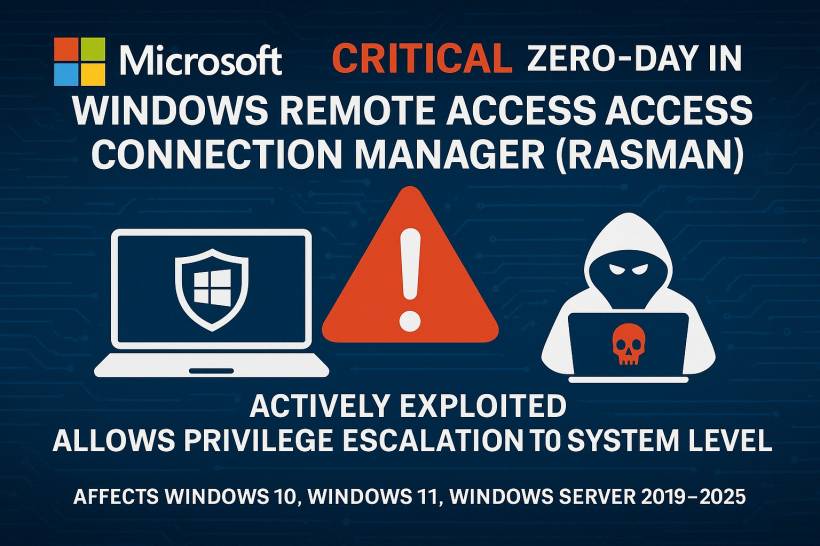
Microsoft has recently confirmed a critical zero-day vulnerability affecting the Windows Remote Access Connection Manager (RasMan) service. The flaw, tracked as CVE-2025-59230, poses a serious risk to enterprise systems, enabling attackers to escalate privileges from low-level user accounts to full SYSTEM-level access. Security researchers have verified that this exploit is already being actively used in the wild, prompting urgent calls for immediate patching.
What Is RasMan and Why It Matters
RasMan is a core Windows service responsible for managing remote access connections, including VPN and dial-up sessions. Because of its deep integration within the operating system, any flaw in RasMan can provide attackers a direct route to privilege escalation.
The vulnerability stems from improper access control, allowing a low-privileged, authorized local user to manipulate service configurations. Through weak permission checks, attackers could modify certain files or inject malicious code that executes under SYSTEM privileges — effectively compromising the entire device.
How the Exploit Works
Although Microsoft has not released public details or proof-of-concept (PoC) code, researchers believe that potential exploitation paths include:
C:\Windows\System32\ras, allowing an attacker to plant malicious files that trigger on service restarts.Such actions typically require only local access and minimal privileges, making this vulnerability particularly dangerous in post-compromise scenarios, such as after a phishing breach or lateral movement attempt.
With a CVSS v3.1 score of 7.8, Microsoft has classified the issue as "Exploitation Detected", meaning active real-world attacks have been observed. However, the company has not disclosed which organizations or regions were targeted.
Affected Versions
The vulnerability impacts the following systems:
Microsoft's full list of affected products is available via its official advisory page
No Workaround — Patch Immediately
Microsoft stresses that there are no viable workarounds for CVE-2025-59230. The only way to mitigate this threat is by applying the October 2025 cumulative updates immediately.
Unpatched systems face high risks from nation-state actors and ransomware operators, who could exploit this vulnerability to gain complete control over affected endpoints or servers. Administrators are strongly advised to:
Failure to patch could allow attackers to execute malicious payloads with elevated permissions, potentially compromising sensitive data or entire domain environments.
Conclusion
The Windows Remote Access Connection Manager vulnerability is a high-severity zero-day that underscores the critical importance of timely patching. Although no public exploits have surfaced, active attacks indicate that this flaw is being leveraged by advanced threat actors.
For organizations managing large Windows deployments, especially servers hosting VPN or remote connections, immediate patching and privilege auditing are essential to maintain security integrity.











Comments 0