

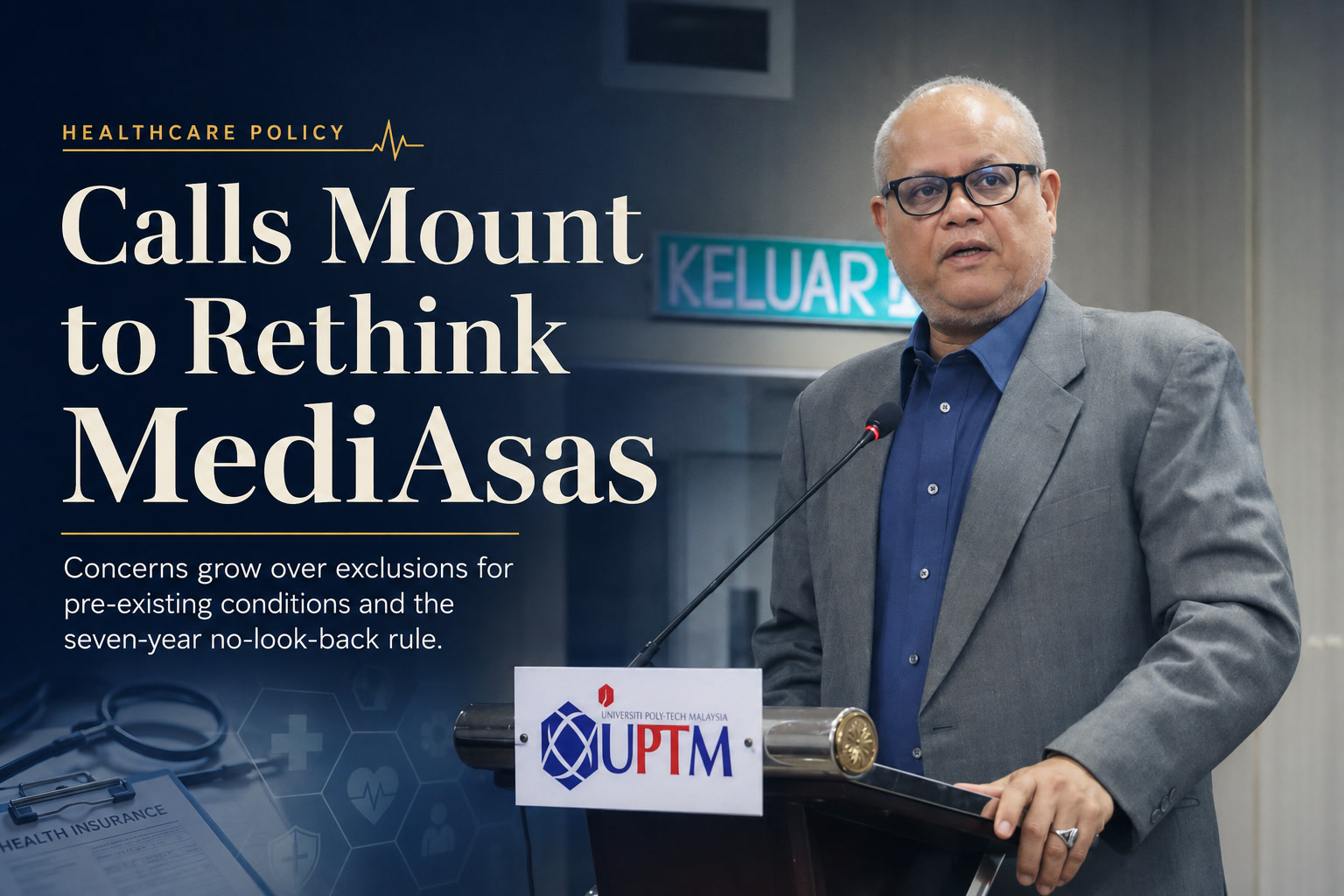
Exclusions Malaysia's upcoming MediAsas medical and health insurance/takaful plan is facing criticism ahead of its planned January 2027 public launch, with health financing expert Prof Emeritus Dr Syed Mohamed Aljunid Syed Junid arguing that the scheme should be reconsidered because of its treatment of pre-existing conditions and its seven-year "no look-back" provision.
MediAsas is being positioned as a government-designed base medical insurance product aimed partly at Malaysians who are currently uninsured or looking for a more affordable alternative to existing medical plans. However, Dr Syed Aljunid argues that some of its proposed features make it too similar to conventional private health insurance and could limit its usefulness as a broader health financing reform.
Pre-Existing Conditions Are at the Centre of the Debate
According to Bank Negara Malaysia's pilot FAQ published on 29 July, MediAsas contains a number of exclusions commonly found in existing private medical insurance products. These include pre-existing illnesses, congenital conditions and certain mental health conditions.
The concern is particularly significant because Malaysia has a large population living with chronic diseases.
National health data has previously shown high levels of diabetes, hypertension, high cholesterol and obesity among Malaysian adults. Millions of people are already living with one or more of these conditions, meaning rules surrounding pre-existing illnesses could determine whether MediAsas genuinely expands access to medical insurance or continues leaving higher-risk individuals dependent on the public healthcare system.
Dr Syed Aljunid argues that a national health financing initiative should aim to include these groups rather than excluding them based on their health risks.
In his view, "everybody should be included", especially if MediAsas is intended to form part of a broader reform of Malaysia's healthcare financing system.
How the Seven-Year 'No Look-Back' Rule Works
Another major concern is MediAsas' proposed seven-year no look-back protection.
Under the current structure, the protection only takes effect after a policy has remained continuously active for seven years. Before that period ends, insurers or takaful operators may potentially examine earlier medical information when assessing claims.
The provision has created confusion because some industry agents have interpreted it as effectively creating a seven-year contestability period, considerably longer than the two-year period commonly associated with many existing insurance products.
Even after seven years, the protection is not absolute.
Claims may still be rejected if an insurer determines that information was withheld fraudulently, deliberately or recklessly. Certain predefined conditions that existed before the policy was purchased may also remain excluded.
That leaves an important question for consumers: how much certainty does the seven-year protection actually provide?
Dr Syed Aljunid expressed concern that the implementation and enforcement remain unclear, particularly during the years before the protection becomes effective.
MediAsas Remains a Fully Underwritten Product
MediAsas will use conventional medical underwriting.
Applicants will disclose their health history, after which individual insurance or takaful operators can decide whether to provide coverage, impose exclusions or charge higher premiums.
The government is not proposing mandatory medical examinations for every applicant.
Health Minister Dzulkefly Ahmad had previously indicated that people with stable and controlled pre-existing conditions, including certain mental health conditions, could potentially obtain coverage under the scheme.
However, that specific wording does not appear in BNM's pilot FAQ.
Instead, insurers are allowed to determine the insurability of applicants with declared medical conditions based on additional medical assessments.
The FAQ also does not specify a maximum amount by which premiums can be increased for higher-risk applicants.
This creates uncertainty over how affordable MediAsas will ultimately be for precisely the people who may need medical insurance the most.
Concerns About 'Cream Skimming'
Dr Syed Aljunid also criticised the use of risk-rated premiums, arguing that it could encourage insurers to concentrate on healthier and lower-risk customers.
In health economics, this is sometimes described as "cream skimming", where providers favour individuals who are less likely to generate expensive claims.
The danger is that people with diabetes, hypertension and other non-communicable diseases could still struggle to obtain affordable private coverage and remain reliant on Ministry of Health facilities.
That would weaken one of the potential purposes of broader healthcare financing reform: reducing pressure on the public system by expanding meaningful coverage elsewhere.
Dr Syed Aljunid instead favours a community-rated approach, where individuals are not priced or excluded purely according to their personal medical risk.
Such a model spreads risk across a much larger population rather than concentrating higher costs on people who are already sick.
Malaysia's Chronic Disease Burden Makes Inclusion Important
The debate becomes particularly important when Malaysia's disease burden is considered.
The National Health and Morbidity Survey 2023 reported that around 29.2% of adults had hypertension, while approximately 33.3% had high cholesterol. More than half of adults were classified as overweight or obese.
Malaysia also has a substantial diabetes burden, with many individuals remaining unaware that they have the condition.
Nearly 2.3 million adults were estimated to be living with three of four major chronic risk conditions: diabetes, hypertension, high cholesterol or obesity.
With such a large proportion of the population potentially carrying some form of pre-existing health risk, a financing model that heavily relies on conventional underwriting could struggle to achieve broad inclusion.
That is the core of Dr Syed Aljunid's criticism.
A scheme designed for national health financing cannot simply work well for people who are already healthy.
Could MediAsas Work Better as a Top-Up Plan?
Dr Syed Aljunid does not necessarily believe every component of MediAsas has no value.
He suggested that the product could potentially serve as a top-up medical plan rather than forming the foundation of a national health financing solution.
Under the current standard structure, MediAsas is expected to provide an annual limit of RM100,000 for people aged 59 and below, increasing to RM150,000 for those aged 60 and above.
Those limits could provide useful supplementary protection for certain consumers.
The concern is whether policymakers are attempting to solve a much larger healthcare financing challenge by focusing on the parts that are easiest to implement.
Malaysia has debated healthcare financing reform for decades precisely because there is no simple solution.
Private insurance, public healthcare funding, risk pooling, provider payments and population coverage all interact with one another.
Changing one component without addressing the rest may produce only limited improvements.
Private Insurance Represents Only Part of Malaysia's Health Spending
Another point raised by Dr Syed Aljunid is the relatively small contribution private insurance currently makes to Malaysia's overall healthcare expenditure.
He estimated that private insurance accounts for only around 8% of total health expenditure.
From that perspective, reforms focused primarily on private medical insurance may have limited ability to solve the country's broader healthcare financing challenges.
The much larger question concerns how the remaining healthcare expenditure is funded and how Malaysia can create a system that provides sustainable access without disproportionately burdening either households or the public sector.
MediAsas may therefore represent one component of reform, but critics argue it should not be confused with a comprehensive solution.
Bank Negara's Role Also Comes Under Scrutiny
Dr Syed Aljunid also questioned BNM's approach, arguing that a regulator should place stronger emphasis on consumer access rather than the financial sustainability of insurers.
BNM, however, has responsibilities for maintaining the stability of Malaysia's financial and insurance sectors, which means it must balance consumer protection with the viability of insurance providers.
That creates a difficult policy tension.
If insurers are forced to cover every risk without appropriate pricing or risk pooling, premiums could become unsustainable.
On the other hand, if underwriting remains too restrictive, people with existing illnesses may continue being excluded from meaningful coverage.
Finding a workable balance between those competing objectives is likely to become one of the central issues surrounding MediAsas before its full launch.
MediAsas Still Has Time to Evolve
MediAsas is not scheduled for public launch until January 2027, meaning there is still time for policymakers, regulators, insurers and healthcare experts to refine the structure.
Some of the current debate may ultimately influence how eligibility, underwriting, exclusions and the no look-back provision are implemented.
There is also room for greater clarity around what qualifies as a "stable and well-managed" pre-existing condition, how much premium loading will be permitted and how claim disputes will be handled during the seven-year period.
Clearer rules could significantly affect public confidence in the scheme.
Final Thoughts
MediAsas is being introduced at a time when Malaysia urgently needs more sustainable ways to finance healthcare, particularly as chronic diseases become increasingly common and medical costs continue rising.
The criticism from Dr Syed Aljunid highlights a fundamental question: should a government-backed base medical plan operate largely like conventional private insurance, or should it be designed around broader risk-sharing and inclusion?
Excluding or heavily pricing people with existing illnesses may make the product easier for insurers to manage, but it also risks leaving many Malaysians outside the very system intended to expand coverage.
At the same time, any more inclusive model needs a sustainable method of funding higher-risk patients.
That is why the debate around MediAsas is ultimately bigger than one insurance product.
It is part of a much wider question about how Malaysia wants to share healthcare risk, fund treatment and ensure that people who are already sick are not the ones who find coverage hardest to obtain.











Comments 0