

Malaysia's rapid rise as a regional data centre destination is creating new opportunities for cloud services, artificial intelligence, digital businesses and foreign investment. But the expansion also comes with a major challenge that is becoming harder to ignore: electricity demand.
Data centres are the backbone of the digital economy. They keep websites, cloud platforms, financial systems, streaming services, enterprise applications and increasingly AI workloads running around the clock. Unlike a conventional office building, they do not simply shut down after business hours. Their servers, cooling systems, network equipment and backup infrastructure need a constant and reliable supply of power.
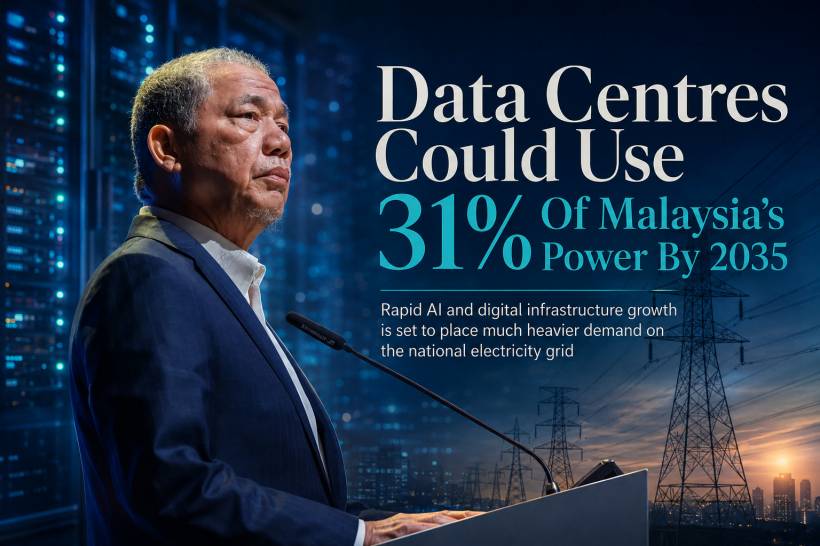
That is why the latest projection for Malaysia is significant. By 2035, data centres could account for around 31% of the country's electricity consumption, compared with roughly 7% today.
A Sharp Rise in Energy Demand
In a written parliamentary reply, Energy Transition and Water Transformation Minister Datuk Seri Fadillah Yusof said electricity use by the data centre sector is projected to climb from approximately 10,544 gigawatt-hours (GWh) currently to 73,274 GWh by 2035.
That is not a small increase. It reflects how quickly Malaysia's digital infrastructure is growing, especially as global cloud providers, artificial intelligence companies and large enterprises continue to look for suitable locations to build or expand their facilities.
The country has several advantages that make it attractive for this sector. Malaysia offers a strategic location in Southeast Asia, growing digital connectivity, competitive operating costs and proximity to Singapore, where land and energy constraints have made large-scale expansion more difficult.
However, the same growth that attracts investment also puts more pressure on national infrastructure.
AI Is Changing the Energy Conversation
Traditional data centres already consume significant electricity, but the rapid growth of artificial intelligence is increasing the challenge further.
AI workloads are much more power-intensive than many standard computing tasks. Training large models, processing massive datasets and running high-performance graphics processors require a huge amount of computing capacity. That capacity generates heat, which then creates an additional need for cooling.
In other words, the demand does not come only from servers. It also comes from the systems required to keep those servers operating safely and efficiently.
This is one reason why data centre planning is no longer simply a technology or investment issue. It is now closely linked to national energy planning, water management, grid reliability and sustainability targets.
Peak Demand Is Also Expected to Rise
The concern is not only about total electricity consumption over a year. Malaysia also has to manage peak demand, which is the highest level of electricity needed at a particular time.
According to Fadillah, peak electricity demand in Peninsular Malaysia is expected to grow at a compound annual growth rate of 5.1% between 2026 and 2035. Peak demand could increase from 21.3 gigawatts in 2026 to 33.5 gigawatts by 2035.
This matters because a stable power grid must always be prepared for the highest likely demand, not just average daily usage. If capacity planning falls behind, the risk is not merely higher electricity costs. It could also affect supply reliability for households, hospitals, factories, public services and businesses.
For a country trying to position itself as a digital hub, stable electricity is non-negotiable. Data centre operators expect high availability, while ordinary users expect the same level of reliability from the grid that supports their homes and workplaces.
Government Measures Focus on Capacity and Stability
To manage the growing demand, the government and the Energy Commission are continuing to monitor electricity requirements, particularly in Peninsular Malaysia where many large data centre developments are concentrated.
Several measures are being considered or implemented to strengthen supply capacity. These include extending the operating life of existing thermal power plants as a short-term measure, introducing open bidding for additional gas-based generation and developing more large-scale solar projects.
Each option comes with its own trade-offs.
Thermal and gas-based plants can provide dependable electricity when demand is high, but they also raise questions about emissions and long-term energy-transition goals. Solar power supports Malaysia's renewable-energy ambitions, but it depends on weather conditions and requires supporting infrastructure such as energy storage, grid upgrades or other reliable generation sources.
The challenge is not simply generating more electricity. It is making sure the system can deliver enough power at the right time, in the right location, without compromising stability.
Renewable Energy Could Play a Bigger Role
One important part of the plan involves encouraging data centres to use renewable energy more actively.
Under the Corporate Renewable Energy Supply Scheme, data centre operators can purchase renewable electricity directly from private developers. This gives companies a way to reduce their carbon footprint while supporting the growth of renewable-energy projects.
Fadillah also encouraged data centre operators to generate electricity based on their own requirements, which could help reduce pressure on the national grid.
This approach could become increasingly important as global technology companies face stronger pressure from investors, customers and regulators to meet sustainability commitments. Many major cloud and AI companies have already set targets to use more renewable energy, reduce emissions and improve energy efficiency across their operations.
For Malaysia, this could create an opportunity. The country does not only need to attract data centres; it can also position itself as a location for more sustainable and energy-conscious digital infrastructure.
Approvals Need to Match Grid Capacity
The government has also said that new data centre applications and expansion proposals are being reviewed through a strict screening process led by the Data Centre Task Force.
The key idea is straightforward: projects should only be approved when they fit within local grid-capacity planning and do not threaten the security or reliability of electricity supply.
That is a sensible direction. A data centre may be a major investment, but approving too many high-energy facilities in one area without sufficient supporting infrastructure could create problems for everyone else connected to the same network.
The goal should not be to slow down digital growth unnecessarily. Instead, it should be to make sure that development happens in a controlled way, with enough power capacity, transmission infrastructure, renewable-energy access and contingency planning behind it.
The Bigger Question Is About Balance
Malaysia's data centre boom has clear economic benefits. It can attract investment, create technical jobs, support local suppliers and strengthen the country's position in the regional digital economy.
At the same time, the sector's expansion will require careful planning. Electricity demand, water use, land availability, emissions and grid resilience cannot be treated as secondary concerns.
The projected rise to 31% of national electricity consumption by 2035 shows just how significant this issue could become. Data centres may power the future of AI, cloud computing and digital services, but they will also test how prepared Malaysia is to support that future sustainably.
Final Thoughts
Malaysia has an opportunity to become one of Southeast Asia's most important data centre hubs, but success will depend on more than attracting new facilities.
The country will need enough reliable generation capacity, stronger grid planning, more renewable-energy options and careful approval processes to ensure that growth does not come at the expense of long-term energy security.
The data centre industry may be digital, but its impact is very physical. It needs land, water, power, cooling and infrastructure. Managing those demands properly will determine whether Malaysia's digital expansion becomes a long-term strength or an avoidable strain on national resources.











Comments 0