


Intel has now officially introduced its new Core Ultra 200S Plus Series, confirming the arrival of two fresh desktop processor models in the Arrow Lake family. The new additions are the Intel Core Ultra 7 270K Plus and the Intel Core Ultra 5 250K Plus, and they are clearly aimed at users who want a stronger balance of gaming performance, multitasking capability, and content creation power without stepping all the way into the company's highest-end territory.
While the naming might suggest a minor refresh at first glance, Intel is positioning these chips as more than a simple spec bump. On paper, the upgrades include extra efficiency cores, slightly higher frequencies, and platform compatibility with existing 800 Series motherboards. But Intel says the bigger story lies deeper inside the architecture, particularly in the way the processors handle internal communication and workload optimisation.
Two New Chips Join the Arrow Lake Lineup
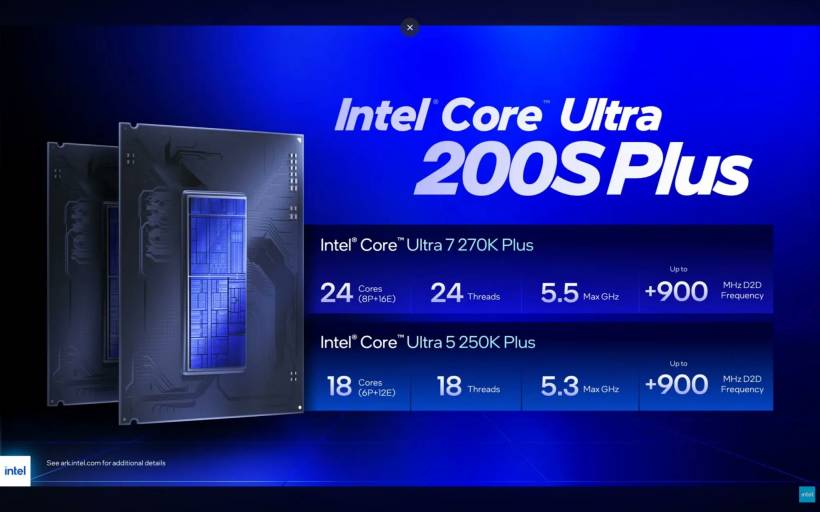
The Core Ultra 200S Plus family expands Intel's Arrow Lake desktop range with two new SKUs that sit in the more enthusiast-friendly middle of the stack. The Core Ultra 7 270K Plus and Core Ultra 5 250K Plus are designed to offer stronger performance than their direct predecessors, while still staying accessible enough for builders looking to upgrade without overspending.
According to Intel, both processors gain additional efficiency cores compared to the models they effectively replace. The Core Ultra 7 270K Plus now reaches a total of 24 cores, thanks to four extra E-Cores. The Core Ultra 5 250K Plus also benefits from the same increase in E-Core count, alongside a modest clock speed improvement, with boost speed reaching 5.3GHz.
At first, those changes may not sound dramatic enough to justify the "Plus" branding on their own. More cores and a slightly higher boost clock are useful, of course, but they are not necessarily headline-grabbing in a market where CPU launches often revolve around much larger generational claims. That is exactly why Intel seems eager to shift attention away from the raw numbers alone and toward the deeper tuning behind these processors.
Intel Says the Real Gains Come From Internal Tuning
Intel's message around the Core Ultra 200S Plus Series is that the real improvement is not just the added hardware, but the refinement of how the processor behaves internally. Robert Hallock, Intel's Vice President and General Manager of Enthusiast Channel Business, highlighted the importance of internal frequencies beyond standard core clocks.
One of the main areas Intel is emphasizing is the connection between the CPU cores and system memory. The company says it has managed to push Direct-to-Device, or D2D, frequency by as much as 900MHz. That may sound like an obscure technical detail to casual buyers, but it matters because faster internal communication can reduce latency and improve how quickly different parts of the processor exchange data.
In practical terms, lower latency and improved internal bandwidth can make the overall system feel faster and more responsive, particularly in workloads that rely on quick data movement across the chip. That includes gaming, multitasking, and some creator applications where performance is not only about how many cores you have, but how efficiently those cores and supporting components work together.
Content Creation Performance Is a Big Talking Point
Intel is also making some ambitious claims for creator workloads. The company says the Core Ultra 200S Plus processors can deliver up to 100% better performance than a competing processor in multithreaded content creation scenarios.
That is the kind of claim that immediately gets attention, although it also naturally invites closer scrutiny. As always, these kinds of figures tend to depend heavily on the exact benchmark, workload type, and comparison point being used. Still, it shows where Intel wants these chips to be seen: not just as gaming parts, but as capable processors for video editing, rendering, and other demanding desktop tasks.
There is also a bit of irony in this positioning. Intel is talking up strong multithreaded gains even after stepping away from Hyper-Threading in its consumer desktop segment. That makes the company's current approach especially interesting. Rather than leaning on legacy threading techniques, Intel appears more focused on extracting better efficiency through architecture, internal frequencies, and smarter workload handling.

Gaming Gets a Noticeable Boost Too
Beyond creator performance, Intel is naturally putting plenty of emphasis on gaming. The company says the Core Ultra 200S Plus chips offer an average gaming uplift of up to 15% over their direct predecessors. In some titles, Intel claims performance gains can climb as high as 43%.
That is a meaningful jump if it holds up across real-world testing, especially for gamers who are already running a system that may be due for a CPU refresh. Not every game will scale the same way, and some titles are always more CPU-sensitive than others, but even an average double-digit improvement is enough to make these processors relevant for enthusiasts building or upgrading a gaming PC in 2026.
It also suggests that Intel is trying to keep Arrow Lake competitive not only through raw horsepower, but through better platform-level efficiency. Gaming performance today is shaped by much more than just headline clock speed. Cache behaviour, latency, memory interaction, and scheduling all play a major role, and Intel seems to be tuning these new chips with that reality in mind.
A New Binary Optimisation Tool Could Be the Wild Card
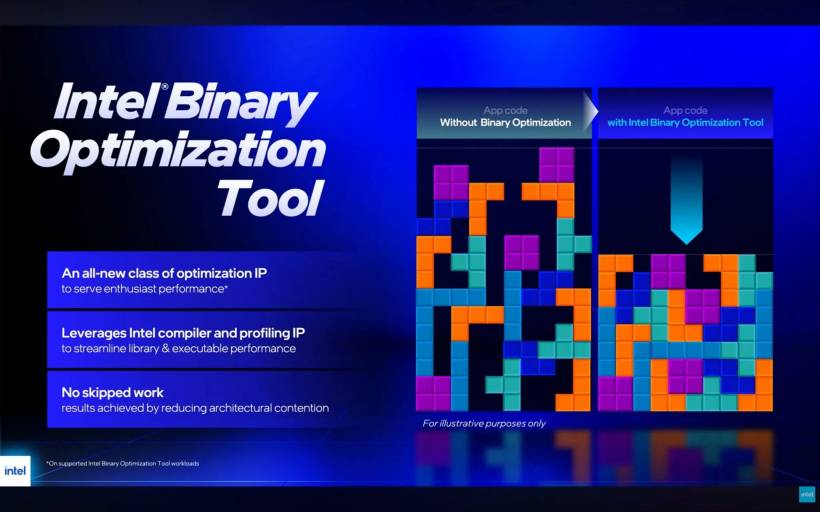
One of the more interesting announcements tied to the Core Ultra 200S Plus Series is Intel's new Binary Optimisation Tool. This may end up being one of the most talked-about features of the launch because it pushes beyond the usual hardware discussion and enters the software optimisation space.
Intel says the tool analyses an existing workload, studies how it is using the CPU, and then restructures or streamlines that application if it is not making ideal use of Intel's architecture. The goal is to improve performance by better aligning the software with Intel's x86 design.
Put more simply, Intel is trying to make software run more efficiently on its own processors by helping it use the cache, execution pipeline, and instruction flow more effectively. The company describes this almost like a form of translation or optimisation layer that helps software originally tuned for another architecture or platform behave better on Intel hardware.
That is a fascinating idea because it points to a future where CPU performance is influenced not just by silicon improvements, but by increasingly intelligent software-side adaptation. If the tool works well in practice, it could give Intel a useful edge in cases where applications are not yet fully optimised for its newer CPU designs.
Of course, the real question will be how broadly this tool is supported, how transparent it is to end users, and whether the gains are consistent outside of Intel's own demos. But as a concept, it is one of the more forward-looking parts of this launch.
Existing 800 Series Motherboards Are Still in Play
For current Intel users, one of the more practical pieces of good news is platform compatibility. The new Core Ultra 200S Plus processors will work with existing 800 Series motherboards, provided users update their BIOS first.
That is an important detail because it lowers the barrier to upgrade. Anyone already on a supported motherboard may be able to swap in one of the new chips without having to rebuild the entire system around a new board. In a market where platform costs can quickly add up, that kind of compatibility helps make the new CPUs more appealing.
At the same time, Intel says its board partners will also introduce new motherboards specifically designed to support the new CPUs. That means buyers will likely have a choice between reusing an existing setup or going for a fresh build with updated board designs and features.
Pricing Looks Fairly Aggressive
Intel is launching the Core Ultra 200S Plus Series with pricing that seems designed to stay competitive. The Core Ultra 5 250K Plus starts at US$199, which works out to around RM782, while the Core Ultra 7 270K Plus starts at US$299, or roughly RM1,175.
Those prices position the chips in a range that could attract both mainstream enthusiasts and more value-conscious builders who still want a modern desktop CPU with respectable gaming and creator credentials. Much will depend on actual retail pricing in Malaysia, of course, but on paper, Intel appears to be aiming for a strong price-to-performance story rather than relying purely on premium branding.
Availability Starts Later This Month
Intel says the Core Ultra 200S Plus Series will become available starting 26 March. That gives desktop users a relatively short wait before they can see how these chips perform in independent reviews and real-world builds.
For buyers who have been sitting on the fence about an upgrade, this launch adds another interesting option to the desktop CPU market. The combination of more cores, better internal tuning, gaming gains, creator-focused claims, and a new optimisation tool makes the 200S Plus lineup look more substantial than a typical mid-cycle refresh.
Final Thoughts
Intel's Core Ultra 200S Plus Series feels like a launch built around refinement rather than reinvention. The extra E-Cores and small clock speed bumps are welcome, but the bigger story is Intel's attempt to squeeze more real-world performance out of its architecture through lower latency, better internal communication, and smarter software optimisation.
That makes these processors interesting for more than one type of user. Gamers will notice the performance promises. Content creators will pay attention to the multithreaded claims. PC builders will appreciate the motherboard compatibility. And hardware watchers will likely be most curious about whether the Binary Optimisation Tool delivers on its promise.
On paper, Intel has put together a refresh that looks thoughtful rather than flashy. The real verdict, as always, will come once the chips are out in the wild and tested across a wider range of applications and games. But for now, the Core Ultra 200S Plus Series looks like a serious attempt to keep Intel's desktop lineup competitive with a mix of practical upgrades and smarter tuning behind the scenes.











Comments 0