

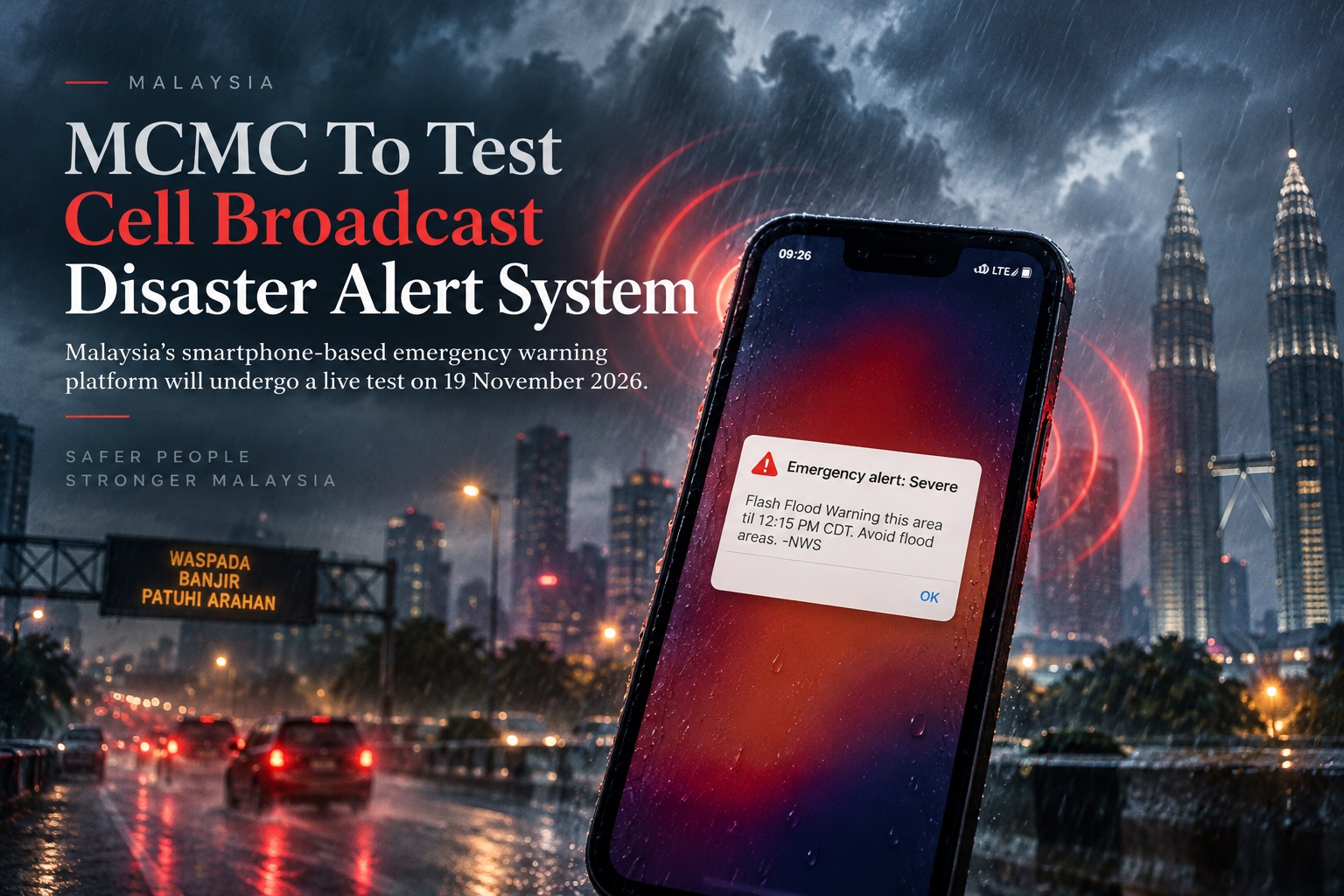
Malaysia is preparing to test a new smartphone-based emergency alert system designed to warn people quickly when disasters or other serious emergencies occur in their area. The Malaysian Communications and Multimedia Commission, or MCMC, is now in the final stages of developing the Cell Broadcast System (CBS), with a live test scheduled for 19 November 2026.
The exercise is expected to cover selected high-risk locations, including flood-prone areas in Selangor, Kuala Lumpur, Kelantan and Pahang. People within the selected locations may therefore receive an emergency-style notification on their smartphones during the test. Importantly, receiving the message does not mean that an actual disaster is taking place; the exercise is intended to evaluate how effectively the new system can reach devices in targeted areas.
Malaysia Is Moving Beyond Traditional SMS Alerts
Malaysia currently relies heavily on SMS and other communication channels when distributing emergency information. While SMS remains useful, it was never designed specifically for large-scale disaster warnings.
During major emergencies, mobile networks can become extremely busy as thousands of people simultaneously make calls, send messages or access the internet. Conventional SMS notifications also need to be delivered individually to mobile numbers, potentially creating delays when authorities need to reach very large populations quickly.
Cell Broadcast works differently. Instead of sending one message to one phone number, authorities broadcast an emergency notification through cellular towers covering a particular geographical area.
Every compatible phone connected to those towers can then receive the warning almost simultaneously.
The System Was First Discussed In 2024
Malaysia's plans for smartphone-based emergency alerts have been developing for several years. In 2024, Communications Minister Fahmi Fadzil revealed that the government was exploring a system similar to emergency-warning platforms already operating in countries such as Japan and South Korea.
Those countries regularly use mobile broadcast warnings for events including earthquakes, extreme weather and other emergencies.
The idea was particularly relevant to Malaysia because of recurring floods during the monsoon season. Getting warnings to people quickly can give residents valuable additional time to move vehicles, protect important belongings or evacuate when necessary.
The upcoming November test represents an important step towards turning those earlier plans into an operational national system.
How Cell Broadcast Works
Cell Broadcast does not send an alert directly to your phone number.
Instead, the telecommunications network broadcasts the message from selected cellular towers. Any compatible device currently connected within that coverage area can receive the alert.
This provides several advantages.
The system can target a specific geographical location without authorities needing to know the identities or phone numbers of everyone inside it. If flooding is expected around a particular district, for example, alerts could potentially be broadcast only through towers serving that area.
Someone travelling through the affected location could therefore receive the warning even if their registered home address is somewhere else.
No Internet Connection Is Required
One of the most important advantages of CBS is that receiving alerts does not depend on mobile internet access.
A user does not need:
• Mobile data
• Wi-Fi
• A dedicated disaster-alert application
• A social media account
• SMS credit or messaging services
As long as a compatible phone is connected to a functioning cellular network broadcasting the emergency alert, the notification can be delivered.
That makes CBS particularly valuable during emergencies because internet connectivity may become unreliable or congested precisely when information is most urgently needed.
You Do Not Need To Install An App
Another major advantage is that users do not need to download anything beforehand.
Traditional emergency applications have an obvious weakness: they only work for people who know the app exists and have taken the time to install and configure it.
Cell Broadcast functionality is built into supported mobile operating systems and cellular networks. This allows authorities to potentially reach millions of devices without requiring users to register for a service first.
For emergency communication, that simplicity can make a major difference.
Alerts Are Based On Location, Not Mobile Provider
The system is also designed to work regardless of which mobile operator a person uses, provided at least one functioning network capable of broadcasting the alert remains available in the affected area.
This is particularly useful during disasters because authorities do not need to create separate warning lists for customers of different telecommunications providers.
The cellular network itself becomes the distribution mechanism.
Someone visiting Malaysia or travelling between states could potentially receive a local warning simply because their device is connected to a tower inside the affected zone.
Why Cell Broadcast Can Be Faster Than SMS
SMS messages are traditionally addressed to individual numbers. Sending millions of messages therefore requires processing enormous numbers of individual deliveries.
Cell Broadcast operates more like a radio transmission.
One message is transmitted from a cell tower, and every compatible device listening within that cell can receive it. Adding another thousand phones does not require the network to generate another thousand separate messages in the same way conventional SMS delivery does.
That makes the technology particularly suitable for scenarios where authorities need to communicate with very large numbers of people quickly.
The 19 November Exercise Will Focus On High-Risk Areas
The scheduled 19 November 2026 exercise is expected to include selected locations considered vulnerable to disasters, particularly flooding.
Areas in the following states and territories are expected to be involved:
• Selangor
• Kuala Lumpur
• Kelantan
• Pahang
These locations make sense for an initial test because several regularly experience flooding during Malaysia's monsoon season.
Testing the system under realistic geographical conditions can help MCMC understand how consistently alerts appear across different devices, operators and network environments.
Do Not Panic If Your Phone Suddenly Displays An Alert
Perhaps the most important thing for people living in the selected test locations is to understand that the November notification will be part of an exercise.
Emergency Cell Broadcast alerts can behave differently from ordinary notifications. Depending on how the final Malaysian implementation works and what the phone supports, the alert could appear prominently on the display and may include distinctive sounds or vibration patterns.
That behaviour is intentional.
Emergency systems are designed to attract attention even when users are not actively looking at their phones.
However, on 19 November, people receiving the test notification should read the message carefully before assuming that a real emergency is underway.
Accessibility Is Being Built Into The System
The Cell Broadcast System is also being developed with accessibility considerations in mind.
Compatible devices may support features such as:
• Audible emergency alerts
• Strong vibration patterns
• Screen-reader support
• Prominent full-screen notifications
These features can help users who have visual or hearing impairments, as well as people who may have difficulty reading a conventional SMS notification.
In an emergency system, accessibility is particularly important because warnings need to reach as much of the population as possible.
The System Could Eventually Replace SMS Disaster Warnings
CBS is intended to complement Malaysia's existing warning infrastructure initially, but it could eventually replace much of the current SMS-based disaster-alert mechanism.
That would represent a significant improvement because Cell Broadcast was specifically designed for mass public warnings.
SMS can still remain useful as a secondary communication channel, particularly for follow-up information, but CBS is much better suited to rapidly notifying everyone within a particular geographical area.
Using several communication methods together could also provide redundancy when one system is unavailable.
Flood Warnings Are An Obvious Use Case
Malaysia's recurring flood events provide one of the clearest examples of how the system could be useful.
Authorities could potentially issue warnings when water levels reach dangerous thresholds, rivers are expected to overflow or residents in specific areas need to prepare for evacuation.
Instead of relying entirely on television, social media or messaging apps, the warning would arrive directly on mobile phones located within the threatened area.
Even a relatively short amount of additional warning time could be valuable for communities regularly affected by floods.
CBS Could Eventually Be Used For Other Emergencies
Although flood preparedness has been a major motivation behind Malaysia's implementation, Cell Broadcast technology can support many other emergency scenarios.
Depending on future government policy, the infrastructure could potentially be used for:
• Severe storms
• Flash floods
• Landslides
• Tsunami warnings
• Major fires
• Hazardous material incidents
• Public safety emergencies
• Evacuation instructions
The same network can deliver different types of alerts according to the severity and geographical scope of an incident.
This makes CBS useful as a broader national emergency communication system rather than something designed exclusively for floods.
There Is Still One Major Limitation
Cell Broadcast may not require internet access, but it still depends on mobile telecommunications infrastructure.
If every cellular tower serving an affected area becomes unavailable, phones within that location cannot receive Cell Broadcast messages until network service returns.
This distinction is important.
CBS can continue functioning when mobile internet is congested or when users do not have data connectivity, but it cannot communicate through a cellular network that has completely failed.
Network resilience therefore remains a critical part of Malaysia's disaster preparedness.
Telecommunications Infrastructure Must Survive The Disaster
Natural disasters can damage power supplies, fibre connections and cellular towers. Even when the tower itself remains intact, prolonged power outages can eventually exhaust backup batteries or generators.
For Cell Broadcast to be dependable, telecommunications providers need robust disaster recovery arrangements.
These can include:
• Backup power systems
• Redundant network routes
• Portable mobile base stations
• Emergency generators
• Rapid repair teams
• Alternative backhaul connections
The warning system is only as resilient as the infrastructure delivering it.
Testing Across Different Phones Will Be Important
Malaysia has an enormous variety of smartphones in active use, ranging from the latest flagship Android devices and iPhones to older budget handsets.
The November exercise will therefore be useful for identifying compatibility problems.
Ideally, authorities will need to understand whether alerts are displayed consistently across:
• Different Android versions
• Different smartphone brands
• iPhones
• Older supported devices
• Different Malaysian mobile operators
A national emergency system needs to work reliably across the widest practical selection of devices rather than only the newest phones.
Emergency Messages Need To Be Clear
The technology itself is only one part of an effective warning system.
The wording of the alert is equally important.
People receiving an emergency message need to understand immediately:
• What is happening
• Where it is happening
• How serious it is
• What they should do next
• Where additional verified information can be obtained
Messages that are overly technical or ambiguous can create confusion at precisely the wrong moment.
The November test could therefore also help authorities refine how warnings are presented to the public.
False Alarms Need To Be Avoided
Because Cell Broadcast alerts are deliberately attention-grabbing, authorities will need strong procedures controlling when they are issued.
Repeated false alarms could eventually cause people to ignore warnings.
This phenomenon, sometimes called alert fatigue, is already a concern in countries with mature public-warning systems. If users receive too many unnecessary alerts, they may become less likely to react quickly during a genuine emergency.
Malaysia will therefore need a clear hierarchy determining which incidents justify emergency broadcasts and how different severity levels are communicated.
Geographical Targeting Can Reduce Alert Fatigue
One advantage of Cell Broadcast is its ability to restrict alerts geographically.
Instead of sending a warning to everyone in Malaysia because one district is flooding, authorities can potentially target cellular towers serving the affected region.
That means users far away from the emergency do not receive unnecessary alerts.
More precise geographical targeting should help maintain public trust because messages remain relevant to the people receiving them.
A Big Upgrade For Malaysia's Disaster Preparedness
Moving from conventional SMS warnings towards Cell Broadcast represents a meaningful technological improvement.
Malaysia already has widespread smartphone ownership and extensive mobile network coverage, meaning much of the infrastructure needed to reach the population already exists.
Rather than asking people to adopt another platform, CBS uses the device most people already carry everywhere.
That gives authorities a direct communication channel during moments when speed and clarity matter most.
Final Thoughts
MCMC's planned Cell Broadcast System test on 19 November 2026 marks an important step towards modernising Malaysia's national disaster-warning infrastructure. By broadcasting emergency notifications directly through cellular towers, authorities can potentially reach people within affected areas quickly without requiring mobile internet, SMS delivery or a dedicated app.
The technology should be particularly useful for flood warnings, but it could eventually support many other types of emergencies. Accessibility features such as audio alerts, vibration and screen-reader support could also help ensure that warnings reach a broader section of the population.
The system is not completely independent of telecommunications infrastructure, so resilient mobile networks and disaster recovery capabilities remain essential. Still, if the November test proves successful, Cell Broadcast could give Malaysia a much faster and more targeted way to warn people when dangerous situations develop.











Comments 0