

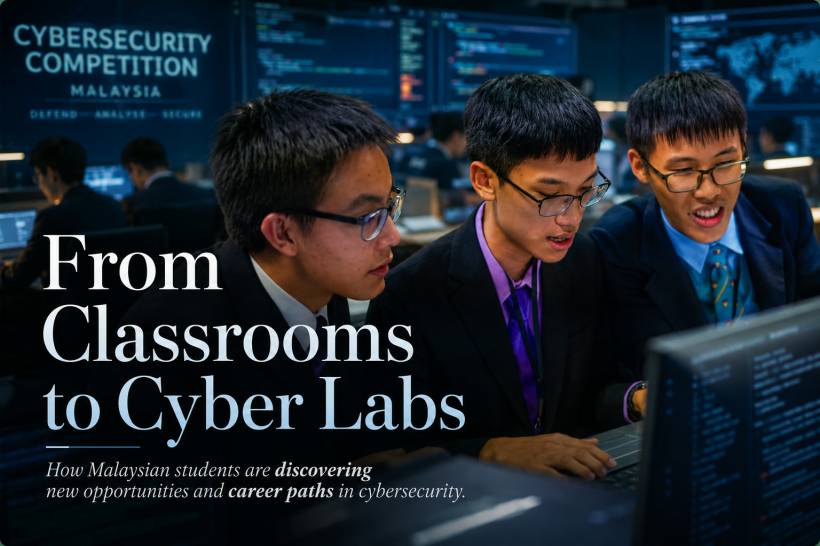
For many young Malaysians, cybersecurity once meant little more than installing antivirus software, changing a password or checking whether Windows Defender was running. But after taking part in hands-on workshops, coding challenges and simulated cyberattacks, students involved in My Cyber Hero 2026 are beginning to see the field very differently.
The national programme brought together more than 21,000 primary and secondary school students from across Malaysia, giving them an opportunity to explore how digital systems are protected, how vulnerabilities are discovered and why cybersecurity now affects almost every part of modern life.
Rather than learning through lectures alone, participants were placed in practical situations where they had to solve problems, analyse code and work together under time pressure. For some students, that experience has already changed the way they think about their future careers.
More Than Antivirus and Laptop Settings
Before joining the programme, 17-year-old They Zee Yuen from SMK Sultan Ismail in Johor believed cybersecurity was mainly about basic computer protection.
That perception changed after he participated in workshops, Capture the Flag exercises and the competition's grand final at the MCMC and BlackBerry Cybersecurity Centre of Excellence.
Capture the Flag, commonly known as CTF, is a type of cybersecurity challenge where participants solve technical puzzles, locate hidden information, identify weaknesses or complete security-related tasks. Unlike a normal classroom exercise, it requires students to understand what they are doing rather than simply follow instructions.
They explained that copying and pasting code was not enough. Participants needed to understand what each command did so they could solve the challenge efficiently.
That combination of problem-solving, teamwork and immediate feedback made the competition one of the most engaging programmes he had joined. It also encouraged him to seriously consider cybersecurity as a future career.
His three-member team eventually won first place in the Star Cyber Hero category for secondary schools.
Cybersecurity Is Part of Everyday Life
The programme also helped younger students recognise that cybersecurity is not limited to banks, technology companies or government agencies.
Twelve-year-old Arif Hilmi Ahmad Azamuddin from SK Ibrahim in Sungai Petani, Kedah, initially believed cyber protection was mainly relevant to large commercial organisations. Through the competition, he learned that simple daily actions—such as choosing passwords, protecting online accounts and identifying suspicious activity—are also part of cybersecurity.
Common or reused passwords, for example, can make it much easier for attackers to gain access to personal accounts. This means even primary school students are already making decisions that affect their digital safety.
Arif was part of the three-member team that won first place in the Rookie Cyber Hero category for primary schools.
Before the competition, he had considered becoming a cardiologist. His ambition has now shifted towards becoming a white hat hacker—an ethical cybersecurity professional who looks for weaknesses in systems before criminals can exploit them.
It is a significant change for a young student, but it also shows how early exposure can introduce children to careers they may never have encountered through the normal school curriculum.
Learning Becomes More Meaningful When Students See the Results
Arif's mentor, Ahmad Azamuddin Zainal Arifin, observed that students became much more engaged when they could immediately see the impact of their actions.
Instead of memorising technical terms, they entered commands, tested ideas and watched the results appear in front of them. Successfully completing a task gave them a sense of achievement and encouraged them to continue experimenting.
This kind of hands-on learning is especially valuable in cybersecurity because the field is built around investigation. Students must learn how to ask questions, identify patterns, test assumptions and understand why something worked—or why it failed.
These are not only technical skills. They also involve critical thinking, persistence, communication and teamwork.
Ahmad believes similar programmes should be expanded to more schools, including communities outside major cities and students in Sabah and Sarawak.
His own students came from Sungai Petani, demonstrating that cybersecurity talent is not limited to schools in large urban centres. Young people across the country may have the interest and ability, but they still need access to training, equipment, mentors and opportunities.
Creating Interest Before Students Choose Their Careers
Early exposure is becoming increasingly important as organisations struggle to find enough people with strong cybersecurity skills.
BlackBerry cybersecurity technical training director Jaclyn Sim noted that developments in cloud computing, artificial intelligence and digital transformation are creating more systems, applications and connected services that must be protected.
Every new digital platform can potentially create another point of entry for attackers. As businesses and public services become more dependent on technology, the number of people needed to secure those environments continues to grow.
Programmes such as My Cyber Hero can introduce the subject while students are still in school. More structured facilities, including the MCMC and BlackBerry Cybersecurity Centre of Excellence, can then provide advanced training for those who wish to continue.
One programme creates curiosity, while the other develops practical and employment-ready capabilities. Together, they help form a wider talent pipeline—from school-level awareness to professional cybersecurity training.
Cybersecurity Is No Longer a Niche Profession
Cybersecurity was once viewed as a specialised area handled by a small group of technical experts working behind the scenes. That is no longer the case.
Today, cybersecurity professionals are needed in healthcare, finance, education, manufacturing, telecommunications, retail, transportation and government. Any organisation that stores information or relies on connected systems must consider how those assets will be protected.
The field also includes far more than ethical hacking. Career paths can involve:
This diversity gives students multiple ways to enter the profession, including both highly technical and non-technical roles.
Sim said Malaysia does not lack interest in cybersecurity. The wider challenge is turning that interest into capability at a large enough scale to meet national and industry demand.
Training Through Realistic Cyber Scenarios
Since 2024, the Cybersecurity Centre of Excellence has trained more than 10,000 participants, ranging from students to working professionals.
Its facilities are designed to make cybersecurity training more practical and realistic. These include the Black Box cybersecurity escape room, a cyber war room and a simulated security operations centre.
A simulated SOC allows participants to experience situations similar to those faced by real security teams. They may need to review alerts, identify suspicious behaviour, investigate an incident and decide how to respond.
This type of environment helps close the gap between theoretical knowledge and workplace requirements.
Reading about an attack is useful, but responding to a simulated incident requires a different level of understanding. Participants must make decisions, communicate with team members and deal with incomplete information—much like they would during an actual cybersecurity event.
Cybersecurity Has Become a National Responsibility
At the programme's closing ceremony, National Security Council director-general Raja Nushirwan Zainal Abidin emphasised that cybersecurity can no longer be treated as a concern for technology departments alone.
Cyber incidents can disrupt essential services, damage businesses, expose personal information and weaken public confidence. A serious attack may affect not only individual organisations but also national security, economic stability and the wellbeing of citizens.
This is why cybersecurity awareness must begin well before someone enters the workforce.
Students need to understand not only how systems can be attacked, but also the values involved in protecting them. Trust, integrity, responsibility and respect for other people's data are just as important as technical knowledge.
My Cyber Hero was therefore described as more than a competition. It represents an investment in the people who may one day become Malaysia's cybersecurity analysts, data scientists, AI engineers, technology innovators and digital leaders.
Making Cyber Education Accessible Across Malaysia
The success of school-level cyber programmes also raises an important question: how can these opportunities be made available to more students?
Schools have different levels of equipment, internet access, teacher support and technical expertise. Students in rural or underserved communities may be just as talented as those in major cities, but they may have fewer opportunities to discover that ability.
Expanding cybersecurity education will require cooperation between schools, government agencies, universities and private-sector technology organisations.
Training educators is equally important. Teachers and mentors need suitable resources so they can introduce cybersecurity safely and responsibly, without requiring every school to maintain an advanced cyber lab.
Online challenges, travelling workshops, shared regional facilities and structured national competitions could help reach more students while keeping the learning practical.
The aim should not be to turn every student into a cybersecurity professional. It should be to ensure that every student understands basic digital safety—and that those with deeper interest have a clear path to continue.
Building Skills Without Losing Sight of Ethics
As students learn about hacking, networks and system vulnerabilities, ethical guidance must remain central to the programme.
The same technical knowledge can be used to protect systems or to cause harm. Young participants must understand the importance of permission, responsible disclosure and working within legal boundaries.
A white hat hacker does not simply attempt to break into systems. Ethical professionals test only environments they are authorised to examine, document what they discover and help organisations fix the weaknesses.
Teaching these boundaries early can help students understand that cybersecurity is ultimately about protection and responsibility, not simply demonstrating technical ability.
Final Thoughts
My Cyber Hero 2026 shows what can happen when cybersecurity education moves beyond textbooks and gives students a chance to experiment, investigate and solve real problems.
For They Zee Yuen, the experience transformed cybersecurity from a few laptop security settings into a possible career. For Arif Hilmi, it opened the door to ethical hacking and changed an ambition he had held since childhood.
Their stories also highlight a wider opportunity for Malaysia. The country already has young people who are curious, capable and eager to learn. What they need is exposure, practical training and a pathway that allows their interest to grow into genuine expertise.
Cybersecurity talent does not suddenly appear when someone applies for a job. It begins much earlier—in classrooms, school competitions, workshops and the first moment a student realises that a simple line of code can help protect the digital world around them.











Comments 0