

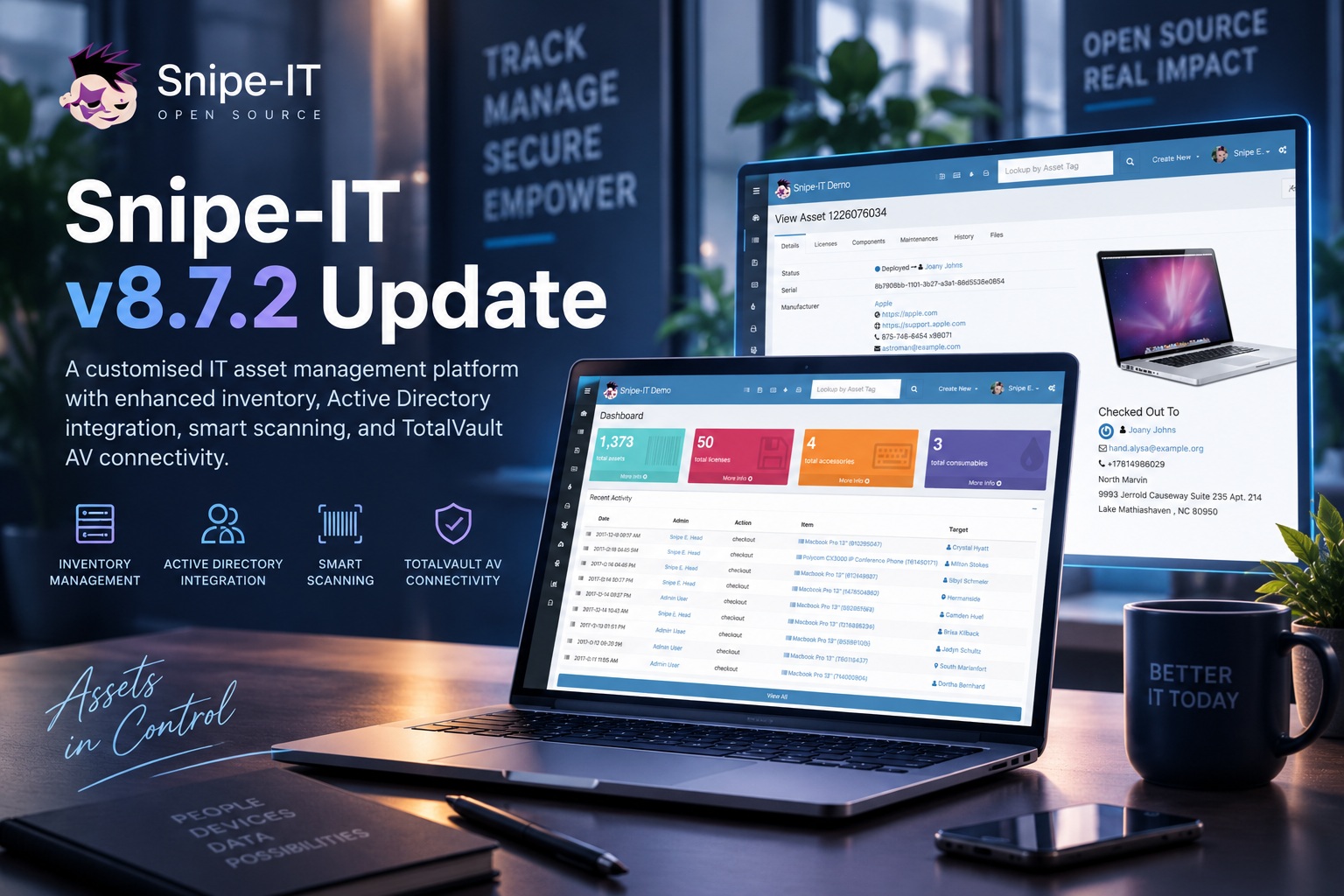
Managing IT assets sounds straightforward until an organisation grows. What begins as a list of laptops, desktops, monitors and software licences can quickly become a much larger operational challenge involving users, locations, device specifications, security status, warranties, inventory, software deployments and the constant movement of equipment between departments. To keep our platform current and continue improving what we can offer our customers, we have now updated our IT Asset Management System to Snipe-IT Open Source v8.7.2.
As of September 2026, Snipe-IT v8.7.2 is the latest stable release published by the Snipe-IT project. The upstream release includes a collection of fixes and improvements, including updates relating to MariaDB compatibility, SCIM and the asset importer, building on the much larger feature and performance improvements introduced throughout the v8.7 release series.
More Than a Standard Snipe-IT Installation
While our system is based on Snipe-IT, what we operate today is considerably different from a standard installation.
Over time, we have developed a customised version of Snipe-IT, modifying and extending different parts of the platform to better suit the operational requirements of our customers. Snipe-IT gives us an excellent open-source foundation for asset management, but real-world environments often require workflows and integrations that go beyond what a default deployment provides.
Rather than forcing organisations to adapt their processes around the software, our approach has been to customise the platform so that it works more naturally with the way their IT teams already operate.
A Customised Inventory Module
One of the areas we have significantly modified is the inventory module.
Traditional asset management normally focuses heavily on individually tagged devices such as notebooks, desktops, servers and monitors. However, IT departments often manage many other types of equipment and stock that do not always fit neatly into a conventional asset workflow.
Our customised inventory capabilities allow the system to better handle different categories of IT inventory while providing administrators with improved visibility over quantities, assignments, availability and equipment movements.
This gives IT teams a more complete picture of what they actually have rather than maintaining separate spreadsheets or additional inventory systems alongside their asset management platform.
Active Directory Integration
User management is another area where integration becomes extremely important, particularly in larger organisations.
Our customised deployment includes Active Directory integration, allowing the asset management environment to work much more closely with an organisation's existing directory infrastructure. Instead of maintaining a completely separate set of user information inside the asset system, employee and account information can be aligned with the organisation's central directory.
This becomes particularly useful when hundreds or thousands of users are involved. It reduces repetitive administration and makes it easier for IT teams to associate devices and equipment with the correct people within the organisation.
It also creates a much more practical relationship between identity management and asset management.
Our Custom Windows EXE Scanning Agent
One of the more substantial additions to our customised platform is our own Windows EXE scanning agent.
Snipe-IT itself is primarily a web-based asset management application. Our customised agent extends that model by allowing endpoint information to be collected directly from Windows computers and submitted back to the asset management environment.
Instead of IT administrators manually checking every computer for hardware information, our agent can help gather relevant device information automatically. Depending on the deployment and customer requirements, this can include information such as computer specifications, operating system details, device identity and other inventory information required by the organisation.
This greatly reduces the amount of manual work required when maintaining a large number of endpoints.
It also turns the system from something that simply records assets into a platform that can actively help IT teams discover and maintain information about those assets.
Direct Integration with TotalVault AV
Security information is becoming increasingly important in IT asset management as well.
Knowing that a laptop exists and knowing who it belongs to is useful, but modern IT teams also need visibility into whether that device is appropriately protected. For this reason, our customised platform also includes direct integration with TotalVault AV.
This allows information from the endpoint security environment to be incorporated into the asset management workflow, giving administrators additional context when reviewing devices.
Combining asset information and endpoint security information can help IT teams identify situations where a registered device may require attention rather than checking multiple completely separate systems.
It is part of our broader approach of turning asset management into a more connected component of IT operations rather than treating it simply as an electronic asset register.
Designed Around Real Customer Requirements
Perhaps the most important aspect of our customised version is that many of these modifications did not begin simply because we wanted to add more features.
They came from actual operational requirements.
Different organisations manage assets differently. Some companies require additional inventory classifications. Others need directory integration, automated endpoint discovery, additional reporting, security integration or specialised workflows that simply do not exist in an off-the-shelf deployment.
Some of the customised capabilities we have introduced include:
And these are only some of the changes. Our customised platform continues to evolve as we encounter new use cases and receive feedback from the organisations using it.
Keeping the Open-Source Foundation Current
Maintaining a heavily customised application creates another challenge: keeping those customisations working while still benefiting from improvements made by the original open-source project.
That is why upgrading to Snipe-IT v8.7.2 is important for us.
Rather than remaining permanently on an older release because of our modifications, we continue working to bring our customised implementation forward alongside the upstream project. This allows us to retain the functionality we have developed while benefiting from newer fixes, compatibility improvements and enhancements introduced by the Snipe-IT developers.
Snipe-IT v8.7.2 itself is a relatively focused point release, but it sits on top of the broader v8.7 series, which introduced numerous improvements across areas such as inventory replenishment, ordering, organisational hierarchy, reporting, performance and user experience.
From Asset Register to IT Operations Platform
Asset management today is no longer simply about answering the question, "Who has this laptop?"
IT departments increasingly need to know what devices exist, who is responsible for them, where they are located, what hardware they contain, whether they are still active, how they relate to users in the organisation and whether those devices are properly protected.
That is the direction in which we have been developing our platform.
By combining the strong asset-management foundation provided by Snipe-IT Open Source with our own customised modules, integrations and endpoint scanning capabilities, we are gradually expanding the system into something much broader than a conventional inventory database.
And because the underlying platform remains open source, we retain the flexibility to continue adapting it as customer requirements change.
Final Thoughts
The move to Snipe-IT Open Source v8.7.2 is another step in keeping our IT Asset Management System current while preserving the extensive customisations we have developed around it.
The real value of the platform for us is not simply the version number. It is the combination of a mature open-source foundation with the ability to customise the system around real operational needs—from specialised inventory management and Active Directory integration to automated endpoint scanning through our custom EXE agent and direct integration with TotalVault AV.
There are many more modifications already built into our version, and development does not stop here. As our customers' environments evolve and new requirements emerge, we will continue enhancing the platform so that asset management becomes easier, more automated and much more closely integrated with everyday IT operations.











Comments 0