

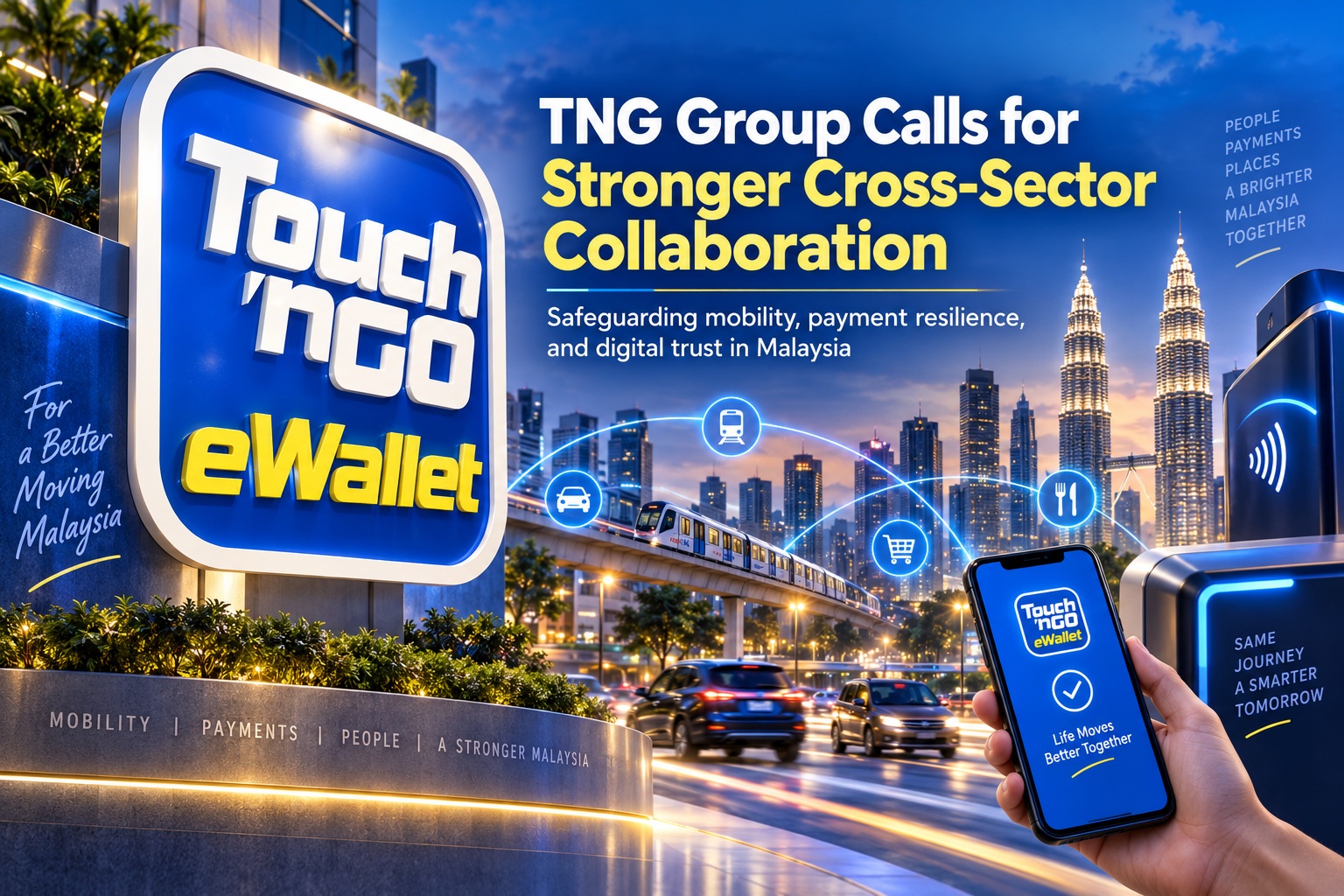
Touch 'n Go Group is calling for closer cooperation between Malaysia's mobility, financial services, technology and regulatory sectors as transport and payment infrastructure becomes increasingly interconnected. The group believes stronger coordination is essential to ensure that services Malaysians depend on every day — from highway tolls and public transport to digital payments and financial services — remain reliable even when disruptions occur.
Touch 'n Go Group Calls for Stronger Cross-Sector Collaboration to Protect Malaysia's Mobility and Payment Systems
Touch 'n Go Group is calling for closer cooperation between Malaysia's mobility, financial services, technology and regulatory sectors as transport and payment infrastructure becomes increasingly interconnected. The group believes stronger coordination is essential to ensure that services Malaysians depend on every day — from highway tolls and public transport to digital payments and financial services — remain reliable even when disruptions occur.
The call follows a seminar organised by Touch 'n Go Sdn Bhd together with the Persatuan Syarikat Konsesi Lebuhraya Malaysia (PSKLM) during the MyASEAN Roads & Traffic Tech Expo 2026. The session brought together industry and regulatory stakeholders to discuss cybersecurity, business continuity, incident response and the growing dependencies between digital payment and transport systems.
Mobility and Payments Are Becoming One Connected Ecosystem
Malaysia's transport and payment landscape has changed significantly over the years. Toll payments, parking, public transport and everyday transactions increasingly rely on digital platforms, connected infrastructure and shared technology providers. This convenience also means that a disruption in one system can potentially affect several other services.
Touch 'n Go Group believes organisations therefore need to understand these dependencies rather than managing risk in isolation. A reliable customer experience increasingly depends on banks, technology companies, highway operators, payment providers and regulators coordinating their response when something goes wrong.
This becomes especially important when the same infrastructure supports millions of transactions every day. An outage involving connectivity, payment processing or cybersecurity may no longer affect only one company; it can quickly influence how people travel, pay or access essential services.
Shared Risk Requires Shared Preparedness
Touch 'n Go Sdn Bhd CEO Praba Sangarajoo said the company's position across both mobility and payments gives it a practical perspective on how closely connected these services have become.
By bringing the relevant organisations together, he said, the industry can share operational experience, identify common risks and improve collective preparedness as technology continues reshaping how Malaysians move and transact.
That approach recognises that resilience is increasingly a shared responsibility. One organisation may operate the payment platform, another the physical transport infrastructure, while third parties provide telecommunications, cloud services or cybersecurity capabilities. If one link fails, the impact can spread beyond organisational boundaries.
The objective is therefore not simply to make each individual company stronger, but to make the overall ecosystem more resilient.
TNG eWallet Has Expanded Far Beyond Payments
TNG Digital CEO Alan Ni also highlighted how the role of TNG eWallet has evolved over time. The platform originally focused heavily on payments linked to areas such as tolls, parking and public transportation, but it has since expanded into a wider range of financial and lifestyle services.
According to Ni, the company wants TNG eWallet to remain an everyday digital companion that users can rely on. Trust therefore plays a central role in how the platform approaches technology, including how systems are secured, how customer information is protected and how the organisation prepares for disruptions.
That trust becomes increasingly important as users depend on the same digital platform for more aspects of everyday life. The more services connected to one ecosystem, the greater the potential impact if availability, security or data protection is compromised.
More Than 27 Million Verified Users Raise the Stakes
Through Touch 'n Go Sdn Bhd and TNG Digital, the group now supports services spanning toll payments, public transportation, parking, everyday digital transactions and access to financial and lifestyle products.
TNG eWallet alone has more than 27 million verified users, giving the organisation significant visibility into the way mobility, finance and technology increasingly overlap.
That scale also brings greater responsibility. Even a relatively short disruption can affect large numbers of customers, merchants and transport users. Resilience therefore needs to include more than simply restoring a system after an outage; organisations need plans for maintaining service, communicating clearly and coordinating with partners throughout an incident.
Cybersecurity Is Becoming Part of Transport Resilience
The seminar also included presentations from representatives of the National Cyber Security Agency (NACSA) and Bank Negara Malaysia (BNM), reflecting how closely cybersecurity is now tied to transport and payment reliability.
Discussions covered cybersecurity controls, incident response readiness, business continuity planning and risk management across digital supply chains. These issues are increasingly relevant as critical services rely on software platforms, APIs, cloud infrastructure, telecommunications networks and external technology vendors.
A cyber incident affecting one provider can therefore have consequences far beyond the original target. If that provider supports payment authorisation, transport systems or customer authentication, disruption can propagate quickly across several services.
For organisations operating critical platforms, cybersecurity is no longer just an IT concern. It has become part of operational resilience.
Digital Supply Chains Need Greater Visibility
Another important topic is the growing complexity of digital supply chains. Modern services often depend on multiple external providers, each contributing a specific part of the overall experience.
A digital payment may involve the customer's device, telecommunications connectivity, payment gateways, financial institutions, cloud systems and merchant infrastructure. Transport systems may add physical readers, roadside equipment and concession operators into that chain.
The service may appear seamless to the customer, but behind the scenes it depends on many organisations operating correctly at the same time.
This makes visibility into third-party dependencies increasingly important. Companies need to understand which external services are critical, what would happen if they became unavailable and how quickly alternative arrangements could be activated.
Incident Response Needs to Cross Organisational Boundaries
Traditional incident-response planning often focuses primarily on what happens inside one organisation. That model becomes less effective when multiple companies contribute to the same customer-facing service.
If a shared payment or mobility service experiences disruption, several organisations may need to investigate simultaneously. Without established communication channels and clearly defined responsibilities, time can be lost determining who owns which part of the incident.
Cross-sector coordination can help reduce that uncertainty. Organisations can agree in advance on escalation procedures, information-sharing mechanisms and responsibilities during major outages or cybersecurity events.
The faster participants can determine what has happened and which systems are affected, the faster they can begin restoring normal service.
Business Continuity Is About the Customer Experience
Business continuity planning is sometimes treated as a technical exercise involving backup systems and disaster-recovery infrastructure. While those are important, Touch 'n Go Group's message highlights a broader perspective: continuity should ultimately be measured by what customers experience.
Users generally do not care which backend provider failed. They simply know that they cannot enter a highway, complete a payment or access a service they expected to work.
That means resilience planning should consider the entire customer journey rather than individual systems. Organisations need to understand which dependencies must remain available for the service to function and what alternative options can be provided when normal operations are disrupted.
A resilient organisation is not necessarily one that never experiences failure. It is one that can contain the impact, recover quickly and communicate effectively when failure occurs.
Regulators Also Play an Important Role
The involvement of NACSA and Bank Negara Malaysia shows that regulators are part of this resilience ecosystem as well.
Financial services already operate under significant requirements around cybersecurity, operational risk and business continuity. As payment platforms become more deeply connected with mobility infrastructure, similar thinking increasingly applies across sectors.
Regulatory coordination can help establish clearer expectations around incident reporting, third-party risk, resilience testing and customer protection. It can also encourage organisations to share threat information and lessons learned rather than treating every incident as an isolated event.
This becomes particularly valuable when several industries depend on the same technology providers or infrastructure.
Collaboration Becomes More Important as Technology Advances
Malaysia's mobility and payment systems will continue becoming more digital. Contactless payments, connected vehicles, smart transport infrastructure, digital identity and increasingly integrated financial services will create new conveniences, but also new dependencies.
The challenge is making sure resilience develops at the same pace.
Every new integration creates another pathway through which disruption can spread. That does not mean organisations should avoid innovation, but it does mean security, continuity and cross-sector coordination need to be considered from the beginning rather than added after systems are already interconnected.
Final Thoughts
Touch 'n Go Group's call for stronger collaboration reflects a broader reality about modern digital infrastructure: critical services no longer operate independently.
Mobility, payments, telecommunications, finance and technology increasingly depend on one another, which means resilience cannot be built by one organisation acting alone. Cybersecurity controls, business continuity plans, incident-response processes and supply-chain risk management all need to account for these connections.
With more than 27 million verified TNG eWallet users and Touch 'n Go services embedded across tolls, parking, public transportation and everyday payments, the group has a clear view of how closely these systems have become linked.
The next step is making sure the organisations behind those services are just as connected when something goes wrong.
Because when millions of Malaysians rely on the same digital ecosystem every day, resilience is no longer simply an IT responsibility. It becomes a shared responsibility across the entire industry.











Comments 0