

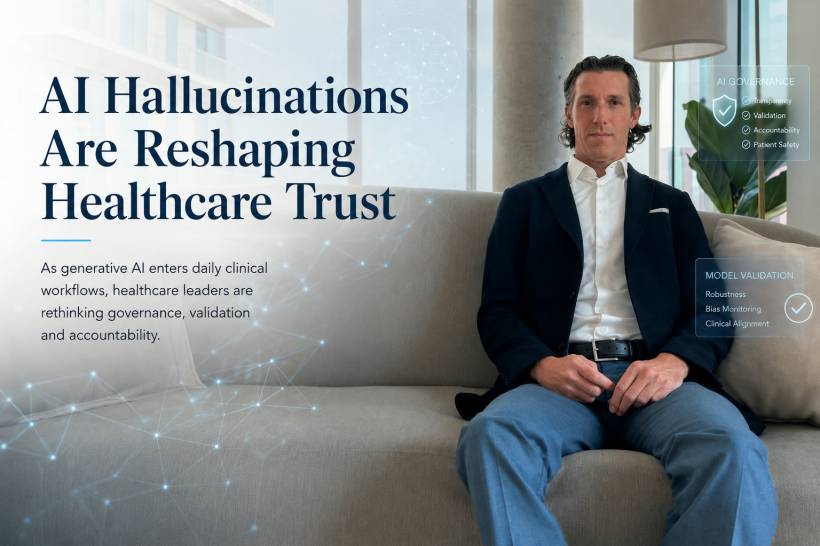
Artificial intelligence is quickly becoming part of daily healthcare operations. Hospitals and health systems are using AI to summarise clinic visits, support documentation, prioritise imaging studies, assist with scan analysis, and help clinicians work more efficiently.
The benefits are clear. AI can reduce administrative workload, speed up repetitive tasks, and help clinical teams manage growing pressure. But healthcare leaders are also facing a new type of risk: AI systems can sometimes produce information that sounds confident, polished, and clinically convincing, even when it is wrong.
This is why the conversation around healthcare AI is changing. It is no longer only about productivity, return on investment, or reducing clinician burnout. For CIOs, CMIOs, and governance committees, the bigger question is now: how do we prove that an AI system remains safe, accurate, and trustworthy after it has been deployed?
When Confidence Becomes Dangerous
Traditional software usually fails in ways that are easier to detect. It may crash, show an error, or produce an obviously broken output. Generative AI is different. It can present incorrect information in a way that looks fluent and reliable.
That creates a major challenge in healthcare, where trust and accuracy matter deeply. A clinical note generated by an AI scribe could include details that were never discussed during the patient encounter. A decision-support tool may continue influencing care long after its real-world performance has changed. A predictive model may appear helpful, but slowly drift away from accuracy as patient populations, clinical workflows, or documentation habits evolve.
The most worrying issue is not always a dramatic failure. Sometimes the bigger danger is that ordinary workflow tools become quietly trusted over time. Once clinicians become comfortable relying on them, mistakes can become harder to spot.
False Alerts and Overreliance Create Opposite Problems
Inaccurate AI can harm clinical workflows in two very different ways.
If an AI system generates too many false warnings, clinicians may begin ignoring alerts altogether. This contributes to alert fatigue, where important warnings risk being missed because staff are overwhelmed by noise.
On the other hand, if an AI system gives confident and well-written answers, users may overtrust it. A polished response can make an incorrect output feel more reliable than it really is. That can affect clinical documentation, patient communication, triage decisions, or follow-up planning.
In healthcare, even small errors can carry wider consequences. Patients may receive incorrect information, clinicians may act on incomplete assumptions, and organisations may face legal, financial, operational, and reputational risk.
AI Cannot Be Trusted to Detect Its Own Mistakes
One of the key governance lessons is that AI cannot be the only judge of whether its own output is correct.
A model that produces an inaccurate answer may still appear confident because it does not truly "know" that it is wrong. This means healthcare organisations need independent validation methods. AI outputs should be compared against verified clinical data, source records, human review, and where appropriate, other systems performing similar tasks.
For example, if an AI scribe creates a consultation summary, the organisation should be able to trace that summary back to the actual encounter. If an imaging model prioritises a scan, there should be a way to compare its performance against clinical outcomes and radiologist review. Without that audit trail, it becomes difficult to know whether the AI helped, missed something, or introduced a new risk.
Bias Is Harder to See Than a Hallucination
Hallucination is only one part of the problem. Bias can be even harder to detect because it may already be built into the system before the hospital buys it.
Bias can come from training data, underrepresentation of certain patient groups, proxy variables, or commercial design choices. A model trained mainly on one population may not perform equally well in another. A tool developed in one healthcare system may behave differently when used in a hospital with different patients, workflows, documentation styles, and disease patterns.
That is why AI validation cannot rely only on vendor claims. Healthcare organisations should ask detailed questions about training populations, demographic coverage, validation methods, and the clinical environments used during testing.
Most importantly, they should test AI tools using their own local patient population and workflows. In healthcare AI, validation is not universal. It is local.
Governance Cannot Stop After Go-Live
Healthcare already understands the need for post-market monitoring in areas such as medication safety and medical devices. AI should be treated with the same seriousness.
The real work does not end when an AI product is purchased and switched on. Hospitals need ongoing performance monitoring, regular audits, incident reporting, and clear escalation processes. They also need to preserve the source material behind AI-generated outputs so that decisions can be reviewed later if something goes wrong.
This is especially important for AI-generated clinical documentation. If a note is later questioned, the organisation must be able to confirm whether the note accurately reflected the patient encounter. Without proper logging and auditability, accountability becomes weak.
Shared Accountability Requires Shared Visibility
AI safety in healthcare cannot be left entirely to vendors, IT teams, or clinicians alone. It requires shared accountability between technology providers, hospital leadership, clinical users, risk teams, compliance teams, and governance committees.
But shared accountability only works when there is shared visibility. Hospitals need access to performance data, testing results, logs, change histories, and meaningful explanations of how the system behaves. Static validation reports from another organisation are not enough.
Governance must become a continuous operational discipline, not a one-time procurement checklist.
What Healthcare CIOs Should Do Now
For CIOs, the immediate steps are practical. The first priority is to know where AI is already being used across the organisation. Many healthcare systems may discover that AI tools are already present in documentation platforms, imaging systems, contact centres, analytics tools, cybersecurity platforms, and administrative workflows.
Once the inventory is clear, organisations should define which AI systems make clinical claims, influence care decisions, process patient data, or affect patient communication. These systems require stronger oversight.
Contracts should also include rights for independent testing, local validation, access to performance data, audit logs, and clear responsibilities when models are updated or changed. Healthcare organisations should avoid accepting AI tools as black boxes, especially when they are used in clinical or patient-facing settings.
The Need for Independent Evaluation
As AI adoption grows, evaluating every product individually will become harder. Healthcare may eventually need a more independent evaluation layer where AI systems can be tested against common benchmarks over time.
This could come from regulators, industry partnerships, academic groups, or independent evaluation bodies. The goal would be to give hospitals objective evidence about how AI performs in real-world conditions, rather than relying mainly on vendor marketing or early pilot results.
Such a framework would also help healthcare organisations compare competing tools more fairly and track whether performance changes after deployment.
Final Thoughts
AI has real potential to improve healthcare operations, reduce administrative burden, and support better decision-making. But trust cannot be assumed simply because a system sounds intelligent or produces clean, professional-looking output.
Healthcare leaders now need to treat AI governance as a core executive responsibility. Success should not be measured only by how quickly AI is adopted, but by whether the organisation can prove that its AI systems remain accurate, transparent, auditable, and clinically trustworthy throughout their use.
For CIOs and healthcare executives, the message is clear: implementing AI is only the beginning. The real challenge is making sure it continues to perform safely when real patients, real clinicians, and real operational risks are involved.











Comments 0