

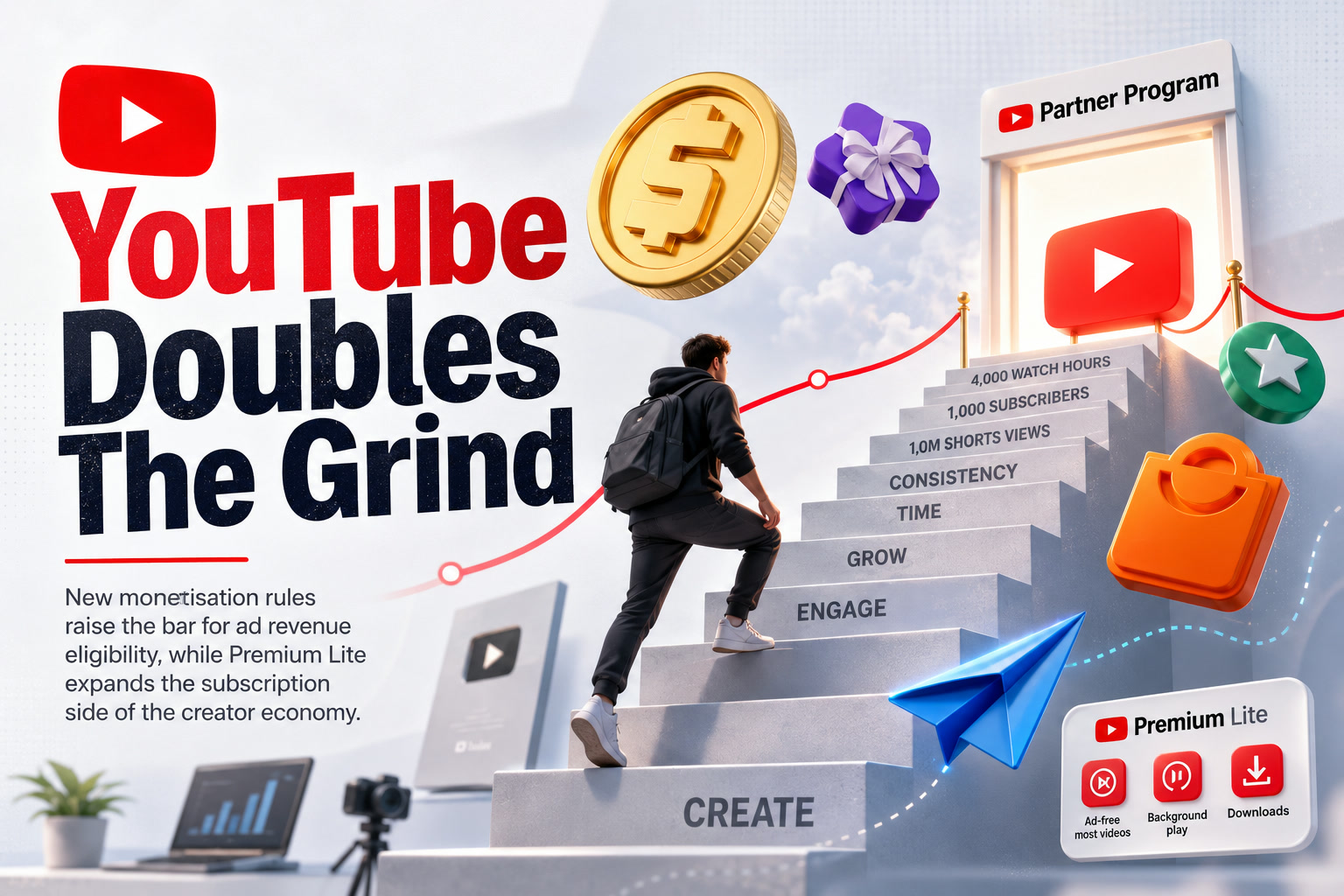
Getting monetised on YouTube has never exactly been effortless, but the platform is preparing to raise the bar considerably for creators hoping to earn advertising revenue. From 1 February 2027, new creators looking to qualify for YouTube's full monetisation programme will reportedly need to generate significantly more watch time or Shorts views than they do today. In some cases, the requirements are effectively being doubled.
YouTube says the changes are intended to make creator earnings more meaningful and direct revenue toward channels that consistently generate strong engagement. For smaller and newer creators, however, the practical result is straightforward: the road toward monetisation is about to become much longer.
YouTube Is Raising the Partner Programme Requirements
At the moment, one of the best-known routes into the YouTube Partner Programme requires creators to reach 1,000 subscribers and 4,000 valid public watch hours during the previous 12 months.
There is also a Shorts-based path that allows creators to qualify by reaching a sufficiently large number of eligible Shorts views within a 90-day period.
Under the new requirements announced for February 2027, creators seeking access to advertising and subscription revenue will need:
1,000 subscribers, together with either:
In other words, YouTube isn't merely tweaking the numbers slightly. For creators relying on long-form content, the watch-time target effectively doubles.
The same general trend applies to Shorts.
That means a new channel that might currently be close to monetisation could find itself considerably further away once the new requirements take effect.
8,000 Watch Hours Is a Much Bigger Challenge Than It Sounds
Four thousand watch hours is already a significant milestone for a small channel.
To put things into perspective, 4,000 hours represents 240,000 minutes of watch time.
Doubling that requirement to 8,000 hours means creators would need to accumulate 480,000 minutes of qualified viewing time over a year.
Of course, how difficult that becomes depends heavily on the type of content being produced.
A channel publishing 20-minute tutorials may accumulate watch hours considerably faster than one producing short two-minute videos. Likewise, channels covering highly searchable evergreen topics can continue generating views for months or years after publication.
For creators relying on occasional uploads or niche subjects, however, reaching 8,000 hours could take substantially longer.
It also puts even greater importance on audience retention rather than simply chasing clicks.
A video receiving 100,000 views doesn't necessarily generate huge amounts of watch time if most viewers leave after a few seconds.
Shorts Creators Face an Even More Aggressive Target
Creators concentrating on YouTube Shorts could face an equally difficult path.
YouTube is reportedly raising the Shorts-based qualification threshold to 20 million qualified views within 90 days for creators using Shorts as their route into full monetisation.
Twenty million views in roughly three months is an enormous amount of traffic for an emerging creator.
Short-form content can certainly go viral very quickly, but Shorts traffic is also notoriously unpredictable. One upload might attract millions of views while the next struggles to reach a fraction of that audience.
This means creators relying primarily on Shorts may need to maintain a much more consistent stream of highly viewed content rather than depending on a single viral hit.
Shorts Ad Revenue Will Also Require Continued Performance
The changes don't stop once a creator enters the programme.
YouTube is also introducing a separate performance requirement for Shorts advertising and subscription revenue.
From February 2027, creators will reportedly need to maintain 10 million qualified Shorts views during a rolling 90-day period to continue receiving revenue associated with Shorts.
That distinction is important.
A creator who falls below the required Shorts threshold may still be able to earn money from eligible long-form videos.
However, their Shorts content would no longer generate the same advertising and subscription revenue until the required level of qualified views is reached again.
Effectively, YouTube appears to be moving Shorts monetisation toward a model where creators need to demonstrate continued high engagement, rather than simply crossing a qualification line once and keeping access indefinitely.
Established Shorts Creators May Not Notice Much Difference
YouTube has suggested that creators already generating significant revenue from Shorts are unlikely to be heavily affected.
That makes sense.
Channels consistently attracting tens or hundreds of millions of Shorts views every few months will probably clear the new thresholds without much difficulty.
The bigger impact will be felt further down the creator ecosystem.
Smaller channels that have recently started building momentum may suddenly find the required numbers far beyond what they can realistically produce in the short term.
This creates a much wider gap between simply becoming a successful YouTube channel and becoming a channel capable of generating meaningful revenue directly from YouTube.
Why Is YouTube Making Monetisation Harder?
According to YouTube executives, the reasoning comes down to directing revenue toward creators generating substantial viewing activity and engagement.
YouTube Vice President of Creator Products Amjad Hanif has explained that the company wants creator earnings to become more meaningful while rewarding channels that are genuinely driving views and audience participation.
From YouTube's perspective, there is some logic behind the move.
Advertising revenue ultimately depends on viewer activity. If millions of channels qualify while generating relatively little traffic individually, the revenue available to each creator can become extremely small.
By increasing the qualification thresholds, YouTube can concentrate monetisation among channels generating larger amounts of sustained viewing.
But there is obviously another side to the equation.
Higher thresholds could discourage newer creators who spend months building toward monetisation, especially when the finishing line suddenly becomes twice as far away.
The Creator Journey Could Change Quite Significantly
For years, reaching 1,000 subscribers and 4,000 watch hours has become something of a symbolic milestone among aspiring YouTubers.
It represents the point where a hobby channel begins transitioning toward something capable of generating revenue.
Moving that watch-time target to 8,000 hours changes the psychology surrounding that milestone.
Creators may increasingly need to approach YouTube with a longer-term publishing strategy rather than expecting monetisation after a handful of successful videos.
Consistency, searchable content, strong thumbnails, audience retention and repeat viewers could become even more important.
For Shorts creators, the pressure may be greater still because reaching tens of millions of views within a relatively short window heavily favours channels capable of producing content frequently.
Premium Lite Is Expanding at the Same Time
Interestingly, YouTube's monetisation changes are arriving alongside another development involving Premium Lite.
YouTube says it plans to expand Premium Lite to markets where the full YouTube Premium subscription is available.
Premium Lite is designed as a cheaper alternative for viewers primarily interested in reducing advertisements while watching YouTube videos.
Depending on the market and implementation, the service provides ad-free viewing across most regular video content while offering features such as background playback and downloads.
However, it doesn't provide the same complete ad-free YouTube Music experience offered through the standard YouTube Premium subscription.
That makes Premium Lite an interesting middle ground for viewers who primarily use YouTube for video rather than music.
Premium Lite Could Still Mean More Money for Creators
There is another important reason YouTube is discussing Premium Lite alongside creator monetisation.
Creators can earn revenue when Premium subscribers watch their content, even though those viewers aren't seeing traditional advertisements.
Subscription revenue is instead placed into dedicated revenue pools before being distributed among eligible creators based largely on viewing activity.
According to YouTube's outlined model, 30% of net subscription revenue from standard Premium and 60% from Premium Lite contributes toward their respective creator revenue pools after operating and promotional costs are accounted for.
The resulting revenue is then distributed based on factors including member watch time and views.
YouTube says the creator revenue-sharing structure remains 55% for long-form content and 45% for Shorts.
This means the expansion of Premium Lite could potentially create another meaningful source of income for creators, particularly if the cheaper subscription encourages significantly more viewers to sign up.
Premium Viewers Can Be Particularly Valuable
One interesting point highlighted by YouTube is that a Premium subscriber can potentially be worth more to creators than a conventional ad-supported viewer.
Instead of revenue depending entirely on whether an advertisement was served, clicked or viewed, Premium revenue is tied to subscription payments and how members spend their viewing time.
If Premium Lite expands the number of paying YouTube users, creators with highly engaged audiences could benefit.
That could partially explain why YouTube is tightening creator qualification requirements while simultaneously broadening its subscription ecosystem.
The platform may be trying to ensure that increasing amounts of subscription and advertising revenue are distributed among creators generating substantial engagement.
It Could Make YouTube Feel More Like a Professional Platform
There is a broader trend emerging here.
YouTube started as a platform where practically anyone could upload a random video and potentially build an audience.
That remains true today.
But the business surrounding YouTube is becoming increasingly professional.
Large channels now operate with editors, researchers, designers, producers and sometimes entire production teams. Brands spend significant amounts of advertising money on the platform, while creators themselves can operate businesses generating substantial annual revenue.
Increasing monetisation thresholds could push YouTube even further in that direction.
Uploading videos remains accessible to everyone, but earning directly from the platform increasingly requires proving that you can maintain a meaningful audience.
Smaller Creators Will Need to Play the Long Game
For aspiring creators, the new requirements don't necessarily mean starting a YouTube channel is no longer worthwhile.
They simply change expectations.
Instead of treating monetisation as the immediate goal, creators may be better served focusing first on building an audience that actually returns to watch future videos.
A channel with a loyal audience can eventually generate income through multiple avenues anyway, including sponsorships, affiliate links, memberships and other opportunities beyond traditional YouTube advertising.
Ironically, by the time a channel consistently produces enough watch time to meet the new requirements, advertising revenue may no longer be its only source of income.
Final Thoughts
YouTube's upcoming monetisation changes could make 2027 a considerably tougher year for new creators trying to enter the Partner Programme.
Doubling the long-form requirement from 4,000 to 8,000 watch hours and pushing Shorts qualification toward tens of millions of views raises the barrier substantially.
Established channels generating large audiences probably won't notice much difference.
For newcomers, though, YouTube monetisation may become less of an early milestone and more of something achieved only after building a genuinely sustainable audience.
At the same time, Premium Lite could introduce another potentially valuable revenue stream by bringing more paying subscribers into YouTube's ecosystem.
The overall message from YouTube appears fairly clear: the platform still wants creators to earn money, but increasingly, it wants that money going to creators who can consistently keep viewers watching.











Comments 0