

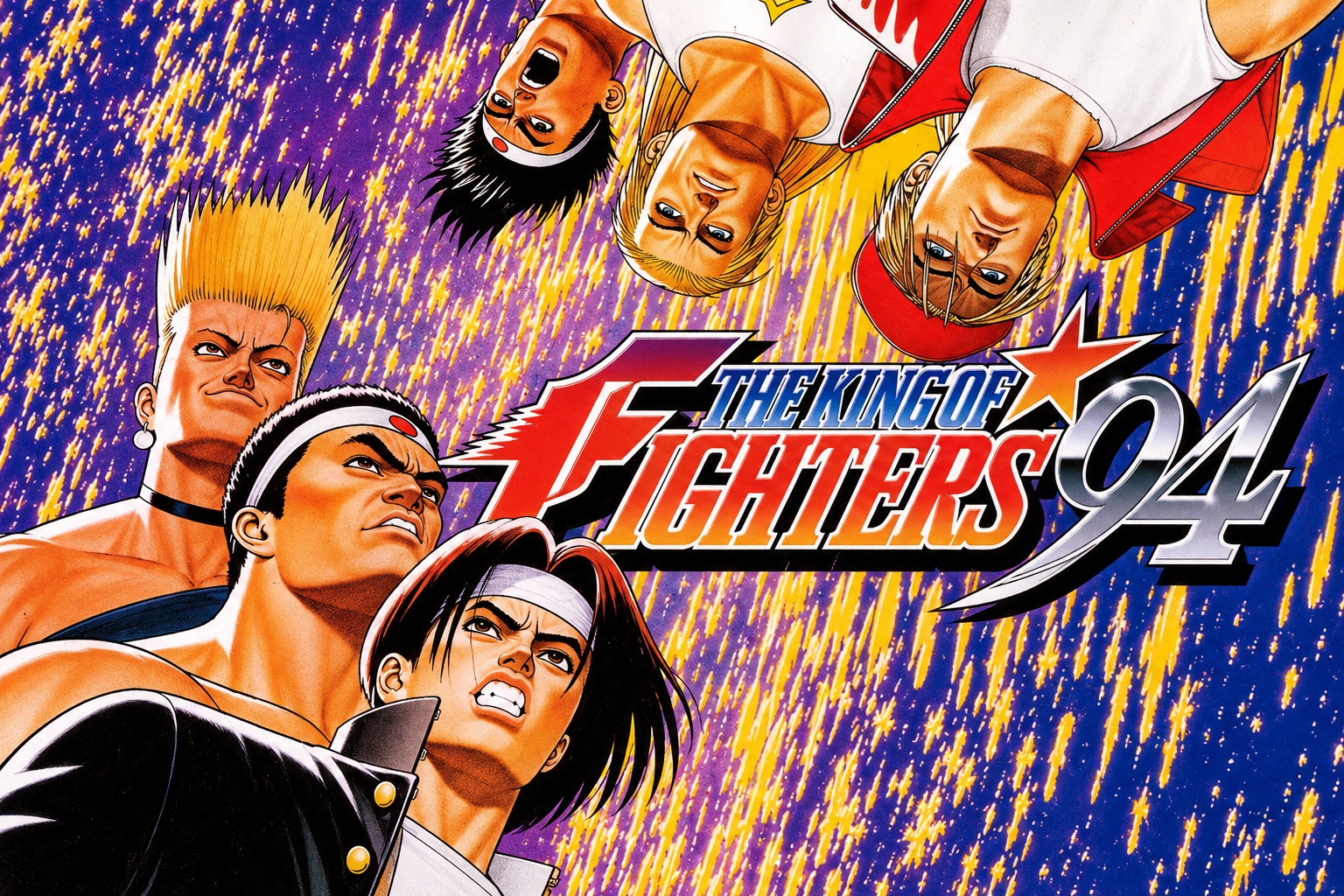
The King of Fighters '94 is the 1994 Neo Geo fighting game that brought several of SNK's biggest characters together for the first time and created a franchise that would eventually become one of the company's defining series. Fatal Fury, Art of Fighting, Ikari Warriors, and Psycho Soldier fighters share the tournament with an entirely new Japan Team led by Kyo Kusanagi, introducing the idea of three-person squads rather than relying entirely on traditional one-on-one competition. Players choose one of eight fixed national teams and fight through an international tournament organized by the mysterious "R." What begins as a competition between powerful martial artists eventually leads to the heavily armed crime lord and weapons dealer Rugal Bernstein.
The three-on-three format immediately distinguishes KOF '94 from most contemporary fighting games. Teams enter each match with three fighters arranged in a chosen order, and the winner of each round remains active against the next opponent until one side has lost its entire roster. This means a particularly strong performance can allow one character to defeat several members of the opposing team, while a poor opening round can place tremendous pressure on the remaining fighters. Combined with SNK's special-move commands, Power Gauge, Desperation Moves, evasive techniques, and character-specific fighting styles, the format provides a surprisingly strategic foundation beneath the straightforward arcade action.
Now playable online through Lemon Web Games, The King of Fighters '94 brings its classic Neo Geo combat, eight international teams, three-on-three elimination battles, Power Gauge mechanics, Desperation Moves, colourful stages, and legendary confrontation with Rugal Bernstein directly into the web browser. Players can choose teams featuring Terry Bogard, Ryo Sakazaki, Athena Asamiya, Kim Kaphwan, Heidern, King, and many other established SNK characters while also experiencing the debut of Kyo Kusanagi. Because teams are fixed rather than freely assembled, learning how the three members complement one another becomes an important part of progression. For anyone interested in the origins of The King of Fighters, this first tournament remains an essential place to begin.
Kyo Kusanagi Makes His Debut
Kyo Kusanagi was created specifically for The King of Fighters '94 and immediately became the central character of the new series. He leads the Japan Team alongside Benimaru Nikaido and Goro Daimon, forming one of the most recognizable teams in SNK history.
Kyo combines traditional martial arts with the Kusanagi clan's flame-based techniques. His style feels aggressive without being completely dependent on ranged attacks, allowing players to pressure opponents directly while using fire techniques to control space.
His introduction was especially important because KOF needed an identity beyond simply combining characters from existing SNK franchises. Kyo provided exactly that and would remain one of the series' central heroes for years.
Benimaru and Daimon Complete the Japan Team
Benimaru Nikaido provides speed and electricity-based attacks, giving the Japan Team a dramatically different style from Kyo. His mobility and fast strikes make him useful for players who prefer constant pressure.
Goro Daimon takes the opposite approach. His judo-inspired fighting relies heavily on throws, grappling, and physical strength rather than speed.
Together, the three characters demonstrate the philosophy behind KOF's team design. One team can contain several completely different fighting styles, forcing players to become comfortable with more than one approach.
The Fatal Fury Team Represents Italy
Terry Bogard, Andy Bogard, and Joe Higashi return from Fatal Fury as the Italy Team. Their inclusion was one of the strongest attractions for existing SNK fans because all three were already established arcade characters.
Terry provides balanced offence through techniques such as Power Wave and Burn Knuckle, while Andy offers faster Shiranui-based martial arts. Joe relies on aggressive Muay Thai attacks and his familiar Hurricane Upper.
Using the Fatal Fury trio inside a different fighting system was a major part of KOF '94's appeal. It demonstrated that SNK's separate franchises could share the same tournament without losing their individual personalities.
The Art of Fighting Team Represents Mexico
Ryo Sakazaki, Robert Garcia, and Takuma Sakazaki form the Mexico Team and bring Kyokugen Karate into the tournament.
Ryo emphasizes powerful direct attacks, while Robert offers a somewhat more agile variation of the same martial arts foundation. Takuma provides experienced, heavy-hitting techniques as the veteran of the group.
Their appearance alongside the Fatal Fury cast was significant because the two franchises had previously existed separately despite sharing certain connections. KOF finally placed those worlds inside the same competitive structure.
The Brazil Team Brings Ikari Warriors Into a Fighting Game
Heidern, Ralf Jones, and Clark Still represent Brazil and transform characters associated with the Ikari Warriors series into dedicated one-on-one fighters.
Heidern uses an unusual military fighting style and techniques capable of draining an opponent's energy. Ralf relies more heavily on powerful strikes, while Clark specializes in throws and grappling.
Their inclusion shows just how ambitious KOF '94 was as a crossover. SNK was not limiting the tournament to characters who originated in traditional fighting games.
The China Team Connects KOF With Psycho Soldier
Athena Asamiya, Sie Kensou, and Chin Gentsai represent China, bringing the Psycho Soldier lineage into the tournament.
Athena uses psychic powers and martial arts, giving her projectile and mobility options that feel very different from many physical fighters. Kensou combines martial arts with psychic techniques, while Chin relies on an unusual drunken-fist style.
Athena would become one of KOF's most enduring characters. Her appearance in the first game helped establish the franchise as a gathering place for characters from across SNK history.
The England Team Combines Several SNK Heroines
King, Mai Shiranui, and Yuri Sakazaki form the England Team, bringing together fighters from Fatal Fury and Art of Fighting.
King relies heavily on powerful kicks and ranged techniques, while Mai uses speed, aerial movement, and fan-based attacks. Yuri combines Kyokugen Karate with a lighter and more playful fighting style.
This team was particularly memorable because it mixed characters who had previously belonged to different storylines. KOF's crossover concept made combinations like this possible for the first time.
The Korea Team Has a Very Unusual Lineup
Kim Kaphwan leads the Korea Team alongside Chang Koehan and Choi Bounge. Kim is an honourable Taekwondo practitioner determined to reform his two criminal teammates.
Chang relies on enormous strength and his heavy iron ball, while Choi is extremely fast and attacks with sharp claws. Their completely different sizes and fighting styles make the team immediately recognizable.
The combination also provides some of the game's strongest character comedy. Kim believes martial arts discipline can rehabilitate his teammates, whether Chang and Choi appreciate the effort or not.
The USA Sports Team Brings an American Theme
Heavy D!, Lucky Glauber, and Brian Battler represent the United States through a team inspired by American sports.
Heavy D! fights as a boxer, Lucky incorporates basketball-inspired movements, and Brian uses his enormous size and American football background to deliver powerful physical attacks.
The team has one of the most distinctive themes in the game. Rather than sharing one martial art, all three characters translate different sports into fighting techniques.
Fixed Teams Create a Different Strategic Challenge
Unlike later KOF games, players cannot freely create a custom three-person roster in KOF '94. Choosing a team means accepting all three fighters together.
This encourages players to learn characters they might otherwise ignore. Someone selecting the Fatal Fury Team needs to become at least reasonably comfortable with Terry, Andy, and Joe rather than relying on one favourite character exclusively.
Team order still matters significantly. Placing the strongest fighter first may create an early advantage, while saving that character for last provides a reliable final line of defence.
Three-on-Three Elimination Changes Match Flow
Each round continues until one fighter is defeated. The winner remains active and faces the opposing team's next member.
This structure can produce dramatic momentum. One character may eliminate two opponents before finally falling, leaving teammates with a major advantage.
Health recovery between rounds prevents every victory from becoming an automatic loss afterward, but surviving fighters still carry some consequences from the previous battle. Winning efficiently therefore matters.
The Power Gauge Adds Another Resource
Players can charge the Power Gauge, creating opportunities for stronger offence and access to powerful techniques.
Charging requires time and leaves the fighter exposed, so it is safest when enough distance has been created. Opponents can punish careless attempts immediately.
This introduces another layer beyond ordinary attacks and special moves. Players need to decide whether creating additional power is worth temporarily sacrificing pressure.
Desperation Moves Create Dramatic Comebacks
Characters can perform powerful Desperation Moves when the correct conditions are met. These techniques deal substantial damage and often feature more dramatic animation than ordinary specials.
Their availability makes late-round situations especially dangerous. A fighter who appears close to defeat may still have access to an attack capable of reversing the entire match.
Experienced players therefore remain cautious even when holding a large health advantage. One mistake can suddenly make the round competitive again.
Special Moves Carry SNK's Arcade DNA
Directional commands combined with attack buttons are central to the game. Fireballs, rushing attacks, uppercuts, throws, and other techniques all require accurate execution.
Each team contains fighters with very different command sets, making the three-character structure more demanding than mastering only one character.
The system rewards practice. Once special moves become reliable, players can concentrate more heavily on spacing and reading the opponent.
Blocking and Spacing Matter More Than Constant Aggression
KOF '94 can punish players who attack continuously without considering distance. Strong CPU opponents often respond quickly to predictable movement.
Blocking creates opportunities to survive pressure and counter once an attack finishes. Maintaining the correct range also determines whether certain special moves are safe or dangerous.
The game becomes far more manageable once defence is treated as seriously as offence. Winning does not require attacking every second.
Rugal Bernstein Establishes the Tradition of Brutal KOF Bosses
The tournament eventually leads to Rugal Bernstein, the mysterious organizer behind the invitation signed only as "R."
Rugal is a powerful weapons dealer obsessed with defeating strong fighters and preserving defeated opponents as trophies. His enormous ship and intimidating presence give the final confrontation a suitably extravagant atmosphere.
He is also notoriously difficult, beginning a tradition of extremely challenging King of Fighters bosses. Reaching Rugal is an achievement; defeating him is another challenge entirely.
International Stages Give the Tournament Global Scale
Each team is associated with a different country, allowing KOF '94 to move between colourful locations around the world.
Backgrounds feature crowds, landmarks, urban environments, and animated details that take advantage of the Neo Geo hardware. The changes in scenery make the tournament feel genuinely international.
These environments also give each team additional personality. Returning to a particular stage immediately creates an association with the fighters who represent that region.
Large Neo Geo Sprites Give Every Fighter Presence
Characters are large, colourful, and well animated, giving attacks strong visual impact.
The roster combines several existing SNK art styles into one coherent presentation. Terry, Ryo, Athena, and Kyo all look as though they belong in the same game despite coming from different franchises.
This visual consistency was crucial to making the crossover idea believable. KOF did not feel like a random collection of imported sprites; it felt like a new unified series.
The Soundtrack Helps Define Every Team
Music changes across the tournament and gives each group additional identity.
Energetic themes support the fast fighting while reflecting the personalities and cultural themes associated with different teams. SNK's strong arcade audio design is already evident throughout the game.
Sound effects reinforce special moves and heavy hits, ensuring that successful attacks feel substantial even during busy matches.
KOF '94 Created a Franchise Far Bigger Than One Crossover
What began as an ambitious SNK crossover quickly became its own major series. Kyo Kusanagi, Rugal, the three-person team format, and the annual tournament concept gave KOF enough original identity to continue independently.
Later games would introduce freely selectable teams, deeper combo systems, new story sagas, and enormous character rosters.
Yet the foundation is already visible in 1994. The basic idea of assembling three fighters and surviving an entire opposing team remains central to the series.
Playing The King of Fighters '94 Online Today
Through Lemon Web Games, The King of Fighters '94 can now be played directly in your web browser with no downloads or setup required. Features of the web-based version include:
New players should choose a team containing at least one fighter they already understand, then gradually learn the other two. The fixed-team system means every member matters, so relying entirely on one character makes later matches considerably harder.
It is also useful to experiment with team order. A dependable character can lead the match and create an advantage, while placing your strongest fighter last can provide insurance when the first two members are defeated.
Who Should Play The King of Fighters '94
The King of Fighters '94 is particularly worthwhile for players interested in fighting-game history. It represents the moment several SNK franchises were brought together while simultaneously introducing characters who would eventually become more famous than many of the veterans around them.
It also remains enjoyable for players who appreciate structured team battles. The fixed rosters may be restrictive compared with later KOF games, but they encourage learning complete teams and give each country a strong identity.
Play The King of Fighters '94 Online Now
The King of Fighters '94 brings SNK's greatest warriors together for the tournament that started an entire fighting-game dynasty. Choose one of eight teams, decide the fighting order, master special moves, build the Power Gauge, unleash Desperation Moves, and survive every opposing fighter before confronting Rugal Bernstein.
Through Lemon Web Games, players can experience KOF '94 directly in the browser and return to the beginning of one of arcade gaming's longest-running fighting franchises. Fatal Fury, Art of Fighting, Ikari Warriors, Psycho Soldier, and a new generation led by Kyo Kusanagi all meet here for the first time.
Final Thoughts
The King of Fighters '94 remains historically important because it achieved something far greater than simply combining popular characters. SNK created a team-based fighting structure strong enough to support an entirely new franchise. Kyo Kusanagi provided a new hero, Rugal Bernstein provided an unforgettable villain, and the three-on-three format gave every match a different strategic rhythm from ordinary one-on-one fighters.
Its fixed teams and relatively early combat systems are simpler than what the series would eventually become, but that simplicity makes the foundation easy to appreciate. Fatal Fury veterans fight beside Art of Fighting legends, characters from non-fighting games are reinvented for the arena, and entirely new fighters immediately feel as though they belong.
Through Lemon Web Games, The King of Fighters '94 can now be enjoyed directly in the browser as the starting point of an SNK institution. The tournament may have begun as a crossover experiment, but its characters, team battles, international stages, Power Gauge, and infamous final boss created something far larger. For anyone wondering where the King of Fighters legacy truly began, 1994 is where the invitation first arrived.











Comments 0