

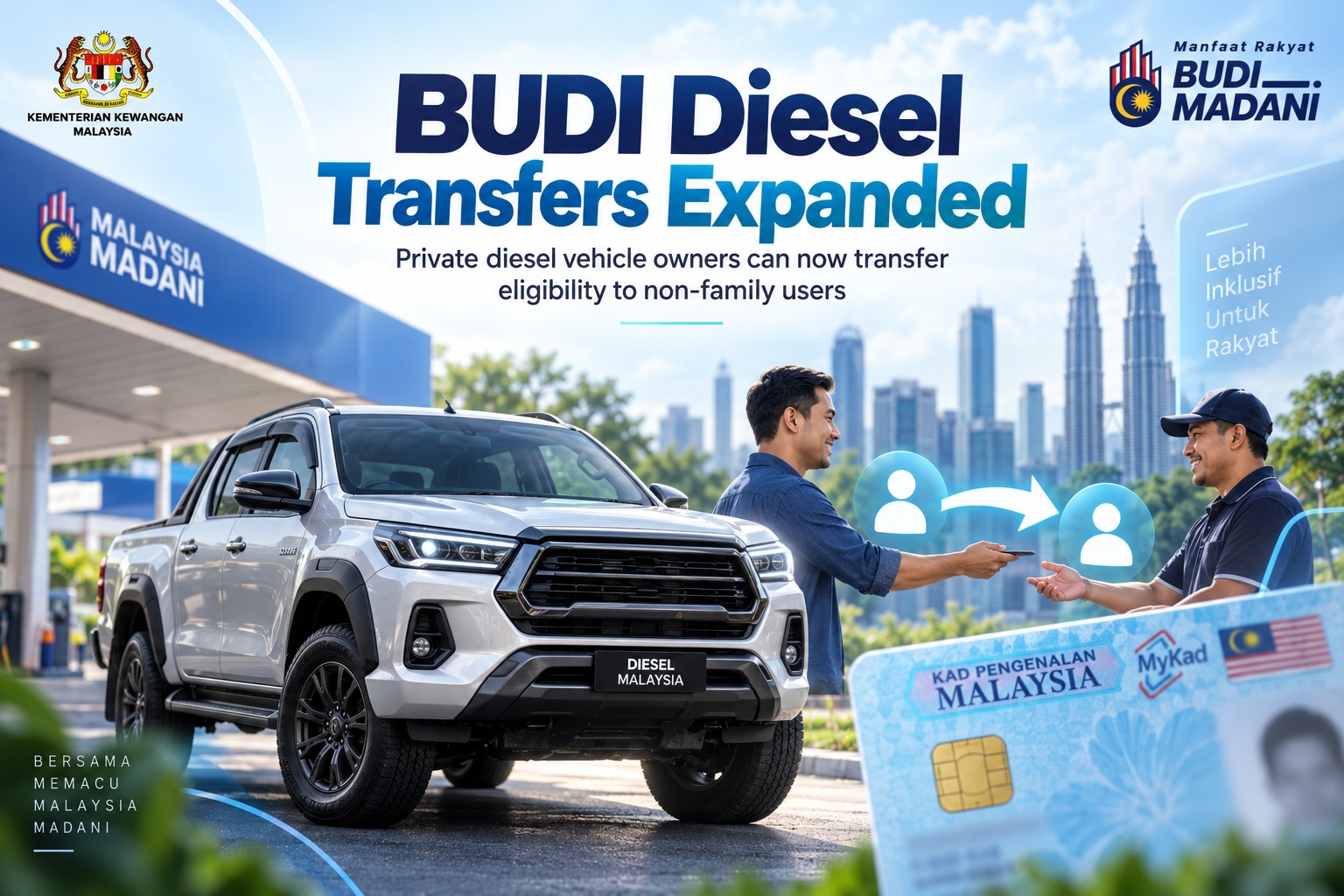
Malaysia's BUDI Diesel programme has become more flexible, with the government expanding the eligibility-transfer mechanism beyond immediate family members. Registered owners of private diesel vehicles can now transfer their monthly subsidised diesel allocation to another eligible Malaysian citizen who genuinely uses the vehicle. The change also applies to owners with several private diesel vehicles, allowing them to transfer eligibility for multiple vehicles instead of having the allocation tied exclusively to the registered owner.
The expanded arrangement is effective immediately, which means eligible vehicle owners can already begin submitting transfer applications. The idea is particularly useful in situations where the person named on the vehicle registration is not actually the person driving the vehicle every day. Instead of forcing the registered owner to personally use the subsidy, the allocation can now follow the legitimate vehicle user, provided the programme's requirements are met.
Transfers Are No Longer Limited to Immediate Family
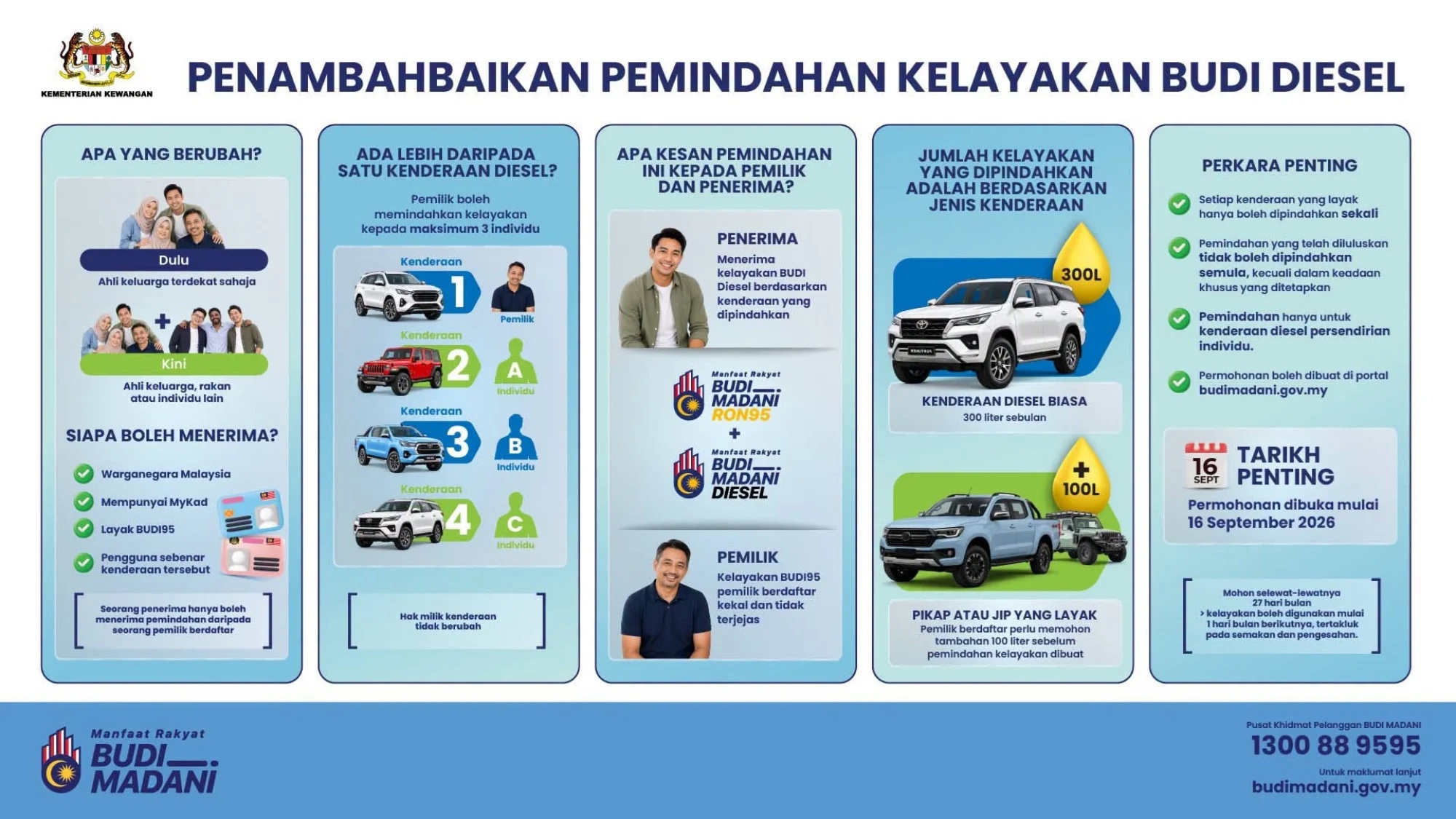
Previously, the BUDI Diesel transfer mechanism was more restrictive, making it less convenient where a vehicle was regularly used by someone outside the owner's immediate family. Under the expanded rules, the recipient does not need to be related to the vehicle owner. This gives owners more flexibility when a diesel vehicle is being used by a friend, employee, colleague, or another individual who is genuinely responsible for driving it.
There are still important eligibility conditions. The recipient must be a Malaysian citizen with a valid MyKad, must qualify for BUDI95, and must be the actual user of the diesel vehicle involved in the transfer. The programme therefore remains tied to verified users rather than allowing diesel allocations to be freely reassigned without a genuine connection to the vehicle.
Each recipient can also receive a BUDI Diesel eligibility transfer from only one registered vehicle owner. This restriction prevents a single person from collecting allocations from several unrelated owners and keeps the mechanism focused on genuine vehicle usage rather than accumulation of subsidised quotas.
Owners With Several Diesel Vehicles Get More Flexibility
The updated rules are also useful for Malaysians who own more than one eligible private diesel vehicle. A registered owner can now transfer the monthly BUDI Diesel eligibility attached to multiple vehicles, subject to a limit of three registered vehicles. This means the subsidy entitlement for each vehicle can be assigned to the person who actually uses it rather than remaining concentrated under one owner.
If only some of the vehicles are transferred, the registered owner will continue receiving the subsidised diesel quota for the vehicles that remain under their own eligibility. For example, an owner with three qualifying diesel vehicles could transfer two to their regular users while retaining the allocation for the third. This allows the subsidy to better reflect how the vehicles are actually being used.
If the owner transfers the eligibility for all three vehicles, however, the owner will no longer receive a BUDI Diesel allocation for those vehicles. They would then only remain eligible for the BUDI95 subsidy, assuming they continue meeting its qualifying requirements.
The Transfer Is Generally a One-Time Decision
Vehicle owners should think carefully before completing a transfer because eligibility for each vehicle can generally be transferred only once. Once approved, the decision cannot simply be cancelled or reversed whenever the owner changes their mind. Revocation is only allowed under specified special circumstances.
That makes the process different from temporarily lending someone access to a fuel allocation. The transfer is intended to formally recognise the person who actually uses the vehicle, so applicants should make sure the recipient details are correct before submitting the request. Owners should also be confident that the person will continue using the assigned vehicle before finalising the arrangement.
This restriction helps prevent allocations from being repeatedly moved between users. It also gives the system a clearer relationship between one vehicle, its registered owner, and the person authorised to use the subsidised diesel allocation.
The Recipient Uses Their Own MyKad for Subsidised Diesel
Once the transfer has been approved, the recipient can use their own MyKad when purchasing subsidised diesel for the assigned vehicle. The eligibility is therefore linked to the recipient's identity rather than requiring them to borrow or use the registered owner's MyKad.
This should make the programme much easier to use in households, workplaces, or other situations where the vehicle owner and regular driver are different people. The registered owner remains the legal owner of the vehicle, while the fuel subsidy entitlement can be assigned to the person who is actually using it.
Keeping the subsidy tied to MyKad also allows the existing verification system to continue operating without creating a separate subsidy card or identification method. The main change is simply which eligible person is recognised as the user of the vehicle's monthly allocation.
Most Eligible Vehicles Receive 300 Litres Per Month
The standard BUDI Diesel allocation remains 300 litres per month for an eligible private diesel vehicle. The expanded transfer system does not automatically change the amount available; it changes who is permitted to use that entitlement.
Certain vehicle categories can qualify for a larger allowance. Diesel-powered pick-up trucks and jeeps can receive up to 400 litres per month, giving them an additional 100 litres compared with the standard quota. However, the higher amount is not automatically applied simply because the vehicle falls into one of those categories.
The registered owner must first apply for the additional 100-litre allocation. Importantly, that application needs to be completed before the BUDI Diesel eligibility is transferred to another user. Owners planning to hand the eligibility to someone else should therefore settle the quota adjustment first if their vehicle qualifies.
Why the Expanded Transfer Mechanism Matters
The change makes the subsidy programme more practical because vehicle ownership and vehicle usage do not always belong to the same person. A car may be registered under one individual while being used every day by somebody else, and restricting the subsidy entirely to the registered owner can create unnecessary complications.
Allowing the entitlement to follow the genuine user helps address that mismatch without removing the eligibility checks surrounding the programme. The recipient still needs to meet BUDI95 requirements, possess a valid MyKad, and have a genuine relationship with the vehicle as its actual user.
For owners with multiple diesel vehicles, the new arrangement is even more useful because each vehicle can effectively have its own eligible user. Instead of one registered owner controlling several allocations they may not personally use, the subsidy can be distributed according to the vehicles' real day-to-day usage.
What Owners Should Check Before Applying
Before transferring BUDI Diesel eligibility, owners should first confirm that the intended recipient satisfies all the required conditions. They should also decide whether the transfer is likely to remain appropriate over the longer term, given that it normally cannot be freely reversed afterward.
Owners of eligible pick-up trucks or jeeps should also check whether they want to apply for the additional 100-litre allowance. Because that request must be completed before transferring the vehicle's subsidy entitlement, doing the steps in the wrong order could mean the recipient remains on the standard 300-litre quota.
Those who own several qualifying vehicles should additionally decide which allocations they intend to retain personally and which ones should go to other users. With transfers supported for up to three vehicles, the revised system gives owners more choice, but it also makes planning those assignments more important.
Final Thoughts
The expansion of BUDI Diesel eligibility transfers is a practical change that recognises a simple reality: the registered owner of a vehicle is not always the person who actually drives it. By allowing transfers to eligible non-family members, the programme can now accommodate a wider range of genuine vehicle-use arrangements without forcing owners and drivers into unnecessary workarounds.
The ability to transfer allocations across as many as three privately registered diesel vehicles also gives multi-vehicle owners considerably more flexibility. At the same time, safeguards remain in place, including MyKad verification, BUDI95 eligibility, the requirement that the recipient genuinely uses the vehicle, and restrictions on receiving transfers from multiple owners.
The most important thing for applicants to remember is that these transfers are not designed to be moved around casually. Once eligibility for a particular vehicle has been transferred, the decision is generally permanent unless special circumstances apply. Owners should therefore confirm both the recipient and the correct monthly quota before completing the process.
For eligible Malaysians who previously could not transfer their diesel subsidy because the vehicle user was not an immediate family member, the new rules remove that limitation. The subsidy can now be assigned more closely to the person actually behind the wheel, making BUDI Diesel considerably more flexible than before.











Comments 0