

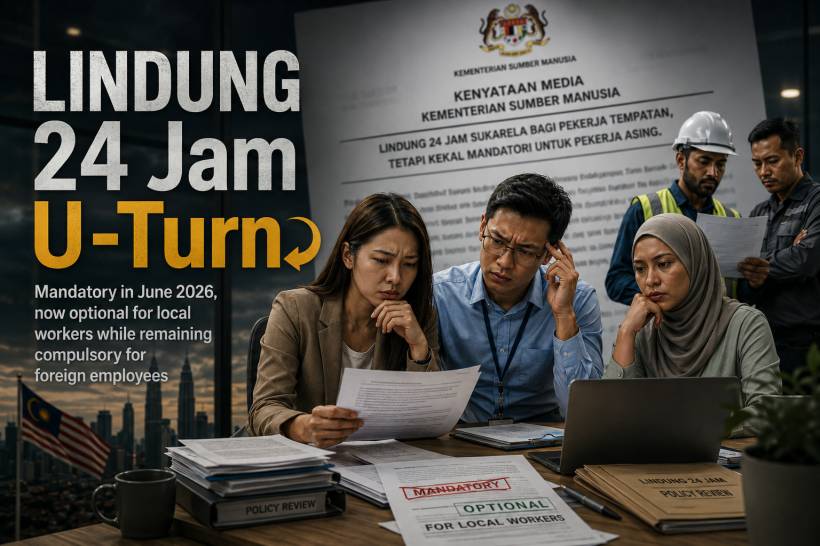
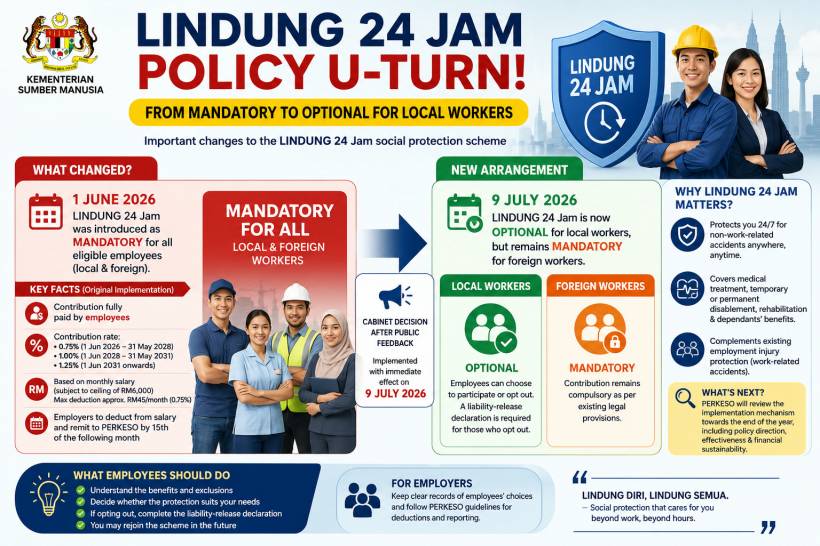
Malaysia's newly introduced LINDUNG 24 Jam social protection scheme has undergone a major policy reversal barely more than a month after its implementation. When the scheme came into force on 1 June 2026, contributions were presented as mandatory for all eligible employees registered under the Employees' Social Security Act 1969, including both Malaysian and foreign workers. Employers were required to deduct the contribution from employees' salaries and remit it to the Social Security Organisation, or PERKESO.
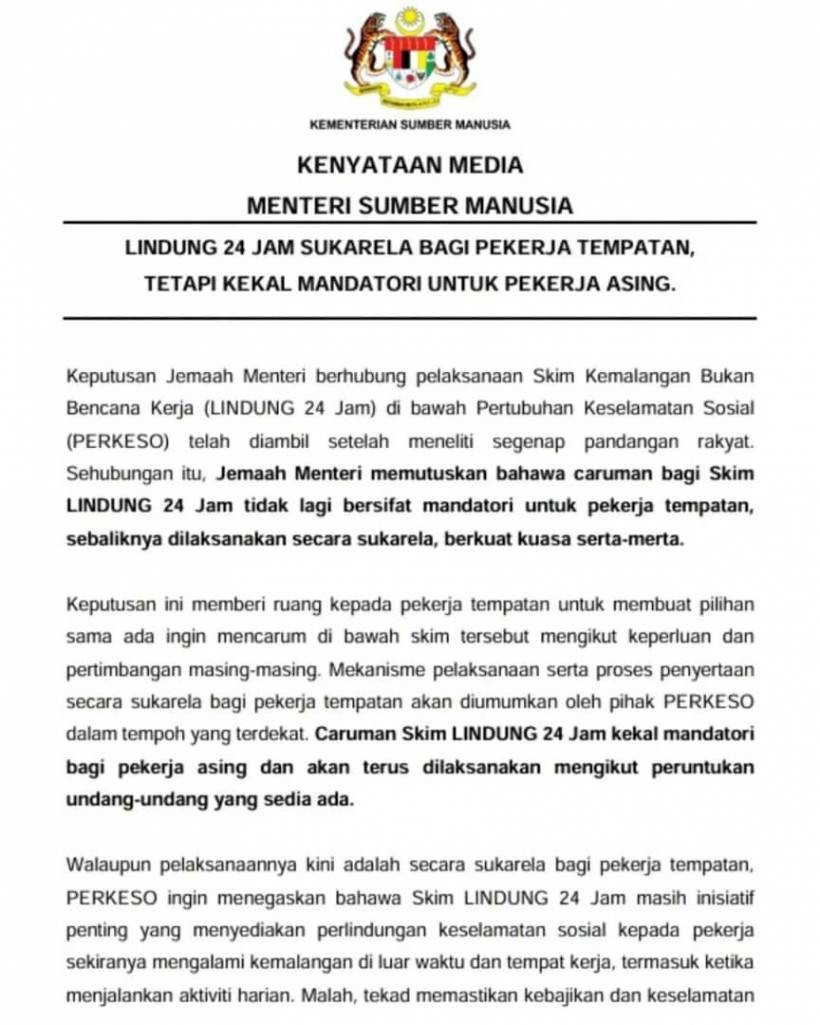
However, on 9 July 2026, the government announced that participation would become voluntary for local employees with immediate effect. Contributions remain compulsory for foreign workers. The Cabinet reportedly made the decision after considering feedback received from the public.
The announcement effectively changes LINDUNG 24 Jam from a universal compulsory scheme into a two-track system: optional for Malaysians but mandatory for foreign employees.
From Mandatory Payroll Deduction to Personal Choice
Under the original arrangement, LINDUNG 24 Jam contributions were mandatory for all workers covered by the relevant PERKESO legislation.
For the first phase, running from 1 June 2026 until 31 May 2028, workers were required to contribute 0.75% of their monthly wages, subject to the current salary ceiling of RM6,000. This meant the maximum deduction could reach approximately RM45 per month.
The rate was scheduled to rise gradually to:
• 1.25% from June 2031 onwards
Unlike some other PERKESO schemes, the contribution was to be fully paid by the employee. Employers were responsible for deducting the amount and forwarding it to PERKESO, but they were not required to contribute their own share. The June 2026 contribution was due to be paid by 15 July 2026.
This employee-funded structure became one of the most noticeable aspects of the rollout. Although the amount may appear relatively small individually, any new compulsory salary deduction is likely to attract attention, particularly during a period when households are already managing rising living costs, existing insurance payments and other statutory deductions.
By changing the scheme to voluntary participation, local workers can now decide whether the additional protection is relevant to their own circumstances.
What Does LINDUNG 24 Jam Actually Cover?
The purpose behind LINDUNG 24 Jam is straightforward: to close the protection gap for accidents that happen outside work.
Traditional employment injury protection generally focuses on accidents arising from employment, including incidents at the workplace and qualifying accidents while travelling between home and work. LINDUNG 24 Jam extends protection to non-work-related accidents occurring outside working hours or away from the workplace.
This could include accidents occurring at home, during recreational activities or while carrying out ordinary daily activities. Depending on the circumstances and eligibility requirements, benefits may include medical treatment, temporary or permanent disablement benefits, rehabilitation assistance and support for dependants.
However, the scheme does not replace the existing Employment Injury Scheme. Accidents that happen while performing work duties continue to be handled under the existing occupational protection framework. LINDUNG 24 Jam is intended specifically for accidents that are not directly related to employment.
The concept itself therefore remains valuable. A serious accident outside working hours can prevent someone from working, create substantial medical expenses and place financial pressure on the worker's family.
The controversy was less about whether protection was useful and more about whether every local worker should be compelled to purchase it through a statutory salary deduction.
Why the Reversal Feels So Sudden
The timing of the decision is what makes the development especially significant.
The scheme was officially implemented on 1 June, with employers instructed to begin payroll deductions from that month. The decision to make it voluntary for local workers was announced only 38 days later.
By then, payroll departments and employers had already been required to prepare their systems, calculate deductions, communicate changes to employees and arrange payment through PERKESO's contribution platform. Some workers would also have seen the deduction reflected in their June salaries.
The reversal therefore did not happen during a consultation or trial stage. It came after the scheme had already entered operational enforcement.
The original PERKESO guidance was unambiguous: contributions were mandatory for both local and foreign workers, employers were responsible for collecting them, and failure to comply could eventually result in penalties—although a six-month grace period had been provided.
The new Cabinet decision shows that public concern was significant enough for the government to reconsider the compulsory model almost immediately.
While responding to public feedback is important, such a rapid reversal also raises questions about the policy development process. It suggests that concerns about affordability, employee choice, payroll readiness and public acceptance may not have been fully resolved before implementation began.
A Two-Tier System for Local and Foreign Workers
Under the revised arrangement, Malaysian workers may decide whether to remain protected under LINDUNG 24 Jam. Foreign workers, however, must continue contributing in accordance with the existing legal provisions.
This creates a clear difference in how the scheme applies to the two groups.
For employers with both Malaysian and foreign staff, payroll administration may now become more complicated. Employers will need to identify which Malaysian workers have chosen to remain in the scheme, which have opted out and which foreign workers must continue contributing.
Clear records will be important, especially when employees join, resign, change their decision or move between employers.
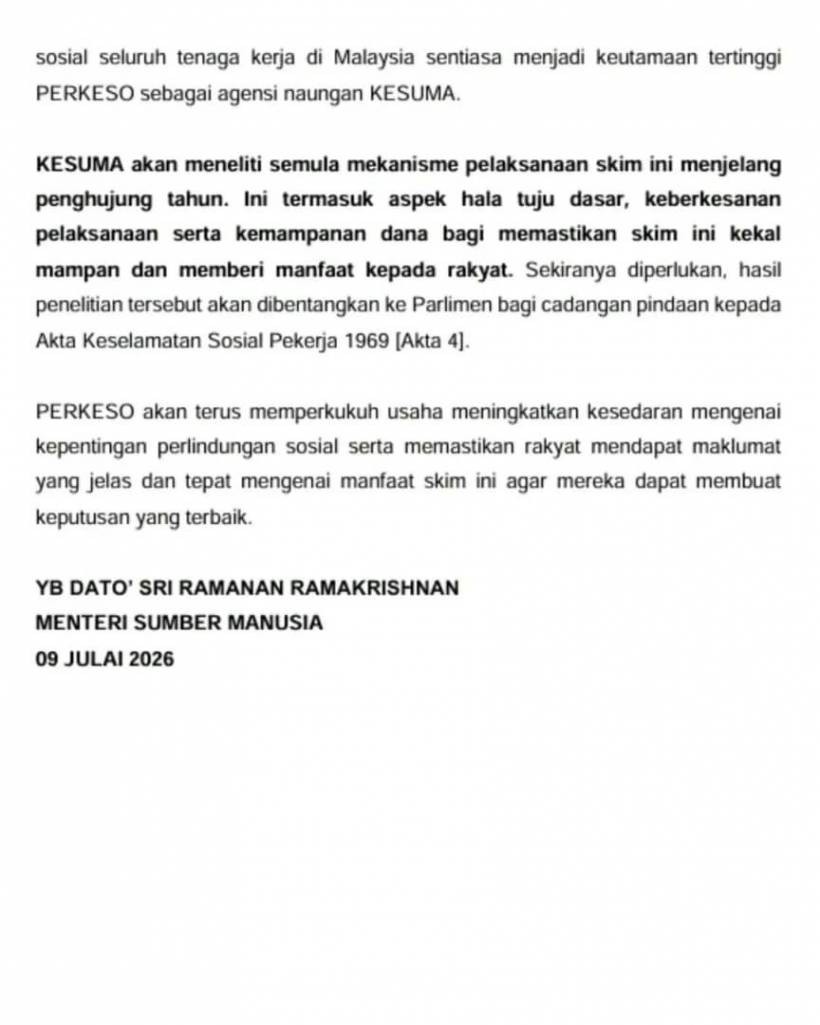
The government has not suggested that the scheme itself is being abolished. Instead, it is changing how participation is determined for local workers. The Human Resources Ministry has also said the overall implementation mechanism will be reviewed towards the end of the year, including its policy direction, effectiveness and financial sustainability. Any necessary legislative amendments could subsequently be presented to Parliament.
What Happens to Contributions Already Deducted?
One of the most immediate concerns is how the transition will affect contributions for June and early July.
The government's statement said the voluntary arrangement took effect immediately, but several practical matters still require clear communication:
• Whether deductions that have already been made can be refunded
• The effective date of an employee's decision to leave the scheme
• How employers should record and submit an employee's choice
• Whether workers will be allowed to rejoin later
• When protection ends after an employee stops contributing
PERKESO's information page has subsequently indicated that workers who do not wish to continue may be required to complete a liability-release declaration as part of the opt-out process. This is important because workers leaving the scheme must understand that they may no longer be entitled to its benefits for future non-work-related accidents.
The opt-out process should not become another complicated administrative burden. Workers need a simple explanation of what protection they are giving up, while employers need a standardised method of recording each employee's decision.
The Scheme Has Already Paid Real Benefits
Despite the debate surrounding mandatory contributions, LINDUNG 24 Jam has already demonstrated that the protection can be useful.
During its first month, PERKESO reportedly received 592 applications and paid more than RM1.2 million in benefits. A large portion involved medical implant costs, alongside temporary disablement payments.
These early cases show that accidents outside work can create substantial financial consequences. For workers without adequate personal accident insurance, medical coverage or emergency savings, a social protection scheme could make a meaningful difference.
Making the scheme voluntary does not make it unnecessary. It changes the responsibility from automatic participation to individual decision-making.
That places greater importance on public education. Employees should be given understandable information about the cost, benefits, exclusions and claims process before deciding whether to continue.
A Valid Objective Undermined by a Confusing Rollout
The objective of providing round-the-clock accident protection is difficult to argue against. Many serious accidents happen during evenings, weekends, holidays and personal activities—periods that may fall outside conventional employment injury coverage.
However, a good objective does not automatically guarantee good implementation.
Introducing the scheme as a compulsory deduction in June and converting it into an optional contribution in early July creates uncertainty for workers, employers and payroll providers. It can also affect public confidence, particularly when people have already seen deductions taken from their salaries.
The government now has an opportunity to improve the scheme by clearly explaining:
• What benefits are available and under what conditions
• How claims are submitted and assessed
• How workers can join, leave or rejoin the scheme
• How employers should manage payroll deductions
• What happens to contributions collected before the policy change
Without clear answers, the voluntary model could result in low participation—not necessarily because the protection lacks value, but because workers may not fully understand it.
Final Thoughts
The LINDUNG 24 Jam reversal is one of the clearest examples of how quickly public policy can change when implementation meets real-world reaction.
On 1 June 2026, the scheme arrived as a compulsory nationwide social protection measure affecting millions of workers. By 9 July, local employees were given the freedom to decide whether they wanted to participate.
The decision may ease concerns over compulsory salary deductions and give Malaysian workers greater control over their personal finances. At the same time, it leaves employers and employees seeking clarity about contributions that have already been deducted and how the new voluntary process will work.
LINDUNG 24 Jam still has the potential to provide meaningful protection for workers involved in accidents outside their jobs. But after such a sudden policy change, its future success will depend not only on the benefits it offers, but also on clear communication, transparent procedures and the ability to rebuild public confidence.











Comments 0