

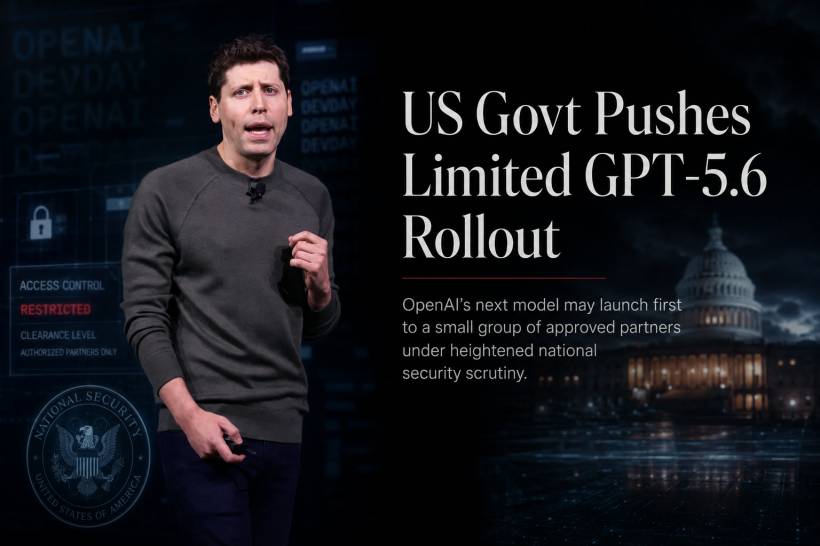
OpenAI may take a far more controlled approach to releasing its next major AI model, GPT-5.6. According to recent reports, the US government has asked OpenAI to begin with a restricted preview involving only a small group of approved partners, rather than making the model immediately available to the wider public. If accurate, it would represent one of the clearest examples yet of Washington becoming directly involved in how frontier AI systems are introduced.
For a company that normally brings new flagship models to ChatGPT users and developers relatively quickly, the proposed arrangement would be a major change in pace.
A Preview Limited to Approved Organisations
The reported plan would see GPT-5.6 initially made available to a carefully selected group of organisations. During this preview stage, access would reportedly be approved customer by customer, with the government involved in determining which partners can use the model.
OpenAI CEO Sam Altman reportedly told employees that the company does not see this as its preferred long-term release model. However, OpenAI is said to be cooperating while the government and AI industry work towards a more sustainable framework for future frontier-model launches.
The broader public release of GPT-5.6 could still happen later, but only after the preview period proceeds as intended.
Why the US Government Is Taking a More Active Role
The concern is not simply about whether an AI model can write better emails, generate code, or answer more complex questions.
As AI systems become more capable, governments are increasingly focused on the possibility that they could be misused for cyberattacks, fraud, surveillance, disinformation, biological research, or other high-risk activities. Frontier models may also be powerful enough to support legitimate security and research work, which makes the question of who gets early access particularly sensitive.
The reported GPT-5.6 discussions involve officials linked to the Office of the National Cyber Director, the Office of Science and Technology Policy, and the US Department of Commerce.
Their role appears to be part of a wider effort to establish a more formal process for evaluating advanced AI systems before they are released at scale.
A Different Type of AI Launch
Most major AI releases follow a familiar pattern. A company announces a new model, enables access through a chatbot or developer platform, and gradually expands capacity as demand grows.
A government-supervised preview would look very different.
Instead of a broad rollout, OpenAI would begin with a much narrower group of users. Those early users could be assessed not only on their technical needs, but also on how the model may be used and whether additional safeguards are required.
This approach could slow down public access, but supporters may argue that it offers more time to test the model in real-world conditions before millions of people begin using it.
What a Controlled Rollout Could Mean
A limited preview may bring some potential benefits:
However, the approach also raises difficult questions.
AI companies operate in an intensely competitive market, where releasing a more capable model even a few weeks earlier can matter. Restricting access could affect developers, businesses, researchers, and paying customers who expect to use new technology as soon as it becomes available.
There are also concerns around transparency. If access is approved organisation by organisation, the public may want clearer answers about the criteria being used and how consistently those decisions are made.
The Policy Shift Is Already Affecting Other AI Labs
OpenAI is not the only AI company navigating tighter US government scrutiny.
Anthropic recently stated that it had received a US government export-control directive requiring it to suspend access to its Fable 5 and Mythos 5 models for foreign nationals, including employees who are not US citizens. Anthropic said the directive affected users regardless of whether they were physically located inside or outside the United States.
That situation is more restrictive than the reported OpenAI arrangement, which appears to focus on limiting early access to approved partners rather than imposing a blanket ban on specific groups of users.
Still, both cases point to the same larger shift: advanced AI models are increasingly being treated as technology with national-security implications, not only consumer products.
OpenAI Has Used Restricted Access Before
The idea of giving selected organisations access to specialised AI capabilities is not entirely new for OpenAI.
The company has previously introduced trusted-access programmes for cybersecurity-focused models, giving vetted defenders and organisations access to tools intended for defensive security work. Those programmes were designed around the idea that some capabilities may need stronger safeguards than ordinary consumer AI features.
The reported GPT-5.6 arrangement would take that concept further. Instead of restricting a specialised security model, it could place a major general-purpose frontier model behind a government-reviewed preview process.
What Happens Next
Neither OpenAI nor the White House had publicly confirmed the reported GPT-5.6 access arrangement at the time of writing.
The key question is whether the limited preview becomes a short-term exception or the beginning of a new standard for releasing highly capable AI models in the United States.
For now, the situation highlights how quickly the AI industry is changing. The debate is no longer only about who can build the most powerful model. It is increasingly about who should be allowed to use it first, what safeguards need to be in place, and how governments should respond when AI capabilities advance faster than existing rules.
Final Thoughts
A government-approved GPT-5.6 preview would be a significant moment for the AI industry.
It could offer a more cautious path for testing frontier models, particularly where cybersecurity and national-security risks are involved. At the same time, it may create new concerns around access, transparency, competition, and the ability of AI companies to release products on their own terms.
Whether this remains a one-off measure or becomes a lasting model for future AI releases may shape how the next generation of advanced systems reaches the public.











Comments 0