

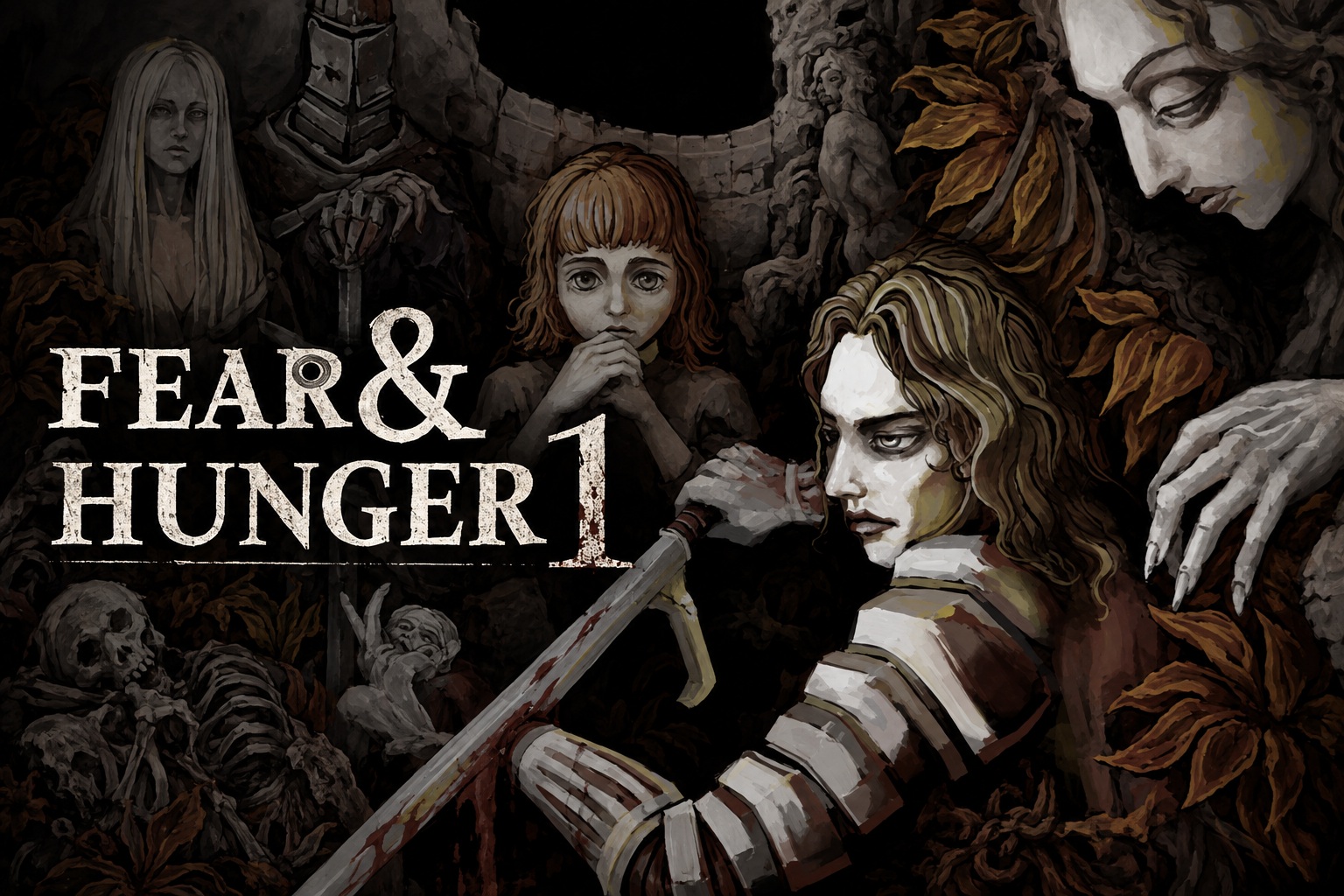
Fear & Hunger is a survival-horror dungeon crawler that takes familiar role-playing mechanics and deliberately removes almost every sense of safety normally associated with the genre. Instead of entering a dungeon expecting to gain levels, collect increasingly powerful equipment, and eventually overpower everything inside, players descend into a place where starvation, madness, infection, permanent injuries, limited supplies, hostile creatures, and unpredictable events can destroy a promising journey within minutes. Every corridor feels dangerous because even seemingly ordinary encounters can leave consequences that follow the party for the rest of the run. Progress is rarely about becoming comfortable; it is about learning how to survive while remaining permanently uncomfortable.
Developed by Miro Haverinen and released in 2018, Fear & Hunger combines turn-based RPG combat, roguelike-inspired uncertainty, resource management, dungeon exploration, psychological horror, and an unusually oppressive dark-fantasy world. Players choose between four very different protagonists—Cahara the Mercenary, D'arce the Knight, Enki the Dark Priest, and Ragnvaldr the Outlander—each entering the Dungeons of Fear & Hunger for their own reasons. Their original objective may involve Le'garde, the imprisoned captain found somewhere deep below the fortress, but the dungeon quickly reveals that something far older and more disturbing exists beneath the immediate rescue mission. The deeper the party travels, the more the adventure becomes connected to forgotten gods, ancient civilizations, ascension, and the horrifying history hidden beneath the earth.
Now playable online through Lemon Web Games, Fear & Hunger brings its punishing dungeon exploration, strategic limb-based combat, survival resources, recruitable companions, Hexen progression, multiple endings, and unsettling dark-fantasy atmosphere directly into the web browser. Players must manage Hunger, Mind, Body, equipment, injuries, party members, and increasingly dangerous decisions while slowly learning which battles should be fought and which should be avoided entirely. The game provides very little protection from bad decisions, but knowledge gained through failure becomes one of the most important forms of progression. Fear & Hunger is intentionally harsh, often disturbing, and sometimes deeply unfair, yet that uncompromising approach is exactly what gives the experience its extraordinary identity.
A Dungeon Where Survival Comes Before Heroism
Fear & Hunger immediately establishes that the player is not entering a conventional heroic adventure. The dungeon is already filled with evidence that stronger, better-prepared people have attempted the same journey and failed. Prison cells, torture chambers, abandoned passages, corpses, broken equipment, and hostile inhabitants communicate that survival here is exceptional rather than expected.
The player begins with limited equipment and relatively little understanding of what lies ahead. Basic resources such as food, healing items, torches, herbs, and useful books can become more valuable than expensive-looking weapons because each solves a different survival problem. Entering every room purely in search of treasure is dangerous because exploration itself consumes resources and exposes the party to additional threats.
This design creates a very different relationship with the dungeon. Progress is measured not only by distance travelled but by how much condition remains afterward. Reaching another floor with no food, low Mind, infected limbs, and almost no healing supplies may technically represent progress while actually placing the run in a worse position.
Le'garde Provides the Initial Reason to Descend
Le'garde is one of the central figures connecting the four protagonists to the dungeon. He is a charismatic military leader whose actions have affected nations, armies, and individuals across the wider world. Imprisoned deep within the Dungeons of Fear & Hunger, he becomes an immediate objective for several possible character routes. Whether the player reaches him quickly enough can significantly influence what happens next.
The interesting part is that finding Le'garde does not conclude the adventure. His imprisonment is only one layer of a much larger mystery surrounding the dungeon. Discoveries beneath his cell eventually connect the journey to Ma'habre, ancient gods, forgotten history, and the possibility of human ascension.
This gradual expansion gives Fear & Hunger an unusual narrative scale. What begins as a desperate journey into a fortress becomes a confrontation with forces that have shaped civilization itself. The dungeon is not merely a prison—it is effectively an entrance into the hidden structure of the game's world.
Four Playable Characters Create Different Starting Experiences
Fear & Hunger offers four primary starting characters, and each approaches the dungeon from a different background. Cahara is a mercenary whose experience supports flexible survival and opportunistic play. D'arce is a trained knight whose connection to Le'garde gives her journey a particularly personal motivation. Enki is a Dark Priest driven heavily by knowledge and occult understanding, while Ragnvaldr is an Outlander whose physical strength and violent history make him especially capable in direct confrontation.
Character selection affects more than appearance. Starting equipment, skills, soul type, backstory choices, and available progression can all influence the opening hours. The introductory sequence allows players to make decisions about each character's past, potentially changing what abilities or resources they bring into the dungeon.
This makes experimentation worthwhile. A route that feels extremely difficult with one protagonist may become more manageable with another because different strengths change how problems can be approached. The game encourages players to understand the dungeon from several perspectives rather than assuming one character represents the entire experience.
Cahara Is Built Around Survival and Opportunity
Cahara the Mercenary feels particularly appropriate for players who value flexibility. His background gives him access to useful skills that support exploration, escape, and opportunistic strategies. In a game where avoiding a dangerous battle can be more valuable than winning it, that flexibility matters considerably.
His story also provides a more grounded motivation compared with some of the game's increasingly cosmic events. Cahara enters the dungeon seeking an opportunity that could transform his life outside it. The deeper journey gradually forces an ordinary mercenary into situations involving gods, ancient cities, and forces far beyond what he expected.
This contrast fits Fear & Hunger well. Characters frequently enter with human motivations and encounter something much larger than themselves. The dungeon has no concern for why they came.
D'arce Brings the Discipline of a Knight
D'arce enters the dungeon with martial training and a strong personal connection to Le'garde. Her experience as a knight gives her a more straightforward relationship with weapons and direct combat than some other characters. For players learning the battle system, that conventional martial foundation can be useful.
Her relationship with Le'garde also gives later discoveries additional emotional weight. Saving him is not simply another quest objective placed inside the dungeon. Her loyalty helps define the character and can influence how certain events are interpreted.
Yet Fear & Hunger consistently complicates apparently simple motivations. The deeper D'arce travels, the more the player needs to question what Le'garde represents and what his ambitions might ultimately mean. Loyalty and destiny do not necessarily lead toward comforting outcomes.
Enki Approaches the Dungeon Through Knowledge and Magic
Enki the Dark Priest is particularly suited to players interested in Fear & Hunger's occult systems. His background provides stronger access to magical knowledge, god affinities, and spell-related progression. Magic can solve situations that physical combat struggles with, but using it often consumes valuable Mind.
That trade-off perfectly reflects the game's design. Powerful supernatural abilities are useful, but they are rarely free. A character who repeatedly relies on magic can become mentally exhausted, placing another survival resource under pressure.
Enki also fits naturally into the deeper lore surrounding the Old Gods, New Gods, and the mysteries beneath the dungeon. His pursuit of knowledge makes discoveries in Ma'habre particularly relevant. For him, the horrors below are not merely obstacles but sources of forbidden understanding.
Ragnvaldr Is Built for Violence but Still Cannot Ignore Survival
Ragnvaldr the Outlander possesses tremendous physical capability and enters the dungeon with a history shaped by loss and violence. His strength can make certain combat situations considerably more manageable, especially for players who prefer direct approaches. Yet Fear & Hunger ensures that physical power never solves everything.
Hunger still weakens him, Mind can still deteriorate, infections remain dangerous, and some enemies are better avoided regardless of strength. A powerful character can still lose a limb or die because of one poorly handled encounter. The dungeon refuses to become a straightforward action game.
Ragnvaldr therefore demonstrates one of Fear & Hunger's central ideas clearly: strength helps, but knowledge is stronger. Understanding enemy behavior, resource management, and dungeon structure remains essential even for the most physically imposing protagonist.
Body, Hunger and Mind Must All Be Managed
Most RPGs treat health as the primary measure of survival. Fear & Hunger adds several overlapping systems that can become dangerous independently. Body represents physical condition, Hunger gradually weakens characters if they are not fed, and Mind deteriorates as the party spends time inside the oppressive dungeon and encounters its horrors.
Hunger ensures that exploration cannot continue indefinitely without preparation. Food is consumed regularly, and allowing characters to become increasingly hungry reduces their effectiveness. A long detour may reveal valuable equipment but also consume supplies needed for the deeper journey.
Mind introduces a different kind of pressure. Darkness, supernatural encounters, and prolonged exposure to the dungeon gradually undermine sanity. Alcohol, certain items, rest, and other resources can restore it, but those supplies are limited. Magic also draws from Mind, forcing spell-focused characters to consider whether each cast is worth the cost.
Combat Is About Dismantling the Enemy
Fear & Hunger's turn-based battles are distinctive because enemies are divided into individual body parts. Instead of simply selecting an enemy and reducing one health bar, players choose specific limbs, the torso, or head. Destroying the correct part can remove an attack completely.
An enemy holding a dangerous weapon may become far less threatening once that arm is severed. Taking out the legs can sometimes destroy balance and make the head easier to target. Other creatures rely on particular limbs or unusual body parts for devastating abilities, making correct targeting essential.
This system turns combat into a puzzle. The strongest attack is not always the best move if it hits the wrong location. Experienced players begin thinking about how to disable an enemy safely before attempting to finish it.
Attacking the Head Immediately Is Usually a Gamble
Many enemies can theoretically be defeated by destroying the head, but head attacks often have poor accuracy while the target remains balanced. New players naturally see the head as the obvious weak point and waste turns attempting unreliable strikes. Fear & Hunger quickly teaches a more methodical strategy.
Removing legs can improve the chance of landing a successful head attack against certain enemies. Alternatively, destroying weapon arms first reduces incoming damage while the party works toward a safer finishing blow. Knowledge of enemy anatomy becomes extremely valuable.
This creates satisfying progression without conventional experience levels. The character may not become statistically stronger after a battle, but the player learns exactly which limb needs to be removed first. That information can transform a previously deadly encounter into something manageable.
Dismemberment Works Both Ways
The same limb-based logic affecting enemies can also permanently damage party members. Arms and legs can be lost through combat or environmental hazards, producing consequences far beyond ordinary health reduction. A character missing an arm may lose access to certain equipment, while damaged legs can severely affect mobility.
Some injuries can be so serious that the player needs to reconsider the entire run. Fear & Hunger rarely provides simple restorative magic capable of returning everyone to perfect condition. Survival often means continuing despite permanent damage.
In extreme situations, players may even intentionally amputate an infected limb using a bonesaw before the infection spreads further. It is a brutal solution, but the dungeon frequently forces decisions where every available option has a cost. Preserving life may require sacrificing capability.
Infections and Status Effects Can Destroy a Run Slowly
Not every dangerous attack kills immediately. Poison, bleeding, infection, blindness, broken bones, and other conditions can remain after combat and gradually become more serious. Some status effects require very specific items or interventions. Entering battle without the resources to treat possible consequences can therefore be reckless.
Infections are especially frightening because they can create delayed danger. A wounded limb may become infected and eventually threaten the character's life unless treated. Green herbs, specialized equipment, or amputation can become desperately important.
This makes inventory knowledge essential. An item that looked insignificant during an earlier run may later become one of the most valuable things in the dungeon. Fear & Hunger teaches players to stop evaluating everything purely through immediate usefulness.
Coin Flips Make Uncertainty Part of the Horror
Fear & Hunger uses coin flips in numerous situations, turning probability itself into a source of tension. Chests, bookshelves, traps, saving, necromancy, and certain enemy attacks can involve a simple choice between heads and tails. The outcome may determine whether something useful happens or whether the situation becomes dramatically worse.
Lucky Coins can be committed to improve the odds during many of these events, transforming a standard fifty-fifty outcome into a more favorable chance. This creates another resource decision. Spending a Lucky Coin now may prevent catastrophe, but the player may desperately need it later.
Some enemies also telegraph particularly dangerous attacks that lead toward coin-flip outcomes if not handled correctly. Experienced players learn that the best solution is often preventing the attack entirely by guarding or destroying the relevant limb. Luck becomes most manageable when strategy reduces how often the player depends on it.
Saving the Game Can Be Dangerous
Fear & Hunger famously makes saving part of the survival system rather than an automatic convenience. Sleeping in certain beds can allow the player to save progress, but attempting to rest may trigger a coin flip. Failure can cause an ambush or other serious consequence depending on the location.
Books of Enlightenment provide another valuable saving method without relying on the same bed-based risk, making them exceptionally useful discoveries. Because these books are limited, deciding when progress is valuable enough to record becomes another strategic decision. Saving itself turns into resource management.
Hard Mode goes even further by removing normal saving entirely. This transforms knowledge, preparation, and consistency into the only protection against losing substantial progress. Few RPGs make the simple act of preserving a run feel this important.
Loot Is Valuable Because Almost Everything Is Scarce
Food, healing items, herbs, torches, ammunition, alcohol, crafting materials, books, equipment, and Lucky Coins all compete for attention. Fear & Hunger rarely provides enough resources to make every problem trivial. Finding something useful often creates relief rather than simple excitement.
Randomized or uncertain loot contributes to replayability because players cannot always depend on obtaining the same resources in exactly the same order. A run blessed with healing items may struggle for food, while another provides useful books but weak equipment. Adaptation becomes essential.
This uncertainty means rigid strategies can fail. Players need plans, but they also need enough flexibility to respond to what the dungeon actually provides. The strongest runs often emerge from using imperfect resources intelligently.
Avoiding Combat Is Frequently the Best Strategy
Traditional RPGs train players to seek battles because combat generates experience and eventually makes the party stronger. Fear & Hunger removes much of that incentive. There is no conventional experience-point leveling system rewarding every enemy killed. Fighting therefore needs a practical reason.
If an enemy blocks nothing important and defeating it will consume healing items, Mind, ammunition, or limbs, walking around it may be objectively smarter. Even a successful fight can leave the party weaker than before. Victory is not automatically profitable.
This reversal can initially feel strange, but it becomes one of the game's most important lessons. The dungeon is not asking the player to conquer everything. It is asking them to survive.
The Hexen Replaces Traditional Leveling
Character progression occurs largely through the Hexen, an occult skill system connected to souls and divine affinity. Lesser souls can be acquired through Soul Stones and then spent to unlock abilities or curse weapons. Special souls open additional branches of knowledge.
The system reflects each protagonist's background and soul type, giving different characters access to different starting possibilities. Magical abilities are also connected to relationships with particular gods. Progression therefore becomes intertwined with the game's mythology rather than appearing as a generic skill menu.
Cursing weapons offers another use for souls. Enhanced weapons can become stronger and gain the ability to damage certain supernatural enemies. The player must decide whether scarce souls are more valuable as new skills or improved equipment.
The Gods Are Mechanical Systems as Well as Lore
Fear & Hunger's mythology is not limited to dialogue and background books. Gods such as Gro-goroth, Sylvian, Alll-mer, and others influence spells, rituals, affinities, and progression. Learning about them can directly change what the player is capable of doing. Lore becomes useful knowledge.
Ritual circles, prayer, books, and specific actions can alter affinity with particular gods. Higher affinity can open additional abilities through the Hexen. This makes religion a tangible part of character development.
The result is a setting where understanding the supernatural world has practical consequences. Players who ignore the mythology may still survive, but they lose access to important possibilities. Knowledge becomes power in a very literal sense.
Party Members Can Completely Change a Run
The protagonist does not necessarily need to explore alone. Other playable characters can sometimes be recruited when encountered under the correct circumstances, while additional companions can also join through specific events. A larger party provides more attacks each turn and allows different skills to complement one another.
Recruitment is rarely automatic. Characters can be missed, killed, frightened away, or encountered only through specific routes. Some may also suffer their own Hunger, Mind, or injury problems after joining. Additional companions therefore provide strength while increasing resource consumption.
This creates another survival calculation. Four characters can dominate battles that would terrify a solo protagonist, but they also require much more food and maintenance. A powerful party is expensive to keep alive.
The Girl Becomes Far More Important Than She First Appears
One of the earliest potential companions is a mysterious young Girl found imprisoned within the dungeon. Initially, she appears physically weak and vulnerable compared with hardened warriors. Protecting her can seem like an unnecessary burden when food and equipment are already scarce.
Yet the Girl becomes extraordinarily important to the larger narrative and one of the game's most significant possible endings. Her presence connects the journey to forces much greater than the immediate dungeon escape. Keeping her alive can eventually change the history of the world.
This is a perfect example of Fear & Hunger's approach to information. A new player has almost no reason to understand why protecting her matters. Only knowledge gained through exploration or later runs reveals the true significance of that decision.
Moonless Is One of the Dungeon's Most Memorable Companions
Moonless is a wolf-like creature who can potentially join the party under the right conditions. Unlike ordinary human companions, she brings her own behaviors and combat advantages. Her presence adds another unusual element to an already strange group of survivors.
Recruiting Moonless also demonstrates that not every creature inside the dungeon must be treated as an automatic enemy. Some encounters contain possibilities that are not obvious through conventional RPG expectations. Violence is not always the only answer.
A party containing hardened warriors, occult priests, a vulnerable child, and a massive wolf can become wonderfully strange. Fear & Hunger allows its group composition to reflect the unpredictability of the dungeon itself.
Nas'hrah Adds Chaos and Forbidden Knowledge
Nas'hrah is another particularly memorable potential companion, existing in a form that immediately reveals how unusual the setting can become. His personality is aggressive, arrogant, and deeply connected to the world's history of ascension and supernatural power. Recruiting him changes both combat and narrative interactions.
His knowledge can reveal perspectives unavailable from ordinary characters. He has direct connections to the world of New Gods and understands forces that the protagonists are only beginning to discover. Yet having powerful knowledge nearby does not make the dungeon safe.
Nas'hrah reinforces the idea that immortality and divinity in Fear & Hunger are not necessarily desirable states. Powerful beings remain flawed, violent, and trapped inside larger cycles. The game's mythology consistently rejects comfortable ideas of godhood.
Ma'habre Changes the Scale of the Entire Game
Deep beneath the dungeon lies Ma'habre, the ancient city of the gods. Reaching it marks a major shift in both atmosphere and narrative scope. The claustrophobic fortress gives way to an enormous forgotten civilization connected directly to the Old Gods and generations of ascended mortals.
Ma'habre can be explored across different states of time, allowing players to move between its ancient glory and ruined present. Areas that are inaccessible or destroyed in one state may be completely different in another. This turns exploration into something much more complex than simply finding another staircase.
The city also contains some of the game's most important lore, bosses, souls, and ending routes. By this point, the original mission involving Le'garde feels almost small compared with what has been uncovered. The player has effectively walked into the hidden spiritual history of humanity.
Old Gods and New Gods Represent Different Forms of Power
Fear & Hunger makes an important distinction between the Old Gods and the New Gods. Old Gods represent forces so ancient and incomprehensible that humanity can barely understand their existence. Gro-goroth and Sylvian are among the most important names connected to destruction and creation, while other divine forces shape the world in similarly enormous ways.
New Gods are fundamentally different. They were once mortal beings who ascended through the Throne of Ascension in Ma'habre. Their power exceeds ordinary humanity, but they remain far beneath the true Old Gods and retain very human flaws.
This creates one of the setting's most compelling ideas: achieving divinity does not necessarily mean achieving wisdom. New Gods can become trapped by ego, history, and limitations just as mortals are. Ascension may change the scale of someone's problems without eliminating them.
The Dungeon Is Connected to Cycles of Human Ambition
As players learn more about Ma'habre and the beings who reached it before them, the dungeon begins to feel less like an isolated place of horror and more like a recurring destination for ambitious people seeking power. Generations of mortals have entered, discovered forbidden knowledge, and attempted to rise beyond their human limitations. The results rarely create lasting salvation.
Le'garde's ambitions therefore exist within a much older pattern. He is not the first person to believe that obtaining extraordinary power might allow civilization to be reshaped. The player gradually sees evidence of others who thought similarly.
Fear & Hunger's horror is therefore philosophical as well as physical. Monsters and mutilation are frightening, but so is the repeated human belief that enough power will finally fix everything. History keeps producing new attempts.
Multiple Endings Reflect Very Different Interpretations of the Journey
Fear & Hunger contains several normal endings along with special character-specific S endings on Hard difficulty. These outcomes can involve escaping the dungeon, confronting traces of ancient gods, participating in ascension, influencing Le'garde's destiny, or enabling events that reshape the wider world. The journey does not converge into one obvious heroic conclusion.
Different endings require radically different decisions. Some depend on particular party members remaining alive, while others require specific souls, locations, or late-game choices. The player can complete the game once and still understand only a fraction of what is possible.
Character-specific S endings deepen replayability even further. Cahara, D'arce, Enki, and Ragnvaldr each receive an outcome connected to their personal identity and motivations. Discovering them requires much stronger mastery of the dungeon than simply reaching an ordinary ending.
Hard Mode Completely Changes the Stakes
Hard Mode is designed for players who already understand the dungeon extremely well. Saving is removed, many ordinary party options become unavailable, and character-specific S endings become the primary reward for surviving under these conditions. Every mistake carries enormous consequences.
This turns route planning into a major skill. The player needs to know where essential resources are likely to appear, which fights are mandatory, which areas can be bypassed, and how to preserve enough supplies for the final objectives. Improvisation remains important, but preparation becomes far more significant.
Completing an S ending therefore represents much more than reaching another narrative scene. It demonstrates deep mechanical knowledge. The player has learned the dungeon well enough to survive without the safety net of ordinary saving.
Terror & Starvation Raises the Horror Further
Terror & Starvation difficulty increases enemy strength and introduces additional dangers beyond the standard experience. Certain events become harsher, enemies can behave differently, and the overall dungeon becomes less forgiving. Players familiar with standard difficulty may discover that old routines no longer provide enough safety.
This mode works well because Fear & Hunger's core systems already create tension. Increasing damage and introducing new threats does not fundamentally change what the game is about. It simply reduces the margin for error.
The name also perfectly reflects the experience. Fear and hunger stop feeling like abstract themes and become practical mechanical pressures. The player is constantly trying to prevent several forms of collapse at once.
The Dungeon Layout Encourages Repeated Exploration
Fear & Hunger includes randomized or variable elements that prevent every run from unfolding identically. Certain room arrangements, loot opportunities, and pathways can differ, making memorization useful without becoming completely absolute. The player may know what kinds of dangers exist while still needing to adapt to the current layout.
This unpredictability strengthens the roguelike influence. Knowledge remains the most important progression, but no guide can completely replace careful observation. The dungeon still needs to be read during each run.
Randomization also makes resource distribution more interesting. One attempt may provide excellent books while another offers superior weapons or food. Players learn to build strategies around what they actually receive.
Failure Is the Primary Teacher
Fear & Hunger explains relatively little directly. New players frequently die because they did not know an enemy could perform an instant-kill attack, a status condition required treatment, a route contained a trap, or a seemingly harmless decision carried a permanent consequence. These failures can initially feel brutal.
Over time, however, each death becomes information. The next run avoids that trap, targets the dangerous arm first, preserves a particular herb, or chooses another route. The player begins accumulating a mental map of the dungeon's dangers.
This creates progression unlike conventional RPG leveling. The protagonist may begin every new run relatively weak, but the person controlling them is significantly stronger because they understand more. Knowledge is the real persistent upgrade.
The Art Style Makes the Dungeon Feel Diseased and Ancient
Fear & Hunger uses a deliberately grim visual style filled with muted colors, decaying stone, organic horror, religious imagery, and disturbing creature design. The environments rarely feel clean or safe. Even areas without immediate enemies can create discomfort simply through atmosphere.
Characters and monsters often look damaged, exhausted, or grotesquely transformed. The dungeon feels like something that has been rotting for generations. Ma'habre provides a different kind of beauty, but even its grandeur is surrounded by decay and forgotten history.
The visuals support the survival mechanics perfectly. Food, sanity, and physical condition are difficult to ignore because the entire environment looks capable of contaminating the party. The world itself appears hostile.
Sound Makes Empty Corridors Feel Dangerous
The soundtrack and environmental audio avoid giving the player constant heroic reassurance. Silence, distant noises, unsettling ambience, and sparse musical cues make exploration uncomfortable even when nothing is immediately attacking. The dungeon frequently sounds empty without ever feeling safe.
This allows ordinary movement to create tension. Walking into another corridor becomes stressful because the player does not know whether something dangerous is nearby. Fear comes from anticipation rather than constant combat.
The quieter audio also makes sudden encounters more effective. An enemy appearing after several minutes of careful exploration feels genuinely disruptive. The player never settles completely.
Fear & Hunger Is Intentionally Uncomfortable
The game contains graphic violence, disturbing imagery, sexual themes, nudity, and situations designed specifically to make the player feel vulnerable or repulsed. These elements are not subtle, and the game is clearly intended for mature audiences comfortable with extremely dark subject matter. Its world is deliberately cruel.
What makes the experience more interesting than simple shock value is that the disturbing content supports a broader mechanical philosophy. The player is rarely protected by conventional RPG rules. Bodies are fragile, resources are scarce, sanity is temporary, and even divine beings are deeply flawed.
The result can be exhausting, but it creates an atmosphere few games replicate successfully. Fear & Hunger does not want the dungeon to become comfortable after a few hours. Even experienced players are expected to respect it.
Why Fear & Hunger Has Become a Cult Favorite
Fear & Hunger stands out because it refuses many of the assumptions players bring from ordinary RPGs. Combat does not automatically make characters stronger, saving is not guaranteed, injuries can be permanent, party members can become liabilities, and seemingly minor decisions can influence entire ending routes. The game constantly asks players to reconsider familiar habits.
Its depth also reveals itself gradually. Someone initially struggling to keep a character fed may eventually be studying divine affinities, Hexen progression, Ma'habre's history, special souls, alternative endings, and advanced enemy strategies. The game grows dramatically as understanding improves.
That sense of discovery has helped Fear & Hunger develop a devoted audience despite its extreme difficulty and mature themes. It rewards curiosity, experimentation, and persistence more than mechanical grinding. Surviving becomes satisfying because the game rarely gives anything away easily.
Playing Fear & Hunger Online Today
Through Lemon Web Games, Fear & Hunger can now be played directly in your web browser with no downloads or setup required. Features of the web-based version include:
New players should resist the instinct to fight every enemy they encounter. There is usually no experience reward making unnecessary combat worthwhile, and even victorious encounters can leave permanent injuries or consume valuable healing supplies. Learn enemy behavior, target dangerous limbs, preserve food and Mind-restoring resources, and treat every save opportunity as something valuable rather than automatic. The dungeon becomes considerably more manageable once survival replaces conquest as the main objective.
It is also worth accepting that the first few runs will probably end badly. Fear & Hunger is built around learning through failure, and information discovered during one attempt can completely change the next. Remember dangerous enemy attacks, useful item locations, recruitment opportunities, and routes through the dungeon. Knowledge will eventually become more valuable than any weapon found inside.
Who Should Play Fear & Hunger
Fear & Hunger is particularly suitable for players who enjoy games that do not protect them from mistakes. A poor decision may cause permanent damage, and the game often expects the player to learn the lesson through consequences rather than warnings. This creates frustration initially, but it also makes eventual mastery extremely rewarding. Dangerous encounters stop feeling random once their underlying mechanics become understood.
It should also appeal to players who enjoy piecing together worlds through environmental storytelling, books, character encounters, and optional discoveries. Much of Fear & Hunger's mythology is not delivered through straightforward exposition. Understanding the Old Gods, Ma'habre, ascension, Le'garde, and the larger historical cycle requires active curiosity. The dungeon contains much more than its immediate survival challenge.
Play Fear & Hunger Online Now
Fear & Hunger begins as a desperate descent into a hostile dungeon and gradually expands into a disturbing exploration of mortality, divinity, ambition, and survival. Players choose between Cahara, D'arce, Enki, and Ragnvaldr, then enter a fortress where every resource matters and nearly every encounter has the potential to cause lasting damage. Hunger weakens the party, darkness destroys Mind, infections demand treatment, limbs can be lost permanently, and even sleeping in a bed may involve risk. Progress requires caution rather than confidence.
Through Lemon Web Games, players can experience Fear & Hunger directly in a modern browser and discover why its brutal systems have developed such a powerful reputation. Learn which enemies should be avoided, dismantle dangerous opponents limb by limb, recruit unusual companions, explore Ma'habre, unlock skills through the Hexen, and gradually uncover the history beneath the dungeon. Every run teaches something, and every piece of knowledge makes the next descent slightly more survivable.
Final Thoughts
Fear & Hunger is memorable because it understands that genuine horror requires consequences. Enemies are frightening because they can permanently damage the party, starvation matters because food is limited, darkness matters because Mind deteriorates, and random events matter because a failed coin flip can destroy hours of careful progress. The game rarely allows players to separate narrative horror from gameplay mechanics. The systems themselves create fear.
Its combat is equally distinctive because winning is less important than winning efficiently. Removing the correct limb can transform a deadly enemy into something manageable, while attacking carelessly can result in permanent injuries even after victory. The Hexen, god affinities, recruitable characters, Ma'habre, multiple endings, and character-specific S routes gradually reveal an enormous amount of depth beneath the initial survival struggle. What first looks like a cruel dungeon crawler eventually becomes an elaborate dark-fantasy mythology.
Through Lemon Web Games, Fear & Hunger can be played directly in the browser as an uncompromising RPG where failure is expected and knowledge is the real form of progression. It is not designed for everyone, particularly because of its extreme difficulty and mature subject matter, but players who appreciate hostile worlds, meaningful decisions, strategic survival, and mysteries that refuse to explain themselves easily may find something extraordinary beneath its brutality. Few games make escaping a dungeon feel like such an achievement—and even fewer make reaching its deepest secrets feel like discovering something that perhaps should have remained buried.











Comments 0