

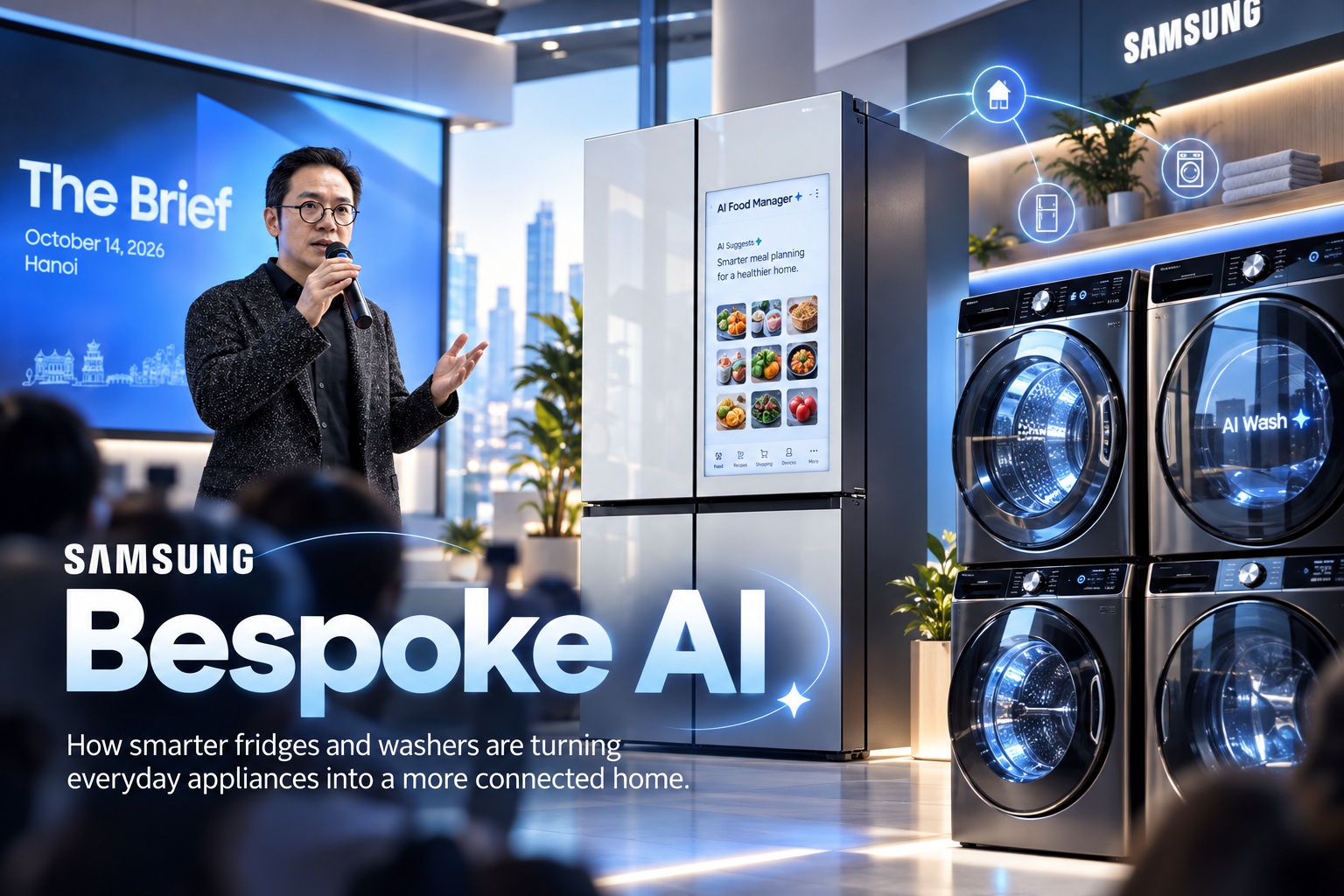
Artificial intelligence has become one of the biggest technology themes of the past few years, although most conversations still revolve around generative AI chatbots, AI agents, smartphones and computers. Samsung is taking a different approach by bringing increasingly autonomous AI capabilities into something people interact with every day: home appliances.
Since introducing its Bespoke AI strategy in 2024, Samsung has gradually expanded what its refrigerators, washing machines and other connected appliances can do. Rather than adding AI simply because it is fashionable, the company says the technology needs to solve genuine everyday problems and operate increasingly in the background. That means a refrigerator that understands food, a washing machine that adjusts itself to the laundry inside it and a connected home capable of anticipating maintenance before something becomes a problem.
AI Needs To Be Useful, Not Simply Visible
Ahead of The Brief 2026 event in Hanoi, Vietnam, Samsung Vice President and Regional Head of Digital Appliances Business for Southeast Asia and Oceania Bernard Ang discussed how the company views AI within the home.
His point was relatively straightforward: AI may be the technology industry's favourite subject right now, but putting it inside an appliance only makes sense if it improves ordinary moments in people's lives.
That is an important distinction. Nobody necessarily needs a refrigerator simply because someone has attached an AI label to it. The technology has to make food management easier, reduce wasted energy, simplify household chores or provide information that would otherwise require additional effort from the user.
Samsung's objective is therefore to make the intelligence increasingly seamless and less dependent on users constantly configuring it.
A Refrigerator That Does More Than Keep Food Cold
The refrigerator is perhaps the easiest example of where Samsung's Bespoke AI approach becomes visible.
A conventional refrigerator essentially maintains temperature and stores food. Connected models added features such as remote monitoring and voice controls, but Samsung's newer approach attempts to understand more about what is actually happening inside the appliance.
AI Vision can help recognise food items, while SmartThings Food can use that information to assist with meal planning and shopping.
Instead of simply asking the refrigerator to open its door through a voice command, the longer-term idea is for the appliance to become aware of what food is available and help users decide what they can prepare.
AI Vision Is Becoming More Capable
Samsung is continuing to improve its AI Vision technology so that refrigerators can understand their contents more effectively.
The practical advantage is less manual inventory management. If the appliance can recognise food as it enters or leaves the refrigerator, that information can become useful elsewhere within the Samsung ecosystem.
SmartThings Food can potentially use those details when suggesting meals or helping update a shopping list.
That begins to turn the refrigerator into something closer to a household food-management assistant rather than merely an appliance with a touchscreen.
The challenge for Samsung will be making all of this reliable enough that users do not spend more time correcting the AI than they would have spent managing everything manually.
The Best AI May Be The AI You Barely Notice
Ang described the direction as becoming more intuitive and operating increasingly seamlessly in the background.
That could ultimately be the most appropriate role for AI inside home appliances.
A washing machine does not necessarily need to have a conversation with its owner. It needs to understand what is inside the drum and choose the right settings.
Likewise, a refrigerator does not need to behave like a chatbot every time the door opens. If it can quietly help track food, suggest something useful at the right moment and warn about a potential problem, the intelligence becomes much more practical.
This kind of invisible automation may eventually matter more to consumers than obviously AI-branded features.
AI Wash Takes The Guesswork Out Of Laundry
Samsung's AI Wash provides another good example of how AI can be useful without fundamentally changing what an appliance is supposed to do.
Compatible Bespoke AI washing machines can analyse several characteristics of the laundry before deciding how to run a wash cycle.
This includes:
• The size of the laundry load
• The type of fabric being washed
• The detected soil level or amount of dirt
Using that information, the machine can determine how much water and detergent should be used and how long the wash cycle should run.
The objective is to provide a more appropriate wash without requiring users to manually calculate everything themselves.
A Smarter Alternative To Using The Same Setting Every Time
Many people have one or two preferred washing-machine programmes and use them for almost everything.
That is convenient, but it is not necessarily efficient.
A lightly soiled load of everyday clothing may not require the same amount of detergent, water or washing time as heavily soiled laundry. Different fabrics can also respond better to different conditions.
AI Wash attempts to make those adjustments automatically.
Rather than relying on the user to estimate how dirty the clothes are or whether enough detergent has been added, the machine makes its own decision using the information it can detect.
If implemented well, that can potentially reduce unnecessary water, detergent and energy consumption while still achieving the desired cleaning result.
The Bigger Idea Is Connected Agentic AI
Samsung's ambitions go beyond making each individual appliance smarter.
Bespoke AI devices are increasingly designed to operate as part of a connected ecosystem through SmartThings. This allows information from several appliances to be brought together rather than remaining isolated inside each device.
The idea becomes particularly interesting as agentic AI develops.
Instead of a refrigerator, washer, television and smartphone functioning independently, the devices could potentially coordinate around the needs of the household.
The user's phone then becomes one of several ways to interact with that connected environment rather than necessarily being the centre of everything.
Now Brief Could Bring Household Information Together
Samsung's Now Brief is one example of how information from connected devices can be surfaced to the user.
Rather than opening several applications to check different appliances, relevant information could be brought together into one personalised overview.
For example, the system might provide information about appliance status, household activity or maintenance requirements alongside other contextual information available through the Samsung ecosystem.
The more devices that become connected, the more valuable this consolidation potentially becomes.
Nobody wants a smart home where every appliance requires constant attention through its own separate interface.
The point of automation should be reducing interaction when interaction is unnecessary.
Different Family Members Could Receive Different Assistance
Connected AI also creates opportunities for personalisation within households.
Ang described a future in which the connected agentic AI ecosystem responds to the requirements of specific people at specific moments.
That is more sophisticated than simply having one universal set of automation rules for the entire home.
Different members of a household may have different routines, preferences and needs. A genuinely intelligent system could eventually understand those differences and provide assistance accordingly.
This is where connected appliances potentially move beyond remote control and towards a more contextual smart home.
Predictive Maintenance Could Be One Of The Most Useful Features
Perhaps one of the least glamorous but most genuinely useful possibilities is predictive maintenance.
A washing machine, for example, could monitor usage patterns and alert the owner when its lint filter needs attention instead of waiting until performance deteriorates.
Other appliances could potentially warn about components requiring cleaning, maintenance or inspection.
This type of functionality may provide considerably more everyday value than flashy AI demonstrations.
An appliance that warns you before something stops working can help avoid inconvenience and potentially reduce repair costs.
It also gives manufacturers an opportunity to move maintenance from reactive servicing towards preventative servicing.
Remote Monitoring Makes Appliances Easier To Manage
Connected appliances can also provide information when the user is away from home.
A smartphone could show whether an appliance has completed its cycle, whether something requires attention or whether an unusual condition has been detected.
Remote monitoring is not particularly new by itself, but AI can make those notifications more useful by determining which events actually deserve attention.
There is little value in receiving dozens of notifications from household appliances every day.
The smarter approach is for the system to quietly monitor normal operation and only surface information when something meaningful changes.
More Connected Intelligence Also Means More Security Risk
The benefits of connected agentic appliances come with an obvious cybersecurity concern.
Every internet-connected device potentially increases the attack surface inside a home.
The issue becomes more significant when those devices contain AI capabilities and communicate with one another. A compromised appliance should not become an easy gateway into every other connected system on the same network.
This concern has become increasingly relevant as security researchers explore whether more autonomous AI systems could eventually identify vulnerabilities and move between unfamiliar connected devices.
Smart home security therefore needs to evolve alongside smart home intelligence.
Samsung Is Bringing Knox Into Home Appliances
Samsung's answer involves extending its established Knox security technologies beyond smartphones and tablets.
Samsung Knox has been part of the company's mobile security strategy for years, but similar principles are increasingly being applied to connected appliances.
Two technologies are particularly important here:
• Knox Vault
• Knox Matrix
Together, they provide security at both the individual device level and across the wider connected ecosystem.
Knox Vault Protects Sensitive Information At Hardware Level
Knox Vault provides hardware-backed protection for sensitive information.
The principle is similar to its implementation on Samsung mobile devices. Critical information can be isolated from the main operating environment so that compromising ordinary software does not automatically expose protected data.
Hardware-backed security creates another barrier an attacker needs to overcome.
This becomes increasingly important as appliances store more account information, preferences and other potentially sensitive data while becoming more deeply connected to users' digital lives.
A refrigerator may once have been little more than a compressor and thermostat. A modern smart refrigerator is effectively also a network-connected computer.
Its security therefore needs to reflect that reality.
Knox Matrix Watches The Wider Device Ecosystem
Knox Matrix addresses the problem from another direction.
Instead of focusing only on securing one appliance, it is designed around security across a connected ecosystem of devices.
If one supported device appears to have been compromised, the system can help isolate it rather than allowing the problem to spread freely through other connected products.
That concept becomes especially important in a smart home where televisions, appliances, smartphones and other devices may communicate with one another continuously.
One compromised endpoint should not automatically become the beginning of a chain reaction.
Could Rogue AI Still Become A Threat?
The security question becomes more complicated as AI agents become more autonomous.
Researchers have warned that future AI-enabled malware may potentially learn how to operate on unfamiliar devices without being explicitly programmed for every hardware model it encounters.
If that capability becomes practical, traditional assumptions about device security could be challenged.
A malicious agent might not simply look for one known vulnerability. It could potentially inspect an unfamiliar environment and attempt to determine how the device works.
That remains largely a future-risk scenario rather than something ordinary Samsung appliance owners need to panic about today, but it illustrates why manufacturers need to think ahead.
Security Cannot Stop At The Appliance
Even strong protections such as Knox Vault and Knox Matrix cannot eliminate every possible risk.
Home network security still matters.
Consumers should continue basic practices such as:
• Keeping appliance firmware updated
• Securing the home Wi-Fi network
• Using strong account passwords
• Enabling multi-factor authentication where available
• Removing devices that no longer receive security support
• Reviewing connected accounts and permissions
The more intelligent homes become, the more important these fundamentals will be.
AI does not make conventional cybersecurity irrelevant.
It makes it even more necessary.
AI Could Make Home Appliances More Efficient
Beyond convenience, one of the most interesting possibilities is efficiency.
A machine capable of understanding its workload can potentially avoid using unnecessary resources.
AI Wash is an obvious example because the washer can adjust water, detergent and cycle duration according to actual conditions.
Similar principles could eventually apply across other appliances.
A refrigerator could optimise cooling according to usage patterns. An air conditioner could better understand occupancy and environmental conditions. Connected appliances could potentially coordinate their energy consumption instead of all operating independently.
That could make AI particularly relevant as households become more conscious of electricity and water usage.
Consumers Still Need To See Real Benefits
The challenge facing Samsung — and every manufacturer attaching AI to appliances — is convincing consumers that these features provide enough practical value to justify the additional complexity and cost.
People replace smartphones frequently, but major home appliances may remain in service for a decade or longer.
That means consumers expect reliability.
An AI refrigerator might sound impressive, but the basic expectation is still that it keeps food cold every day for years.
Likewise, a smart washing machine still needs to wash clothes properly even if its connected features eventually become outdated.
AI therefore needs to complement the appliance rather than becoming a dependency that undermines its basic function.
Long-Term Software Support Will Matter More Than Ever
As appliances become increasingly software-driven, their useful life will depend partly on how long manufacturers continue supporting them.
Security patches, AI improvements and SmartThings compatibility may become increasingly important over the lifespan of the product.
This creates a different challenge from traditional appliances.
A conventional refrigerator could continue working perfectly even if its manufacturer stopped paying attention to the model years earlier. A highly connected AI appliance may need ongoing software maintenance to remain secure and fully functional.
Long-term update commitments could therefore become an increasingly important factor when consumers choose premium smart appliances.
The Smart Home Is Gradually Becoming An AI System
What Samsung is building through Bespoke AI is ultimately larger than a collection of appliances with individual intelligent features.
The longer-term direction appears to be a connected household where appliances exchange information, understand context and increasingly perform routine decisions without requiring constant instructions.
The refrigerator understands food.
The washing machine understands laundry.
The phone brings information together.
The wider system monitors devices and alerts users when something needs attention.
That starts looking less like traditional home automation and more like a distributed household AI system.
Final Thoughts
Samsung's Bespoke AI strategy provides an interesting glimpse into how artificial intelligence could become useful outside smartphones and computers. The most convincing features are not necessarily the ones that make appliances look futuristic, but those that quietly remove everyday decisions.
AI Vision and SmartThings Food could make refrigerators better at helping households manage food, while AI Wash can automatically adjust water, detergent and cycle duration according to the laundry being cleaned. Connected agentic AI could then bring information from multiple appliances together, provide personalised assistance and warn users about maintenance before something becomes a bigger problem.
The bigger challenge will be security. As appliances become smarter and more interconnected, manufacturers need to ensure that one compromised device cannot put the entire home ecosystem at risk. Samsung's combination of Knox Vault and Knox Matrix is intended to provide protection at both the individual device and network level.
Ultimately, AI inside appliances will succeed only if users stop thinking about the AI itself. If the refrigerator quietly helps reduce wasted food, the washing machine makes better decisions and the home warns about problems before they happen, then the technology is doing something genuinely useful.
The smartest home may therefore not be the one constantly reminding you that it contains AI. It may be the one where the AI quietly works in the background and simply makes everyday life easier.











Comments 0