

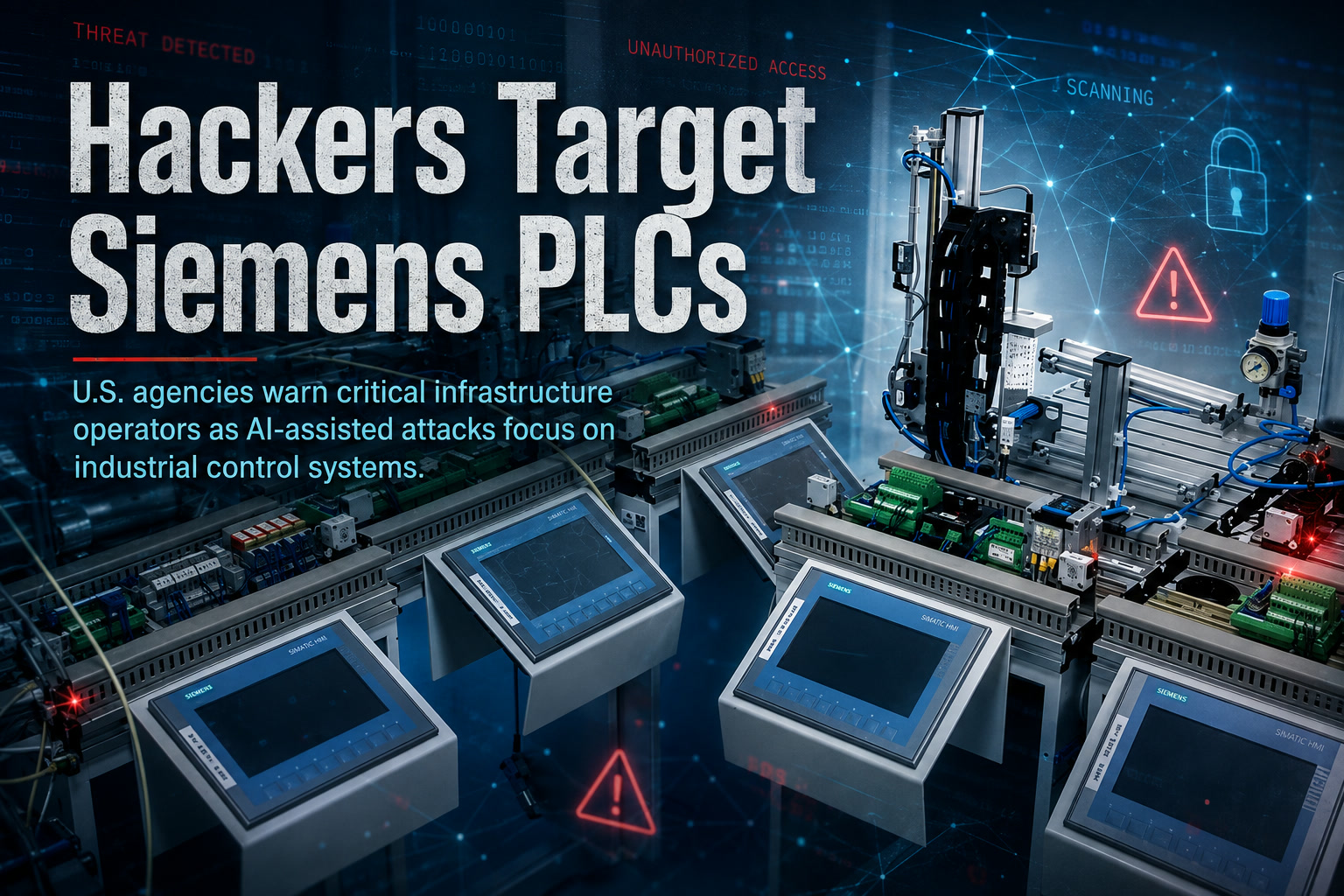
U.S. authorities are warning that hackers linked to Iran are actively targeting Siemens S7-series programmable logic controllers (PLCs) used across water systems, energy facilities, manufacturing plants and other critical infrastructure.
The warning is particularly concerning because the attackers are reportedly using AI tools to help generate exploitation scripts, identify additional attack paths and adapt their techniques as defenders strengthen their systems.
The advisory was jointly issued by several U.S. agencies, including the Cybersecurity and Infrastructure Security Agency (CISA), National Security Agency (NSA), Federal Bureau of Investigation (FBI), Department of Energy (DOE) and Environmental Protection Agency (EPA).
Their message is clear: this is not merely a theoretical cybersecurity scenario.
Industrial control systems that are directly exposed to the internet and poorly secured are already being actively targeted.
Hackers Are Searching for Exposed Siemens Controllers
Siemens S7 PLCs are industrial computers designed to control physical equipment and processes.
They can be found in factories, water-treatment facilities, energy infrastructure and many other industrial environments.
According to CISA, attackers are using internet-scanning services to locate PLCs that are publicly accessible, running outdated software or protected by weak security controls.
Once an exposed system is identified, publicly available technical information can potentially help attackers understand how the device works and develop methods for interacting with it remotely.
The sectors highlighted in the advisory include:
Unlike an attack against an ordinary website, compromising industrial equipment can have consequences that extend beyond stolen information.
A successful attack could potentially interrupt production, shut down equipment, disrupt water services or create dangerous operating conditions.
AI Is Making the Attacks More Adaptable
One of the most important parts of the warning is the reported use of artificial intelligence.
Attackers can use AI coding tools to accelerate the creation and modification of exploitation scripts.
That does not necessarily mean AI automatically discovers and compromises industrial systems on its own.
However, it can reduce the amount of time and expertise required to analyse technical documentation, modify existing code and explore additional attack vectors.
This can be particularly useful when attackers encounter defensive controls.
Instead of manually rewriting tools repeatedly, AI can potentially help generate variations more quickly.
The agencies also warn that malicious software can be designed to resemble legitimate industrial monitoring tools by incorporating widely available open-source automation libraries.
That can make suspicious software more difficult to recognise at first glance.
Internet-Connected PLCs Are a Major Risk
Many industrial devices were originally designed to operate inside isolated networks.
Security was often based on the assumption that outsiders simply could not reach them.
That assumption has gradually disappeared.
Industrial systems are increasingly connected to corporate networks, cloud services and remote-management platforms.
This connectivity provides enormous operational benefits, but it also creates new attack surfaces.
A PLC directly reachable from the public internet is particularly risky.
If attackers can interact with an industrial controller remotely, they may be able to study its configuration, identify outdated components or attempt known vulnerabilities without ever physically entering the facility.
For critical infrastructure operators, the safest approach is therefore to ensure that industrial controllers are not directly exposed to the internet unless absolutely necessary.
Remote access should instead pass through properly secured gateways, VPNs or other controlled access systems.
The Impact Could Go Far Beyond IT Downtime
An attack against a normal office computer may result in stolen files, ransomware or lost productivity.
Industrial control systems are different because they interact with the physical world.
A compromised PLC could potentially affect pumps, valves, motors, production equipment or other machinery.
CISA warns that exploitation could lead to:
The water sector is an obvious example.
A successful compromise might not simply take a website offline.
Depending on the targeted system, it could interfere with pumping, treatment or monitoring processes.
That is why cybersecurity incidents involving industrial infrastructure are treated as national-security concerns rather than ordinary IT problems.
Operators Are Being Urged to Patch and Isolate Systems
The joint advisory recommends several basic but important protections.
Organisations operating Siemens S7 PLCs should ensure firmware and related software are kept up to date with the latest applicable security patches.
Industrial systems should also be separated from the public internet whenever possible.
Strong authentication and access controls should be applied to any system that supports remote access.
Network monitoring is equally important.
Industrial-control-system operators need visibility into unusual commands, unexpected connections or abnormal behaviour.
Traditional enterprise cybersecurity tools alone may not always be enough because industrial protocols and devices behave differently from conventional servers and workstations.
Dedicated ICS monitoring can therefore help identify behaviour that would otherwise go unnoticed.
Recent Attacks Show Why the Warning Matters
The advisory arrives shortly after cyberattacks reportedly affected water infrastructure across several U.S. states, with the activity suspected of having links to Iran.
Although the agencies did not directly attribute every Siemens-related attack described in the warning to a specific organisation, the timing reinforces broader concerns around cyber operations targeting critical infrastructure.
Such attacks are increasingly becoming part of geopolitical conflict.
During Russia's invasion of Ukraine in 2022, cyberattacks were used alongside conventional military operations to disrupt government websites and digital services.
More recently, destructive malware reportedly wiped systems in Iran during the first quarter of 2026 while military tensions involving the United States were escalating.
These incidents demonstrate that cyber operations are no longer isolated from real-world geopolitical events.
Digital infrastructure can become another battlefield.
Critical Infrastructure Has Become a High-Value Target
Water systems, energy grids and manufacturing facilities are particularly attractive targets because disruption can create immediate economic and social consequences.
Cybercriminals may attack these organisations for ransom because they know operators cannot afford prolonged downtime.
Nation-state actors may have different motivations, including espionage, disruption or establishing access that could be used during a future conflict.
The increasing use of internet-connected industrial equipment makes those environments easier to find.
Search engines designed to identify publicly accessible devices can reveal industrial controllers around the world within minutes.
Attackers no longer necessarily need to spend weeks discovering potential targets.
If a vulnerable PLC is exposed directly to the internet, it may already be visible to anyone who knows where to look.
AI Does Not Replace Basic Security Weaknesses
It is easy to focus entirely on the AI component of this warning, but the more fundamental problem remains familiar.
Attackers are still benefiting from:
- Outdated software
- Internet-exposed systems
- Weak access controls
- Poor network segmentation
- Limited monitoring
AI simply allows malicious actors to work faster against weaknesses that already exist.
A properly patched industrial controller isolated from unnecessary internet access remains much harder to attack regardless of how sophisticated the attacker's AI tools become.
The lesson is therefore not that AI suddenly makes every industrial system vulnerable.
It is that existing security gaps become increasingly dangerous when attackers have better automation tools available.
Final Thoughts
The warning surrounding Siemens S7 controllers shows why cybersecurity for critical infrastructure needs to move beyond traditional IT thinking.
Industrial controllers can operate pumps, manufacturing equipment, water-treatment systems and other machinery that directly affects the physical world.
If attackers gain control of those systems, the consequences can extend far beyond stolen files or an unavailable website.
The reported use of AI adds another layer of urgency because attackers can potentially develop and modify exploitation tools faster than before.
But the most effective protections remain straightforward: patch vulnerable systems, remove unnecessary internet exposure, strengthen authentication, segment industrial networks and monitor closely for abnormal activity.
AI may be accelerating cyberattacks, but poorly protected infrastructure remains the real opportunity attackers are exploiting.











Comments 0