

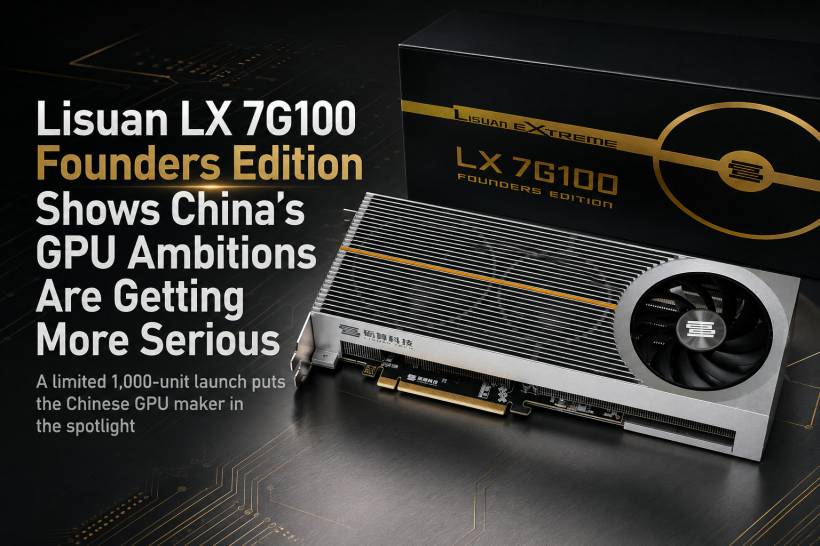
The graphics card market has long been dominated by familiar names, especially NVIDIA and AMD. Because of that, whenever a newer GPU maker enters the conversation with a consumer graphics card, it naturally attracts attention. Lisuan, a Chinese GPU company, is now preparing to release its LX 7G100 graphics card, and the company is presenting it in a rather eye-catching way: as a Founders Edition model.
Of course, the name immediately sounds familiar because NVIDIA has used "Founders Edition" branding for its own graphics cards for many years. Lisuan's use of the same phrase may raise eyebrows, but the more interesting part is not really the naming. The bigger story is that China's domestic GPU development continues to move forward, and Lisuan appears to be positioning the LX 7G100 as a serious limited-run product rather than a quiet technical experiment.
A Limited Edition GPU For The Chinese Market
The Lisuan LX 7G100 Founders Edition will reportedly be limited to only 1,000 units. Each card will come with its own serial number and a signature from Xuyan Yifang, the company's co-founder and co-CEO. That makes the card feel more like a collector-focused or launch-celebration product than a normal mass-market graphics card.
For now, the card is expected to be sold only in China. That is not too surprising, especially for a domestic GPU maker still building recognition, software support, driver maturity, and user confidence. Launching locally first gives Lisuan more control over the rollout and allows it to gather feedback from a market that is increasingly interested in homegrown technology alternatives.
Limited availability also creates a sense of exclusivity. Whether that is enough to attract gamers, developers, collectors, or domestic hardware enthusiasts will depend on how well the card actually performs once it reaches users.
What The LX 7G100 Offers On Paper
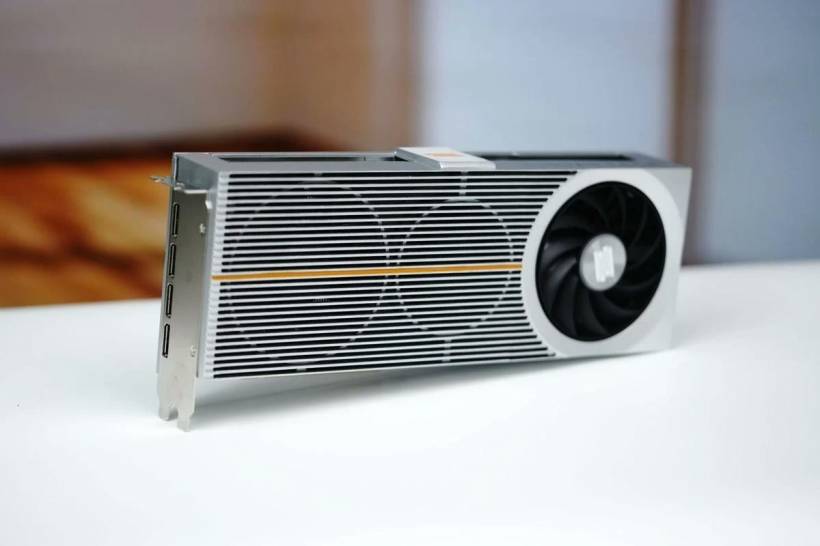
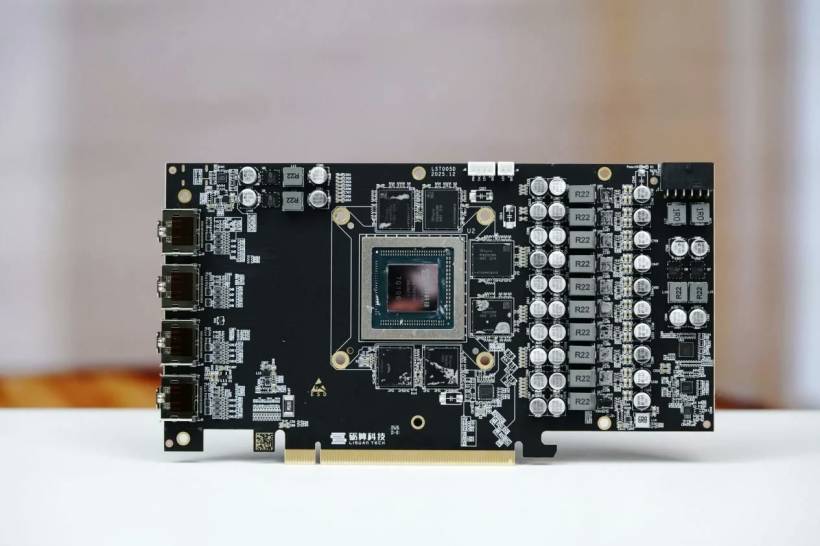
In terms of specifications, the LX 7G100 is built around a 6nm GPU and comes with 12GB of GDDR6 memory. It runs on a PCIe 4.0 interface and includes four DisplayPort 1.4a outputs. The card also supports DirectX 12, Vulkan, OpenGL 4.6, and OpenCL 3.0.
Those specifications suggest that Lisuan is not trying to produce a very basic display adapter. The card is clearly meant to support modern graphics workloads, gaming APIs, and compute-related tasks. The 12GB of GDDR6 memory is also notable, especially in a market where memory capacity has become a common talking point among gamers and creators.
Still, specifications only tell part of the story. GPU performance depends heavily on architecture, drivers, game optimisation, software compatibility, and long-term support. That is where newer GPU vendors usually face their biggest challenge.
The RTX 4060 Performance Claim Needs Caution
Lisuan has claimed that the LX 7G100 can deliver performance on par with NVIDIA's GeForce RTX 4060. That is a bold comparison because the RTX 4060 is a well-known mainstream gaming GPU with mature drivers, broad game support, and strong compatibility across modern Windows gaming environments.
It is always worth treating early manufacturer performance claims carefully, especially when independent reviews are not yet widely available. Matching another GPU on paper or in selected tests does not always translate into consistent real-world performance across different games and workloads.
This is especially important for a newer GPU ecosystem. Even if the raw hardware has potential, drivers can make or break the experience. A card may perform well in one benchmark but struggle in certain games, APIs, engines, or productivity tools if the software stack is not mature enough.
Why Domestic GPU Development Matters
The LX 7G100 is more than just another graphics card launch. It is part of a wider push by Chinese technology companies to develop more domestic hardware capabilities. GPUs are especially important because they support gaming, graphics rendering, video processing, AI workloads, scientific computing, and professional visualisation.
Building a competitive GPU is extremely difficult. It requires strong chip design, manufacturing access, memory support, driver engineering, developer tools, API support, and years of software refinement. That is why the global GPU market has remained difficult for new players to enter.
Even if Lisuan's first cards do not immediately challenge NVIDIA or AMD at the highest level, their progress still matters. Every working product gives the company more experience, more developer feedback, and more opportunity to improve future generations.
The LX 7G106 Shows More Real-World Signs
Lisuan also has another GPU known as the 7G106, and this model appears to have more visible performance evidence available. A post on X reportedly showed the card running Black Myth: Wukong at 4K, while also achieving a playable average of around 70fps at Full HD using the High graphics preset.
That kind of demonstration is important because it gives people something more concrete to discuss. Black Myth: Wukong is a modern and visually demanding game, so seeing a domestic GPU handle it in some form suggests that Lisuan's platform may have genuine gaming potential.
However, as with any early performance showcase, it still needs to be tested more broadly. A single game demo does not tell the whole story. Users will want to know how these GPUs perform across multiple titles, resolutions, graphics settings, APIs, and driver versions.
A Look At The 7G106 Specifications
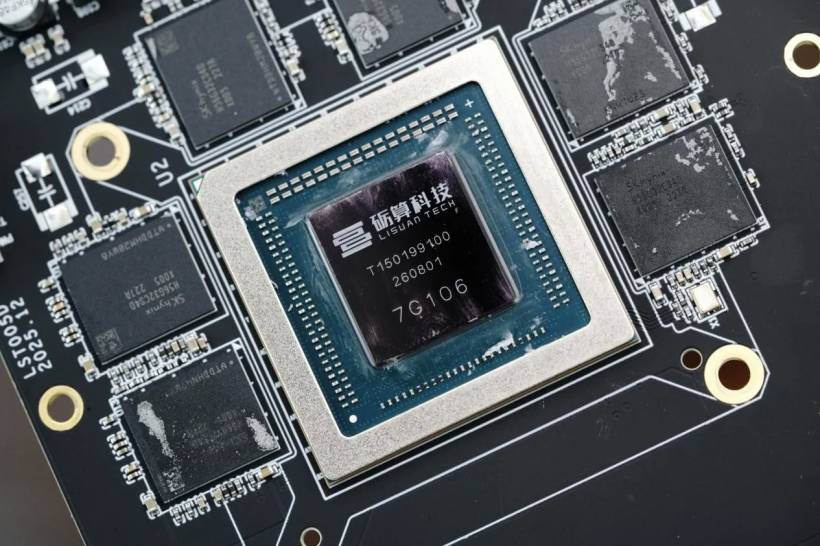
The 7G106 reportedly supports DirectX 12 without ray tracing, Vulkan 1.3, OpenGL 4.6, and OpenCL 3.0. Under the hood, it features 192 texture mapping units, 96 raster operation units, and support for up to 12GB of GDDR6 memory across a 192-bit memory bus.
It also includes hardware-accelerated AV1 and HEVC decoding up to 8K60, along with AV1 encoding at 4K30 and HEVC encoding at 8K30. That matters because GPUs are no longer judged only by gaming frame rates. Video encoding, decoding, streaming, editing, and media playback are now important parts of the overall graphics card experience.
Good media support could make Lisuan's GPUs more useful beyond gaming, especially for users who need video playback, content creation, or workstation-style workloads.
The Real Test Will Be Software Support
For Lisuan, the biggest challenge will likely be software rather than hardware alone. NVIDIA and AMD have spent decades refining their drivers, developer relationships, game profiles, productivity application support, and feature ecosystems. Intel has also shown how challenging it can be to enter the modern GPU market, even with strong engineering resources behind it.
New GPU makers need to prove that their cards are not only capable in selected demos but dependable across everyday use. Users will expect stable drivers, regular updates, broad game compatibility, proper API support, and predictable performance.
This is where Lisuan's long-term commitment will matter. A limited Founders Edition launch may generate attention, but wider confidence will come only when the company shows consistent software improvement over time.
Why The Founders Edition Branding Is Interesting
The use of "Founders Edition" may be the easiest talking point because it immediately reminds people of NVIDIA. Whether Lisuan intended that comparison or simply wanted a premium-sounding launch name, it does make the card more noticeable.
But the branding also places pressure on the product. A Founders Edition-style release usually suggests something special, polished, or symbolic. If the LX 7G100 is meant to represent Lisuan's arrival as a serious GPU maker, then users will expect the card to feel more than experimental.
The limited 1,000-unit run, serial numbering, and co-founder signature all point toward a launch meant to create identity and prestige. Whether that identity grows into a broader market presence remains to be seen.
Final Thoughts
The Lisuan LX 7G100 Founders Edition is an interesting development because it shows another step in China's domestic GPU journey. On paper, it offers modern specifications, 12GB of GDDR6 memory, support for key graphics APIs, and a limited collector-style release aimed at the Chinese market.
The company's claim of RTX 4060-level performance is ambitious, but it should be treated carefully until independent testing becomes available. The real question is not only whether the hardware can produce strong numbers in selected situations, but whether Lisuan can deliver stable drivers, broad game support, and a smooth user experience over time.
Even so, the LX 7G100 is worth watching. It may not immediately shake the global GPU market, but it represents progress from a newer player trying to build its own place in a very difficult industry. For now, Lisuan's Founders Edition card is less about replacing the established giants and more about proving that China's GPU ambitions are becoming harder to ignore.











Comments 0