

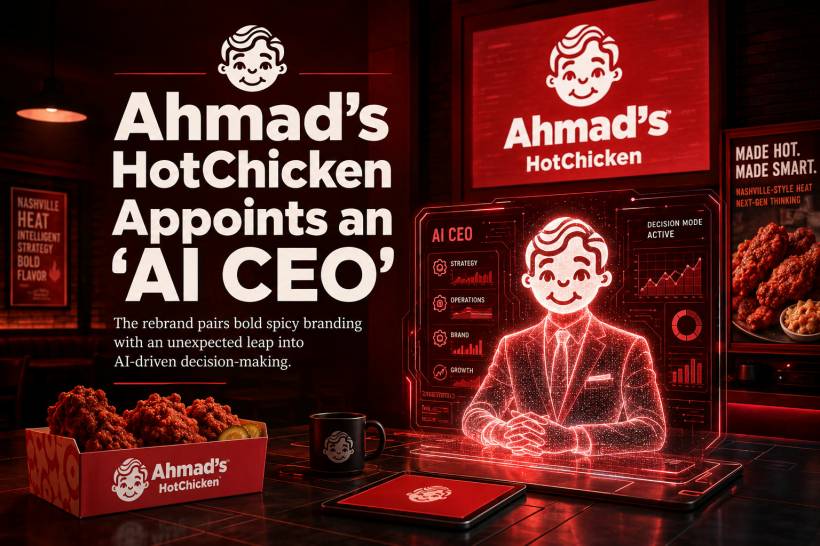
Ahmad's Fried Chicken has entered a new phase with a refreshed name, a new brand direction, and an unusual leadership announcement. The local fried chicken chain is now known as Ahmad's HotChicken, signalling a stronger focus on spicy chicken offerings and a more modern identity.
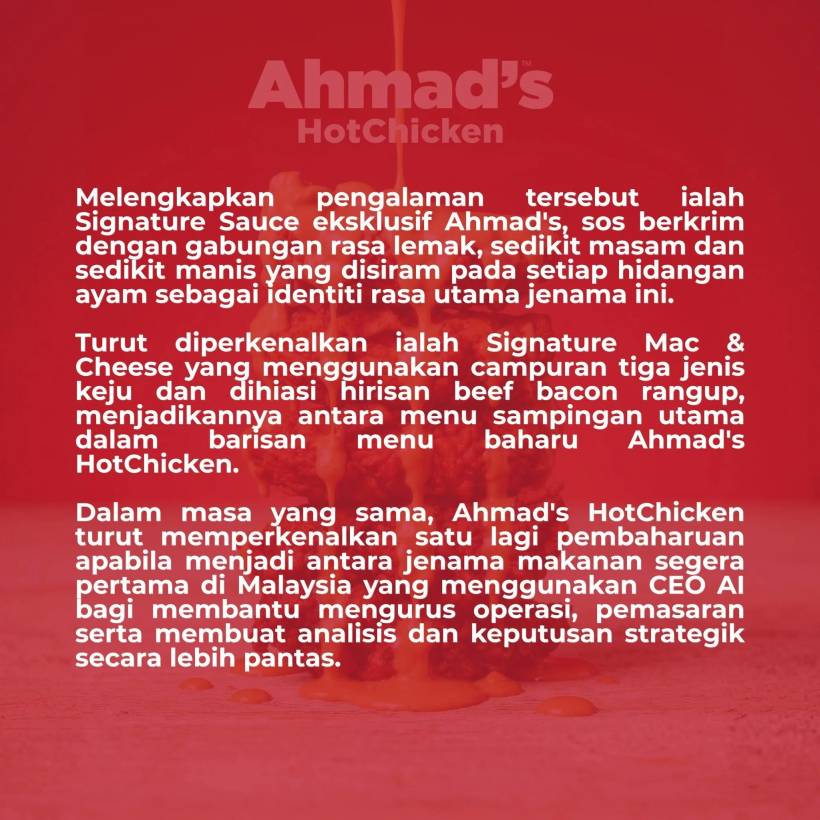
However, the rebrand is not the only thing drawing attention. The company has also announced the appointment of what it describes as an "AI CEO" — an artificial intelligence system intended to support areas such as operations, marketing, data analysis, and strategic decision-making.
It is a bold move for a food-and-beverage business, especially one operating across dozens of locations in Malaysia.
More Than a Name Change
The shift from Ahmad's Fried Chicken to Ahmad's HotChicken appears to be part of a wider attempt to position the brand around spicy, attention-grabbing menu items. The company has already introduced increasingly intense chicken options, including a Carolina Reaper-based offering that requires customers to acknowledge a waiver before ordering.
That kind of menu approach is clearly aimed at a generation of diners who enjoy food challenges, social media-worthy experiences, and bold flavours. The new name makes that direction much clearer: this is no longer simply a fried chicken brand, but one that wants to be associated with heat, spice, and a more distinctive personality.
With around 40 outlets across Peninsular Malaysia and East Malaysia, Ahmad's HotChicken already has a sizeable presence. A rebrand at this stage can help the company create a more consistent identity across its outlets, packaging, marketing campaigns, and digital platforms.
What Does an "AI CEO" Actually Mean?
The company has not yet provided detailed information about how its AI CEO will operate in practice. Based on its announcement, the system is expected to help manage operational processes, support marketing activities, analyse business data, and provide faster insights for strategic decisions.
That does not necessarily mean artificial intelligence will completely replace human leadership. In most real-world business settings, AI works more as a decision-support tool than an independent executive. It can analyse sales trends, identify popular menu items, compare outlet performance, forecast demand, track campaign results, and flag operational issues much faster than manual reporting.
For a restaurant chain, this could potentially be useful in several ways:
• Forecasting demand to reduce food waste and improve stock planning
• Tracking customer preferences and campaign performance
• Supporting outlet staffing and operational scheduling
• Analysing sales data to guide promotions and pricing decisions
• Helping marketing teams respond faster to customer behaviour and trends
The important question will be how much authority the AI system actually has. A company can describe a platform as an "AI CEO" for branding purposes, while still keeping real approval, accountability, and leadership decisions in the hands of human executives.
AI Leadership Roles Are Still Rare
The idea of appointing AI to an executive-level role may sound futuristic, but it remains uncommon. A few organisations have experimented with similar announcements in recent years, often positioning AI systems as digital executives that can assist with workflows, analysis, automation, and internal decision-making.
One often-cited example is Dictador Europe, a Polish spirits company that introduced an AI-powered robot named Mika as its CEO in 2023. Another is NetDragon WebSoft, a Hong Kong-based gaming and education technology company that appointed an AI humanoid named Tang Yu to assist with organisational management, workflow automation, data review, and administrative processes.
Even in these cases, AI does not remove the need for human oversight. Businesses still require people to make ethical choices, manage relationships, handle unexpected situations, take legal responsibility, and understand the emotional side of customer and employee experience.
AI may be able to spot trends in a spreadsheet, but it cannot fully replace the judgement needed when dealing with people, brand reputation, local culture, or a crisis involving staff or customers.
A Marketing Statement or a Genuine Business Experiment?
For Ahmad's HotChicken, the AI CEO announcement could serve two purposes at once. It may be a practical effort to make operations more data-driven, but it is also an effective way to create public interest around the brand.
Food businesses compete heavily for attention. A spicy chicken menu may attract customers looking for a challenge, while an AI CEO announcement gives people another reason to talk about the company online. Combined, the rebrand creates a more technology-forward and unconventional image for the chain.
The real test will come later. Customers and industry observers will likely want to know whether the AI system produces measurable improvements, such as faster service, better outlet management, more relevant promotions, or smarter menu decisions.
Final Thoughts
Ahmad's HotChicken is making a noticeable attempt to stand apart from the usual fried chicken chain. The new branding leans into bold flavours and viral-friendly food experiences, while the AI CEO announcement positions the company as willing to experiment with emerging technology.
For now, there are still many unanswered questions about what the AI CEO will actually control and how deeply it will be involved in business decisions. Still, the move reflects a growing reality: artificial intelligence is no longer limited to tech companies, and businesses in retail, hospitality, food, and services are increasingly looking at how AI can support faster and more informed decision-making.











Comments 0