

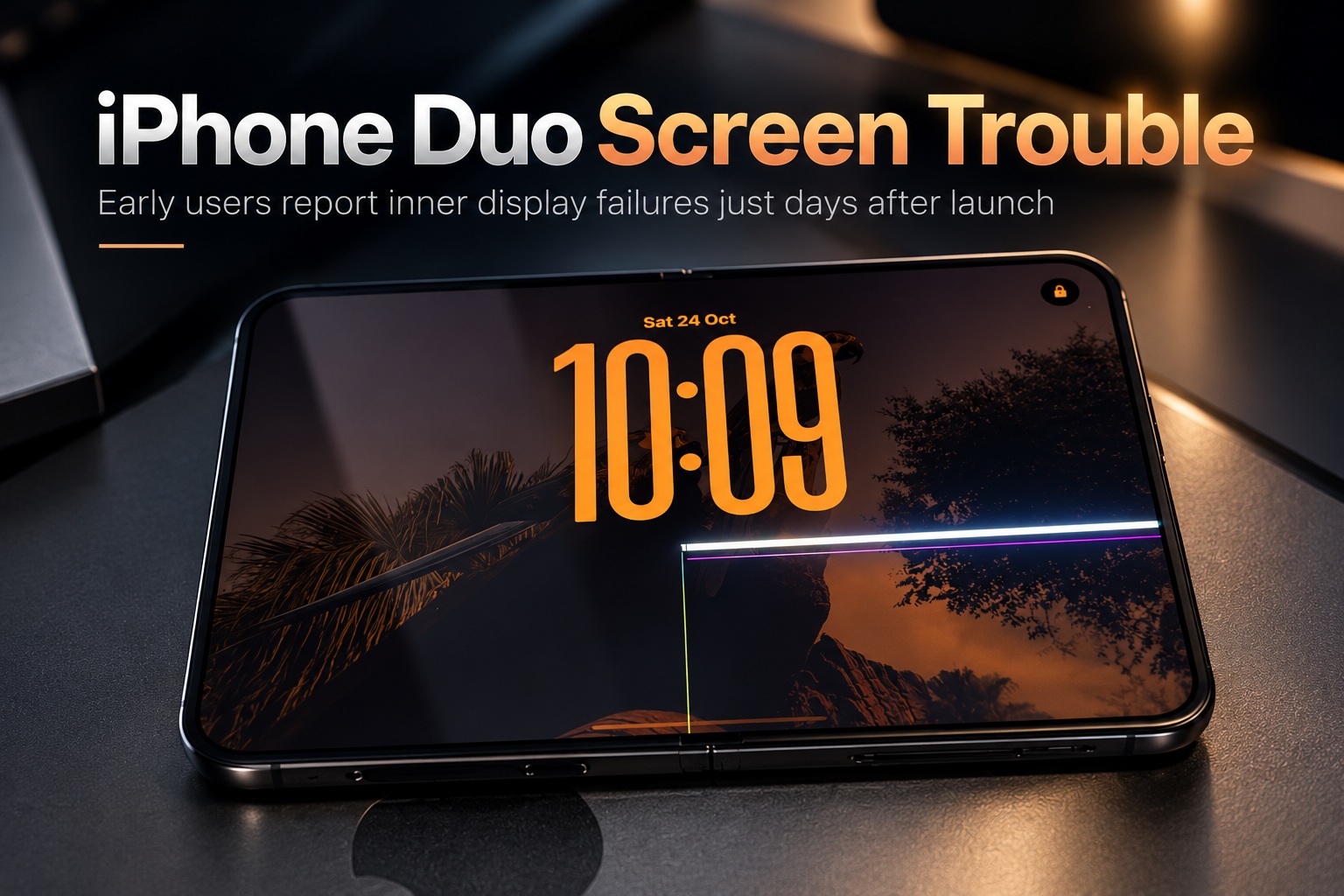
Apple entered the foldable smartphone market much later than many Android manufacturers, apparently preferring to wait until it believed the technology and overall design were mature enough for its own approach. The recently launched iPhone Duo was therefore expected to avoid many of the problems that affected some earlier foldable devices, but early user reports suggest the first-generation product may already be facing a serious display-related issue.
Several owners have reported that the phone's internal foldable display developed permanent damage after only hours or days of normal use. The failures appear to share a remarkably similar visual pattern, with a vertical line running down the centre of the screen and another horizontal line extending across the right side of the folding panel.
Reports Describe A Similar Failure Pattern
The most interesting aspect of the complaints is how similar the reported failures appear to be. Rather than showing random cracks or isolated dead pixels, affected devices reportedly develop the same combination of vertical and horizontal lines around the folding area.
This consistency has raised questions over whether the problem could be related to a particular structural or mechanical weakness rather than accidental damage. In several cases, users said the display worked normally until the phone was opened and the hinge suddenly behaved differently from usual.
The damage reportedly appeared immediately after the unusual hinge resistance was overcome.
Users Say The Hinge Becomes Unusually Stiff
According to several reports, the first warning sign is increased resistance when opening the iPhone Duo. Instead of unfolding smoothly, the hinge begins to feel noticeably stiffer and requires more force than expected.
Users who continued opening the device said they then heard a popping or cracking sound from around the hinge area. Once the phone was fully opened, permanent lines became visible across the internal display.
One affected owner described the sound as similar to glass snapping, suggesting that something inside the folding mechanism or screen assembly may have been placed under excessive stress.
One Device Reportedly Failed After Only Three Hours
Perhaps the most concerning report involves an owner who said the problem appeared only around three hours after receiving the phone. Other users reported experiencing similar failures after several days rather than immediately.
The affected owners generally insist that they had not modified the device, dropped it or subjected it to unusual conditions. Several also claimed previous experience with foldable smartphones, arguing that they were familiar with how such devices should be handled.
If those accounts are accurate, the failures appear to have occurred during ordinary opening and closing rather than obvious misuse.
The Problem Has Already Earned The Name "Crackgate"
As more reports appeared online, users began informally referring to the issue as "crackgate." The nickname reflects concern that the problem could eventually develop into a broader controversy if additional units begin failing in the same way.
At this stage, however, there is no reliable information showing how widespread the problem actually is. A small number of highly visible complaints can make an issue appear larger than it really is, particularly after the launch of a heavily anticipated product.
The possibility that the failures are limited to a defective manufacturing batch therefore cannot yet be ruled out.
Apple Has Not Yet Issued An Official Explanation
Apple has not publicly explained what is causing the display failures or confirmed whether the company is investigating a wider hardware defect. Without an official statement, it remains unclear whether the affected phones share a particular production run, component supplier or manufacturing date.
This lack of information also makes it difficult to determine whether existing owners should be concerned or whether the reports involve only a very small number of units.
For now, users noticing unusual hinge resistance would probably be better off avoiding excessive force and contacting Apple rather than attempting to push the device open.
iFixit May Have Identified A Possible Weak Point
A teardown by iFixit has provided one possible explanation for the repeated damage pattern. During its examination of the iPhone Duo, the repair specialist paid particular attention to the hinge and the area corresponding with the reported display failures.
The team observed that part of the hinge has a slightly different shape around the location where the damage appears to occur. This has led to speculation that the problem could involve the central support structure rather than the OLED panel alone.
The theory remains unconfirmed, but it offers a plausible explanation for why several damaged devices display similar lines in almost exactly the same area.
A Centre Support Bar Could Be Creating A Stress Point
One possibility is that the centre support bar within the hinge may not be moving sufficiently downward when the device closes. If that component remains slightly too high, pressure could become concentrated at one particular area of the fold.
Repeated opening and closing could then create a mechanical stress hotspot. When the hinge becomes unusually stiff and the user pushes past that resistance, the pressure may become enough to damage the extremely thin internal display structure.
This would also help explain why users report hearing a snap or pop immediately before the permanent display lines appear.
Several Structural Components Meet Around The Same Area
The hinge design appears particularly complicated around the suspected failure point. Several structural edges and components converge near the centre of the fold, potentially concentrating stress in a relatively small area.
Foldable screens are fundamentally more delicate than conventional smartphone displays because the panel and protective layers need to flex repeatedly. A mechanical component that applies even slightly excessive pressure can eventually damage the layers underneath.
Still, the support-bar explanation currently remains a theory rather than a confirmed diagnosis from Apple.
Foldable Smartphones Have A History Of Display Problems
Apple would not be the first company to encounter difficulties with a first-generation foldable smartphone. Samsung famously experienced significant problems with the original Galaxy Fold before its commercial release.
Early review units suffered display failures for several reasons, forcing Samsung to delay the launch and redesign parts of the device. Improvements were eventually made to the hinge, protective layers and overall structure before the revised model reached consumers.
The episode demonstrated how difficult it is to create a reliable display that repeatedly folds while remaining thin enough for a smartphone.
Apple Waiting Longer Did Not Eliminate Every Risk
Apple's decision to enter the foldable market much later created expectations that it would avoid the mistakes experienced by earlier manufacturers. The company had years to observe the evolution of folding displays, hinge designs and protective materials before releasing its own device.
That additional development time may have solved many problems, but foldable hardware remains mechanically complicated. Moving parts, flexible screens and extremely tight tolerances create failure points that conventional smartphones simply do not have.
If the reported iPhone Duo failures are caused by the hinge, it would demonstrate that even extensive development cannot completely remove the risks associated with first-generation hardware.
First-Generation Products Often Reveal Unexpected Weaknesses
Completely new product categories frequently expose issues that laboratory testing fails to reproduce. Real customers open devices differently, carry them under different conditions and expose them to thousands of combinations of temperature, pressure and everyday handling.
A hinge that performs reliably during controlled durability testing could still behave differently under particular manufacturing tolerances or environmental conditions. This is why early production batches sometimes reveal weaknesses only after thousands of units reach consumers.
The important question will be whether the reported iPhone Duo failures represent isolated manufacturing defects or evidence of a fundamental design problem.
A Bad Manufacturing Batch Would Be The Better Scenario
If the problem is restricted to a particular batch of devices, Apple could potentially resolve it through replacement units and manufacturing adjustments. Components produced outside their intended tolerances could create additional pressure around the hinge even if the overall design itself is sound.
This kind of issue would still be inconvenient for affected customers, but it would be considerably easier to address than a structural defect affecting every iPhone Duo.
Serial-number patterns or manufacturing-date information from affected units could eventually provide more clues if additional reports emerge.
A Design-Level Problem Would Be Much More Serious
The more concerning possibility is that the hinge itself contains an inherent stress point. If every unit uses the same structural design and the problem develops gradually through normal use, Apple could face a much larger hardware issue.
Correcting a fundamental hinge problem may require revised internal components rather than simply improving manufacturing quality. Depending on the severity, that could potentially involve repair programmes or changes to later production units.
There is currently no evidence strong enough to conclude that this is the case, but the repeated failure pattern explains why the reports are receiving attention.
Foldable Displays Remain Extremely Difficult To Engineer
Unlike conventional smartphone displays, foldable OLED panels need to bend through the same region thousands of times throughout their lifespan. The screen must remain thin and flexible while still resisting scratches, pressure and internal mechanical forces.
The hinge underneath the panel also needs to provide consistent support across the fold. Too little support can leave the display vulnerable to pressure, while too much pressure can damage the screen during movement.
This balance makes foldables inherently more complicated than rigid smartphones. Even relatively small design differences can influence long-term durability.
Limited Availability Makes Replacements More Difficult
Some affected owners have already contacted Apple for support, although the reported outcomes have varied. One user ultimately chose to return the faulty phone instead of attempting to obtain a replacement.
Limited availability appears to be part of the problem. Because the iPhone Duo remains difficult to obtain shortly after launch, receiving an immediate replacement may not always be straightforward.
That can make an early hardware failure particularly frustrating for customers who waited to purchase Apple's first foldable smartphone.
Owners Experiencing Resistance Should Be Careful
If an iPhone Duo suddenly becomes unusually difficult to open, forcing the hinge may not be the best response based on the reported failures. The common pattern described by users involves increased resistance followed by a cracking or popping sound and immediate display damage.
Until the cause becomes clearer, users encountering similar behaviour should consider stopping rather than pushing through the resistance. Contacting Apple or an authorised service provider would be a safer option than potentially turning a hinge problem into permanent screen damage.
A foldable phone should normally open smoothly without requiring excessive force.
Documenting The Failure Could Help With Support
Owners experiencing display problems should also document the condition of the device as soon as possible. Photographs or video showing the display lines, hinge behaviour and physical condition of the phone could be useful when discussing the issue with Apple Support.
This is particularly relevant if there is no visible external damage. Clear documentation can help demonstrate that the screen failed during normal operation rather than after an impact.
Keeping purchase information and device details available may also make the support process easier.
Apple's Response Will Be Important
The next major development will likely come when Apple either acknowledges the reports or enough affected devices appear to establish a clearer pattern. A relatively small number of isolated failures may simply be handled through normal warranty procedures.
If reports continue increasing, however, Apple may need to explain whether the issue involves a specific production batch or an aspect of the hinge design itself.
How quickly the company responds could also influence confidence in the iPhone Duo. Buyers spending premium prices on a first-generation foldable will naturally expect strong after-sales support if hardware problems appear.
The iPhone Duo Still Faces The Same Physics As Every Foldable
Apple's arrival in the foldable market was always going to attract comparisons with manufacturers that had spent years refining similar products. The company may have waited longer, but it still has to deal with the same fundamental engineering challenge: making a flexible screen survive repeated mechanical movement.
Samsung, Huawei, Honor, Motorola and other manufacturers have all gradually refined their foldable designs across multiple generations. Apple is beginning that journey much later, but the iPhone Duo is still ultimately a first-generation product.
Even Apple's engineering resources cannot completely eliminate the learning process that comes with introducing an entirely new form factor.
Final Thoughts
Reports of iPhone Duo inner displays failing after only hours or days of use are concerning, particularly because several affected devices appear to develop the same vertical and horizontal line pattern around the folding area. Users describe the hinge becoming unusually stiff before a popping or cracking sound is heard, after which permanent display damage appears.
A teardown has raised the possibility that a centre support component inside the hinge may be creating excessive stress at the same location, although that theory has not been confirmed. It remains entirely possible that the failures involve a limited manufacturing batch rather than a fundamental flaw across every iPhone Duo.
Apple has not yet publicly addressed the reports, so it is too early to know whether "crackgate" will develop into a significant hardware controversy or remain a relatively isolated launch issue.
What is clear is that foldable smartphones remain mechanically challenging even after years of industry development. Apple may have waited longer than its competitors before releasing one, but the iPhone Duo is still a first-generation foldable — and first-generation hardware has a habit of revealing weaknesses only after it reaches real users.
If your iPhone Duo begins feeling unusually stiff while opening, forcing it past that resistance may not be worth the risk. Until Apple provides more information, contacting support is probably the safer option.











Comments 0