

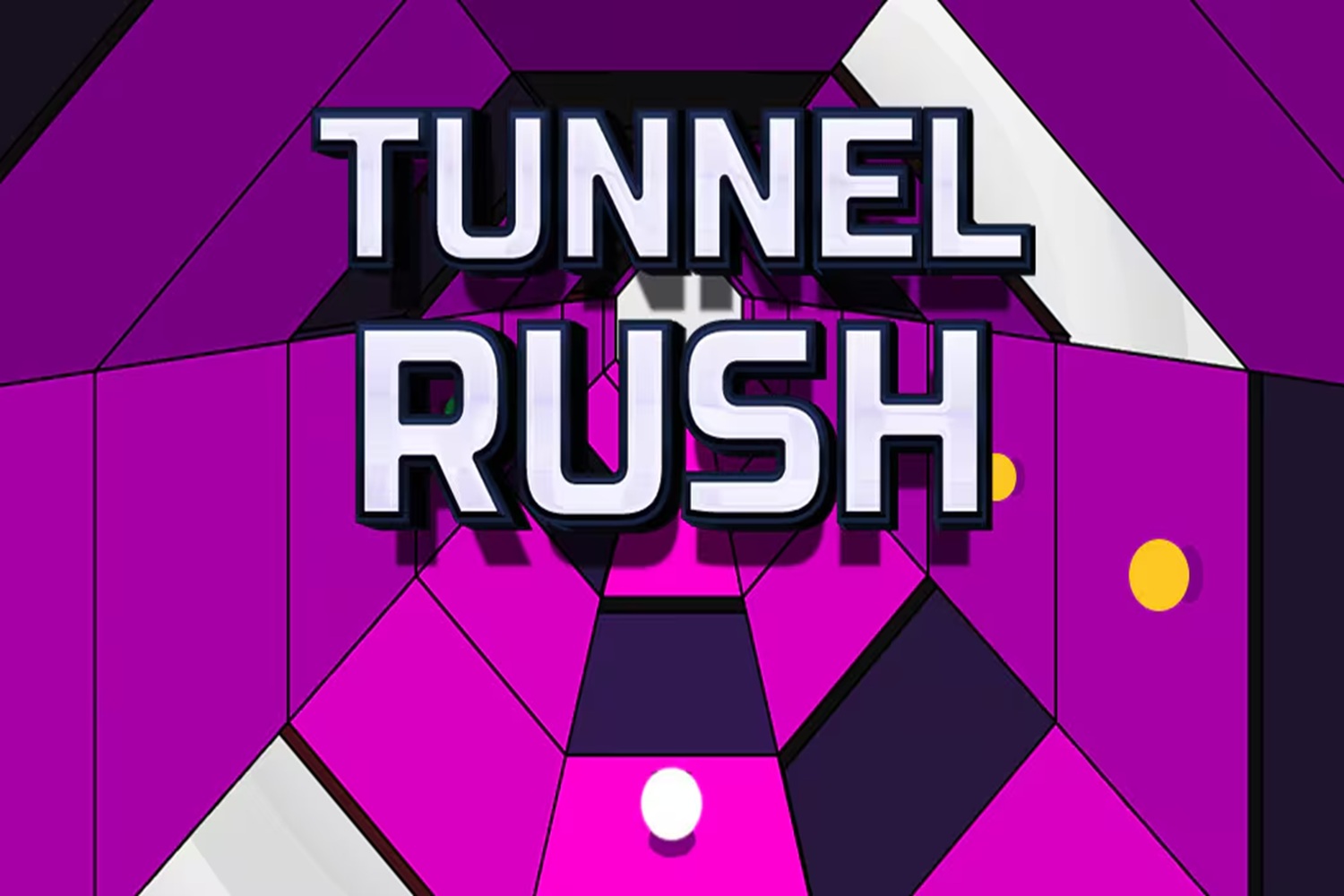
Tunnel Rush is a fast-paced 3D reflex game that strips arcade gameplay down to one simple challenge: survive for as long as possible while racing through a tunnel packed with moving obstacles. The player travels forward automatically, leaving only one responsibility—move left or right at exactly the right moment to avoid crashing. That simplicity makes the game easy to understand within seconds, but the speed and constantly changing obstacle patterns quickly turn each run into an intense test of concentration. One small mistake is enough to end an otherwise excellent attempt.
The tunnel constantly shifts in colour, shape, and visual rhythm while barriers rotate, slide, split apart, and appear directly in the player's path. Some obstacles provide obvious openings, while others require much faster reactions because the safe route changes as the player approaches. The further the run continues, the faster everything seems to happen, leaving less time to recognize patterns and commit to a direction. Tunnel Rush therefore becomes less about learning complicated controls and more about improving reaction speed, timing, and the ability to remain calm while the tunnel rushes toward you.
Now playable online through Lemon Web Games, Tunnel Rush brings its high-speed 3D movement, rotating obstacles, colourful environments, simple controls, and addictive reflex challenge directly into the web browser. Players can jump into a run almost immediately, move left and right through increasingly difficult sections, and attempt to survive farther than during the previous attempt. There are no complicated menus or lengthy tutorials slowing down the action, making the game ideal for quick sessions that can easily turn into repeated attempts. Whether chasing a better score or simply trying to survive one more difficult sequence, Tunnel Rush delivers a pure arcade challenge built around speed and precision.
The Tunnel Moves Forward Automatically
Tunnel Rush removes one of the most common decisions found in racing and platform games by controlling forward movement automatically. The player does not need to accelerate, brake, or decide when to advance. The tunnel is always moving toward the next obstacle.
This creates constant pressure because there is no option to stop and study what lies ahead. Every barrier must be understood while the player is already approaching it at speed.
The automatic movement also keeps the gameplay focused. Instead of managing several controls simultaneously, the player can concentrate entirely on positioning and timing.
Left and Right Are All You Need
The controls are deliberately minimal. Players move horizontally around the tunnel using simple directional input while the game handles everything else.
That simplicity makes Tunnel Rush extremely accessible. Even someone who has never played it before can understand what to do almost immediately.
However, simple controls do not mean easy gameplay. Because the game demands precise movement at high speed, small mistakes become increasingly costly as the run continues.
Rotating Barriers Create Constant Uncertainty
Many obstacles rotate around the tunnel, changing the location of the safe opening while the player is approaching. A gap that appears to be on the left may move toward the top or right by the time it is reached.
This forces players to read motion rather than simply aiming for a fixed hole. Understanding where the opening will be is more important than where it currently appears.
Rotating barriers are especially dangerous at higher speeds because the player has less time to predict the final position. What initially looks like a straightforward obstacle can become surprisingly difficult.
Moving Walls Demand Better Timing
Some hazards slide across the tunnel instead of rotating. These obstacles create temporary openings that may disappear or shift before the player reaches them.
The safest strategy is often to observe the direction of movement for a brief moment before committing. Moving too early can result in lining up with a gap that is no longer there.
Later runs become increasingly difficult because several moving elements can appear close together. Players need to process each one quickly without losing track of the obstacle immediately behind it.
Narrow Gaps Punish Overcorrection
Wide openings are relatively forgiving, but narrow gaps demand much more precise movement. Moving too far in either direction can cause a collision even when the correct route was identified.
This makes small adjustments increasingly important. Beginners often make large movements because they are reacting in panic, while experienced players learn to position themselves with greater control.
Narrow gaps also create some of the most satisfying moments in Tunnel Rush. Passing cleanly through one at high speed feels rewarding because there is almost no room for error.
The Tunnel Creates a Strong Sense of Speed
The first-person perspective makes movement feel much faster than a traditional overhead obstacle game. Walls, colours, and barriers rush directly toward the player, creating an almost roller-coaster-like sensation.
The visual design exaggerates this speed by constantly changing the shapes and patterns surrounding the route. Even when the actual mechanics remain simple, the presentation makes the experience feel intense.
This sense of speed is central to the game's appeal. Tunnel Rush is not simply about avoiding obstacles; it is about doing so while everything appears to be flying toward you.
Colour Changes Keep the Environment Visually Fresh
Tunnel Rush frequently changes the colours and lighting of the tunnel. Bright reds, blues, greens, yellows, and other combinations create a continuously shifting visual experience.
These changes help distinguish one section from another without interrupting the run. The environment can feel dramatically different even though the basic objective remains unchanged.
The changing colours also contribute to the hypnotic quality of the game. Long runs can feel almost rhythmic as the tunnel cycles through different visual moods.
The Minimalist Graphics Improve Readability
Despite the colourful presentation, Tunnel Rush does not overload the screen with unnecessary detail. Obstacles are usually represented through clear geometric shapes that can be recognized quickly.
This clarity is essential because the player has very little time to interpret what is coming. Detailed scenery would make the challenge harder for the wrong reasons.
The minimalist design keeps the focus on movement. Every visible shape matters because it may be something the player needs to avoid.
Reaction Speed Becomes More Important Over Time
Early sections provide enough time to recognize most obstacles comfortably. As the run continues, however, the margin for hesitation becomes smaller.
Players begin needing to react almost immediately after identifying a safe route. A delay of even a fraction of a second can place the player on the wrong side of the tunnel.
This creates a natural difficulty curve without introducing complicated new systems. The same basic actions simply need to be performed faster and more accurately.
Pattern Recognition Helps Reduce Panic
Although the obstacles can initially seem unpredictable, many follow recognizable styles of movement. Players gradually become familiar with rotating bars, sliding walls, split openings, and other recurring patterns.
Recognizing an obstacle quickly provides additional time to prepare. Instead of wondering what it will do, experienced players already understand the general behaviour.
This is one of the main ways skill develops in Tunnel Rush. Better players are not only reacting faster; they are identifying danger earlier.
Looking Ahead Is Better Than Watching Yourself
One common mistake is focusing too closely on the player's current position. Tunnel Rush becomes much easier when attention is directed farther down the tunnel.
Looking ahead gives more time to recognize the next obstacle and begin planning movement. The immediate position can often be controlled through peripheral vision.
This technique becomes increasingly important as the speed rises. Reacting only when an obstacle reaches the foreground is usually too late.
Small Movements Are Often Safer
Large directional changes can be useful when an opening appears on the opposite side of the tunnel, but they also increase the chance of overshooting.
Experienced players often use smaller corrections whenever possible. Staying close to the centre of a safe opening provides more flexibility for the next obstacle.
This controlled movement also helps when multiple hazards appear in rapid succession. A player who overcommits to one side may have difficulty recovering before the next barrier arrives.
Staying Near the Centre Can Be Useful
When the next obstacle is not yet clear, remaining relatively central provides more options. From the middle, the player can respond to an opening on either side without travelling as far.
Moving to the extreme left or right too early can become dangerous if the next safe route suddenly appears opposite.
The centre is not always the correct position, but it works well as a neutral starting point between obstacles. It keeps future movement flexible.
Speed Makes Familiar Obstacles Feel New
An obstacle that appears easy during the early game can become much more dangerous when encountered at higher speed. The mechanics have not changed, but the available reaction time has.
This is one of the cleverest aspects of Tunnel Rush's difficulty design. The game can reuse familiar obstacle concepts while still making them feel increasingly demanding.
Players therefore cannot simply memorize the shape and stop paying attention. The timing of every movement continues to matter.
One Mistake Usually Ends the Run
Tunnel Rush does not provide much room for recovery after a collision. Hitting an obstacle generally ends the attempt immediately.
This makes every successful section meaningful because there is always something to lose. A long run can disappear instantly after one poorly judged movement.
The harsh consequence also makes restarting extremely tempting. Players often know exactly what caused the failure and immediately want another chance to correct it.
Fast Restarts Keep the Game Addictive
A failed run does not lead to a lengthy loading sequence or complicated menu. Players can usually begin another attempt quickly.
This rapid restart cycle is essential to the game's appeal. Failure feels less frustrating when the next attempt begins almost immediately.
The player also retains knowledge from the previous run. Even though the score resets, reaction timing and pattern recognition continue improving.
Tunnel Rush Works Like an Arcade Score Challenge
There is no need for a complicated story or campaign structure because survival itself provides the objective. The farther the player travels, the stronger the run becomes.
This naturally encourages score chasing. Players begin comparing current attempts with previous records and trying to survive slightly longer.
The simplicity resembles classic arcade design. The mechanics are easy to understand, but mastery comes from repeatedly improving personal performance.
Concentration Matters as Much as Reflexes
Fast reactions are important, but maintaining concentration is equally critical. Long runs can become difficult simply because the player begins relaxing after several successful sections.
Tunnel Rush punishes distraction immediately. Looking away for only a moment can be enough to miss an obstacle.
The best runs usually happen when the player finds a steady rhythm and remains focused without becoming tense. Calm reactions are often faster than panicked ones.
Panic Causes More Mistakes Than Speed
When an obstacle appears unexpectedly, players may make several rapid corrections rather than committing to one direction. This often creates more danger than the obstacle itself.
Overcorrecting can send the player back and forth until there is no longer enough time to align with the opening. A single confident movement is usually better.
Learning to trust the first correct decision is an important skill. Tunnel Rush rewards decisive reactions.
The Game Creates a Rhythm
After enough practice, movement begins to feel almost musical. Obstacles appear, the player shifts position, another barrier arrives, and the cycle repeats.
This rhythm can make long runs feel surprisingly smooth. Instead of consciously thinking about every movement, players begin reacting instinctively.
The effect is one reason Tunnel Rush can become so absorbing. Once the player enters that rhythm, stopping voluntarily becomes difficult.
The First-Person Perspective Increases Tension
Seeing obstacles directly ahead creates more pressure than viewing them from above. The player feels as though they are physically travelling through the tunnel rather than guiding an object from a distance.
Barriers become larger as they approach, making mistakes feel increasingly dramatic.
This perspective also strengthens the sense of momentum. Even relatively simple geometric obstacles can feel threatening when they rush directly toward the screen.
The Game Is Easy to Learn but Difficult to Master
Almost anyone can understand Tunnel Rush within a few seconds. Move left. Move right. Avoid obstacles.
Mastery is much more complicated because higher speeds require increasingly precise decisions. The difference between a beginner and an experienced player becomes obvious through movement quality and survival distance.
This balance makes the game suitable for both casual and competitive play. New players can enjoy it immediately, while skilled players still have meaningful goals.
Short Sessions Can Easily Become Long Ones
A single attempt may last only a few minutes, making Tunnel Rush ideal for quick play. The problem is that failure often creates an immediate desire to try again.
One attempt becomes two, then five, then ten. The short format removes the psychological barrier of starting another run.
This makes Tunnel Rush especially effective as a browser game. Players can begin instantly without committing to a long campaign.
The Challenge Comes From Execution Rather Than Upgrades
There are no complicated skill trees required to improve performance. The most important upgrade is the player's own reaction speed and familiarity with obstacle patterns.
This creates a very clear form of progression. A section that once seemed impossible eventually becomes manageable because the player has improved.
The game does not need to tell players they are stronger. Their longer survival times provide the evidence.
Repeated Attempts Build Muscle Memory
After enough runs, certain movements become automatic. Players begin recognizing obstacle shapes and moving before consciously analysing them.
This muscle memory reduces hesitation, allowing attention to shift toward obstacles farther ahead.
The transformation is noticeable. Early attempts feel frantic, while later runs can feel surprisingly controlled even at much higher speeds.
Tunnel Rush Rewards Consistency
A spectacular dodge means little if the next simple obstacle causes a collision. Long runs depend on making many correct decisions consecutively.
This makes consistency more important than occasional brilliance. Players need to remain accurate through easy and difficult sections alike.
The strongest runs often look smooth rather than dramatic. Good players avoid unnecessary movements and maintain control for as long as possible.
The Game Remains Fair Despite the Speed
Tunnel Rush can feel overwhelming, but the obstacles generally provide a visible route through them. The challenge comes from recognizing that route quickly enough.
This gives failures a sense of responsibility. Players often understand exactly what they should have done differently.
That clarity is important because it motivates improvement. The game feels demanding rather than completely random.
Simple Sound Effects Strengthen the Experience
Audio helps reinforce movement, speed, and collisions without distracting from the visual challenge.
The sound design complements the tunnel's rapid presentation and helps maintain the arcade atmosphere.
Because concentration is important, the game avoids overwhelming the player with unnecessary audio information. Visual recognition remains the primary skill.
The Hypnotic Presentation Makes the Game Memorable
Tunnel Rush's combination of geometric shapes, shifting colours, first-person speed, and constant forward motion creates a distinctive visual identity.
Even screenshots are easy to recognize because the game looks unlike many traditional runners or obstacle games.
The presentation is not merely decorative. The tunnel itself becomes the entire world, creating an enclosed and focused challenge.
Playing Tunnel Rush Online Today
Through Lemon Web Games, Tunnel Rush can now be played directly in your web browser with no downloads or setup required. Features of the web-based version include:
New players should avoid making unnecessarily large movements. Stay relatively central whenever possible, look farther down the tunnel rather than concentrating only on the immediate foreground, and make controlled adjustments once the next safe opening becomes clear. Small movements preserve more options for whatever obstacle appears immediately afterward.
It is also important not to panic when the speed increases. The obstacle patterns remain readable even when reaction time becomes shorter. Focus on one barrier at a time while keeping enough awareness of what is coming next.
Who Should Play Tunnel Rush
Tunnel Rush is especially suitable for players who enjoy games that provide immediate challenge without requiring lengthy tutorials. The rules are understood almost instantly, leaving the rest of the experience entirely dependent on execution.
It should also appeal to players who enjoy personal improvement. Each run provides a clear opportunity to survive farther, react faster, and handle difficult patterns more confidently.
Play Tunnel Rush Online Now
Tunnel Rush turns a simple 3D tunnel into an increasingly intense test of reaction speed. Move left and right, weave through rotating barriers, anticipate sliding walls, line up with narrow gaps, and keep your concentration as the pace becomes faster and faster.
Through Lemon Web Games, players can experience Tunnel Rush directly in a modern browser and begin another run within moments. There are no complicated systems standing between the player and the challenge. Enter the tunnel, stay focused, and see how far your reflexes can take you.
Final Thoughts
Tunnel Rush succeeds because it understands how powerful simplicity can be. The controls require almost no explanation, yet the combination of speed, shifting obstacles, narrow gaps, and constant forward motion creates a challenge that can remain engaging for repeated sessions. Every failure feels immediate, but so does the opportunity to improve.
Its first-person presentation and colourful geometric design give the game a hypnotic quality that makes long runs surprisingly intense. The tunnel constantly changes without distracting from the central task, and increasing speed transforms familiar obstacles into fresh challenges. Players gradually learn that careful movement and pattern recognition matter just as much as raw reflexes.
Through Lemon Web Games, Tunnel Rush can now be enjoyed directly in the browser as a pure arcade-style test of concentration and timing. It is easy enough to understand in seconds but difficult enough to keep demanding improvement long after the first attempt. For players who enjoy simple games where one perfectly timed movement can make the difference between a new record and an instant crash, Tunnel Rush remains an addictive challenge.











Comments 0