

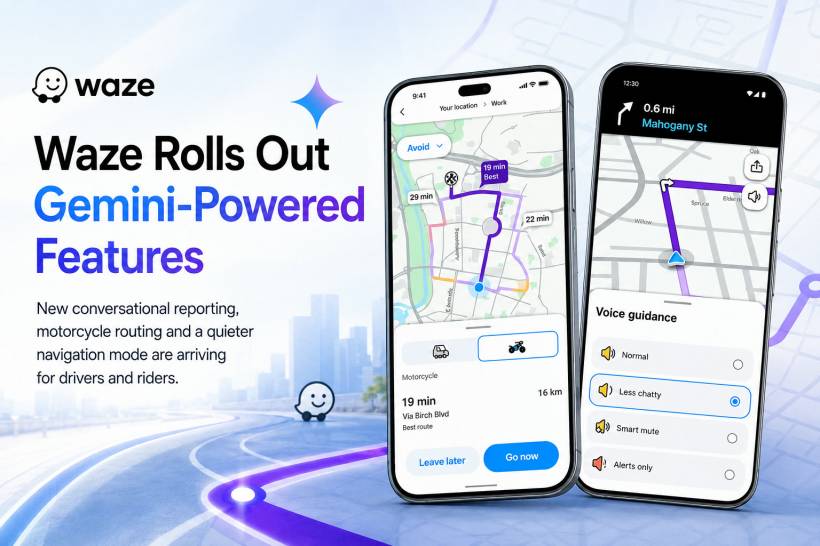
Waze has always stood out from other navigation apps because of its community-driven approach. Instead of simply calculating the fastest route, it relies on drivers to report accidents, congestion, road closures and other problems as they happen.
Google is now expanding that experience with several new Waze features powered by Gemini and other artificial intelligence technologies. The updates are designed to make reporting road conditions easier, improve voice-based destination searches and provide more useful routes for motorcyclists.
Malaysia is also among the first countries receiving one of the most notable additions: a dedicated motorcycle navigation mode.
Reporting Road Problems Through Natural Conversation
One of the biggest changes is a feature known as Conversational Reporting.
Previously, drivers usually had to select a specific reporting category, such as heavy traffic, a stopped vehicle or an accident. The new system allows users to describe what is happening using everyday language.
A driver could say something like, "Traffic is slowing down because there is a broken-down car in the left lane," rather than navigating through several menus. Gemini can interpret the description and turn it into a relevant Waze report.
This should be particularly useful while driving because it reduces the amount of attention needed to interact with the application. The experience becomes closer to speaking with a passenger than operating a traditional navigation interface.
Conversational Reporting can also be used to suggest changes to the map. Drivers may report issues such as a closed road, an incorrect address or outdated road information.
These map-related suggestions will not necessarily appear immediately. They will first be forwarded to local Waze map editors, who can examine and verify the information before updating the map. This review process remains important because inaccurate reports could otherwise create incorrect routes for thousands of users.
Google says Conversational Reporting is being introduced globally for Waze users on both Android and iOS.
Finding Destinations Without Using Exact Search Terms
Gemini is also being used to make destination searches more conversational.
Instead of entering the exact name of a business, users may ask Waze to find a place based on what they currently need. For example, someone could say, "Find me a coffee shop that is open right now."
Waze can then provide a selection of suitable destinations. After choosing one, the driver can begin navigation using voice commands without needing to type or manually search through the results.
This represents a broader shift in how people may interact with navigation applications. Traditional searches depend heavily on keywords, business names and categories. An AI-powered search can potentially understand context, timing and intent.
A person travelling late at night may not know the name of a nearby petrol station or restaurant. They simply need somewhere that is open, reasonably close and located along their route. Conversational search is intended to handle that type of request more naturally.
The feature is currently being introduced to beta users. Google has not confirmed when it will become available to the wider Waze community.
A Dedicated Motorcycle Mode Is Coming to Malaysia
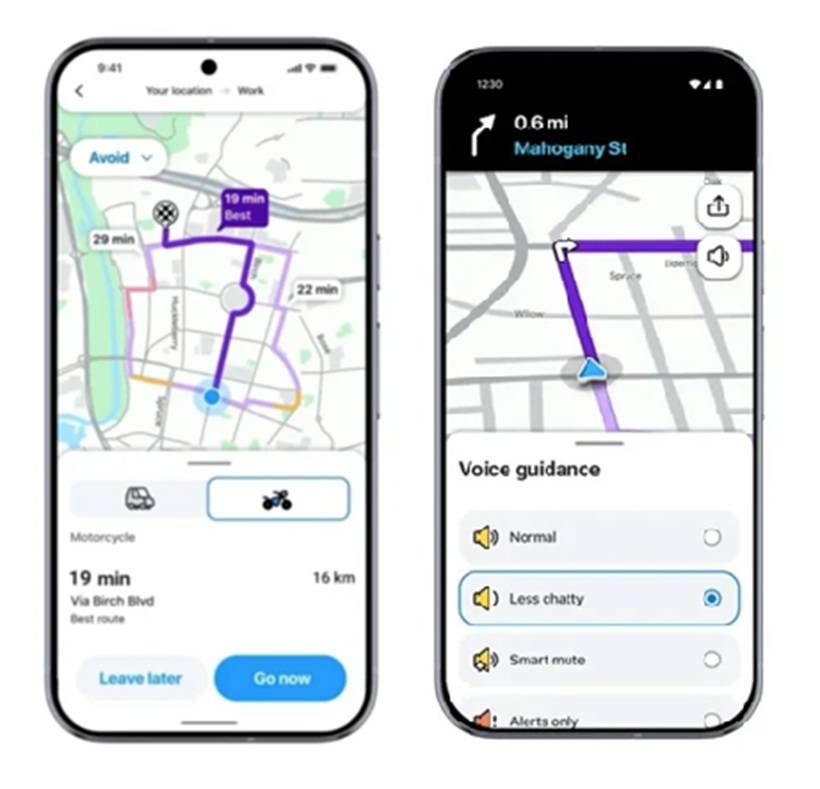
Another major addition is Waze's new motorcycle mode.
Motorcycle navigation has already been available in Google Maps for some time, but Waze is now developing its own version with features intended specifically for riders.
Google says the system uses AI to consider routes, shortcuts and restrictions that may apply differently to two-wheeled vehicles. This could help Waze produce more appropriate journey times and avoid recommending roads that are unsuitable or inaccessible to motorcycles.
The mode will also highlight hazards that may be particularly dangerous or uncomfortable for riders. These include potholes, speed bumps, raised pedestrian crossings, narrow bridges and locations where the road shoulder suddenly ends.
Such information can be useful because road conditions that cause only a minor inconvenience to a car may present a much greater risk to someone riding a motorcycle. A pothole, uneven surface or unexpected narrowing of the road can significantly affect a rider's ability to maintain control.
The accuracy of these warnings will likely depend on the quality of available map data and reports from the Waze community. Nevertheless, bringing motorcycle-specific hazards directly into navigation could make the application more relevant in countries where motorcycles are widely used for commuting and delivery services.
Malaysia is included in the initial rollout alongside the Philippines, Argentina, Brazil, Colombia, Mexico and Peru.
The inclusion of Malaysia makes sense given the large number of motorcycles on local roads. A navigation mode capable of recognising rider-specific routes and hazards could be especially useful in busy urban areas, smaller roads and locations where road conditions change frequently.
A Quieter Navigation Experience for Drivers
Not every new Waze feature is focused on AI.
Google is also introducing a "less chatty" navigation mode for users who do not want frequent voice instructions interrupting their music, audiobooks or podcasts.
The quieter mode will continue to announce important information, including upcoming turns, lane changes and road hazards. However, less essential guidance will apparently be reduced.
Google has not provided a detailed explanation of exactly which announcements will be removed. The feature will probably limit repetitive instructions or confirmations that drivers may not need once they are already familiar with the route.
This could be helpful during long journeys where constant voice prompts become distracting. It may also appeal to regular commuters who already know most of the route but still want Waze to warn them about congestion, accidents or unexpected road closures.
The less chatty navigation option is being rolled out globally.
Waze Is Moving Beyond Basic Turn-by-Turn Navigation
These updates show that Google is gradually transforming Waze from a conventional navigation tool into a more conversational driving assistant.
Gemini allows the application to understand descriptions and requests that do not follow a fixed command structure. Drivers no longer need to remember the correct reporting category or enter precise search phrases. They can simply explain what they see or describe where they want to go.
However, AI will not replace the community that made Waze popular. Reports from drivers and updates from volunteer map editors will remain central to the platform. Gemini mainly provides a more convenient way for users to contribute information and interact with that existing network.
The challenge will be maintaining accuracy. Spoken reports may be unclear, incomplete or misunderstood, particularly in noisy vehicles or areas where drivers switch between different languages and local expressions. Waze will need to interpret these reports carefully to prevent incorrect alerts from being distributed.
Final Thoughts
Waze's latest updates combine artificial intelligence with the application's strongest advantage: real-time information from people who are actually on the road.
Conversational reporting could make it faster and safer to share traffic information, while natural voice search may reduce the need to interact manually with a phone. Motorcycle mode is potentially even more significant for Malaysian users, especially if it can provide reliable warnings about road conditions that directly affect riders.
The quieter navigation option may appear less advanced, but it addresses a practical frustration for drivers who want important alerts without constant interruptions.
Together, these features suggest that Waze is not simply trying to provide better directions. It is working towards a navigation experience that listens, understands context and adapts to the different ways people travel.











Comments 0