

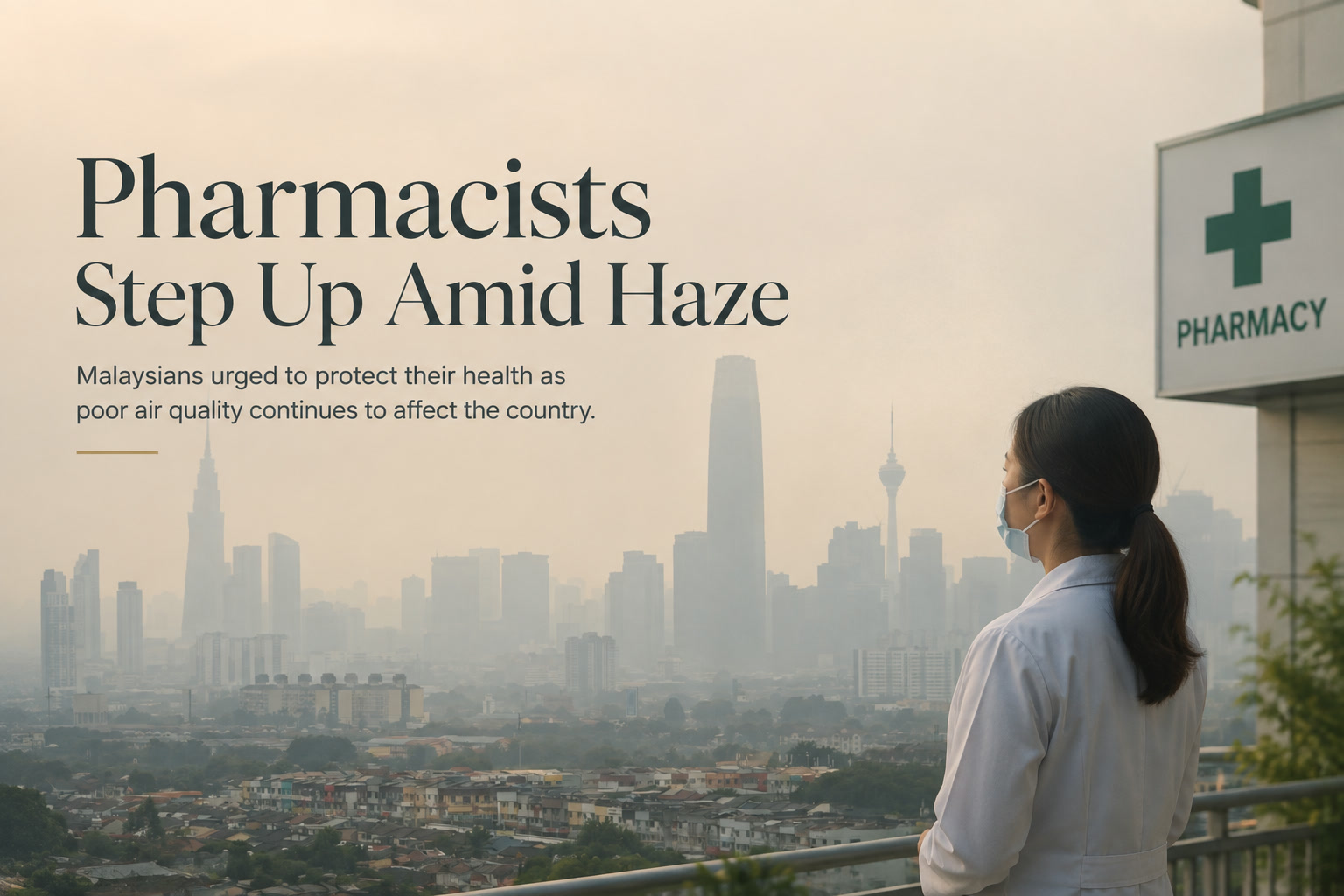
Malaysians are being urged to take extra precautions as transboundary haze continues to affect parts of the country, with Sarawak currently experiencing some of the worst air-quality conditions.
The Malaysian Pharmacists Society (MPS), Sarawak Pharmaceutical Society and Sabah Pharmaceutical Society have jointly reminded the public that haze should not be treated as just another seasonal inconvenience.
Air quality in several parts of Sarawak has reached unhealthy and, at times, very unhealthy levels, while schools in affected areas have already been closed. Smoke from fires in Kalimantan continues to cross into Malaysia, and conditions can change quickly depending on wind direction, weather and fire activity.
For that reason, Malaysians are being encouraged to regularly check official Air Pollutant Index (API) readings even when the haze does not appear particularly severe outside.
Some People Face Greater Health Risks
Haze can affect anyone, but certain groups are more vulnerable to polluted air.
These include:
cardiovascular conditions.
When air quality deteriorates, people should reduce unnecessary outdoor exposure and avoid strenuous physical activity outside.
Those who must spend time outdoors may benefit from wearing an appropriate respirator such as an N95, provided it fits correctly and is used properly.
Patients Should Continue Their Regular Medicines
People living with chronic illnesses should not stop or alter their regular treatment simply because of the haze.
Asthma, COPD, heart disease and other long-term conditions can become harder to manage when air quality deteriorates, making medication adherence even more important.
Patients should make sure they have an adequate supply of their usual medicines and avoid waiting until symptoms become severe before seeking advice.
For people using inhalers, correct technique matters.
An inhaler that is not used properly may deliver much less medication than intended, which can become particularly problematic when haze triggers breathing problems.
Community Pharmacists Can Provide Immediate Support
Community pharmacists are among the most accessible healthcare professionals in Malaysia and can play an important role during haze episodes.
People do not necessarily need to wait for a hospital or clinic appointment before asking for help with minor symptoms, medication concerns or respiratory protection.
Pharmacists can help the public:
This accessibility becomes particularly valuable during widespread haze events when larger numbers of people may experience irritation, coughing or worsening chronic conditions.
Do Not Wait Until Breathing Problems Become Severe
People with asthma, COPD or other respiratory conditions should seek advice early if their symptoms begin worsening.
Certain warning signs require prompt medical assessment.
These include difficulty breathing, worsening shortness of breath, chest pain, significant deterioration of an existing condition or other severe symptoms.
Self-care has its limits.
While pharmacists can help with symptom management and medicines, anyone experiencing serious respiratory distress should obtain medical attention quickly.
Pharmacists' Role in Air Pollution Is Recognised Internationally
The role of pharmacists during air-pollution events is not unique to Malaysia.
The International Pharmaceutical Federation (FIP) has also called for community pharmacists to become more involved in reducing the health effects of air pollution.
FIP has highlighted roles such as public health education, inhaler-technique optimisation, disease management and appropriate referral to doctors or hospitals.
This reflects a broader shift in healthcare where pharmacists are increasingly recognised not only for dispensing medicines, but also for helping patients manage chronic conditions and make informed health decisions.
Sarawak Is Feeling the Impact Most Strongly
Sarawak Pharmaceutical Society president Ngu Soon Hieng highlighted the immediate impact currently being felt in the state.
Schools have already been closed in affected areas, but many people still cannot completely avoid going outdoors.
Not everyone can remain inside an air-conditioned environment throughout the day.
Workers, caregivers, students and people travelling for essential activities may still need to be exposed to outdoor conditions.
For vulnerable groups, preparing early becomes particularly important.
Keeping medications available, reducing unnecessary exposure and seeking advice before symptoms become severe can make a meaningful difference.
Sabah Should Remain Prepared Too
Although Sabah may not currently be experiencing conditions as severe as parts of Sarawak, the situation can change rapidly.
Wind and weather patterns can shift haze across regions in a relatively short period.
Sabah Pharmaceutical Society president Hiew Chui Li therefore urged the public to remain prepared rather than waiting until air quality becomes unhealthy.
Regularly checking the API is one of the simplest steps Malaysians can take.
People should also seek advice if they are unsure about their medication, inhaler use or which type of respiratory protection is appropriate.
Community Pharmacies Need to Prepare for Higher Demand
The three pharmaceutical societies are also asking community pharmacies, particularly those in haze-affected areas, to prepare for increased demand.
Pharmacists may encounter more patients asking about coughing, irritated eyes, sore throats, breathing difficulties and protective masks.
They should also proactively support vulnerable patients with chronic respiratory conditions.
This includes checking inhaler technique, reinforcing medication adherence, providing evidence-based advice and referring patients for further medical care when necessary.
Having pharmacists prepared at community level can help prevent minor symptoms from progressing unnecessarily and reduce some pressure on clinics and hospitals.
N95 Masks Need to Be Used Properly
During severe haze, many people immediately reach for a mask.
However, not every mask provides the same protection.
An N95-type respirator is designed to filter fine airborne particles more effectively than ordinary loose-fitting masks.
But it only works properly when it forms an adequate seal around the face.
Simply wearing an N95 incorrectly does not guarantee protection.
People with questions about respirator selection or proper use can ask their community pharmacist for guidance.
Comfort also matters, especially for older people or those with existing breathing conditions.
Anyone who experiences significant difficulty breathing while wearing a respirator should seek professional advice rather than forcing themselves to continue using it.
Indoor Air Quality Still Matters
Reducing outdoor exposure is helpful, but haze particles can also enter buildings.
Keeping doors and windows closed during periods of poor air quality can reduce infiltration.
Air-conditioning systems and air purifiers equipped with suitable filters may also help improve indoor air quality.
However, people should avoid assuming that being indoors automatically means the air is completely clean.
This becomes especially relevant in buildings with poor sealing or where outdoor air is frequently introduced.
Monitoring symptoms remains important regardless of whether someone is indoors or outside.
Malaysia Should Not Become Complacent About Haze
MPS president Amrahi Buang warned that although haze is familiar to Malaysians, familiarity should not lead to complacency.
Malaysia has experienced repeated transboundary haze events over the years, which can make the problem feel almost routine.
But repeated exposure does not make polluted air harmless.
Fine particulate pollution remains associated with respiratory and cardiovascular health effects, particularly among vulnerable individuals.
Each haze episode should therefore be treated as a health issue rather than simply an inconvenience affecting visibility and outdoor activities.
Regional Cooperation Is Still Needed
The pharmaceutical societies also expressed support for continued efforts by Malaysia and other ASEAN countries to address transboundary haze and its underlying causes.
Individual precautions can reduce personal exposure, but they do not solve the larger problem.
Regional coordination, fire prevention and environmental management remain essential if Southeast Asia wants to reduce recurring haze events in the long term.
While those broader measures take time, Malaysians can still take practical steps immediately.
Final Thoughts
The current haze affecting Malaysia, particularly Sarawak, is another reminder that poor air quality can quickly become a public-health concern.
The most important actions are relatively simple:
Check the API regularly, reduce unnecessary outdoor exposure, keep chronic conditions under control and seek advice early when symptoms worsen.
Community pharmacists are well positioned to help Malaysians understand respiratory protection, manage medicines correctly, review inhaler technique and recognise when medical attention is needed.
Haze may be something Malaysia has experienced many times before, but that does not mean we should learn to ignore it.
When the air becomes unhealthy, protecting our health early is far better than waiting until breathing becomes difficult.











Comments 0