

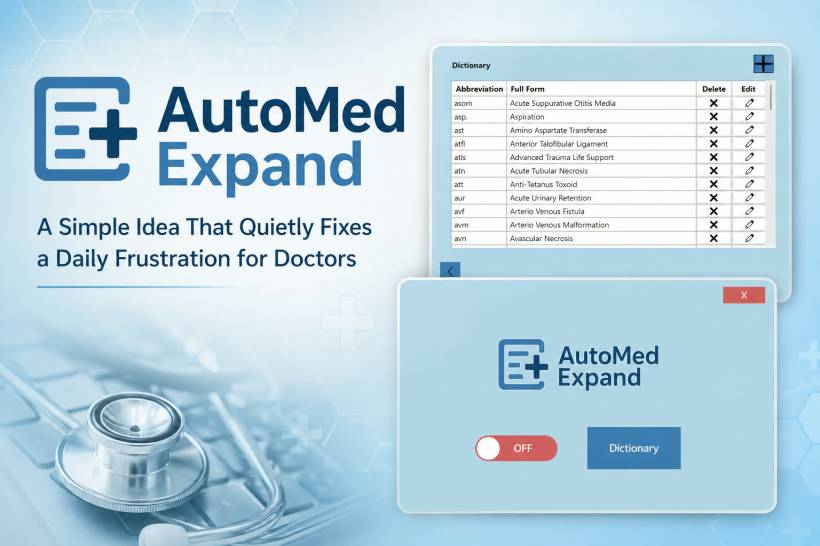
If you've ever spent time observing doctors working inside a Hospital Information System (HIS), one thing becomes clear very quickly — a large part of their day is spent typing. Not just typing, but repeating the same long clinical terms again and again.
Total Knee Replacement. Chronic Kidney Disease. Acute Urinary Retention.
Now imagine doing that across dozens of patients, every single day.
It may sound like a small inconvenience, but over time, it becomes a real source of fatigue. And in a fast-paced clinical environment, even a few extra seconds per entry can quietly add up into something much bigger. This is exactly the kind of everyday problem that AutoMedExpand was designed to solve.
The Hidden Inefficiency in Clinical Documentation
Doctors naturally rely on abbreviations in their daily workflow. It's fast, intuitive, and part of how medicine is practiced. Writing "TKR" instead of "Total Knee Replacement" just feels natural when you're moving quickly between patients.
But the moment documentation enters the picture, things change.
Clinical notes are expected to be complete, clear, and standardised. In many hospitals, especially in Malaysia, there is a strong push toward using full medical terminology instead of informal abbreviations. This creates a subtle but constant friction. Doctors think in abbreviations, but they are required to document in full terms.
That gap between how clinicians naturally work and what documentation requires is where inefficiency creeps in.
Why Full Terms Are Important (And Not Just a Preference)
This isn't just about formatting or style. There are real compliance and safety reasons behind it.
Healthcare documentation is influenced by expectations from bodies such as the Ministry of Health Malaysia, the Malaysian Medical Council, and accreditation frameworks like Malaysian Society for Quality in Health. While they may not always explicitly ban abbreviations, the emphasis is consistently on clarity, accuracy, and standardisation.
Abbreviations can be risky. A shortform like "MS" could mean multiple sclerosis or morphine sulphate depending on context. In a clinical record, that ambiguity is not acceptable.
Beyond that, medical records are legal documents. During audits, insurance claims, or medico-legal reviews, unclear documentation can create unnecessary complications. This is why many hospitals enforce internal policies that encourage or require the use of full terms, or at least restrict abbreviations to approved lists.
So while abbreviations are convenient, proper documentation demands something more structured and consistent.
The Everyday Trade-Off Clinicians Face
This leads to a very real and very common dilemma.
Do you type quickly using abbreviations, or do you slow down to ensure everything is written out properly?
In a busy clinic or ward setting, that trade-off happens repeatedly throughout the day. Over time, it contributes to fatigue, reduced efficiency, and sometimes even inconsistent documentation.
This is exactly the gap that AutoMedExpand is designed to bridge.
AutoMedExpand: A Simple but Effective Approach
AutoMedExpand doesn't try to change how clinicians think or type. Instead, it works with their natural habits.
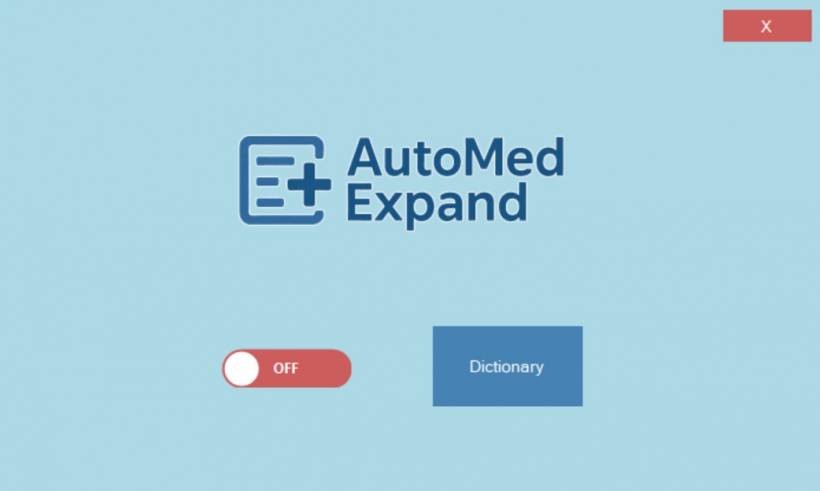
A doctor can type "TKR", press the Tab key, and instantly see it expanded into "Total Knee Replacement". The same applies to many other commonly used clinical abbreviations.
There's no need to pause, retype, or second-guess. The expansion happens seamlessly in the background, allowing the clinician to maintain their flow while still producing proper, compliant documentation.
It's a small interaction, but when repeated hundreds of times a day, it makes a noticeable difference.
What's Happening Behind the Scenes
While the experience feels simple, there is quite a bit happening underneath.
The application quietly listens to keyboard input, builds a buffer of what the user is typing, and waits for a trigger (such as the Tab key). When triggered, it checks whether the typed word matches any known abbreviation. If a match is found, it replaces it instantly with the full term.
All of this is done using a keyboard hook and input simulation approach , ensuring that it works across different applications without needing direct integration.
What's important here is that the tool is designed to behave like a natural extension of typing, not something that interrupts or overrides it.
Built Around Real Hospital Standards
One of the key strengths of AutoMedExpand is that it is not based on arbitrary abbreviations.
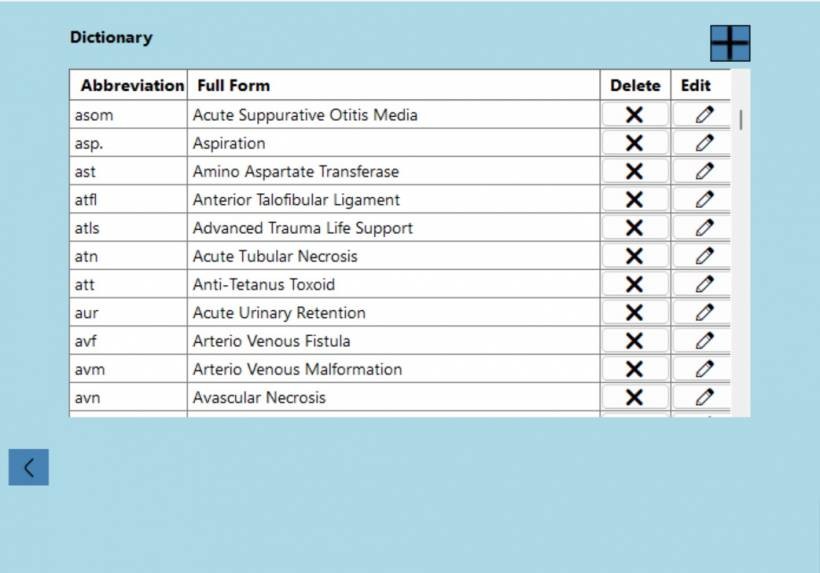
The dictionary used by the application is derived from an approved set of medical shortforms used within a private hospital in Malaysia. This ensures that the expansions are not only accurate, but also aligned with internal policies and expectations.
Even more importantly, the dictionary is centrally managed. It can be stored on a shared network location and automatically synced to users' machines. This means updates can be rolled out consistently without manual intervention, keeping everyone aligned with the same standards.
Customisation Without Losing Control
At the same time, the system is not rigid.
Hospitals evolve, departments have different needs, and new terminology appears over time. AutoMedExpand accommodates this by allowing controlled customisation of the dictionary.
Users or administrators can add new abbreviations, refine existing entries, or remove outdated ones. This ensures the dictionary remains relevant to actual clinical practice, rather than becoming a static list that no longer reflects reality.
The important part is that this flexibility doesn't come at the cost of standardisation. Changes can still be managed centrally, reviewed if needed, and shared across all users. It's a practical balance between adaptability and governance.
Works Everywhere Without Integration Headaches
Another advantage that stands out is how easily AutoMedExpand fits into existing environments.
Because it operates at the keyboard level, it doesn't need to integrate directly with any system. Whether it's a modern web-based EMR or an older legacy HIS, the application works as long as there is a text input field.
This removes one of the biggest barriers in healthcare IT — the need for complex integration, vendor coordination, or system modification. Deployment becomes straightforward, and the risk of disruption is minimal.
A Small Tool With a Meaningful Impact
Individually, expanding a shortform into a full term might save only a few seconds. But across an entire hospital, those seconds accumulate quickly.
More importantly, the impact is not just about speed. It's also about reducing fatigue, improving consistency, and supporting better documentation practices without forcing behavioural change.
Clinicians get to work the way they are used to, while the system ensures that the output meets the required standards.
Final Thoughts
AutoMedExpand is a great example of how a simple idea can solve a very real problem.
It doesn't try to replace existing systems or introduce complicated workflows. Instead, it quietly improves what is already there — making documentation faster, smoother, and more consistent.
In a healthcare environment where every second counts and every detail matters, solutions like this don't need to be flashy to be valuable.
They just need to work.
And sometimes, that's exactly what makes them powerful.











Comments 0