

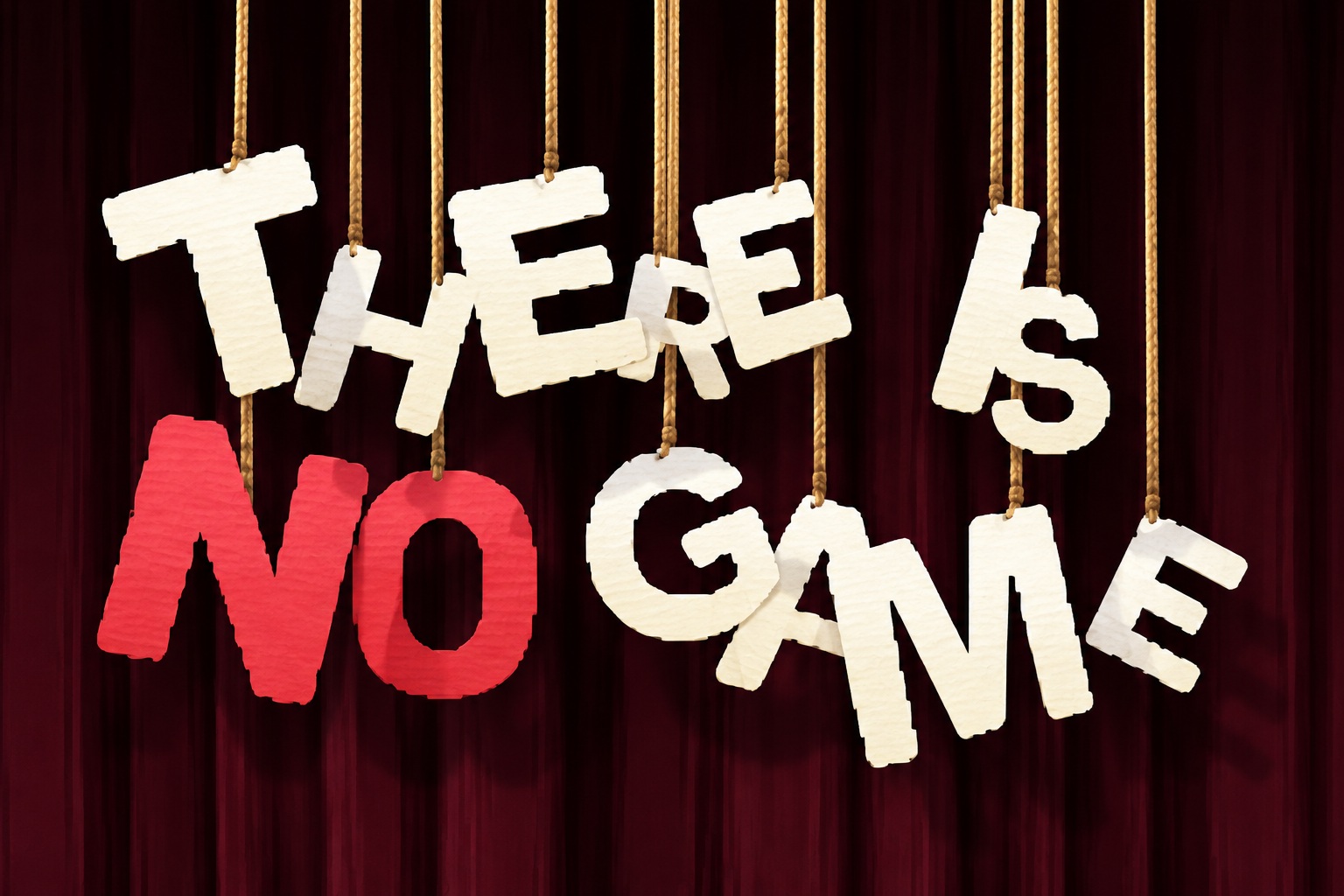
There Is No Game is a clever 2015 point-and-click comedy puzzle that spends nearly its entire runtime trying to convince players that there is absolutely nothing to play. Created by KaMiZoTo, the experience begins with a simple title screen and a narrator who repeatedly insists that the player should leave everything alone. Naturally, the quickest way to make progress is to ignore him completely. Clicking suspicious objects, dragging interface elements, breaking parts of the presentation, and experimenting with anything that looks interactive gradually reveals that the supposedly nonexistent game is hiding in plain sight.
Instead of presenting traditional levels, enemies, or objectives, There Is No Game transforms the interface itself into the puzzle. Letters can become physical objects, buttons may behave differently from what their labels suggest, sound controls can become useful tools, and decorations that initially appear meaningless may eventually provide the solution to another problem. The narrator responds constantly to the player's behaviour, becoming increasingly frustrated as each new layer is uncovered. His reactions are not merely comedy because they frequently contain hints about what the player should investigate next.
Now playable online through Lemon Web Games, There Is No Game brings its fourth-wall-breaking humour, point-and-click puzzles, interactive interface tricks, hidden objects, narrator commentary, and deliberately misleading presentation directly into the web browser. Players can experiment with everything on screen, uncover hidden mechanisms, manipulate text, and gradually discover the game hiding underneath repeated claims that no game exists. The experience is short compared with a traditional adventure, but almost every minute introduces another surprising interaction. For players who enjoy clever puzzle design and games that constantly play with expectations, There Is No Game remains wonderfully inventive.
The Narrator Really Does Not Want You to Play
The narrator is immediately established as the most important personality in the experience. He repeatedly tells the player there is no game and insists that clicking, dragging, or investigating the screen is unnecessary.
Of course, those warnings have the opposite effect. Every instruction not to touch something effectively makes that object more suspicious.
This creates a playful relationship between player and narrator. Progress feels almost like deliberately annoying a character who knows exactly what you are trying to do and desperately wants you to stop.
Ignoring Instructions Is the Main Rule
Most games teach players to follow instructions carefully. There Is No Game does the opposite by turning disobedience into the central mechanic.
When the narrator says not to click something, clicking it is usually worth trying. When he insists an object is meaningless, that object often becomes important moments later.
The game therefore rewards curiosity rather than obedience. Progress comes from questioning everything the interface tells you.
The Title Screen Becomes Part of the Puzzle
The opening title is not merely decoration. Letters can become interactive pieces that the player manipulates in unexpected ways.
This immediately establishes one of the game's most important ideas: text is not necessarily static information. Words can become objects with physical properties.
Once the player understands this, the entire screen becomes suspicious. Menus, labels, and other interface elements can no longer be treated as separate from the game world.
Letters Can Become Useful Objects
Individual letters from words can be moved, dropped, combined, or repurposed depending on the puzzle.
This creates some of the game's most memorable interactions because the player is effectively dismantling the interface itself. A letter that originally exists only to form a title can suddenly become a physical tool.
The mechanic also encourages experimentation. If one piece of text can move, players naturally begin wondering what else might behave differently than expected.
Breaking the Interface Is Often Progress
Traditional interfaces are designed to remain stable. There Is No Game frequently rewards players for doing the opposite.
Parts of the presentation can be disturbed, moved, damaged, or manipulated until something hidden underneath becomes available. What initially appears to be destructive behaviour is often the intended solution.
This makes the game feel rebellious. Progress rarely comes from politely choosing a menu option; it comes from figuring out how to break the screen in exactly the right way.
The Mouse Becomes the Primary Tool
There are no complicated movement controls or combat commands. The player interacts with the experience almost entirely through pointing, clicking, and dragging.
Because the controls remain so simple, all difficulty comes from understanding what can be manipulated. The challenge is not executing a complicated action but realizing that an action is possible at all.
This makes There Is No Game accessible while still allowing its puzzles to feel clever. Anyone can click an object, but recognizing the correct object is another matter.
Dragging Objects Reveals Hidden Possibilities
Some elements respond differently when dragged instead of simply clicked. Players need to test whether objects can be moved, repositioned, or used somewhere else.
This gives apparently static screens a surprising amount of physicality. Interface pieces begin behaving almost like items inside a traditional adventure game.
The lesson is simple: if clicking something does nothing, dragging it may be worth trying.
Sound Controls Are Not Just Settings
Even ordinary interface options can become part of the puzzle design. Sound-related controls may have uses beyond adjusting volume.
This is exactly the kind of trick the game enjoys. Something normally ignored as a technical setting suddenly becomes important to progression.
Players quickly learn that no interface element should automatically be dismissed as irrelevant. Everything on screen might have another purpose.
The Narrator Provides Hints Without Acting Like a Hint System
The narrator constantly comments on what the player is doing, and those reactions often contain useful information.
He may complain about a particular action, accidentally draw attention to an object, or reveal that something should not be investigated. His frustration becomes another source of clues.
This keeps the hint system integrated naturally into the comedy. The narrator never needs to say, "Here is the solution." His attempts to prevent progress often reveal exactly where progress can be found.
Comedy Comes From the Player's Behaviour
Much of the humour emerges because the narrator reacts directly to the player's actions.
Breaking something may trigger disbelief. Ignoring another warning may cause increasingly exaggerated frustration. The player's curiosity effectively becomes the setup for the joke.
This makes the comedy feel interactive rather than scripted independently from gameplay. The funniest moments happen because the player deliberately causes them.
The Fourth Wall Barely Exists
There Is No Game constantly acknowledges that it is software being played by someone sitting outside the screen.
Menus, interface elements, sound controls, text, and even the idea of whether a game exists become part of the fiction. The boundary between game world and user interface is deliberately blurred.
This fourth-wall-breaking approach gives the experience its strongest identity. The game is not simply telling jokes about video games; it is turning the structure of a video game into the joke.
The Player Is Constantly Being Misled
Many puzzle games hide clues, but There Is No Game actively attempts to convince players that clues do not exist.
The narrator may insist an object is useless or claim nothing interesting is hidden behind another element. These statements immediately create suspicion.
The result is a playful form of reverse psychology. Every denial becomes another reason to investigate.
Simple Visuals Leave Space for Clever Ideas
The presentation is deliberately minimal. Instead of filling the screen with detailed environments, the game concentrates on a relatively small number of interactive elements.
This simplicity makes unexpected interactions easier to notice. When something moves or changes, the player immediately understands that it matters.
The minimalist style also keeps attention focused on the puzzle logic. There is very little visual clutter hiding the important information.
Small Changes Can Completely Transform the Screen
One successful interaction can cause the entire situation to evolve.
A hidden object appears, a new mechanism becomes accessible, or the narrator introduces another obstacle designed to stop further progress. Each discovery creates another small layer.
This constant transformation makes the experience feel larger than its simple presentation suggests. The same screen can effectively become several different puzzles over time.
There Is No Traditional Inventory
Rather than collecting dozens of objects in a separate menu, players frequently interact directly with the items already visible on screen.
This keeps the puzzles immediate. Objects remain physically present rather than becoming icons stored elsewhere.
The absence of a conventional inventory also supports the game's interface-focused design. The screen itself is both the puzzle and the workspace.
Logic Matters More Than Speed
There Is No Game places almost no emphasis on reflexes. Players can stop and think for as long as necessary.
This makes observation especially important. A small clue may reveal how an object should be moved or why another interaction failed.
Because there is little pressure, getting stuck becomes an invitation to experiment rather than a punishment. The answer is usually somewhere nearby.
Random Clicking Will Only Get You So Far
Although experimentation is encouraged, later puzzles reward more deliberate thinking.
Players need to understand how one discovered element connects with another rather than simply clicking every visible object repeatedly.
This is where the game becomes especially satisfying. A solution often feels obvious only after the player understands the relationship between several small clues.
The Game Constantly Changes Its Own Rules
Just when the player becomes comfortable with one type of interaction, the game introduces another idea.
A puzzle involving letters may be followed by one based on sound, movement, hidden objects, or interface manipulation. The game rarely relies on one trick for too long.
This prevents the short experience from becoming repetitive. Every new section creates another question about what can be interacted with.
Surprise Is One of the Main Rewards
There Is No Game works best when players do not know exactly what will happen next.
The puzzles are enjoyable on their own, but the larger pleasure comes from discovering how far the developers are willing to stretch the original joke.
Each time the player thinks the game has revealed everything, another hidden layer appears. Surprise becomes part of progression.
The Short Length Helps the Concept Stay Fresh
The experience does not attempt to stretch its central joke into dozens of hours.
Instead, it moves quickly from one idea to another and ends before the interface tricks become predictable.
This compact design works in the game's favour. It feels like one carefully constructed comedy puzzle rather than a conventional long-form adventure.
Replaying Reveals How Carefully the Puzzles Are Constructed
Once the solutions are known, a second playthrough naturally becomes much faster.
However, replaying can reveal how many narrator reactions and small visual cues were designed to guide the player toward the answer without making it obvious.
The experience changes from solving the puzzle to appreciating how the puzzle was built. Clever misdirection becomes easier to recognize.
The Narrator Becomes a Character Through Voice Alone
There is no need for a traditional on-screen companion because the narrator's voice provides enough personality.
His frustration, sarcasm, panic, and constant attempts to regain control make him feel like a genuine character despite rarely having a physical presence.
The relationship between narrator and player becomes the emotional centre of the game. Without him, many puzzles would still work mechanically, but much of the charm would disappear.
The Game Parodies Traditional Game Design
There Is No Game constantly plays with familiar expectations about menus, objectives, tutorials, settings, and player interaction.
Instead of presenting those systems normally, it asks what happens when they become part of the puzzle itself.
This makes the game especially enjoyable for people familiar with common video game conventions. The more recognizable the interface behaviour is, the funnier it becomes when the game deliberately breaks it.
Curiosity Is Always Rewarded
Players who naturally test unusual ideas are likely to make progress faster.
What happens if the title is dragged? What if a setting is manipulated? What if the narrator's warning is ignored completely?
The game continuously rewards that kind of thinking. Curiosity is effectively the player's main ability.
Playing There Is No Game Online Today
Through Lemon Web Games, There Is No Game can now be played directly in your web browser with no downloads or setup required. Features of the web-based version include:
New players should avoid treating the interface like an ordinary menu. Click suspicious objects, try dragging elements that appear fixed, and pay attention whenever the narrator becomes unusually defensive about something. His objections frequently contain more useful information than they initially appear to.
When stuck, reconsider assumptions about what counts as part of the game. A title, button, letter, sound control, or decorative element may be just as interactive as an ordinary puzzle object. The game rewards experimentation as long as it is guided by observation.
Who Should Play There Is No Game
There Is No Game is particularly suitable for players who enjoy discovering solutions through experimentation. The game constantly challenges assumptions about what can be clicked, dragged, moved, or treated as part of the puzzle.
It is also ideal for anyone who appreciates humour that directly responds to player behaviour. The narrator turns even simple interactions into small comedy routines, making progress entertaining as well as satisfying.
Play There Is No Game Online Now
There Is No Game begins by insisting there is nothing to do, then spends the rest of the experience daring players to prove that statement wrong. Pull apart the interface, move letters, investigate buttons, uncover hidden objects, manipulate settings, and keep ignoring the increasingly desperate narrator until the supposed absence of a game becomes a puzzle of its own.
Through Lemon Web Games, players can experience There Is No Game directly in the browser and discover why one of the best ways to solve it is simply refusing to follow instructions. Every warning is suspicious, every interface element deserves investigation, and almost nothing should be accepted at face value.
Final Thoughts
There Is No Game succeeds because its central joke is completely integrated into the mechanics. The narrator insists there is no game, while every interaction slowly proves the opposite. Titles become objects, settings become puzzle pieces, and the user interface becomes a physical space that players can manipulate.
The experience is also remarkably efficient. It does not need large environments or complicated controls because every puzzle grows naturally from the idea of breaking the interface. The narrator's reactions provide personality, comedy, and subtle guidance without separating those elements from gameplay.
Through Lemon Web Games, There Is No Game can now be enjoyed directly in the browser as a short but wonderfully inventive puzzle experience. It rewards curiosity, disobedience, careful observation, and the willingness to question every instruction placed on screen. There may supposedly be no game—but discovering why that statement is completely unreliable is exactly what makes playing it so much fun.











Comments 0