

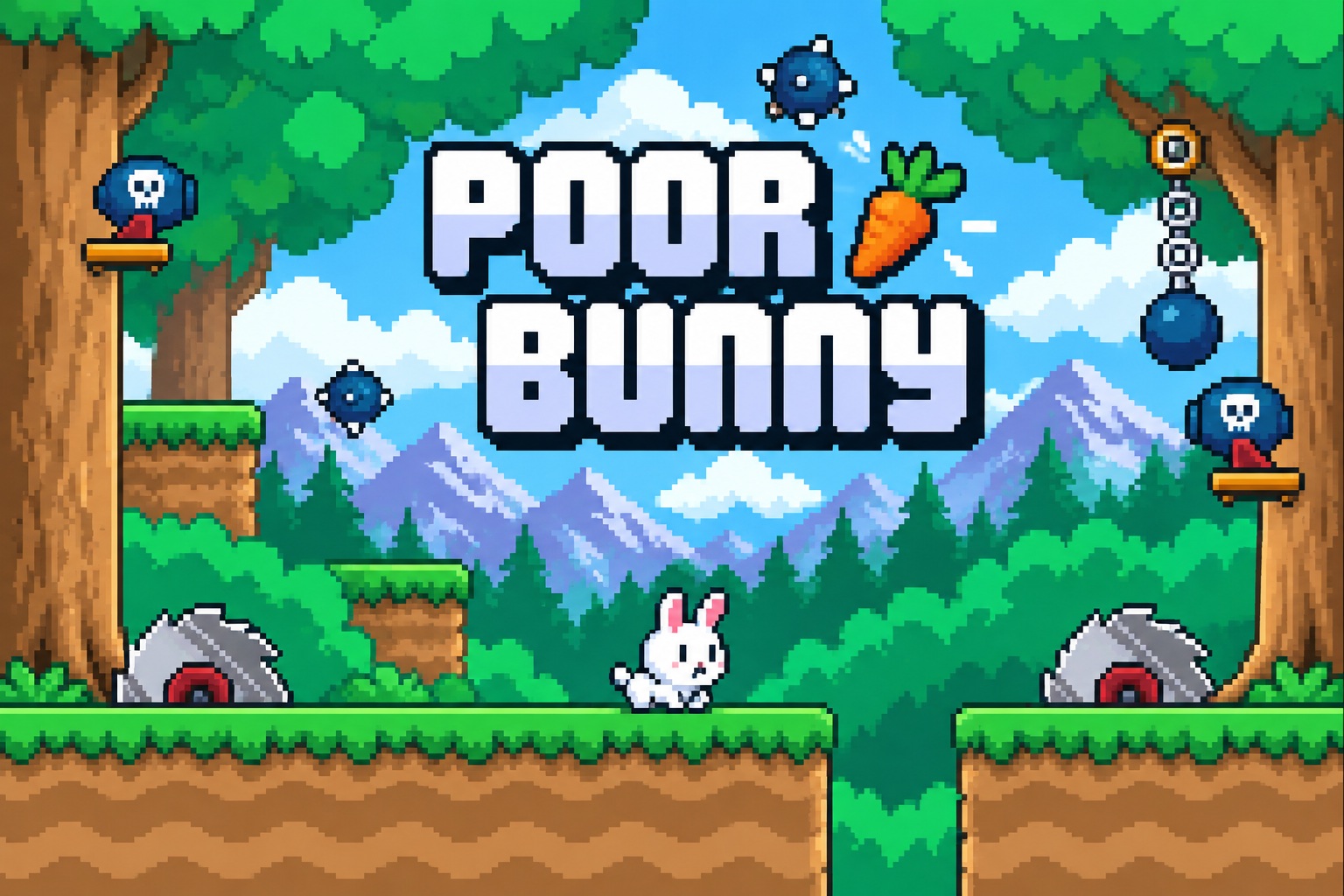
Poor Bunny! looks adorable at first glance, but the cute pixel-art rabbit quickly discovers that collecting carrots is far more dangerous than it should ever be. Created by Adventure Islands, the game is a fast-paced survival platformer built around a deceptively simple objective: keep moving, grab as many carrots as possible, and survive an arena that becomes increasingly filled with deadly traps. There are no complicated quests or lengthy tutorials standing between the player and the action. Within seconds, the peaceful-looking platform becomes a chaotic obstacle course filled with spikes, saw blades, falling projectiles, and other hazards determined to end the run.
What makes Poor Bunny! so enjoyable is how quickly its simple mechanics develop into a demanding test of movement and awareness. The rabbit can jump between platforms and change direction easily, but survival depends on understanding where hazards are appearing and reacting before they close off a safe route. Every carrot provides another reason to take a risk, while special golden carrots encourage players to venture into especially dangerous parts of the arena. The combination of immediate controls, escalating difficulty, unlockable bunny designs, and quick restarts creates exactly the kind of game where one failed attempt usually turns into another run almost immediately.
Now playable online through Lemon Web Games, Poor Bunny! brings its frantic survival platforming directly into modern web browsers with no lengthy setup standing between the player and the next attempt. Players can collect carrots, dodge increasingly chaotic traps, unlock new bunny appearances, and challenge themselves to survive longer with every run. The game also supports two-player modes, allowing friends to cooperate against the arena or compete directly for carrots and survival. Whether you are chasing a personal high score or simply seeing how long a pair of adorable rabbits can survive an absurd collection of hazards, Poor Bunny! delivers fast and accessible browser-friendly action.
A Simple Objective That Becomes Chaotic Very Quickly
The central objective of Poor Bunny! could hardly be simpler. Carrots appear around a compact arena, and the player needs to reach them while staying alive. Collecting one increases the score before another appears somewhere else, creating a continuous cycle of movement and risk. There is no finish line waiting at the end because the challenge continues until the rabbit finally hits a trap.
That simplicity allows the game to become entertaining almost immediately. Players do not need to memorize a complicated control scheme before understanding what they are supposed to do. Instead, nearly all of the depth comes from recognizing hazards, planning movement, and deciding whether the next carrot is worth pursuing immediately. A safe position can become dangerous within seconds as new traps enter the arena.
The endless structure also means that every run naturally becomes a competition against the player's previous performance. Surviving slightly longer or collecting one additional carrot can feel like genuine progress. Because a failed run can be restarted almost instantly, there is very little interruption between attempts. The game continually encourages the familiar thought of trying just one more time.
One-Screen Platforming Keeps the Danger Visible
Poor Bunny! takes place primarily within a compact single-screen arena rather than scrolling through long platforming levels. This gives players a complete view of the immediate environment and theoretically makes every danger visible. In practice, the rapidly increasing number of hazards means keeping track of everything becomes progressively harder. What begins as a manageable space eventually becomes crowded with threats moving in several directions.
The fixed arena works particularly well for survival gameplay because the player is always aware of the available platforms and escape routes. There is no hidden obstacle waiting beyond the edge of the screen. Instead, the challenge comes from interpreting everything happening simultaneously and predicting where danger will appear next. Experienced players begin thinking several movements ahead rather than simply reacting to the closest threat.
This design also keeps each run focused. The player never needs to search through a large map for the next objective because the carrot is always somewhere within the visible area. Every movement therefore has immediate consequences. Jumping toward one platform may collect a carrot but leave the rabbit with very few safe options afterward.
Carrots Keep You Moving
Carrots are the primary objective and the main reason players cannot simply find one safe location and remain there indefinitely. A new carrot appears after the previous one has been collected, constantly encouraging movement around the arena. This forces the player to interact with increasingly dangerous sections instead of waiting for hazards to disappear. The scoring system therefore directly drives the platforming.
The position of each carrot can completely change the risk involved. One may appear directly beside the rabbit and provide an easy point, while another could spawn across several platforms surrounded by dangerous traps. Players need to decide how quickly they should pursue it and which route provides the best chance of survival. Hesitating can sometimes be safer than rushing directly toward the target.
As the arena becomes more chaotic, collecting carrots begins to require careful timing rather than simple movement. A route that appears safe may soon be crossed by a saw blade or falling projectile. Experienced players learn to observe hazard patterns before committing themselves. The basic act of collecting a carrot gradually becomes a miniature platforming puzzle.
Golden Carrots Tempt Players into Taking Bigger Risks
Golden carrots provide an additional incentive to leave comfortable positions and move toward dangerous parts of the arena. These valuable rewards stand out immediately from ordinary carrots and encourage the player to act before the opportunity disappears. The temptation can be difficult to resist, particularly during a strong run where every additional reward feels important. That urgency creates some of the game's most entertaining moments.
A golden carrot can appear at exactly the wrong time, forcing players to decide whether chasing it is worth the danger. The safest decision may be to ignore it entirely, but doing so means passing up a valuable opportunity. This creates a constant tension between survival and greed. Many runs inevitably end because the player attempts one risky movement too many.
That risk-reward relationship is a major part of Poor Bunny!'s appeal. The game rarely forces the player into unnecessary danger immediately; instead, it gives them reasons to choose danger voluntarily. Chasing another carrot is always technically optional, yet scoring depends on continuing to move. The player becomes responsible for deciding how ambitious each run should become.
The Trap System Drives the Difficulty
The traps are what transform Poor Bunny! from a simple collection game into a frantic survival challenge. Hazards begin appearing around the arena and gradually make safe movement more difficult. Spikes, saw blades, falling projectiles, swinging dangers, and other obstacles can enter from different directions. Players need to understand how each behaves before they can reliably avoid it.
Some hazards create temporary danger in one part of the arena, while others travel across larger sections and force the rabbit to keep moving. Multiple traps can overlap in ways that create unexpectedly difficult situations. A platform that seems safe from one obstacle may place the player directly into the path of another. Surviving therefore depends on watching the entire screen rather than focusing on a single threat.
The increasing density of traps provides a natural difficulty curve without requiring the rules to change dramatically. Early runs allow players to become familiar with movement and carrot collection. Later portions become increasingly chaotic as the available safe space begins disappearing. The game becomes difficult through escalation rather than complicated mechanics.
Spikes Punish Careless Landings
Spikes are among the most straightforward hazards in the game, but their simplicity makes them especially effective. They occupy areas the player would otherwise use for movement and instantly turn familiar platforms into dangerous territory. A jump that would normally be completely safe can suddenly become fatal if the player does not notice a newly introduced spike. This keeps movement from becoming automatic.
Their stationary nature also allows experienced players to plan around them. Once spikes occupy a section, the player knows that route should be avoided unless circumstances demand it. The real difficulty occurs when moving hazards force the rabbit toward those blocked areas. The combination of permanent and temporary threats gradually reduces the number of comfortable positions.
Spikes demonstrate how Poor Bunny! creates difficulty without needing elaborate enemy behavior. A simple environmental object becomes threatening because it changes how the player can use the limited arena. When several sections become dangerous simultaneously, even basic jumps require careful thought. The game constantly reshapes what counts as safe.
Saw Blades Force Constant Repositioning
Moving saw blades introduce much more dynamic danger. Rather than simply occupying one location, they travel through parts of the arena and force the player to anticipate their movement. Standing still becomes dangerous because a saw that is currently far away can soon cross directly through the rabbit's position. Players need to watch both direction and timing before jumping.
Saw blades become particularly dangerous when combined with narrow platforms. The player may know exactly where the blade is moving but have very few options available for avoiding it. Jumping too early can send the rabbit into another hazard, while waiting too long can make escape impossible. These situations create some of the game's strongest reaction-based challenges.
They also encourage players to understand movement cycles. Instead of reacting only when the blade is nearby, experienced players begin positioning themselves based on where it will be several seconds later. This shift from reaction toward prediction is an important part of improving. Successful runs increasingly depend on seeing danger before it becomes immediate.
Falling and Flying Hazards Keep the Screen Unpredictable
Not every trap remains attached to the platforms. Projectiles and other moving hazards can enter the arena from above or across the screen, creating danger that is harder to predict through position alone. Players need to watch for warning signs and adjust movement accordingly. Even a previously safe platform may become dangerous without much notice.
These hazards are especially effective because they prevent players from developing a single permanent strategy. A corner of the arena that works well against saw blades may become vulnerable to something falling vertically. The player needs to adapt continuously rather than simply memorizing one ideal location. This keeps long runs from becoming passive.
As more trap types begin overlapping, the arena can become extremely difficult to read. Experienced players develop the ability to prioritize immediate threats while still tracking what is happening elsewhere. The frantic visual activity is part of the appeal. Poor Bunny! eventually becomes a test of attention as much as platforming ability.
Movement Is Simple but Requires Precision
The rabbit's movement is deliberately straightforward, allowing players to focus on survival rather than complex controls. Running and jumping are responsive enough to support quick changes of direction, which becomes essential once the arena begins filling with hazards. The simplicity makes the game approachable even for players who do not regularly play demanding platformers. Understanding the controls takes only moments.
Mastering those controls is considerably harder. Small differences in jump timing can determine whether the rabbit lands safely or touches a trap. Players need to learn how quickly the character changes direction and how much movement can be adjusted while airborne. These details become increasingly important during difficult runs.
The best players make the movement look effortless because they rarely need unnecessary corrections. They position the rabbit where future escape routes remain available instead of simply reacting to the current carrot. This creates an interesting gap between basic understanding and genuine mastery. Anyone can begin playing immediately, but surviving for long periods requires considerable practice.
Momentum Comes from Constant Decision-Making
Poor Bunny! rarely gives players time to stop and carefully plan an entire sequence. Carrots keep appearing, traps continue moving, and safe positions can disappear quickly. Decisions need to be made almost continuously. Should the rabbit jump now, wait for a saw to pass, move toward the carrot, or escape to another platform first?
These decisions become more complicated as the run continues. The closest carrot is not always the safest one to approach immediately, and the shortest route can sometimes be significantly more dangerous than taking a longer path. Players gradually learn to think about survival before score. Ironically, surviving longer usually produces a better score anyway.
This constant decision-making gives the game an arcade-like rhythm. There is rarely a single perfect solution because the combination of carrot placement and hazards changes from moment to moment. Players need to improvise within familiar rules. That unpredictability keeps repeated runs engaging.
Solo Mode Is Perfect for High-Score Chasing
The single-player mode provides the purest version of the game's survival challenge. One rabbit enters the arena with a simple goal: collect as many carrots as possible before being eliminated. There are no teammates or opponents affecting the player's decisions. Every success and failure comes directly from personal movement and risk management.
This makes Solo mode particularly suitable for chasing personal best scores. Improvement is easy to measure because the carrot count provides a clear objective. Players can compare a new run with their previous best and immediately know whether they performed better. Even small improvements can feel meaningful.
The quick restart structure supports this style perfectly. A failed run does not require navigating through lengthy menus before another attempt begins. Players can immediately return to the arena and test what they learned. This creates the highly addictive loop associated with classic arcade games.
Two-Player Co-Op Adds Shared Chaos
Poor Bunny! also supports two-player cooperative play, placing two rabbits into the arena at the same time. Both players work toward survival while navigating the same increasingly dangerous environment. This immediately makes the screen more chaotic because each player needs to track both the hazards and the position of their partner. Coordinating movement can become surprisingly important.
The mode creates memorable situations when one player survives a dangerous sequence while the other narrowly escapes somewhere else on the screen. Because everyone shares the same limited arena, movement decisions can indirectly affect how easy it is for the other player to see what is happening. Communication can help prevent both rabbits from making the same risky jump at once. Even experienced solo players may need to adjust their habits.
Co-op also makes failure more entertaining. Watching a friend accidentally jump directly into a trap can be just as funny as surviving a difficult sequence together. The simple controls make it easy for another player to join without a long explanation. This accessibility gives the multiplayer mode strong party-game appeal.
Versus Mode Turns Carrot Collecting into Competition
Versus mode changes the relationship between the two rabbits completely. Instead of cooperating toward survival, players compete to collect more carrots while dealing with the same hazards. The arena becomes both a platforming challenge and a race for resources. Every carrot collected by one player is an opportunity denied to the other.
Competition naturally encourages riskier movement. A player may attempt a dangerous jump simply because the opponent is already approaching the same carrot. This creates situations where both rabbits make questionable decisions in pursuit of a single point. The resulting chaos fits the game's lighthearted personality perfectly.
Survival still matters because getting eliminated removes opportunities to continue scoring. Players therefore need to balance aggression with caution. Someone who collects several carrots quickly but repeatedly takes reckless risks may still lose to a more consistent opponent. The mode adds strategic tension without changing the basic controls.
Unlocking Bunny Skins Adds Long-Term Progression
Poor Bunny! includes a large collection of unlockable bunny appearances, giving players another reason to continue collecting carrots beyond simply improving a high score. More than 100 different bunny designs can be unlocked, ranging from relatively straightforward variations to much more unusual appearances. These cosmetic rewards allow players to personalize their rabbit without changing the fundamental gameplay. The challenge remains based on skill rather than character statistics.
Unlocking new bunnies provides useful long-term motivation because even an unsuccessful run can contribute toward future cosmetic rewards. Players who enjoy collecting everything have a substantial number of designs to discover. The variety also adds visual personality to multiplayer sessions. Two players can choose clearly different rabbits before entering the arena together.
Importantly, these skins do not make one rabbit objectively stronger than another. The player still needs to survive using the same movement mechanics regardless of appearance. This keeps progression fun without interfering with the high-score challenge. Unlockables provide rewards while leaving the core balance untouched.
Pixel Art Gives the Game Its Charming Identity
The visual presentation uses colorful pixel artwork that immediately gives Poor Bunny! a cheerful appearance. The rabbits are small but expressive, while carrots and hazards remain easy to identify even when the screen becomes crowded. The bright presentation deliberately contrasts with the absurd danger surrounding the characters. A cute rabbit being chased by giant saw blades creates exactly the kind of visual contradiction the game embraces.
The arena itself remains relatively uncluttered, allowing the hazards to stand out clearly. This is important because visibility directly affects gameplay. Players need to recognize a trap immediately rather than searching through complicated background detail. The minimalist environment keeps the focus on survival.
Animation also contributes to the personality. The rabbit's movements are quick and playful, making successful jumps feel lively without sacrificing responsiveness. Hazards move with clear patterns that experienced players can learn. The game looks simple, but that simplicity supports the mechanics extremely well.
Cute Presentation Makes the Difficulty Even Funnier
There is something inherently amusing about watching such a harmless-looking rabbit attempt to survive an increasingly ridiculous death trap. The game never presents itself as dark or serious despite the constant danger. Instead, the cheerful artwork makes every sudden failure feel more like slapstick comedy than punishment. This helps prevent repeated deaths from becoming too frustrating.
The contrast is especially effective during long runs. The player may be intensely focused on navigating a screen filled with lethal hazards, yet the central character remains an adorable bunny collecting carrots. That mismatch gives the game a strong identity. It feels playful even when the difficulty becomes severe.
This tone also makes Poor Bunny! suitable for casual multiplayer. Friends can laugh at unexpected failures rather than treating every mistake as a competitive disaster. The game understands that dying repeatedly is part of the experience. It makes those failures entertaining enough that players want to try again.
Quick Restarts Keep the Action Moving
Poor Bunny! understands that survival games need to respect the player's time after failure. A run can end abruptly after one mistake, but another attempt begins almost immediately. There is no long loading sequence or complicated reset process standing between the player and the next challenge. This keeps frustration low and momentum high.
The quick restart also encourages experimentation. Players can try a risky movement or unfamiliar route knowing that failure will not cost several minutes of setup. This makes learning the game faster. Every attempt becomes another opportunity to understand hazard timing.
The result is a classic arcade-style loop where failure feels temporary. The player rarely stops because one run went badly. Instead, the immediate instinct is usually to restart and prove the mistake can be avoided next time. That rhythm is one of the strongest reasons the game becomes addictive.
High Scores Give Every Run a Clear Goal
The high-score structure provides a simple but effective long-term objective. There is always a number to beat, even after players have unlocked plenty of bunny skins and experienced every major trap. A new personal best becomes evidence that the player is improving. This creates lasting motivation without requiring new levels or story content.
Scores also make runs easy to compare between friends. Multiplayer sessions can naturally turn into challenges over who can survive long enough to collect the most carrots. Even solo players can compete informally by sharing their personal best. The rules are simple enough that everyone immediately understands what a stronger score means.
The best high-score games make players believe another attempt could be slightly better, and Poor Bunny! succeeds at creating that feeling. One more carrot can become enough justification for another run. Improvement happens gradually but remains visible. That simplicity gives the game significant replay value.
Difficulty Grows Naturally Rather Than Through Complicated Rules
Poor Bunny! does not need increasingly complicated controls to become challenging. The rabbit behaves essentially the same way from the beginning of a run to the end. Difficulty grows because the environment becomes more dangerous. Additional hazards and overlapping movement patterns gradually reduce the amount of safe space.
This creates a natural learning curve. Beginners can concentrate on basic jumping when only a few threats are active. More experienced players eventually need to consider several hazards simultaneously. The controls remain familiar while the context becomes increasingly demanding.
This type of difficulty feels fair because the player always understands the basic rules. When a run ends, the cause is usually visible and easy to recognize. The challenge comes from executing movement under pressure rather than discovering hidden mechanics. That clarity makes repeated attempts more satisfying.
Why Poor Bunny! Is So Easy to Pick Up
One of the game's biggest strengths is how little explanation it needs. A player sees a rabbit, a carrot, some platforms, and dangerous obstacles. The objective becomes obvious almost immediately. Movement is simple enough that even someone unfamiliar with platformers can begin experimenting within seconds.
This accessibility makes Poor Bunny! particularly effective as a browser game. Players can launch it without committing to a lengthy tutorial or complicated setup. A short session can still feel complete because individual runs begin and end quickly. At the same time, players who become invested can spend much longer chasing scores and unlockables.
The two-player modes benefit from this simplicity as well. Introducing a friend to the game requires very little explanation. Within a few minutes, both players understand enough to cooperate or compete effectively. Games with this kind of immediate accessibility often become excellent casual multiplayer experiences.
Why Poor Bunny! Remains Addictive
The game combines several proven arcade ideas into an especially efficient structure. There is a clear score, immediate controls, steadily increasing difficulty, frequent rewards, quick failure, and instant restarts. None of these systems are individually complicated, but together they create a powerful incentive to continue playing. Each run feels short enough that another attempt seems harmless.
Randomness in carrot placement and hazard combinations prevents every attempt from unfolding exactly the same way. Players can become familiar with the mechanics without completely memorizing each run. This keeps reaction and adaptation important even after extensive practice. High-level play remains dynamic rather than completely scripted.
The unlockable bunny collection adds another reason to continue beyond personal improvement. Players who may not care deeply about high scores can still pursue new appearances. Competitive players can focus entirely on survival and scoring. Poor Bunny! supports both motivations without complicating the core experience.
Playing Poor Bunny! Online Today
Through Lemon Web Games, Poor Bunny! can now be played directly in your web browser with no downloads or setup required. Features of the web-based version include:
Poor Bunny! is particularly well suited to browser play because almost everything happens immediately. Players can begin a run within moments and understand the objective without reading a long set of instructions. Short attempts make it suitable for quick gaming sessions, while high-score chasing and unlockable bunnies provide reasons to continue far longer. The experience scales naturally depending on how much time the player wants to spend.
The multiplayer modes also make the browser-based experience especially entertaining when two players are available. Cooperative survival creates shared tension, while Versus turns the same arena into a frantic race for carrots. Because both modes use the same basic movement mechanics, switching between them is effortless. The result is a compact platformer that works equally well alone or with another player.
Who Should Play Poor Bunny!
Poor Bunny! is particularly suitable for players who enjoy improving through repetition. The basic controls are easy to learn, but surviving longer requires increasingly strong awareness, timing, and movement. Each run provides immediate feedback about what went wrong, making it easy to identify mistakes and attempt a better approach. Players who enjoy chasing personal bests can spend a surprising amount of time refining their movement.
It is also an excellent choice for casual multiplayer. Both players can understand the controls quickly, yet the constantly changing hazards ensure that even experienced players cannot completely relax. Cooperative mode encourages teamwork while Versus encourages exactly the opposite behavior. That flexibility makes Poor Bunny! entertaining in several different situations.
Play Poor Bunny! Online Now
Poor Bunny! takes an extremely simple idea—collect carrots without dying—and turns it into a fast, unpredictable platforming challenge. The rabbit's controls are immediately accessible, but the steadily increasing number of traps ensures that every additional carrot becomes harder to earn. Spikes, saw blades, falling dangers, and other hazards gradually transform the small arena into a chaotic survival puzzle. Golden carrots tempt players into taking additional risks, while quick restarts ensure failure rarely interrupts the fun for long.
Through Lemon Web Games, players can jump directly into the action through a modern browser and begin chasing higher scores immediately. Solo players can concentrate on improving their survival record, while two-player modes add either cooperation or direct competition to the same frantic formula. Unlockable bunny designs provide another long-term objective alongside score chasing. It is an easy game to understand, difficult to master, and particularly effective at convincing players that the next attempt will be the one that finally breaks their record.
Final Thoughts
Poor Bunny! succeeds because it understands exactly how much game can be built around a small number of well-designed mechanics. Running, jumping, collecting carrots, and avoiding traps sounds extremely simple, yet the increasing hazard density turns those actions into an intense test of awareness and timing. The fixed arena keeps everything visible, but that does not make survival easy when several dangerous objects are moving at once. Each additional carrot becomes another small victory.
The game's cheerful pixel art and adorable rabbit designs also prevent the difficulty from feeling overly serious. Failure is frequent, but watching a cute bunny meet an absurd collection of traps often becomes funny enough that restarting feels natural rather than frustrating. Solo high-score chasing provides plenty of replay value, while co-op and Versus modes introduce completely different kinds of chaos. The large collection of unlockable bunny appearances adds another reason to continue collecting carrots long after the basic mechanics have become familiar.
Through Lemon Web Games, Poor Bunny! offers exactly the kind of browser experience that is easy to begin and surprisingly difficult to stop. A run can last only a short time, yet the combination of improving scores, unlocking new bunnies, and attempting to survive increasingly impossible trap patterns constantly encourages another try. Whether played alone or with a friend, its mixture of cute presentation, immediate controls, and relentless survival gameplay makes Poor Bunny! a wonderfully chaotic platformer worth returning to.











Comments 0