

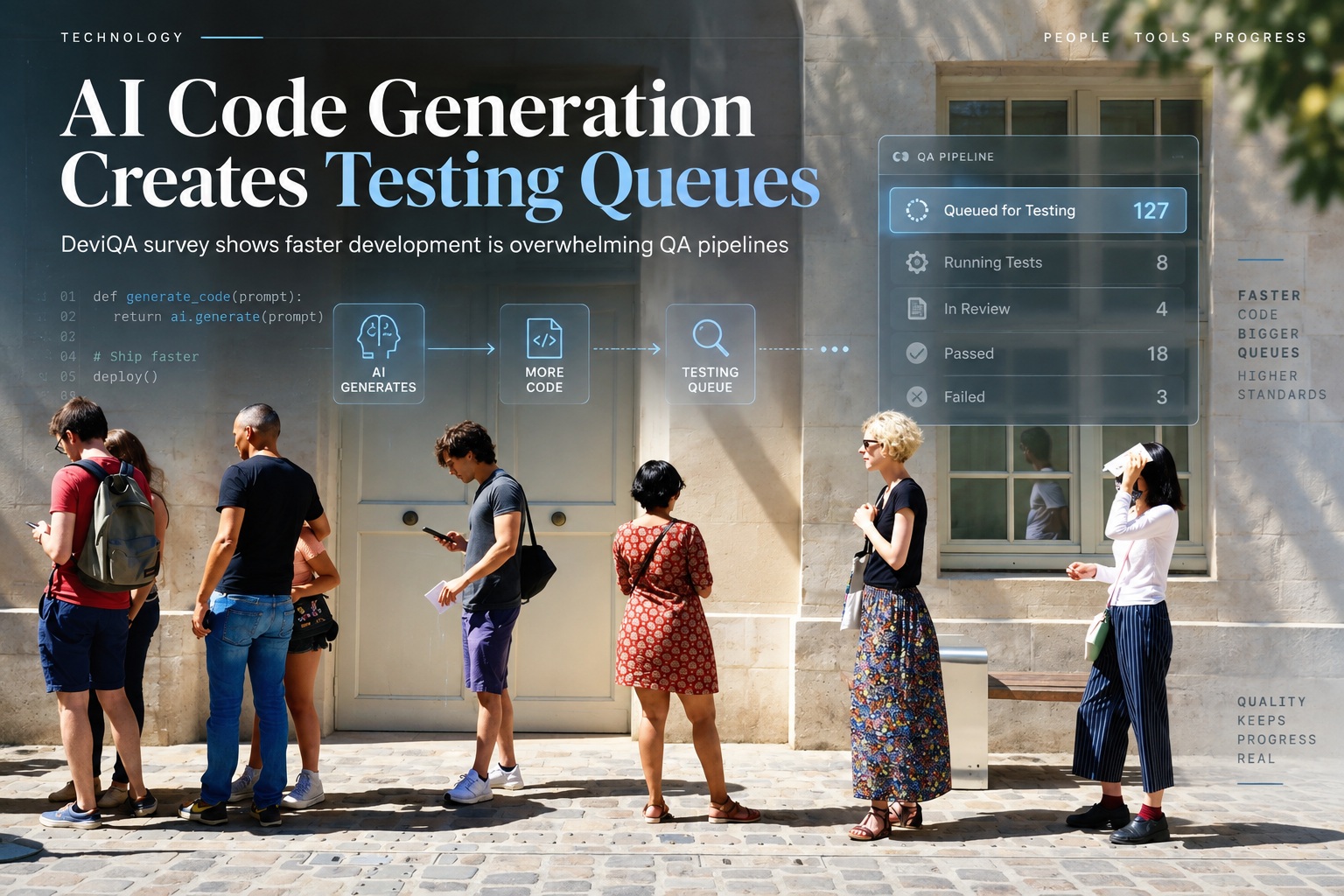
AI-assisted coding is helping developers move faster, but that speed is creating a new bottleneck further down the software delivery pipeline. According to a DeviQA survey of 4,000 quality assurance specialists, engineering teams are increasingly finding that code reaches testing sooner while arriving in larger batches, overwhelming QA teams and expanding validation queues.
The findings highlight an important reality behind AI-generated software: writing code faster does not automatically mean releasing software faster. If testing, documentation, impact analysis, and review processes cannot keep pace, the bottleneck simply moves from development to quality assurance.
Features Reach QA Faster, but They Arrive All at Once
Around 65% of respondents said new features are now reaching validation sooner, suggesting that AI coding tools are genuinely increasing development velocity. However, 64% said work increasingly arrives in parallel batches, creating sudden spikes in testing demand.
That pattern is contributing directly to QA backlogs. 55% of respondents reported growing verification queues, meaning teams are receiving more work than they can comfortably validate within existing delivery schedules.
This is the contradiction at the centre of AI-assisted development. Developers can produce changes much faster, but testing capacity does not automatically scale at the same rate.
Faster Coding Does Not Always Mean Faster Releases
The survey also found that the full path from implementation to production is not necessarily becoming shorter. 52% of teams reported an increase in testing, fixing, and retesting cycles, with 39% describing a slight increase and another 13% experiencing major delays.
Only 21% said their rework cycles had become shorter.
That suggests AI-generated code may reduce the time required to create the first version of a feature while increasing the amount of effort required to validate everything surrounding it. A feature might appear complete from the developer's perspective, but QA still needs to determine whether business logic, related modules, edge cases, and older functionality remain intact.
As one experienced manual QA engineer observed, AI may write code quickly, but a human still remains responsible for whether that code actually works.
The Main Scenario May Pass While Everything Around It Breaks
One of the more concerning findings is how often AI-generated changes appear successful in isolation while introducing problems elsewhere.
Around 47% of QA practitioners said they occasionally encounter code that completes its primary scenario but causes failures somewhere else in the product. Existing functionality accounted for 44% of reported defects, while incorrect business rules, missing edge cases, and data-validation problems each appeared in 33% of failures.
This is a particularly difficult category of defect because the newly generated feature may look correct during an initial review. The problem only becomes visible when the surrounding system is tested.
AI can often satisfy the immediate request extremely well. The harder question is whether it understands every hidden dependency that request touches.
Regression Problems Are Spreading Across Modules
The impact of these defects often extends beyond the files directly modified by the AI.
The survey found that 42% of failures affected neighbouring modules, while 23% reached older legacy components. Another 18% involved broken integrations with external interfaces.
That creates additional work for QA because a seemingly small feature change can require a much wider regression sweep than the source-code diff initially suggests.
A developer may change one component and see the expected behaviour locally. QA, however, may need to test authentication, reporting, data flows, integrations, older workflows, and anything else connected to that component.
This is where architecture knowledge becomes extremely important.
QA Teams Often Receive Too Little Context
The problem is made worse by weak handoffs between development and testing.
According to the survey, 44% of testers receive changes without documented component dependencies, while 42% receive no structural impact analysis at all. Only 18% said the documentation accompanying incoming changes was sufficient.
That means QA engineers are often being asked to validate faster-moving code without being told clearly what else might have changed.
This creates unnecessary detective work. Before testing can even begin properly, the QA team may need to figure out which components depend on the modified code, what business rules could have changed, and which older workflows require retesting.
AI can accelerate implementation, but poor context can erase much of that time advantage.
Testing Scope Is Becoming Broader
To compensate, QA teams are widening their inspection boundaries.
Around 58% of respondents said they are testing adjacent functionality more thoroughly, while 56% increased exploratory testing. The same percentage expanded their use of end-to-end test suites.
Regression testing also grew across 52% of organisations.
This is a logical response. If teams cannot fully trust that an AI-generated change is isolated to the requested feature, then validating only the obvious path becomes risky.
The result is that each change may require more surrounding testing than before, increasing QA workload even when developers are delivering code faster.
Planning Is Getting Faster for Some Teams and Harder for Others
Interestingly, the effect on test planning is not uniform.
About 36% of respondents said planning became faster, likely because AI-assisted development and automation make requirements or scenarios easier to generate. At the same time, 29% said planning demands actually increased.
That split probably reflects differences in team maturity and architecture.
Teams with strong documentation, clear dependencies, and well-defined acceptance criteria may benefit significantly from AI-generated development. Teams with fragmented systems and poorly documented relationships may find that every faster code change introduces more uncertainty downstream.
AI does not remove architectural complexity. In some environments, it may simply expose it faster.
Clear Acceptance Criteria Are Becoming More Important
Engineering leaders are responding by introducing stricter controls before work reaches QA.
The most widely supported measure was clear acceptance criteria, cited by 77% of respondents as the most effective way to reduce defects. Another 55% highlighted direct discussions between developers and QA engineers about risks before handoff.
That makes sense because an AI agent can only work effectively when the objective is defined clearly. Ambiguous requirements can lead to code that technically satisfies the prompt while missing important business expectations.
Good acceptance criteria provide a shared definition of what success actually looks like.
Developers Are Being Asked to Verify Their Own AI-Generated Work
The survey also shows a strong move toward greater developer responsibility before code reaches QA.
Around 80% of respondents said developers should personally verify that acceptance criteria have been met before submitting a pull request. Another 58% wanted proof that the main operational paths had been tested locally, along with documented checks of interactions with related components.
This reflects an important principle: AI-generated code should not be treated as QA-ready simply because it compiles or passes the first test.
The developer remains accountable for understanding what was generated, verifying the result, and identifying areas where the change could affect the wider system.
AI can create the code. It should not transfer responsibility for that code to the testing team.
Smaller Tasks and Better Context Produce Better Results
One automation QA engineer in the survey recommended focusing on architecture, breaking work into smaller tasks, providing AI agents with enough context, and requiring generated code to be reviewed by the responsible specialist.
That is probably one of the most practical lessons from the research.
Large, vaguely defined tasks create more opportunities for an AI coding agent to make incorrect assumptions. Smaller tasks with clear boundaries and documented dependencies are easier to validate and less likely to introduce unexpected changes elsewhere.
The quality of AI-generated code therefore depends heavily on the quality of the environment around it.
A powerful coding model cannot compensate indefinitely for weak architecture, vague requirements, or missing documentation.
Release Checklists Are Becoming More Formal
Some organisations are responding by introducing structured seven-point release checklists before changes reach functional testing.
These checklists can document exactly which files were changed, map dependencies, identify potentially affected components, and explicitly record any areas that have not yet been verified.
The goal is to make uncertainty visible before QA begins.
Named human reviewers also remain responsible for approving each commit, reinforcing the idea that AI may assist with implementation but should not become the final authority over software quality.
That accountability becomes increasingly important as autonomous coding agents take on larger portions of the development process.
AI Is Moving the Bottleneck, Not Eliminating It
The broader lesson from the DeviQA survey is that AI coding tools are clearly accelerating part of the development lifecycle, but software delivery is a chain.
If implementation becomes twice as fast while testing capacity remains unchanged, the organisation does not necessarily ship twice as quickly. Instead, more unfinished work accumulates in front of QA.
The same problem can eventually appear in security review, deployment, documentation, change management, or operations.
Improving one stage of the pipeline therefore requires organisations to rethink everything around it rather than assuming downstream processes will automatically absorb the additional velocity.
Final Thoughts
AI-generated code is already changing software development, but the DeviQA findings show that speed alone is not the same thing as productivity.
Developers are getting features into testing sooner, yet QA teams are facing larger parallel batches, broader regression requirements, incomplete handoffs, and more testing-fixing-retesting cycles. The result is a new kind of bottleneck where software is produced faster than organisations can confidently validate it.
The answer is not to slow AI adoption. It is to improve the systems surrounding it.
Clear acceptance criteria, smaller tasks, documented dependencies, local developer validation, stronger impact analysis, and accountable human review can help turn faster code generation into genuinely faster delivery.
Otherwise, AI may simply make one part of the pipeline faster while creating a longer queue somewhere else.











Comments 0