

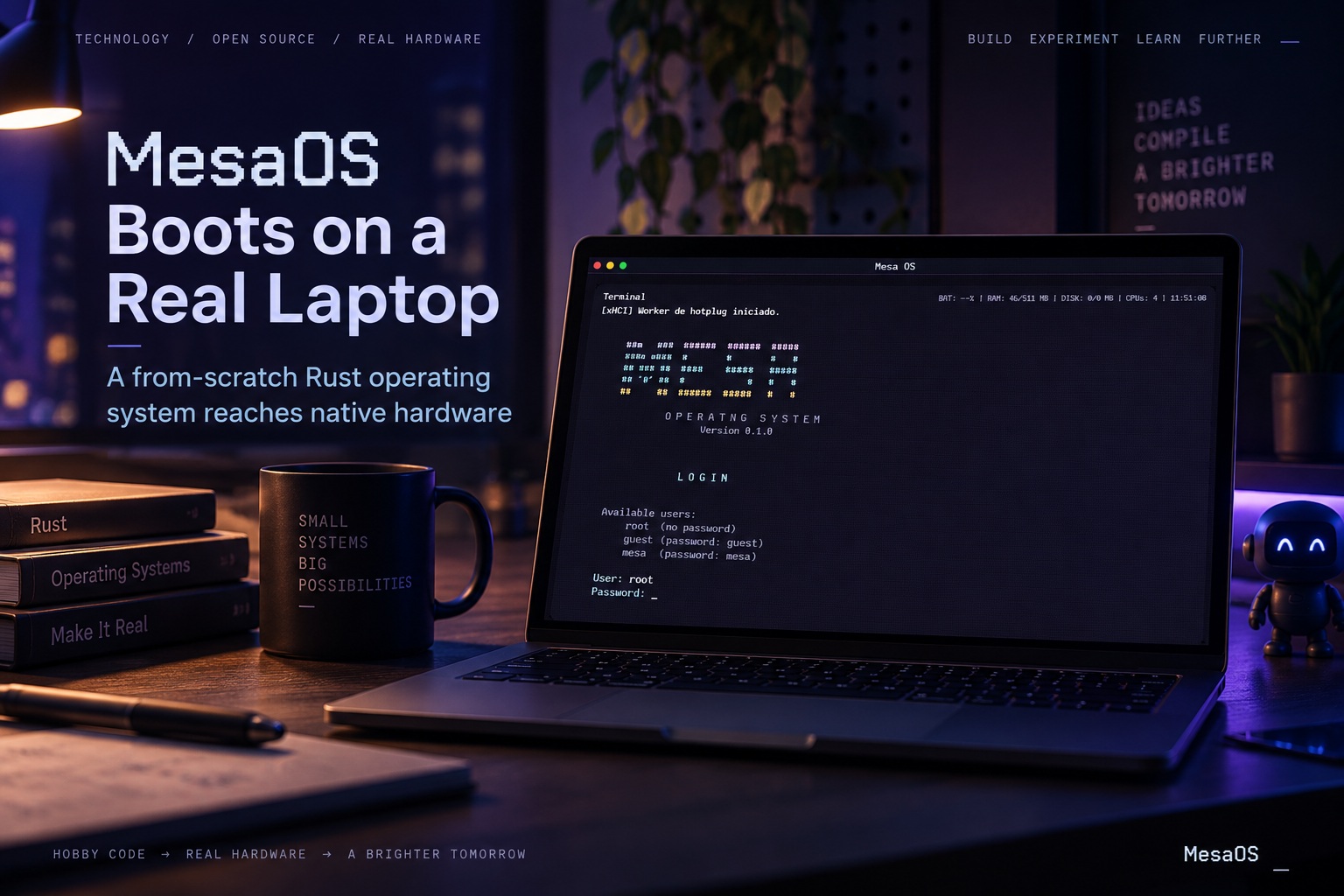
Building an operating system from scratch is one of those programming projects that sounds exciting until you realise just how much work sits between displaying a few lines of text in an emulator and actually running on real hardware. Memory management, storage, networking, USB, graphics and countless hardware quirks all have to work before the system becomes remotely practical.
That is why the latest milestone from MesaOS is particularly interesting. The independent operating-system project has successfully cold-booted its own Rust-based kernel directly on a retail HP laptop, moving beyond the controlled environment of virtual machines and into the much messier world of physical PC hardware.
MesaOS is still an experimental project rather than something ready to replace Windows or Linux, but successfully booting on an ordinary consumer laptop demonstrates that its foundations are beginning to work where they ultimately matter: on real machines.
Built From Scratch Rather Than on Linux or BSD
MesaOS is being developed completely in Rust for modern 64-bit PCs, without using the Linux or BSD kernels as its foundation. That distinction makes the project considerably more ambitious than creating another Linux distribution or building a custom desktop environment on top of an existing operating system.
The kernel needs to perform fundamental tasks itself, including allocating physical memory, discovering hardware connected through PCI and processing network traffic. Every one of these capabilities requires direct interaction with the computer's hardware rather than relying on decades of infrastructure already available in established operating systems.
For a young operating-system project, reaching the point where these components work together well enough to boot on a physical laptop is a meaningful achievement.
Why Rust Is an Interesting Choice for an Operating System
Rust has become increasingly popular for systems programming because it provides low-level hardware control while attempting to eliminate entire categories of memory-safety problems during development. Traditional systems languages such as C provide enormous flexibility, but mistakes involving pointers, memory allocation and object lifetimes have historically been responsible for many serious software vulnerabilities.
Rust approaches the problem differently. Its ownership and borrowing rules are designed to catch many memory-management errors during compilation rather than allowing them to appear later as crashes or security vulnerabilities.
That does not mean an operating system written in Rust automatically becomes secure or bug-free. Kernel development still involves complex hardware interactions and, in some cases, carefully controlled unsafe operations. However, Rust gives developers additional tools for reducing the likelihood of memory corruption as the system grows.
MesaOS Can Now Boot on an HP 15s Laptop
The project's biggest recent achievement is native operation on an HP 15s consumer laptop. Until now, like many experimental operating systems, much of MesaOS development could be carried out using virtualised hardware where devices behave predictably and developers can control the environment.
Physical laptops are much less forgiving. They contain real PCI devices, firmware implementations, USB controllers, storage hardware, power-management systems and network adapters, all of which can behave differently between manufacturers and even between models from the same product family.
Getting through the complete boot process on commercially available hardware therefore demonstrates that MesaOS is moving beyond purely theoretical kernel development.
It Already Has a Shell and Text Editor
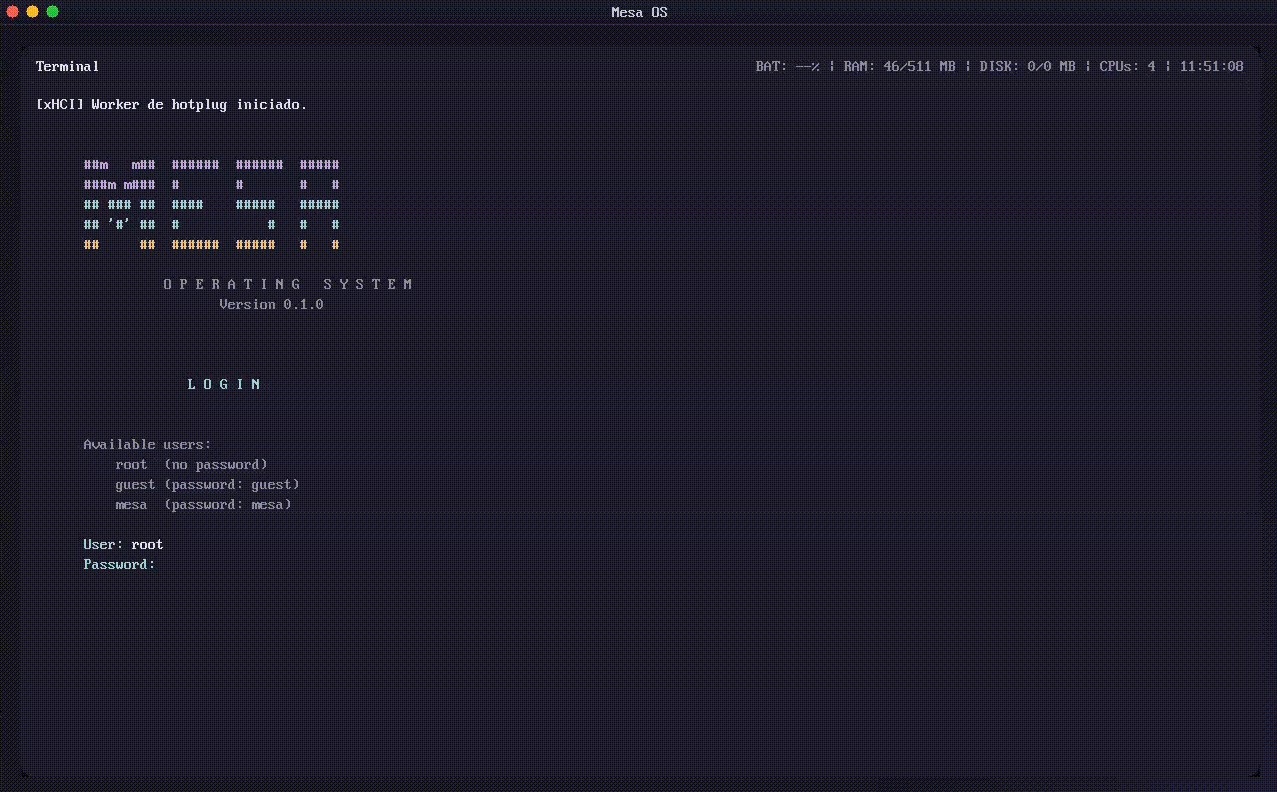
MesaOS has also progressed further than simply displaying a successful boot message. The operating system currently includes a functional command-line shell, allowing users and developers to interact with the environment directly.
A basic text editor is also available, which may sound modest when compared with mature desktop operating systems but represents another important step toward making the system interactive. Early USB storage support is also being developed, beginning to provide a way for the operating system to interact with removable storage devices.
These capabilities are still fundamental rather than polished, but that is exactly what should be expected at this stage. An operating system needs reliable foundations before graphical interfaces, sophisticated applications and desktop conveniences become worthwhile.
Real Hardware Is Where Operating-System Development Gets Difficult
Booting in a virtual machine is relatively straightforward because platforms such as QEMU can present standardised hardware interfaces. A developer knows roughly what devices will exist and how those devices are expected to behave.
Move the same operating system onto a laptop and suddenly there are dozens of variables. Storage controllers may behave differently, ACPI firmware needs to be interpreted correctly and hardware that appears similar can require completely different drivers.
This is one reason many hobby operating-system projects remain inside virtual machines indefinitely. Writing the kernel is already difficult; supporting the enormous diversity of PC hardware can become an entirely different project.
MesaOS successfully reaching physical hardware therefore represents more than a change of test environment. It marks the beginning of the far more challenging hardware-compatibility phase.
Wi-Fi Is Already Becoming One of the Hard Problems
MesaOS developer Crackanimad0r is currently working on support for the HP laptop's onboard Realtek wireless hardware. This requires reverse-engineering aspects of the device and developing a driver capable of communicating with it directly.
Networking hardware can be particularly challenging for independent operating-system projects because vendors do not always provide sufficiently detailed documentation for every chipset. Linux and Windows benefit from decades of driver development, vendor cooperation and enormous contributor communities.
A new operating system has none of that infrastructure. If documentation is incomplete, developers may have to study existing behaviour and painstakingly determine how the hardware operates.
Successful Wi-Fi support would therefore represent another major milestone for MesaOS.
A Working Laptop Requires Much More Than a Kernel
It is easy to see a successful boot and imagine that the operating system is almost usable, but there is still an enormous distance between these two stages. Modern laptop users expect graphics acceleration, wireless networking, Bluetooth, audio, battery management, USB peripherals, sleep and resume functionality, touchpads and countless other features to simply work.
MesaOS currently lacks several of those capabilities. In particular, hardware-accelerated graphics, broad Wi-Fi support, Bluetooth and proper sleep-state power management remain major areas of future development.
Without them, the system may technically run on the laptop but cannot yet offer anything resembling the everyday experience of Windows, Linux or macOS. That does not diminish the achievement; it simply illustrates how much engineering goes into an operating system people normally take for granted.
Graphics Will Be Another Major Challenge
A graphical desktop is one of the most visible differences between an experimental kernel and something people might actually use every day. Drawing pixels onto a framebuffer is relatively manageable, but modern accelerated graphics are considerably more complicated.
GPUs require sophisticated drivers, memory management and communication with hardware that can differ dramatically between vendors. Mature operating systems rely on enormous driver stacks developed over many years.
MesaOS will eventually need some approach to graphics if it intends to move beyond the command line. Whether that involves writing drivers directly, initially supporting a limited selection of hardware or building a simpler graphics stack remains part of the project's longer journey.
Power Management Is Easy to Ignore Until You Use a Laptop
Another challenge is power management. Desktop development can initially ignore many of these problems, but portable computers make them impossible to overlook.
A practical laptop operating system needs to understand battery state, processor power modes, display power, sleep states and the complex firmware interfaces used to coordinate them. Closing the lid should put the machine to sleep, and opening it again should restore everything without crashing the system.
These are features users barely think about because established operating systems handle them quietly in the background. Building them from scratch reveals just how much invisible engineering supports an ordinary laptop experience.
Projects Like Redox and SerenityOS Show How Long the Journey Can Be
MesaOS is certainly not the first independent operating system attempting to challenge the assumption that everything must ultimately be built on Linux. Projects such as SerenityOS and Redox OS demonstrate both what is possible and how long the development process can take.
Redox OS is particularly relevant because it is also built around Rust and has been under development since 2015. Despite years of work and contributions from an open-source community, broad hardware support remains an ongoing challenge.
SerenityOS has similarly evolved from a personal project into a sophisticated operating system with its own desktop environment and substantial software ecosystem, yet hardware compatibility remains a continuous effort.
These examples put the MesaOS milestone into perspective. Booting a retail laptop is a major success, but developing a complete desktop operating system is usually measured in years rather than months.
Hardware Compatibility Is Ultimately the Bigger Battle
An operating system can have an elegant kernel architecture and still struggle to gain practical adoption if it cannot operate reliably on people's computers. This is where established platforms possess an enormous advantage.
Linux supports an extraordinary range of hardware because thousands of developers and hardware vendors have contributed drivers over several decades. Windows benefits from manufacturers developing and testing drivers specifically for Microsoft's platform.
MesaOS currently has one developer project facing that same enormous ecosystem from the beginning. Supporting even a carefully selected range of hardware will require significant time and effort.
The sensible path for an experimental operating system is therefore often to support a narrower group of known hardware first and gradually expand from there.
The HP 15s Could Become an Important Reference Platform
Having one physical laptop that successfully boots provides MesaOS with something particularly valuable: a stable reference machine.
Instead of attempting to support every possible PC immediately, development can concentrate on making increasingly more components of that HP 15s function correctly. Wi-Fi can be added, followed by better USB support, graphics, power management and other hardware capabilities.
Once those components work reliably on one machine, the lessons learned can be applied to additional hardware. This is usually far more practical than trying to solve the entire PC ecosystem simultaneously.
Over time, a small collection of officially supported machines could provide MesaOS with a realistic route toward broader compatibility.
USB Storage Is a Small Feature With Big Implications
Early USB storage support is another milestone worth paying attention to. Removable storage may appear simple from a user's perspective, but implementing it requires several layers of operating-system infrastructure to work together correctly.
The kernel needs USB-controller support, device discovery, storage protocols and eventually reliable filesystem handling before a flash drive becomes genuinely useful.
Each successfully implemented subsystem makes the next one possible. This incremental progress is how an operating system gradually moves from a kernel demonstration into a functioning computing environment.
The Project Also Demonstrates Rust's Expanding Role in Systems Programming
Beyond MesaOS itself, the project contributes to a larger discussion about whether Rust can become a serious foundation for low-level system software. Rust has already been appearing in areas traditionally dominated by C and C++, including operating-system components, embedded development and security-sensitive infrastructure.
Building an independent operating system entirely around Rust provides an unusually demanding test of the language. Kernel code cannot depend on the same comfortable runtime environment available to normal applications; it ultimately needs to control the hardware itself.
MesaOS successfully handling memory allocation, PCI discovery, networking and physical hardware strengthens the case that Rust can operate effectively at these lower levels.
Memory Safety Does Not Remove Every Kernel Risk
Rust's safety guarantees are valuable, but it is important not to overstate what they accomplish. A memory-safe language cannot prevent incorrect hardware programming, flawed access-control decisions, driver logic errors or architectural mistakes.
Operating-system developers also occasionally need capabilities that cannot be expressed entirely through Rust's safe abstractions. Those portions need to be carefully isolated and audited because they can bypass some of the compiler protections that normally make Rust attractive.
The advantage is therefore not that vulnerabilities become impossible. It is that developers can potentially eliminate a substantial category of memory-related failures while concentrating their attention on other kinds of mistakes.
MesaOS Is Still Years Away From Being a Daily Driver
Anyone hoping to install MesaOS tomorrow and replace their existing operating system will need to wait. The current achievement is a development milestone rather than a product release.
A genuinely usable daily operating system requires stable hardware support, applications, networking, graphics, audio, security mechanisms, package management, update infrastructure and countless smaller components. Building all of that with a small independent project could take years.
But judging MesaOS by whether it can currently replace Windows would miss the point. The important question today is whether the project's architecture can survive outside a virtual machine and interact with genuine PC hardware.
It now can.
Why This Milestone Matters
Experimental operating systems are valuable because they provide a place to explore ideas that mature platforms may find difficult to adopt. Decades-old operating systems carry enormous compatibility obligations, while new projects can reconsider fundamental design decisions without needing to support software written thirty years ago.
MesaOS can explore what an operating system designed from the beginning around Rust's memory-safety model might look like. Even if it never becomes a mainstream desktop platform, the lessons learned through the project can influence wider systems engineering.
Many important computing ideas begin exactly this way: as experiments developed by people willing to rebuild something everyone else assumes has already been solved.
Final Thoughts
MesaOS cold-booting its independent Rust kernel on a retail HP 15s laptop is a meaningful milestone for a project still near the beginning of an extremely long journey. Moving from a virtual machine to real hardware proves that the operating system can already handle enough physical memory management, PCI discovery and low-level device interaction to operate outside a carefully controlled emulator.
There is still an enormous amount left to build. Wi-Fi driver development is underway, while hardware-accelerated graphics, Bluetooth, power management and broad hardware compatibility remain major challenges before MesaOS could realistically become an everyday operating system.
But that is precisely why the current achievement matters. MesaOS does not need to compete with Windows or Linux today to demonstrate something interesting. It has already shown that a completely independent operating system written from the ground up in Rust can cross the boundary from virtual hardware to an ordinary retail laptop.
For an operating-system project, that is where an experiment begins to feel a little more real.











Comments 0