

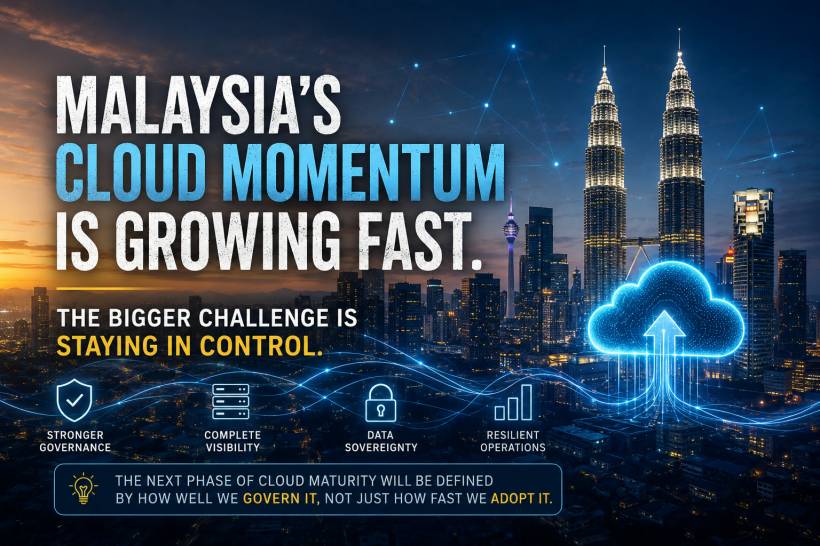
Malaysia is no longer simply exploring the potential of cloud computing. The country is actively building around it. Cloud platforms, data centres, artificial intelligence services, and digital infrastructure are becoming a bigger part of how organisations operate, compete, and deliver services. From banks and hospitals to retailers, government agencies, manufacturers, and fast-growing startups, more businesses are moving critical systems away from traditional on-premises servers and into cloud-based environments.
This shift brings real advantages. Organisations can scale faster, launch new services more quickly, support remote teams, strengthen disaster recovery, and access modern data and AI tools without having to build every capability from scratch.
But cloud adoption also creates an important new question.
It is no longer just about whether an organisation should move to the cloud. The more important question is whether it can still see, govern, protect, and recover everything once its systems are spread across multiple environments.
Cloud Is Becoming Part of Malaysia's Digital Foundation
Malaysia's digital ambitions are closely tied to cloud infrastructure.
As more global providers establish local capacity and as more organisations adopt cloud-based platforms, the country is strengthening its position as a regional destination for digital services, artificial intelligence, and data-driven innovation.
This is a positive development. Local cloud infrastructure can improve performance for Malaysian users, support more resilient digital services, and give organisations more options around where their data is hosted and processed.
For many businesses, cloud is no longer viewed as a side project for the IT department. It is becoming a foundation for customer portals, mobile applications, enterprise systems, data analytics, cybersecurity tools, backup platforms, and AI workloads.
The opportunity is clear. However, the speed of adoption can sometimes hide the complexity that comes with it.
More Flexibility Can Also Mean More Moving Parts
Cloud gives organisations choices.
A company may use one provider for productivity tools, another for application hosting, another for analytics, and an on-premises environment for older systems that cannot yet be migrated. This type of hybrid or multi-cloud setup can be practical because different platforms offer different strengths.
The problem begins when those environments grow without a clear overall design.
Applications may be hosted in different places. Data may move between services without proper visibility. Teams may use separate dashboards, security tools, identity systems, and backup methods. Over time, the organisation can end up with a collection of cloud services rather than one coordinated cloud strategy.
Everything may appear manageable during normal operations.
The real difficulty often becomes visible during an outage, cyber incident, compliance review, audit, or disaster-recovery test. That is when leaders need clear answers to important questions.
Which systems depend on each other? Where is sensitive data stored? Who has access? Which backups are usable? How quickly can essential services be restored?
Without visibility, these questions become much harder to answer.
The Next Stage Is Not Adoption. It Is Governance
Moving workloads to the cloud is only the first stage of cloud maturity.
The next stage is building the governance needed to keep those workloads secure, efficient, compliant, and resilient over time. Governance does not mean slowing innovation down with unnecessary approvals. It means ensuring that innovation happens within clear boundaries.
Every organisation should know who is responsible for cloud security, access control, monitoring, backup validation, cost management, and incident response.
This may sound straightforward, but responsibility can easily become unclear in a multi-cloud environment. One team may assume the cloud provider manages a security setting, while another assumes the application team owns it. A critical backup may exist, but nobody may have tested whether it can actually be restored.
Cloud services operate under a shared-responsibility model. Providers protect the underlying infrastructure, but organisations remain responsible for how they configure services, manage identities, protect data, and secure the applications they run.
Strong governance makes those responsibilities visible.
Visibility Is the Starting Point for Control
An organisation cannot properly govern what it cannot see.
That is why a complete inventory of cloud assets is essential. Teams should be able to identify their applications, databases, storage locations, user accounts, third-party integrations, backup copies, and network connections across every environment.
This inventory should not sit in a spreadsheet that is updated once a year. It needs to be actively maintained as systems change.
Good visibility also means being able to understand data flows. Sensitive information may move from a website to an application, then to an analytics platform, a backup service, or an external vendor. Each of those steps can introduce security, privacy, and compliance considerations.
When leaders have a clear view of where systems and data sit, they can make better decisions about risk, resilience, and investment.
Resilience Has to Be Designed, Not Assumed
Cloud platforms can provide impressive levels of availability, but resilience does not happen automatically.
An organisation can still experience serious disruption if it relies on a single misconfigured environment, has weak backup processes, lacks recovery procedures, or does not understand how dependent systems connect to one another.
A real cloud-resilience plan should look beyond the question of whether data is backed up.
It should ask whether the backup is isolated from the main environment, whether it can be restored within an acceptable timeframe, and whether teams have actually tested the recovery process. It should also define which systems must be restored first and which services can remain unavailable temporarily.
This is especially important for organisations that support essential services. In sectors such as healthcare, finance, logistics, retail, and public services, downtime can affect more than productivity. It can disrupt customer access, patient services, transactions, communications, and public confidence.
The cloud should improve resilience, not create a false sense of security.
Data Sovereignty and Compliance Are Now Board-Level Issues
As more data moves into cloud platforms, organisations are paying closer attention to where that data is stored, who can access it, and which laws apply to it.
For Malaysian organisations, this is becoming increasingly relevant as data sovereignty, privacy, and digital trust move higher on the national agenda.
Data sovereignty is not simply about keeping every file inside one country. It is about understanding the legal, operational, and security implications of where information is stored and processed. Different categories of data may require different protections.
For example, customer records, financial information, healthcare data, employee details, and confidential business documents should not all be treated in exactly the same way.
A mature cloud strategy includes proper data classification, access policies, encryption standards, retention rules, and clear guidance on which workloads can be placed in which environments.
These are not purely technical decisions. They involve legal, operational, financial, and reputational risk. That is why cloud governance is increasingly becoming a leadership and boardroom conversation.
Cloud Costs Also Need Discipline
Another challenge that often appears after cloud adoption is cost visibility.
Cloud services are flexible because organisations can provision resources quickly. However, that flexibility can lead to unnecessary spending when unused storage, oversized virtual machines, duplicate services, and forgotten test environments are left running.
Cloud cost management should not focus only on cutting expenses. It should help organisations understand whether their spending supports real business value.
Teams need visibility into which departments, applications, and projects are using cloud resources. They should be able to spot unusual growth, remove idle services, and plan budgets based on expected demand.
This approach is often described as financial operations, or FinOps. At its core, it is simply the practice of bringing technology, finance, and business teams together so that cloud spending remains accountable.
The Strongest Organisations Will Build for Change
Cloud environments will continue to evolve.
New AI services will emerge. Regulations will change. Providers will expand their offerings. Organisations will acquire new systems, retire older platforms, and face new security threats.
This means cloud strategies cannot remain static.
The organisations that succeed will not necessarily be the ones using the most platforms or adopting every new service first. They will be the ones that can make changes confidently because they understand their environments, maintain clear standards, and have strong operational discipline.
They will know where their data is, who has access, how their critical services connect, and what must happen when something goes wrong.
Final Thoughts
Malaysia's cloud journey is moving quickly, and that momentum creates genuine opportunities for businesses, public services, and the wider digital economy.
But the next phase should not be measured only by the number of cloud regions, data centres, or platforms available. It should be measured by how responsibly organisations use them.
The future belongs to organisations that combine cloud flexibility with clear governance, strong visibility, tested resilience, and practical control.
Cloud adoption may be the starting point. Cloud confidence is what comes next.











Comments 0