

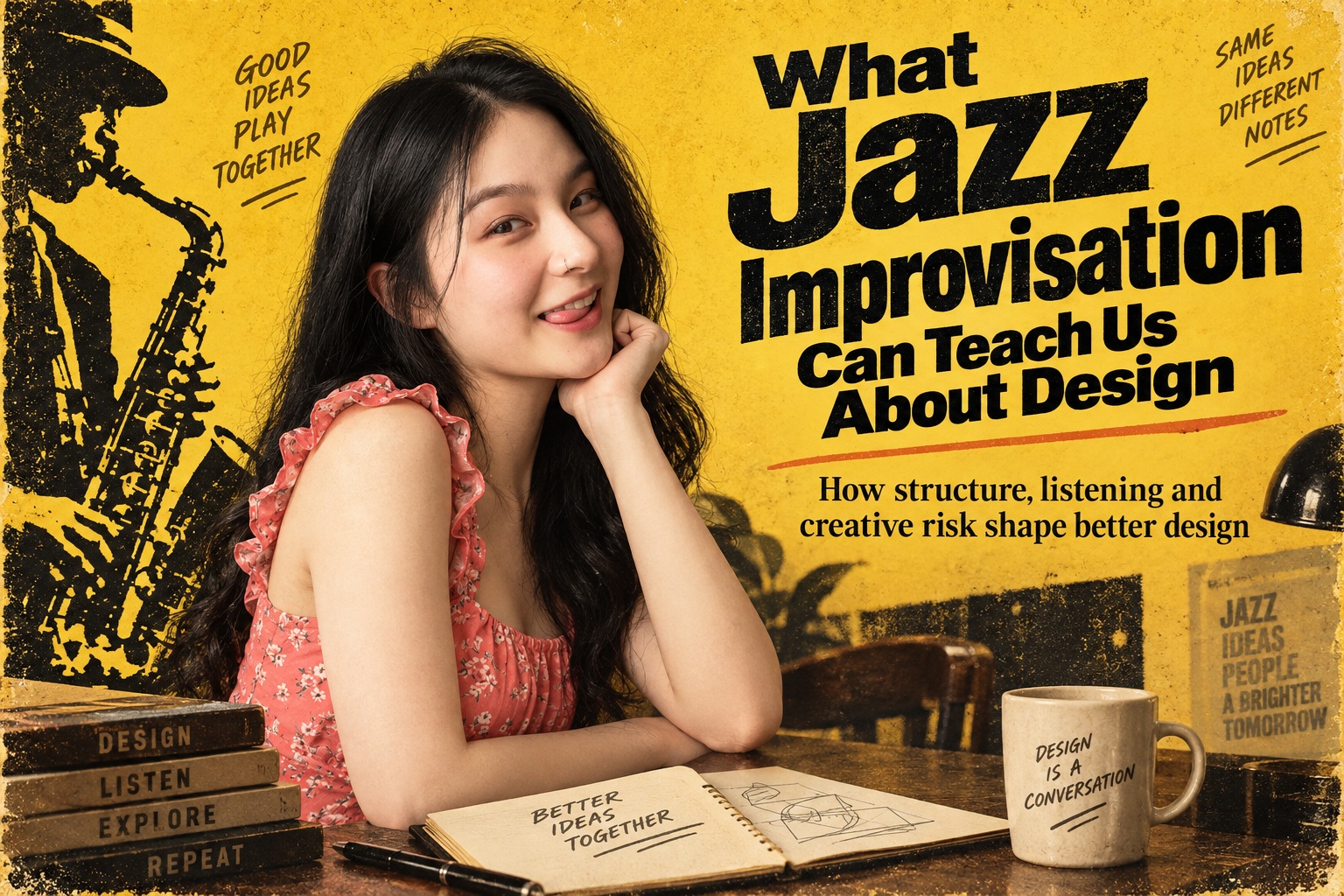
Jazz and design may seem like two completely different disciplines. One is rooted in music and spontaneous performance, while the other focuses on solving problems through visual communication, structure and function. But underneath the surface, both rely on many of the same creative habits: understanding constraints, responding to context, building on existing ideas and knowing when to trust instinct. Jazz improvisation, in many ways, offers a powerful model for how designers can think and work.
Creativity Still Needs Structure
Jazz improvisation is not simply a musician playing random notes and hoping they work. Behind every improvisation is a framework of chord progressions, scales, rhythms and musical conventions that the player understands deeply. The musician knows where the music is going, even if the exact journey is being invented in the moment.
Design works in much the same way. A successful design is built around goals, constraints, hierarchy, usability and visual principles rather than arbitrary choices. Knowing the rules gives a designer the freedom to bend them intelligently, because experimentation becomes grounded in purpose rather than chaos.
Improvisation Is A Conversation With The Rules
The most interesting jazz performances often happen when musicians move slightly beyond what is expected. They may alter a rhythm, stretch a phrase or introduce a note that creates tension before resolving into something familiar. This does not mean they are ignoring musical structure; they understand it well enough to explore its boundaries.
Designers face a similar challenge. Following every established convention exactly may create something functional, but it can also result in work that feels predictable. Strong design often emerges when familiar patterns are adjusted carefully without losing clarity or usability, allowing something fresh to appear while still respecting the underlying structure.
Good Designers Need To Listen
Jazz is fundamentally collaborative. Each musician listens closely to what the others are doing, responds to subtle cues and adjusts their playing as the performance develops. A great solo is rarely isolated from the rest of the band; it grows from the musical conversation happening around it.
Design also depends heavily on listening. Designers must understand clients, users, technical limitations, business requirements and the environment in which the final product will exist. Ignoring those voices can produce beautiful work that ultimately fails because it solves the wrong problem.
Respond To Context Instead Of Forcing An Idea
Improvising musicians cannot simply arrive with a fixed performance and ignore everything happening around them. They respond to changes in tempo, mood, rhythm and the ideas introduced by other players. Their creativity comes partly from adapting to the situation in real time.
Designers benefit from the same flexibility. An idea that worked perfectly for one project may be completely unsuitable for another, even when the visual style seems appealing. Good design responds to its context rather than forcing a predetermined solution onto every problem.
Taking Risks Is Part Of Creative Work
Improvisation inevitably involves uncertainty. A jazz musician may play an unexpected phrase or move outside the obvious scale, knowing there is a chance it will not work. Without that willingness to take risks, however, the music can become technically correct but emotionally flat.
Designers face a similar temptation to stay within safe and familiar solutions. Playing it safe may produce competent results, but memorable work often comes from testing ideas that initially feel uncertain. Not every experiment succeeds, but experimentation creates opportunities that purely predictable work never can.
Mistakes Can Become Part Of The Process
One of the strengths of improvisation is that mistakes do not always have to remain mistakes. An unexpected note can be repeated, developed or transformed until it feels intentional. Experienced musicians often use the moment rather than stopping the performance to correct it.
Designers can approach mistakes in the same way. An unsuccessful layout, unusual colour combination or failed prototype may reveal an unexpected direction worth exploring. Creative work becomes more flexible when failure is treated as information rather than something that must always be avoided.
Repetition Does Not Mean A Lack Of Creativity
Jazz musicians frequently return to familiar melodies, rhythmic patterns and phrases. Repetition gives the listener something recognisable while allowing the musician to gradually change and develop the idea. Creativity often comes from how something familiar is transformed rather than from inventing every element from scratch.
Designers also rely on repetition. Established components, design systems, grids and reusable patterns help maintain consistency and reduce unnecessary effort. Reusing a successful solution is not laziness when it allows more attention to be spent solving the parts of a project that genuinely require new thinking.
Constraints Can Actually Improve Creativity
It is easy to assume that complete freedom produces the most creative work, but jazz suggests otherwise. Musicians often create remarkable improvisations precisely because they are working within a defined key, tempo, chord progression and musical form. The limitations provide direction and give creative decisions something to push against.
Design constraints can serve the same purpose. Limited screen space, budget, technology, brand guidelines or accessibility requirements may initially feel restrictive, but they often encourage clearer thinking. When everything is possible, choosing a direction can become difficult; constraints help define the problem and focus creativity.
Design Is Also A Performance
There is another useful similarity between jazz and design: preparation happens before the moment of improvisation. Jazz musicians spend years practising scales, studying harmony and developing technique so that spontaneous creativity becomes possible. The effortless performance audiences hear is supported by a huge amount of disciplined practice.
Design intuition develops in much the same way. What sometimes looks like an instinctive creative decision is often built on years of observing typography, layout, colour, interaction patterns and user behaviour. The stronger the foundation, the more confidently a designer can improvise when a project requires something unexpected.
Final Thoughts
Jazz improvisation reminds us that creativity is not about ignoring structure. It is about understanding structure deeply enough to respond to it, question it and occasionally reshape it. Listening, experimentation, repetition and risk all become more powerful when they are supported by strong fundamentals.
The same applies to design. Great designers do not simply follow rules, nor do they reject them for the sake of originality. They work in conversation with those rules, responding to users, constraints and context while still leaving room for instinct and surprise. Like a great jazz performance, the best design feels spontaneous and alive, even when a tremendous amount of knowledge and discipline exists beneath the surface.











Comments 0