

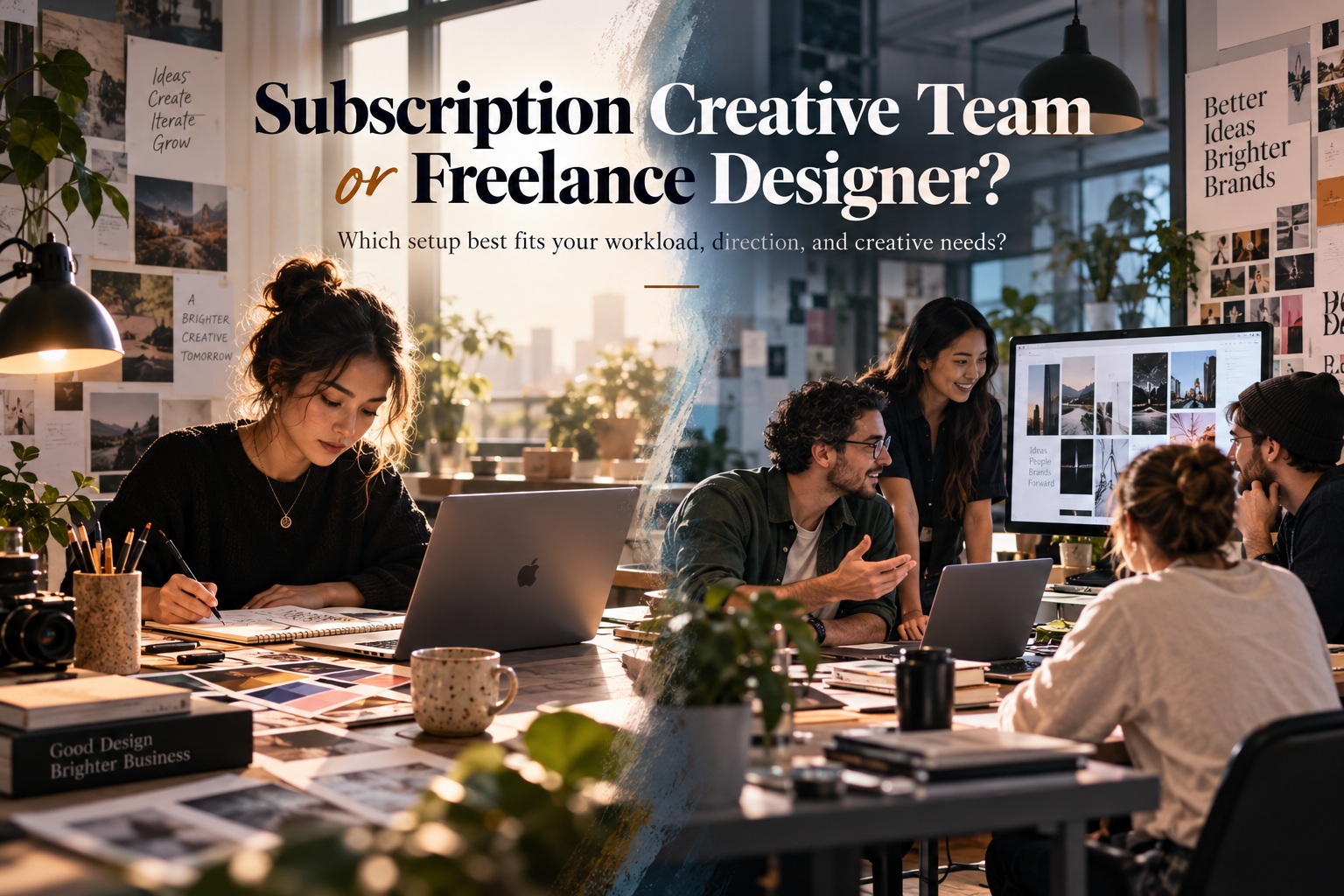
Choosing between a freelance designer and a subscription creative team is less about deciding which model is generally better and more about understanding what kind of work needs to be done. A freelancer can be an excellent fit when the required skill is clear, the project is well defined and someone internally already knows how to direct the work.
A subscription creative team becomes more useful when projects arrive continuously, the required disciplines keep changing and somebody needs to coordinate strategy, execution and quality across several contributors. The real question is therefore not whether you need a brochure, landing page or advertising campaign. It is whether your team already has the creative leadership and coordination needed to carry that work from brief to completion.
A Freelancer Works Best When The Assignment Is Clearly Defined
A strong freelancer can be extremely effective when the project has clear boundaries. If you need a packaging layout, presentation redesign, editorial piece or illustration in a particular style, you can choose someone whose portfolio directly matches the brief.
This gives you a high degree of control over who actually performs the work. Instead of paying for a broader creative service, you are hiring one specialist for a specific problem.
For companies that already know exactly what they need, that simplicity can be a major advantage.
The Relationship Can Be Very Direct
Working with one freelancer often means fewer layers between the person requesting the work and the person creating it.
You can discuss the brief directly, provide feedback and agree on revisions without passing everything through several project-management steps. That can make communication faster and more personal, particularly when both sides already understand how the other prefers to work.
For straightforward projects, this direct relationship can be more efficient than involving a larger team.
Freelancers Are Particularly Effective When You Already Have Creative Leadership
The freelance model becomes even stronger when your organisation already has someone capable of providing direction.
An internal creative director, marketing lead or experienced designer can establish the concept, consolidate feedback and judge whether the final work meets the intended standard.
In that situation, the external freelancer only needs to focus on execution.
You are therefore not buying leadership or project coordination because those capabilities already exist internally.
A Specialist Portfolio Can Matter More Than Team Breadth
Certain projects depend heavily on one specific visual style or technical skill.
If the job requires a particular type of illustration, motion style, editorial design or packaging expertise, selecting one individual whose previous work closely matches the brief can be more valuable than accessing a broad team.
A subscription service may offer several disciplines, but that does not automatically mean the specific person assigned to your project will be the strongest match.
For specialist work, individual selection can provide greater confidence in the creative fit.
Freelancers Can Become Long-Term Brand Partners Too
One common assumption is that subscription teams automatically provide better continuity than freelancers. That is not necessarily true.
A freelancer who works with the same company repeatedly can develop deep knowledge of its brand, products and preferred working style. Over time, the relationship may become extremely efficient because less explanation is required with each new project.
Continuity depends more on the relationship, availability and agreement than on whether the provider operates under a subscription model.
The Challenge Appears When The Project Expands
Freelance arrangements become more complicated when a supposedly simple assignment starts growing beyond the original skill set.
A brochure might suddenly become a landing page. The landing page may then require animation, an email sequence and a set of campaign graphics.
At that point, somebody needs to find the additional specialists and ensure their work feels connected.
That responsibility may fall back on the client unless the original freelancer has explicitly agreed to manage the wider team.
Coordination Should Never Be Assumed
Some freelancers are excellent at managing collaborators. They may already have trusted developers, copywriters, animators or photographers they bring into larger projects.
Others prefer to stay focused on their own specialty.
Both approaches are perfectly reasonable, but the distinction should be clear before the project expands. If coordination becomes necessary, define who owns it rather than assuming someone will naturally take responsibility.
That single decision can determine whether a growing project remains organised or becomes fragmented.
A Subscription Team Makes More Sense When Work Keeps Coming
Subscription creative services become more attractive when design needs are recurring rather than occasional.
Instead of finding a new provider for every project, the company maintains an ongoing relationship with a service that can continuously accept new requests.
This can reduce the administrative work involved in sourcing and onboarding freelancers repeatedly.
For organisations producing creative material every month, the predictability of an ongoing service can be valuable.
The Biggest Advantage Is Access To Multiple Disciplines
A subscription team can be particularly useful when different projects require different types of expertise.
One month may involve presentation design, while the next requires motion graphics, illustration, web design or campaign assets.
Instead of separately finding specialists for each discipline, the subscription provider may already have access to people covering those areas.
The benefit is not simply having more designers. It is having a defined way to access several types of creative expertise through one relationship.
Not Every Subscription Service Is The Same
This distinction matters because the term "subscription creative team" can describe very different offerings.
Some services primarily provide design production based on briefs created by the client. Others include creative direction, strategy, specialist selection, project management and quality control.
Two subscriptions charging similar monthly fees may therefore provide completely different levels of responsibility.
When comparing services, focus on who owns each part of the creative process rather than the subscription label itself.
Managed Creative Services Can Fill Leadership Gaps
A managed creative service becomes much more valuable when the client lacks internal creative leadership.
For example, a platform such as Designity positions itself as a human-led, AI-enabled Creative-as-a-Service model. Its structure includes a dedicated Creative Director responsible for strategy, specialist selection, creative direction and quality, supported by a Creative Project Manager handling workflow and delivery.
That arrangement can suit companies with recurring creative needs but without enough internal resources to manage several specialists themselves.
The main value is therefore not just production capacity. It is having someone accountable for keeping the work strategically and visually aligned.
Creative Direction Is Often The Hidden Cost
Many companies compare only the price of the designer producing the final asset. The more significant cost may actually be everything around that work.
Someone needs to interpret the brief, decide what the work should look like, consolidate stakeholder feedback and determine whether the final result is acceptable.
If those responsibilities already belong to an internal employee, the additional cost is largely invisible.
If nobody owns them, however, the organisation may spend significant time trying to coordinate the project informally.
Project Management Matters More As Complexity Increases
A single designer can manage one defined deliverable relatively easily. Coordinating several specialists across multiple deadlines is very different.
Every additional person introduces scheduling, feedback and dependency management.
The web designer may need assets from the illustrator. The motion designer may depend on approved copy. The presentation designer may need brand decisions finalised first.
Someone needs to ensure those dependencies occur in the right order.
Subscription Teams Can Provide A More Structured Workflow
A good subscription service generally has an established process for handling briefs, assigning specialists and managing revisions.
This structure can be particularly useful when the client has several active projects and changing priorities.
Instead of negotiating a new scope and timeline with different freelancers every time priorities move, the client works within the service's existing workflow.
That can make the process more predictable, although the actual flexibility depends on the provider's capacity and active-project limits.
Subscriptions Are Not Unlimited Creative Output
One mistake is assuming that paying a monthly fee means unlimited simultaneous production.
Most services have practical limits on how many projects can remain active at once or how quickly requests can move through the queue.
Revisions and priorities may also compete for the same production capacity.
Before subscribing, understand how the service handles concurrent work, turnaround expectations and reprioritisation.
The monthly fee only makes sense when those limits match the organisation's actual workload.
Freelancers Often Fit Irregular Work Better
A subscription can become wasteful when creative demand arrives only occasionally.
If the company needs one major project every few months, a project-based freelancer may provide a much better match.
You pay for the specific work when it is required instead of maintaining monthly capacity that may sit unused.
This is particularly sensible when project scopes are relatively predictable and there is enough internal capability to handle creative direction between engagements.
Bursty Demand Requires A Different Calculation
Some businesses do not have steady creative needs but occasionally experience intense periods of production.
A product launch, conference or rebranding project may create several weeks of heavy demand followed by months of relatively little work.
In that situation, either model could work depending on how the service is structured.
A freelancer or temporary team may suit one concentrated project, while a subscription could make sense if the busy periods occur frequently enough to justify maintaining ongoing access.
Changing Priorities Favour Flexible Team Structures
Creative priorities rarely remain completely stable.
A campaign that initially appears urgent may suddenly be delayed while another project becomes more important.
With freelancers, changes in priority may affect agreed scopes and availability. Someone booked specifically for one assignment may not be able to immediately shift into another.
Subscription teams are often designed around reprioritisation, but you still need to understand how changing priorities affect delivery times and existing work.
The Brief Still Matters In Either Model
Neither freelancers nor subscription teams eliminate the need for a good brief.
The client still needs to provide accurate information, identify priorities, supply brand materials and approve decisions.
No external creative provider can compensate indefinitely for unclear objectives or contradictory feedback.
The best working arrangement still requires somebody inside the organisation who understands what the business is trying to achieve.
Use A Real Assignment To Compare The Options
One practical way to choose between the models is to take an actual upcoming project and map the responsibilities.
Write down who will decide the concept, choose the specialists, consolidate feedback and approve the final quality.
Wherever the answer is unclear, leave the responsibility blank.
Those gaps often reveal what kind of support the organisation actually needs.
A Presentation Redesign Is A Good Example
Imagine the company needs a major presentation redesign.
If the marketing lead already owns the narrative and an internal designer has established the visual direction, the remaining gap may simply be layout production.
That is an excellent freelance assignment because the boundaries are clear.
The freelancer receives the content, follows the established direction and delivers the redesigned presentation.
The Same Presentation Could Require A Managed Team
Now imagine the project also needs the story rewritten, custom diagrams created and selected slides animated.
Suddenly the project requires copywriting, information design, illustration and motion graphics alongside presentation design.
Someone needs to coordinate those people and ensure every element works together.
In that scenario, the value of a managed creative team becomes much easier to justify.
The deliverable may still be "a presentation," but the work behind it has become completely different.
The Deliverable Does Not Determine The Best Model
This is why deciding based solely on the final asset can be misleading.
A landing page could be one simple design assignment or a complex project involving strategy, UX, copywriting, illustration and development.
A brochure could require nothing more than clean production or could involve positioning, photography and extensive content development.
The same output can fit either a freelancer or subscription team depending on what decisions and skills are required to create it.
Identify The Missing Capability
Rather than asking whether you need a freelancer or creative subscription, ask what capability is currently missing.
If the answer is "we need an illustrator," hiring a strong illustrator directly may be the simplest solution.
If the answer is "we need someone to decide the creative direction, find the right specialists and keep several projects consistent," then a broader managed service may make more sense.
Buying more capability than necessary adds cost. Buying too little creates coordination problems.
Compare Costs Using The Same Scope
Price comparisons only become meaningful when both options are measured against the same work.
Ask the freelancer what is included in the project price and how additional revisions or expanded requirements will be handled.
Ask the subscription provider how much capacity the work consumes and whether additional services require separate fees.
Only then can the financial comparison become useful.
The Lowest Invoice Is Not Always The Lowest Cost
A freelancer may quote less than a subscription service, but the company may still spend considerable internal time managing the project.
Employees need to source additional specialists, arrange meetings, provide direction and consolidate feedback.
That time has a cost even if it does not appear on the designer's invoice.
A more expensive managed service may occasionally reduce enough internal coordination to make the total cost competitive.
A Subscription Is Not Automatically Better Value Either
The opposite assumption can also be misleading.
Paying a monthly fee for access to several disciplines provides little benefit if the business rarely uses them.
A company needing only occasional design production may spend much more through a subscription than through carefully scoped freelance engagements.
The important measure is not how many services are theoretically available. It is how much useful work the organisation will realistically consume.
Freelancers Offer Greater Control Over Individual Selection
One strong advantage of freelance hiring is knowing exactly who will perform the work.
You can inspect that designer's portfolio, speak directly with them and choose someone whose aesthetic aligns closely with the project.
With larger creative services, the assigned specialist may depend on internal availability.
Before committing to a subscription, understand how specialists are selected and whether clients have any influence over that decision.
Subscription Teams Can Reduce Hiring Friction
The advantage on the other side is speed of access.
Finding one excellent freelancer can take time. Finding several excellent specialists for different disciplines can take significantly longer.
A managed service handles much of that sourcing internally.
For businesses where creative demand changes frequently, avoiding repeated searches and onboarding processes can provide substantial operational value.
Availability Is An Important Freelance Risk
A strong freelancer may already have other clients.
Even if they know your brand extremely well, they may not always have capacity when an urgent project appears.
This can become a problem when a business depends heavily on one individual.
Long-term freelance relationships work best when both sides communicate expected demand and availability clearly.
Subscription Capacity Can Be More Predictable
A larger service may be better able to absorb fluctuations because work can potentially be distributed across multiple specialists.
This does not mean capacity is unlimited, but the relationship is less dependent on one person's calendar.
That can provide additional reliability for businesses producing creative work continuously.
The trade-off is that the same individual may not always handle every project unless the service specifically guarantees continuity.
Brand Familiarity Depends On Process
Both models can develop strong brand knowledge.
A long-term freelancer may understand the brand exceptionally well because they have personally worked on dozens of previous projects.
A subscription team can also maintain continuity if it has documented brand guidelines, dedicated leadership and effective internal handoffs.
The model itself does not determine familiarity.
The quality of the relationship and knowledge-management process does.
Quality Control Needs A Clear Owner
Another question worth asking is who decides when the creative work is actually finished.
A freelancer may rely primarily on the client to determine whether the design meets the required standard.
A managed team may have a creative director performing an internal review before work reaches the client.
Neither approach is inherently superior, but the responsibility needs to be clear.
Poor quality often survives because everyone assumes somebody else is responsible for checking it.
Internal Teams Should Be Honest About Their Own Capacity
A company may technically have someone capable of providing creative direction but that person may already be overloaded.
If the marketing director is expected to manage several freelancers while also running campaigns, strategy and reporting, coordination may become the hidden bottleneck.
In that situation, external creative leadership can provide meaningful relief.
The correct decision depends not only on what skills exist internally but whether those people realistically have time to use them.
Speed Depends On More Than Headcount
A subscription team may have access to many specialists, but that does not automatically make every project faster.
Decision-making, feedback cycles and active-project limits still affect timelines.
Likewise, one experienced freelancer working directly with a decisive client may complete a focused assignment extremely quickly.
Speed comes from clear responsibilities and efficient communication more than the number of people involved.
Freelancers Can Be Ideal For Experiments
When a company wants to test a new style or campaign concept, hiring one specialist can be an efficient approach.
The organisation can evaluate the work without committing to an ongoing service relationship.
If the experiment succeeds, the freelancer can continue or the work can later expand into a larger team.
This makes project-based hiring particularly useful when demand is uncertain.
Subscription Teams Can Be Stronger During Growth
A growing business may reach a point where creative requests become too frequent for ad hoc freelancer management.
One week requires social graphics, the next needs web design and another team suddenly needs a presentation.
At that stage, the problem is no longer finding one good designer.
The challenge becomes maintaining quality and consistency while several creative requests compete for attention.
That is where a structured subscription relationship may begin earning its cost.
The Best Choice Can Change Over Time
The arrangement that works today does not need to remain permanent.
An early-stage company may initially rely on freelancers because its creative requirements are occasional and narrowly defined.
As marketing activity expands, the same company may eventually benefit from a managed subscription team.
Later, it could hire an internal creative department and return to using freelancers only for specialist support.
Creative sourcing should evolve alongside the organisation.
Hybrid Models Can Work Extremely Well
Companies also do not need to choose one model exclusively.
An internal team might use a subscription service for recurring production while hiring a specialist freelancer for one particularly distinctive campaign.
Alternatively, a trusted freelance designer could handle most brand work while a managed team provides motion, web or video capability when projects expand.
Using different models for different types of work can often produce better results than forcing every project through the same structure.
The Key Question Is Who Will Lead The Work
Ultimately, the most important distinction is creative ownership.
Who interprets the brief? Who makes the major decisions? Who chooses the specialist? Who consolidates feedback? Who checks the final result?
If your organisation already has clear answers to those questions, a freelancer may be all you need.
If several answers are missing, a managed creative team becomes much more valuable.
Final Thoughts
The choice between a freelance designer and a subscription creative team should begin with the shape of the workload rather than the type of deliverable.
A freelancer is often the strongest option when the project is clearly defined, one specialist skill matters most and your internal team already provides creative direction and coordination. The direct relationship can be efficient, flexible and cost-effective, particularly for occasional assignments.
A subscription creative team becomes more compelling when work arrives continuously, several disciplines are involved and someone needs to coordinate strategy, staffing, feedback and quality across multiple projects.
The key is understanding exactly what each arrangement includes. Some subscriptions provide little more than design production, while others provide a managed creative structure with dedicated leadership and project coordination.
Take one real upcoming project and map every responsibility from the initial concept to the final file. Wherever ownership is unclear, you have identified the capability you actually need to purchase.
If the only missing piece is one specialist, hire the right freelancer. If the gaps extend across creative direction, specialist selection and ongoing coordination, a managed team deserves a much closer look.
The best option is not the one with the lowest invoice or the largest list of services. It is the arrangement that fits the work your organisation can realistically brief, manage and use.











Comments 0