

A trade show booth has only a few seconds to make an impression. Visitors walking past need to understand who you are, what you offer and whether stopping is worth their time. Lighting, graphics and motion can all help attract attention, but choosing the brightest or most technically impressive display does not automatically create the strongest booth.
Backlit Fabric Displays vs. LED Video Walls: Which Is Better For Your Trade Show Booth?
A trade show booth has only a few seconds to make an impression. Visitors walking past need to understand who you are, what you offer and whether stopping is worth their time. Lighting, graphics and motion can all help attract attention, but choosing the brightest or most technically impressive display does not automatically create the strongest booth.
The better choice depends on what visitors need to notice, understand and do next. When planning a custom trade show exhibit, the display technology should support the booth layout, messaging and visitor journey rather than becoming the entire concept. Whether you are working with an exhibit designer or developing the booth internally, it makes sense to define the communication goal before deciding between a backlit fabric display and an LED video wall.
Understanding The Difference
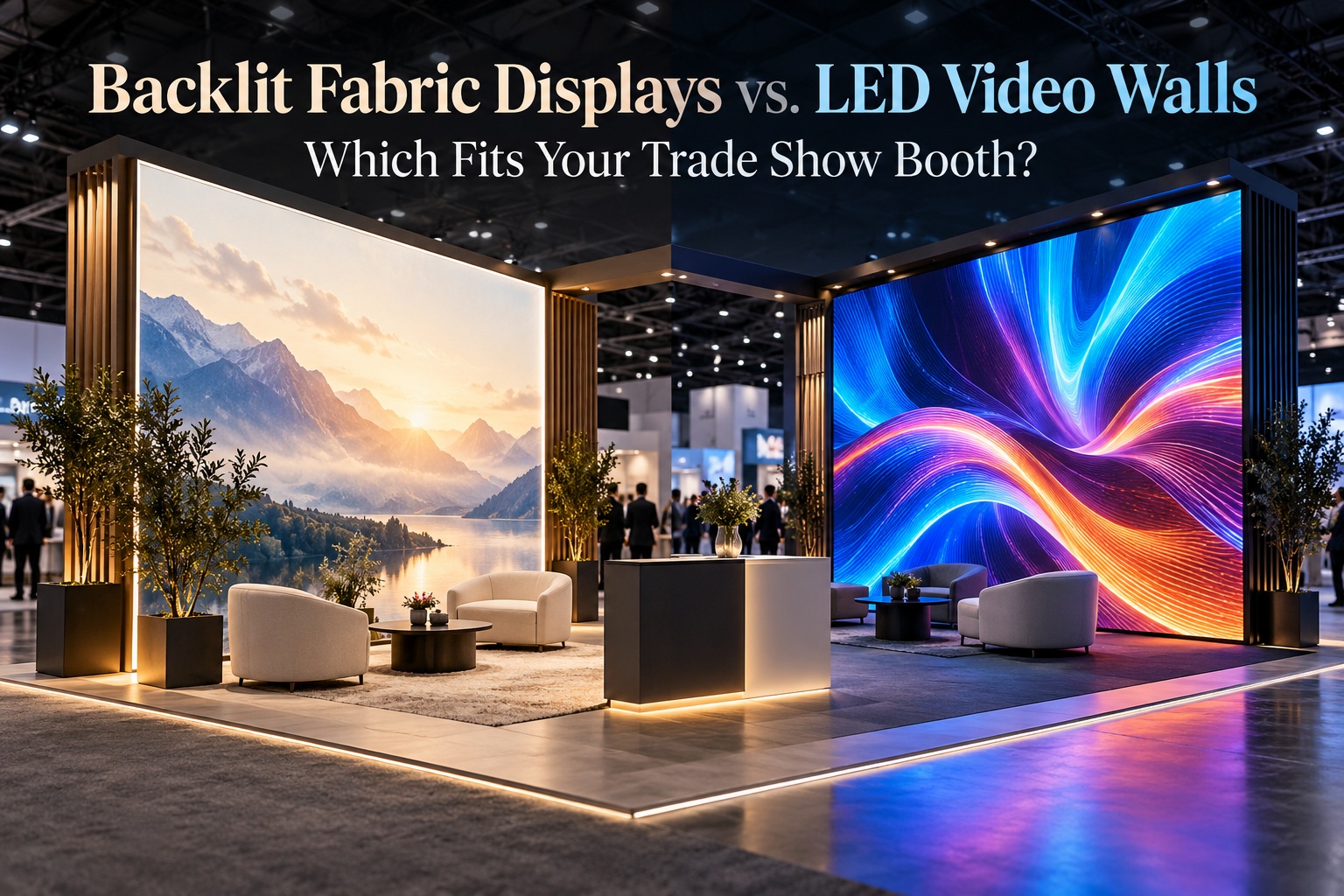
A backlit fabric display uses a printed textile graphic illuminated from behind or within a frame. Most modern systems already use LED lighting, so the distinction is not really between fabric and LED technology. Instead, it is the difference between an illuminated printed surface and a digital screen capable of displaying moving content.
A fabric lightbox normally presents one fixed composition, such as a product photograph, brand statement, illustration or campaign graphic. If you want to change the content, the printed fabric needs to be replaced.
An LED video wall works very differently. Multiple display panels combine to form a large digital surface capable of showing animation, video, presentations and changing messages. Content can be updated without producing another physical graphic, although someone still needs to design, test and manage the digital material.
Start With What You Actually Need To Communicate
The most important question is not which display looks more impressive. It is whether the message becomes clearer when it moves.
Backlit fabric works particularly well when the main message should remain visible throughout the event. A strong headline combined with a memorable image can immediately explain what the company does without requiring visitors to wait for a video sequence to reach the relevant point.
An LED video wall becomes more useful when movement genuinely helps explain the product or service. Manufacturing processes, before-and-after transformations, animated demonstrations or visual walkthroughs can often communicate more effectively through motion than through one static image.
If movement does not improve understanding, a large digital screen may simply introduce unnecessary complexity. Decorative animation can create activity, but activity alone is not communication.
Backlit Fabric Creates A Strong Architectural Presence
One advantage of backlit fabric is that it can become part of the booth itself rather than feeling like equipment placed inside it. A large illuminated wall can define the reception area, frame a product display or create a recognisable backdrop behind a meeting space.
Because the light is integrated into the structure, the display can create a clean and polished appearance without introducing visible screens, bezels or supporting hardware. This makes fabric lightboxes particularly effective for brands that want the booth to feel calm, premium or visually consistent.
The result can be especially powerful when the graphic is simple enough to be understood from a distance.
Keep Fabric Graphics Focused
A backlit display works best when the design does not try to communicate everything at once. One strong photograph, a concise headline and enough empty space usually create a clearer hierarchy than a collage filled with competing messages.
Visitors should be able to understand the main idea while walking past the booth rather than stopping to read several paragraphs of copy. Supporting information can appear elsewhere once someone enters the space.
A lightbox should function more like a billboard than a brochure.
Backlighting Changes How Printed Graphics Look
Designers should also remember that a graphic illuminated from behind will not necessarily look identical to the same artwork displayed on a monitor. Colours, contrast and perceived brightness can change once light passes through the fabric.
Requesting a suitable proof before final production is therefore important. Review image quality, colour reproduction and text legibility under conditions that approximate the intended display.
A beautiful desktop preview does not guarantee that the finished illuminated graphic will produce the same effect on the exhibition floor.
LED Video Walls Excel When Movement Has A Purpose
LED walls are strongest when changing content adds genuine value. They can demonstrate products, show processes, cycle through different messages or support live presentations during the event.
This makes them particularly useful for booths where visitors need to see something happening before they fully understand the offering. A complicated piece of equipment, for example, may be much easier to explain through animation than through a static photograph.
The key is making sure the motion serves the message rather than existing purely because the technology is available.
Design Digital Content For Interrupted Viewing
Trade show visitors rarely watch a presentation from beginning to end. Someone may look at the screen for only a few seconds while walking past and encounter the video halfway through a sequence.
Content therefore needs to remain understandable regardless of when a visitor begins watching. Short, self-contained segments generally work better than one long narrative that only makes sense from the opening frame.
Important messages should also appear repeatedly rather than being shown once and disappearing for several minutes.
Do Not Make The Brand Message Depend On The Video
One common mistake is placing the entire booth message inside the digital sequence. If the screen happens to be showing something else when a visitor walks past, the person may never understand what the company does.
Keep the essential brand identity visible elsewhere in the booth. A headline, logo and core message should remain available even while the LED wall cycles through demonstrations or supporting material.
The screen should enhance the booth rather than become the only place where the booth makes sense.
Plan For Silent Viewing
Trade show environments are noisy. Even when a video wall has audio capability, attendees may not hear it clearly or may simply be unwilling to stop long enough to listen.
Digital content should therefore work without sound. Captions, clear visual sequencing and readable on-screen text help ensure the message remains understandable.
If the presentation only works when visitors can hear a voiceover, it may struggle on a crowded exhibition floor.
Viewing Distance Should Influence The Design
Every display needs to be evaluated from where visitors will actually stand. A design that looks excellent while viewed on a laptop may behave very differently when enlarged across several metres.
For backlit graphics, test the headline from the aisle and secondary information from inside the booth. Make sure counters, products and people are unlikely to obscure essential text.
Visitors should not need to stand directly in front of the wall before understanding the main message.
Pixel Pitch Matters For LED Video Walls
With LED displays, viewing distance also affects the appropriate pixel pitch. Pixel pitch refers to the spacing between individual LEDs, and closer viewing generally requires finer spacing to prevent the pixels from becoming distracting.
A screen designed to be viewed from across a large exhibition hall may not look equally impressive when someone stands only a few feet away. Small text, interface demonstrations and detailed visual content are particularly sensitive to resolution.
Ask the display supplier to show representative content at approximately the same viewing distance expected in the actual booth.
Large Screens Do Not Automatically Need Tiny Pixel Pitch
Finer pixel pitch generally improves close-up image quality, but it can also increase cost considerably. Paying for extremely high resolution may provide little benefit if the audience will always view the screen from far away.
The appropriate specification should therefore come from the booth layout and content requirements rather than simply choosing the highest technical specification available.
A well-selected screen is one that looks convincing from the visitor's actual position.
Compare The Total Cost, Not Just The Display Price
Budget comparisons can become misleading when they focus only on the initial rental or purchase price. Both display formats involve additional expenses that need to be considered.
For a backlit fabric system, the budget may include the structural frame, lighting, printed graphic, transportation, installation, storage and future replacement graphics. A reusable frame can support several events, potentially reducing long-term costs if the dimensions remain suitable.
The structure may therefore become an investment while individual fabric graphics change from campaign to campaign.
LED Walls Have More Operational Requirements
An LED video wall typically requires panels, mounting structures, processing equipment, playback systems, electrical power, installation and potentially technical support during the event.
Content production is another important cost. Buying or renting the screen accomplishes very little if nobody has budgeted for creating appropriate video or animation.
Venue requirements may introduce additional expenses as well, particularly when electrical service, rigging or specialised technical labour is required.
The complete system should therefore be quoted against the same booth brief rather than comparing only the visible hardware.
Backlit Fabric Is Often Simpler For Static Messaging
When the booth primarily needs one clear message and strong product imagery, backlit fabric usually provides a relatively straightforward solution.
There are fewer playback systems to configure, fewer technical components that can fail and no video sequence requiring management throughout the event.
Once the graphic is installed and illuminated correctly, it generally remains consistent for the entire show.
That simplicity can be valuable for teams that do not want significant technical overhead during setup and operation.
LED Walls Offer More Flexibility Once Installed
The main advantage of digital displays is that the content can change without physically producing another graphic. A company attending several events can adapt presentations according to the audience while reusing the same display hardware.
Different products can also be highlighted throughout the day. Scheduled demonstrations may use one visual sequence, while general booth traffic sees another.
This flexibility becomes more valuable when the booth genuinely needs to communicate several messages rather than one permanent statement.
A Hybrid Approach Can Work Extremely Well
Choosing between fabric and LED does not always need to be an either-or decision. Some of the strongest booth designs use both technologies for completely different purposes.
A backlit fabric wall might establish the brand identity and primary headline, while a smaller digital display near the demonstration area explains product features through animation.
This gives visitors a consistent visual anchor while still allowing selected areas of the booth to present changing information.
Give Every Surface A Specific Job
Hybrid booths become confusing when every display repeats the same content. Instead, each surface should have a distinct purpose.
The backlit graphic might attract attention and establish the brand. The digital screen might explain a complicated product. Another sign could direct visitors towards a meeting area or demonstration.
When every visual element performs a different role, the booth becomes easier to understand.
Repeating the same promotional message everywhere generally adds clutter without adding information.
Product Launches Can Benefit From Both Formats
For a product launch, a large illuminated graphic can establish the product name and visual identity immediately. Visitors walking through the aisle see the branding even when the digital screen is showing something else.
The LED display can then provide demonstrations, animations and feature explanations closer to the product area.
This combination separates the tasks of recognition and explanation. The static surface tells visitors what they are looking at, while the digital surface shows why it matters.
Consultation-Focused Booths May Prefer Static Displays
A booth designed primarily around conversations may benefit from a calmer visual environment. Constant movement can become distracting when representatives are trying to speak with visitors.
An illuminated fabric wall can create a polished atmosphere without continuously competing for attention. Digital content can still be included elsewhere, but it should support discovery rather than dominate the entire space.
The booth experience should reflect what visitors are actually expected to do once they enter.
Digital Screens Work Well For Scheduled Demonstrations
If a booth hosts demonstrations at specific times, an LED wall can become especially useful. The screen can support presentations during scheduled sessions and return to simpler looping content afterwards.
This allows one display to perform several functions throughout the event.
The surrounding static branding remains consistent while the digital screen changes according to the programme.
Think About The Booth When It Is Busy
Design reviews often happen with empty booth renderings, but real exhibitions can become crowded. Visitors, staff and furniture will inevitably block parts of the display.
Important text should therefore be placed high enough to remain visible above people and counters. Screens should be positioned so that groups watching demonstrations do not completely block circulation.
A display that only works when the booth is empty is not designed for the real environment.
Think Like Someone Walking Down The Aisle
Before approving either format, mentally walk past the booth as an attendee.
What can you understand from several metres away? Is the company name obvious? Does the main message make sense within a few seconds?
Then imagine moving closer. Is there another layer of information worth discovering? Does the display naturally encourage someone to ask a question or approach a demonstration?
The booth should reveal information progressively rather than demanding that visitors process everything immediately.
Consider Who Will Operate The Display
Operational responsibility is another practical consideration. A fabric lightbox generally requires little attention once it has been installed correctly.
An LED wall may need someone to manage playback, troubleshoot signal problems or update content. If the booth team has no technical specialist available, this needs to be considered during planning.
The most impressive technology becomes less useful if nobody knows how to fix it when something stops working during the event.
Content Updates Need Ownership Too
Digital flexibility only helps when someone is responsible for preparing the content. The ability to update a video wall instantly does not mean good content appears automatically.
Someone needs to create the files, check resolution and aspect ratio, test playback and make sure the latest version reaches the event team.
Clear ownership prevents the booth from opening with outdated graphics or videos that were never tested on the actual screen.
Storage And Transportation Matter For Reusable Exhibits
Backlit fabric structures and LED equipment also have different transportation and storage requirements.
Fabric graphics themselves can often be packed relatively compactly, while frames may be broken down and reused. LED panels require protective cases, careful handling and appropriate transport.
For companies attending many trade shows throughout the year, these logistical costs can become important.
The best display is not only the one that looks good during the event but also the one the organisation can realistically transport, store and deploy repeatedly.
Brand Consistency May Favour Backlit Fabric
Static illuminated graphics can be particularly effective for brands that value extremely consistent visual presentation.
Once the artwork has been approved and printed correctly, every visitor sees the same composition throughout the entire event. There is no possibility that someone arrives during an unimportant moment in a video sequence.
This makes backlit fabric especially strong for campaigns built around one powerful hero image or statement.
Storytelling May Favour LED
Digital displays are stronger when the message depends on progression.
A product transformation, workflow or technical process can unfold step by step. Complex information can be introduced gradually rather than compressed into one static composition.
The screen can also adapt throughout the day according to different visitor groups.
When storytelling genuinely requires time and sequence, LED becomes much more valuable.
Avoid Choosing Technology For Prestige Alone
Large LED walls can certainly make a booth look expensive and technologically advanced. That does not necessarily mean they improve communication.
A poorly conceived video running on a massive screen may communicate less effectively than one beautifully designed illuminated image.
Similarly, choosing fabric simply because it is cheaper can be a mistake if the product genuinely needs animation to be understood.
Technology should follow communication rather than becoming the reason for the design.
The Display Should Support The Visitor Journey
Every booth ultimately needs to move visitors towards some next step. That might be speaking with a representative, trying a product, attending a demonstration or booking a consultation.
The display should contribute to that progression.
An attention-grabbing screen that keeps people watching but never encourages them to engage with the booth may not be doing its job. Likewise, a beautiful fabric wall that provides no reason to enter the space may be visually successful but commercially weak.
The best display creates curiosity and then helps convert that curiosity into interaction.
When Backlit Fabric Makes More Sense
Backlit fabric is usually the stronger choice when the booth needs a permanent visual anchor, consistent branding and high-impact imagery.
It works particularly well for simple messages that visitors should understand immediately. It can also integrate naturally into booth architecture while requiring relatively little operational management once installed.
For organisations prioritising simplicity and visual consistency, fabric lightboxes can deliver an extremely polished result without unnecessary technical complexity.
When An LED Video Wall Makes More Sense
An LED wall becomes more appropriate when moving content genuinely makes the product or service easier to understand.
It is especially valuable for demonstrations, animations, changing campaigns and presentations that need to evolve throughout the event.
The trade-off is greater technical complexity, higher content-production requirements and potentially higher operational costs.
Those costs are worthwhile when the digital content performs a job static graphics simply cannot accomplish.
Final Thoughts
Backlit fabric displays and LED video walls can both become powerful focal points inside a trade show booth, but they solve different communication problems.
Backlit fabric excels when the brand needs one strong, consistent visual statement. It can become part of the booth architecture, provide beautiful illumination and communicate immediately without requiring visitors to wait for a sequence.
LED video walls become more useful when movement explains something important. Product demonstrations, transformations, animated workflows and changing messages can benefit significantly from a digital surface.
A hybrid approach can also work extremely well when each format is given a separate purpose. Static graphics can establish the brand while digital content handles explanation and demonstration.
The most important question is therefore not whether fabric or LED is more impressive. It is whether the chosen display helps visitors understand the business more quickly and naturally.
A good trade show display earns the space it occupies. It attracts attention, communicates something useful and guides visitors towards the next step rather than simply becoming another bright object competing for attention on a crowded exhibition floor.










Comments 0