

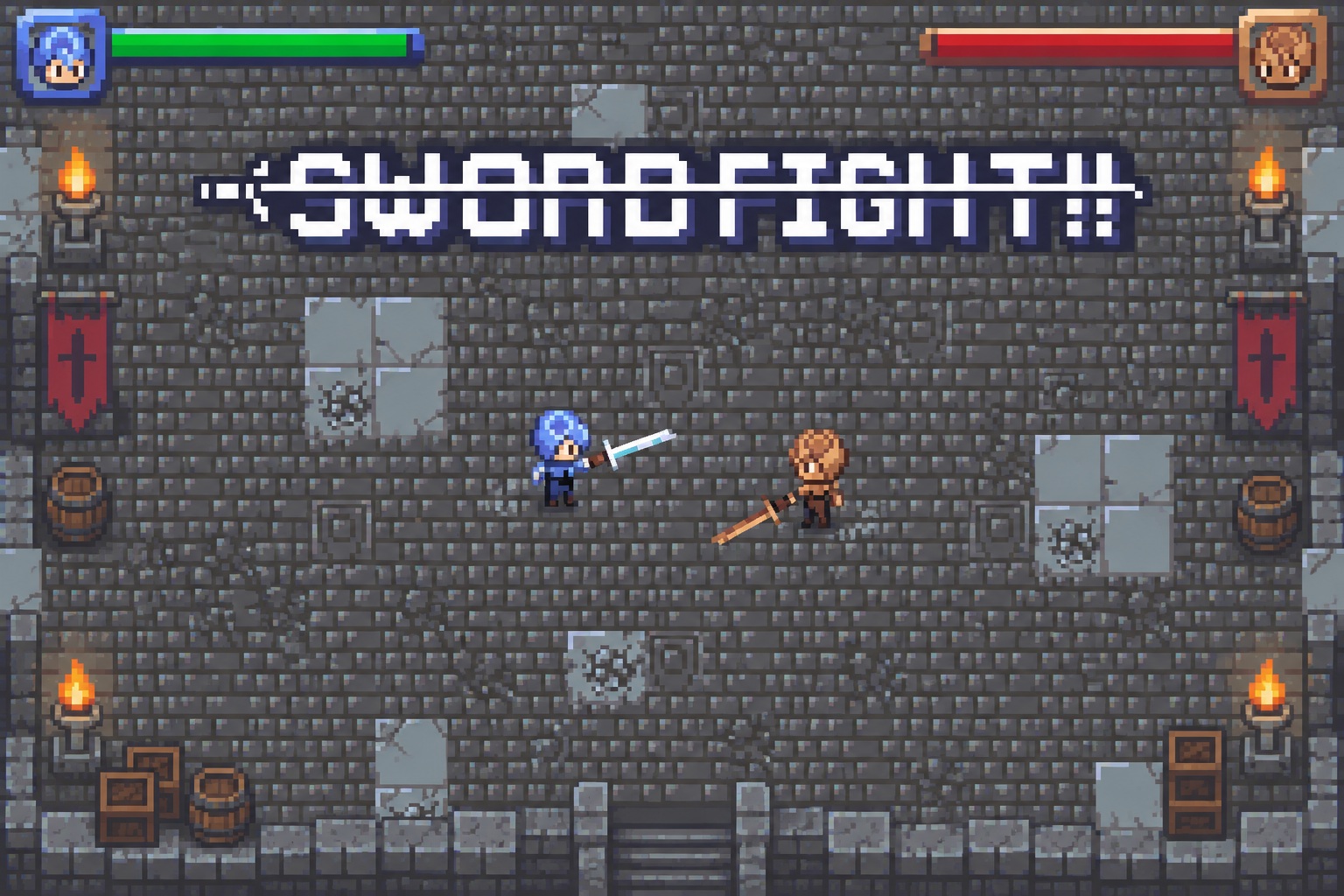
Sword Fight takes the familiar fantasy of becoming a legendary swordsman and turns it into an incremental progression game built around training, challenging stronger opponents, improving equipment, and steadily developing an entire school of swordsmanship. Instead of relying purely on fast reflexes, the game focuses heavily on preparation and long-term advancement, with each victory contributing toward stronger statistics, better abilities, and access to tougher rivals. Early progress begins modestly, but the scope gradually expands as new systems become available and the player's fighter becomes increasingly capable. What starts as a straightforward series of sword duels eventually develops into a much broader cycle of combat, upgrades, management, and strategic growth.
The appeal comes from watching small improvements gradually transform an inexperienced fighter into someone capable of confronting increasingly dangerous opponents. Training strengthens core combat abilities, equipment provides additional advantages, and unlocked skills create new ways to improve performance. Progress does not stop with the main swordsman either, as the adventure eventually expands into building a school, recruiting disciples, improving facilities, and developing systems that benefit future battles. This constant stream of new objectives gives Sword Fight the satisfying feeling that almost every action contributes toward something larger.
Now playable online through Lemon Web Games, Sword Fight brings its incremental sword-fighting progression directly into modern web browsers without requiring a separate installation. Players can train their fighter, challenge rivals, improve equipment, develop their school, recruit disciples, and gradually unlock increasingly powerful upgrades as the adventure continues. Its browser-friendly structure makes it easy to play in short sessions while still providing enough long-term development for players who enjoy watching numbers, abilities, and facilities steadily improve. Whether you prefer direct combat progression or the management side of building a successful sword school, Sword Fight offers a rewarding cycle of continual advancement.
Starting as a Lone Swordsman
The adventure begins on a relatively small scale, with the player controlling a single swordsman who still has plenty to learn. Early battles introduce the basic progression loop by placing the fighter against opponents that provide rewards when defeated. Those rewards can then be invested into improvements that make subsequent encounters easier. The structure is immediately understandable: fight, improve, and return stronger.
This simplicity works particularly well during the opening stages because players can clearly see the effect of each upgrade. A stat increase may shorten a battle that previously felt difficult, while better equipment can improve survivability or offensive power. Progress becomes visible almost immediately rather than remaining hidden behind complicated systems. That constant feedback makes even modest upgrades feel meaningful.
The early game also establishes one of Sword Fight's most important themes: stronger enemies are not necessarily obstacles that need to be defeated immediately. Sometimes the correct answer is simply to train more, gather additional resources, and return later. This makes progression feel deliberate rather than forcing every encounter to be solved through repeated attempts. Becoming stronger is part of the strategy rather than merely a consequence of playing.
Challenging Rival Swordsmen
Rival fighters provide the main milestones throughout much of the adventure. Each new opponent represents another test of how far the player's training and equipment have developed. Defeating a difficult swordsman creates a noticeable sense of progress because it demonstrates that previous upgrades have actually changed what the character can handle. The next challenger then establishes another target to work toward.
These encounters give structure to what could otherwise become a purely numerical progression game. Instead of improving statistics without a clear purpose, players always have stronger opponents waiting somewhere ahead. A rival who appears overwhelming at first can eventually become manageable after enough preparation. That transformation is one of the most satisfying parts of the experience.
The increasing difficulty also encourages players to use more than one progression system. Simply increasing a single statistic may not always be enough, particularly when equipment, skills, and other bonuses become available. Players gradually begin thinking about how different improvements work together. The combat itself may remain straightforward, but the preparation behind each victory becomes increasingly important.
Incremental Progression Drives the Entire Experience
Sword Fight is fundamentally built around incremental improvement. Every completed battle contributes resources or progress that can eventually be converted into stronger combat performance. These improvements then allow the player to defeat enemies more efficiently, earn additional rewards, and continue advancing. The cycle is simple but highly effective.
The key to a good incremental game is making improvement feel noticeable, and Sword Fight regularly provides new targets to reinforce that sensation. A small stat increase might not appear dramatic in isolation, but several upgrades together can completely change the outcome of a difficult fight. Players can watch encounters that once required significant preparation gradually become routine. That visible growth creates strong motivation to continue.
Progress also expands beyond raw combat statistics. Equipment, abilities, school development, disciples, and facilities gradually introduce additional ways to increase power. This prevents progression from becoming entirely dependent on one number rising indefinitely. The game continually adds another layer to the improvement cycle.
Training Turns Weakness into Strength
Training is one of the most direct ways to improve the swordsman. Instead of expecting the player to defeat every opponent immediately, the game encourages periods of development between major challenges. Training provides the foundation needed to deal with increasingly powerful enemies. It reinforces the martial arts theme particularly well because becoming stronger feels tied to repeated practice.
Different upgrades can influence different aspects of combat, allowing players to strengthen areas that currently feel inadequate. A fighter struggling to deal enough damage may benefit from offensive improvements, while someone losing too quickly may need additional durability. The correct priorities can change depending on the next opponent. This creates useful decisions even within an otherwise straightforward progression system.
Training also gives the game a steady rhythm. Players alternate between preparation and testing themselves against stronger enemies. When a difficult opponent finally falls, the victory feels connected to all of the preparation that came beforehand. The process resembles the familiar martial arts story of training repeatedly before returning to confront a previously overwhelming rival.
Equipment Adds Another Layer of Progression
Equipment provides another important method of strengthening the player's fighter. Better gear can improve combat effectiveness beyond what ordinary training alone provides. Acquiring and upgrading equipment therefore becomes increasingly valuable as tougher opponents begin appearing. It gives players another reason to collect resources rather than spending everything immediately.
Weapons naturally play an important role in a game centered around sword fighting. Improving offensive equipment can dramatically increase the pace of battles and help overcome opponents with greater durability. Defensive equipment can be equally valuable when the player's fighter is unable to survive long enough to take advantage of stronger attacks. Finding the right balance depends on the current challenge.
The equipment system also creates additional long-term goals. A player may recognize that the next major improvement requires more resources than currently available and decide to continue fighting weaker enemies until enough has been earned. This kind of planning adds structure to repeated battles. Each fight contributes toward something specific rather than existing only for its own sake.
Forging Helps Push Equipment Further
As progression expands, forging provides another way to improve available equipment. Rather than relying entirely on finding or purchasing stronger items, players can develop existing gear and increase its usefulness. This gives equipment a longer lifespan and makes resource decisions more meaningful. A weapon does not necessarily become irrelevant immediately after the next progression milestone.
Forging also fits naturally into the wider sword-school theme. A successful martial arts organization should have access to increasingly capable equipment, and improving weapons becomes another representation of the school's growth. Stronger gear supports stronger fighters, who in turn can defeat more difficult enemies and generate more progress. The systems begin reinforcing one another.
Players therefore need to think about when investing in equipment is worthwhile. Resources spent improving a weapon might delay another upgrade elsewhere, but the resulting combat advantage could make future battles significantly faster. These trade-offs provide simple but useful strategic choices. Incremental games are at their best when multiple upgrades compete for attention.
Skills Expand the Fighter's Capabilities
Stat improvements provide raw strength, but skills allow progression to become more specialized. Unlocking or developing abilities gives the player additional ways to improve performance beyond simply increasing base numbers. Certain skills may strengthen existing combat advantages, while others can compensate for weaknesses. This creates a stronger sense of developing an actual fighting style.
Skills also make progression feel more substantial because they can represent meaningful milestones. Gaining another point of damage is useful, but unlocking a new ability often feels more significant. These moments break up the regular cycle of small upgrades and provide larger goals. Players have something new to work toward besides simply increasing the next statistic.
As more skills become available, different combinations can support different priorities. Some players may prefer maximizing offensive efficiency, while others may value survivability or long-term resource generation. The system does not need to become overwhelmingly complex to support meaningful decisions. Even a handful of distinct abilities can dramatically change progression strategy.
Building a Sword School Expands the Adventure
One of the more interesting developments in Sword Fight is the transition from improving a single swordsman toward managing an entire martial arts school. This changes the scale of the adventure considerably. The player is no longer focused exclusively on personal combat power but begins developing an organization capable of producing additional benefits. Progress becomes both individual and institutional.
The school provides a natural home for many of the game's broader systems. Facilities can be improved, disciples can be recruited, and resources can be invested into long-term advantages. These systems create another progression path alongside ordinary fighting. A stronger school eventually supports a stronger fighter.
This expansion also helps prevent the game from feeling repetitive. Early stages revolve primarily around training and combat, while later progression introduces management decisions and additional objectives. Players gain more systems to monitor without completely abandoning the original sword-fighting foundation. The game gradually grows rather than overwhelming players immediately.
Recruiting Disciples Creates a Growing Community
Disciples become an important part of the sword school as the player's influence expands. Recruiting students gives the organization a stronger sense of growth because the main character is no longer progressing alone. The school begins feeling like something that exists beyond the player's individual statistics. Each additional disciple contributes to the feeling of building a martial arts legacy.
Training disciples can also become another source of progression. Their development may contribute bonuses, additional resources, or other advantages that support the wider school. This creates another reason to keep improving facilities and systems rather than spending everything directly on the main fighter. Progress begins circulating through multiple connected mechanics.
The disciples also reinforce the fantasy of becoming a master rather than remaining a wandering fighter forever. Early in the game, the player is trying to prove themselves against stronger swordsmen. Later, others begin learning under the player's guidance. That shift provides a satisfying narrative progression even within a relatively system-focused game.
Facilities Provide Long-Term Benefits
Improving facilities expands what the sword school can accomplish. Rather than functioning as simple decoration, these upgrades provide meaningful benefits that support future growth. Increasing a facility's effectiveness can improve training, equipment development, resource production, or other aspects of progression. The school gradually becomes more efficient as investment continues.
Facility upgrades also create another set of competing priorities. Resources used to improve the school may not provide an immediate combat advantage, but the long-term benefit can be substantial. Players need to decide whether to focus on beating the next opponent quickly or invest in systems that will make future progression easier. This creates useful strategic tension.
The best incremental games frequently reward players who think beyond the next immediate upgrade, and Sword Fight follows that pattern. A strong long-term investment may initially feel slower but eventually produce much greater benefits. Watching the school become increasingly productive gives players another form of progression beyond individual combat power.
Different Systems Begin Reinforcing One Another
As more mechanics unlock, Sword Fight becomes less about choosing one isolated upgrade and more about understanding how several progression systems interact. Training improves the fighter, equipment strengthens combat performance, facilities increase school capabilities, and disciples contribute additional development. Each system feeds into the next. The game gradually becomes a network of improvements rather than a single upgrade path.
This interconnected structure keeps progression interesting over longer sessions. Players may initially focus entirely on combat statistics but later realize that improving another part of the school creates better long-term results. A new facility might strengthen equipment production, which then makes rival battles easier. The reward from those fights can then fund another school upgrade.
These feedback loops are central to the appeal of incremental strategy games. Progress generates more progress, but players still influence which systems receive attention first. Optimization becomes part of the experience without requiring complicated spreadsheets or overwhelming menus. The game remains approachable while offering room for planning.
Pixel-Style Graphics Keep the Presentation Focused
Sword Fight uses a compact pixel-style presentation that suits its incremental structure particularly well. Characters, environments, and combat scenes remain easy to understand without unnecessary visual complexity. The art supports the martial arts atmosphere while leaving plenty of space for progression information and interface elements. This keeps the player's attention on development and combat.
The visual simplicity also allows upgrades to remain readable. Players can quickly recognize the main fighter, opponents, facilities, and other important elements without searching through cluttered environments. Incremental games frequently rely on clear information presentation, and a focused pixel-art style helps achieve that. Functionality and atmosphere work together.
There is also a nostalgic quality to the presentation. Pixel graphics naturally recall older role-playing and strategy games while still working comfortably inside a modern browser. The style complements the game's straightforward progression systems. Sword Fight feels deliberately compact rather than visually underdeveloped.
Combat Works as a Test of Preparation
The battles themselves function as checkpoints for the player's progression decisions. A fight reveals whether the current combination of training, equipment, skills, and bonuses is strong enough to overcome the opponent. Winning confirms that preparation has reached the required level. Losing indicates that another round of improvement may be necessary.
This approach makes combat easy to understand while keeping preparation meaningful. Players do not need an extremely complicated control system for battles to feel rewarding because the strategic decisions happen beforehand. Choosing what to improve determines how effectively the swordsman performs. The confrontation becomes the final test of those choices.
The structure is particularly satisfying when returning to an opponent who previously seemed impossible. After investing in training and equipment, the same rival can suddenly fall much more quickly. The difference makes progress tangible. Numbers have increased, but more importantly, the outcome has changed.
Defeat Is Usually a Sign to Improve
Sword Fight does not treat losing as the end of progression. A defeat usually provides useful information about what needs to be strengthened before the next attempt. Perhaps the player's damage is too low, survivability is inadequate, or available equipment has fallen behind. The solution is often to step away from the challenge temporarily and continue developing.
This makes difficult opponents less frustrating than they might be in a pure action game. Players know there are several ways to become stronger rather than being forced to execute the exact same fight repeatedly. Training, equipment, forging, facilities, and other systems all provide possible solutions. Progress remains available even when the current rival is too powerful.
The result is a more relaxed form of difficulty. Challenges still provide meaningful barriers, but the player can approach them on their own terms. There is satisfaction in eventually returning with enough strength to win decisively. The game continually reinforces the idea that preparation matters.
Unlocking New Areas Keeps Progress Moving
As the player's strength and reputation increase, additional areas become available. These new locations provide stronger opponents, new progression opportunities, and additional reasons to continue developing the school. Unlocking another area feels like reaching a major milestone because it represents movement beyond the current stage of the adventure. The world gradually expands alongside the player.
New areas also help prevent progression from becoming visually repetitive. Even if the core systems remain familiar, different environments and opponents create a sense of advancement. Players can clearly see that they have moved beyond the challenges that dominated earlier stages. This gives the incremental structure a stronger sense of journey.
The increasing difficulty of later areas also creates new goals. Upgrades that seemed powerful earlier may no longer be sufficient, encouraging another round of investment. The cycle begins again at a higher level. Each new region effectively resets the player's ambitions without erasing previous progress.
Long-Term Progression Is the Main Reward
Sword Fight is designed around the satisfaction of gradual development rather than a short sequence of isolated battles. Players are constantly moving toward stronger characters, better equipment, improved facilities, and more capable disciples. Small upgrades accumulate into major differences over time. The game rewards patience.
This makes it particularly appealing to players who enjoy watching systems grow. There is always another statistic to improve, another item to strengthen, or another school feature to develop. Progress may occasionally slow, but it rarely stops entirely. The next meaningful upgrade is usually visible somewhere ahead.
The incremental structure also makes returning after a break relatively easy. Players do not need to relearn complicated combat combinations before continuing. The important questions are straightforward: what can be improved, which opponent should be challenged next, and where should resources be invested? This makes the game well suited to repeated browser sessions.
Strategy Comes from Choosing What to Improve
At first glance, incremental games can appear to be entirely about accumulating resources, but the interesting decisions come from how those resources are spent. Sword Fight presents several competing progression paths that can all appear useful. Training the main character provides immediate combat strength, while equipment and facilities may offer stronger long-term value. Players need to decide which upgrade matters most right now.
These decisions become more interesting as the cost of improvements rises. Resources that were plentiful during early stages may no longer be enough to purchase everything immediately. Players begin prioritizing upgrades that solve specific problems. A difficult opponent may require a stronger weapon, while another situation could make additional durability more valuable.
The school systems introduce another layer because not every investment directly affects the next battle. Building long-term infrastructure can delay immediate progress but improve efficiency later. This gives players opportunities to develop their own progression strategy. There may be several workable paths toward the same objective.
The Game Rewards Patience and Optimization
Sword Fight is not necessarily about rushing toward the final opponent as quickly as possible. Taking time to strengthen systems can make later progression dramatically smoother. Players who regularly invest in equipment, facilities, and disciples may find themselves better prepared when the next major challenge appears. Long-term thinking often pays off.
Optimization becomes especially interesting once several systems are operating simultaneously. Players may discover that one upgrade indirectly improves several others, making it more valuable than initially expected. Another upgrade might provide a strong immediate boost but little long-term benefit. Recognizing these differences becomes part of mastering the progression.
The game remains accessible because players do not need to calculate everything perfectly. Even an inefficient choice usually contributes something useful. Optimization simply allows progression to happen faster or more smoothly. Casual players can continue improving at their own pace while more dedicated players search for better strategies.
Why Sword Fight Works Well as a Browser Game
Incremental games are particularly suited to browser play because progress can happen in short, focused sessions. Players can challenge several opponents, purchase upgrades, manage the school, and return later without needing a lengthy reintroduction. Sword Fight's straightforward interface and compact presentation support this structure well. The main objectives remain easy to understand.
The game also avoids requiring demanding hardware or elaborate controls. Most of the important decisions involve selecting upgrades and managing progression rather than executing complicated real-time actions. This makes it accessible on a wide range of systems. Players can concentrate on strategy instead of technical performance.
Short sessions can still feel productive because even a small amount of progress contributes toward larger goals. Purchasing one facility upgrade or defeating one stronger rival may be enough to make a session worthwhile. Longer sessions naturally allow deeper progression. The structure adapts easily to different amounts of available time.
Why Sword Fight Remains Addictive
Sword Fight uses one of the strongest ideas in incremental game design: there is almost always another visible improvement within reach. A difficult opponent provides motivation to train, training generates progress toward stronger equipment, and stronger equipment unlocks the next challenge. Each completed objective immediately reveals another. The loop rarely leaves the player without a goal.
The school-management systems extend this considerably. Once personal upgrades are familiar, disciples and facilities provide entirely new areas to develop. Progress begins expanding outward instead of simply increasing the same statistics forever. This gives the game a stronger sense of evolution.
Most importantly, advancement remains easy to understand. Players can clearly see that their fighter, equipment, and school are becoming stronger. There is little ambiguity about whether progress is being made. That clarity makes it difficult to stop immediately after reaching another milestone.
Playing Sword Fight Online Today
Through Lemon Web Games, Sword Fight can now be played directly in your web browser with no downloads or setup required. Features of the web-based version include:
Playing Sword Fight through a browser makes it easy to experience the game's progression loop in whatever amount of time is available. Players can spend a short session improving equipment or training before challenging another rival, while longer sessions provide enough room to develop facilities and expand the school. The simple presentation makes returning to the game straightforward because the next objective is usually clear. There is always another upgrade or opponent waiting.
The browser-based format also suits the game's emphasis on strategic progression rather than complex action controls. Players can concentrate on deciding where resources should be invested and how their fighter should develop. Each improvement contributes toward defeating stronger opponents and unlocking additional systems. The result is an experience that works equally well for casual progression and more dedicated optimization.
Who Should Play Sword Fight
Sword Fight is particularly suitable for players who enjoy games where improvement itself is the main reward. Watching an opponent move from impossible to manageable and eventually to easy creates a strong sense of progress. The combination of training, equipment, skills, and school development provides several different ways to reach that point. Players rarely depend on a single progression mechanic.
It should also appeal to players who enjoy management systems alongside combat. Developing facilities and disciples gives the game a broader scope than simply improving one swordsman indefinitely. The player gradually moves from individual fighter to martial arts master. That progression gives the experience a satisfying sense of growth beyond statistics alone.
Play Sword Fight Online Now
Sword Fight builds an engaging incremental adventure around the simple fantasy of becoming a stronger swordsman one battle at a time. Players begin with limited capabilities, challenge rivals, gather resources, improve equipment, unlock skills, and gradually establish a school capable of supporting even greater progress. Every system feeds into the same central goal of becoming powerful enough to defeat the next opponent. The steady introduction of new mechanics ensures that progression continues evolving rather than remaining completely static.
Through Lemon Web Games, players can begin this journey directly in a modern browser and develop their fighter at their own pace. Short sessions can focus on training and individual upgrades, while longer play can involve managing disciples, facilities, forging, and broader school progression. The game does not require complicated controls to create satisfying development because the excitement comes from watching preparation translate into stronger combat performance. Each defeated rival becomes another proof that the training has worked.
Final Thoughts
Sword Fight succeeds because it understands the appeal of incremental progression at its most fundamental level. Players always have something that can become stronger, whether that means the main swordsman, equipment, skills, disciples, or the school itself. Every improvement contributes toward defeating opponents that previously seemed unreachable. That constant relationship between preparation and visible results keeps the progression loop rewarding.
The school-building systems give the game additional depth by expanding the player's role beyond a single fighter. Recruiting disciples, improving facilities, forging equipment, and unlocking new areas create a broader sense of development as the adventure continues. These systems reinforce one another, gradually turning what begins as a personal sword-fighting journey into the growth of an entire martial arts organization. Players who enjoy optimizing progression can spend considerable time deciding which investment should come next.
Through Lemon Web Games, Sword Fight offers a browser-friendly combination of combat progression, equipment development, strategic upgrading, and martial arts management. Its pixel-style presentation keeps everything readable while the underlying systems provide plenty of long-term objectives. For players who enjoy incremental games built around the satisfaction of becoming noticeably stronger with every round of training, Sword Fight delivers a focused and rewarding journey from inexperienced swordsman to accomplished master.











Comments 0