

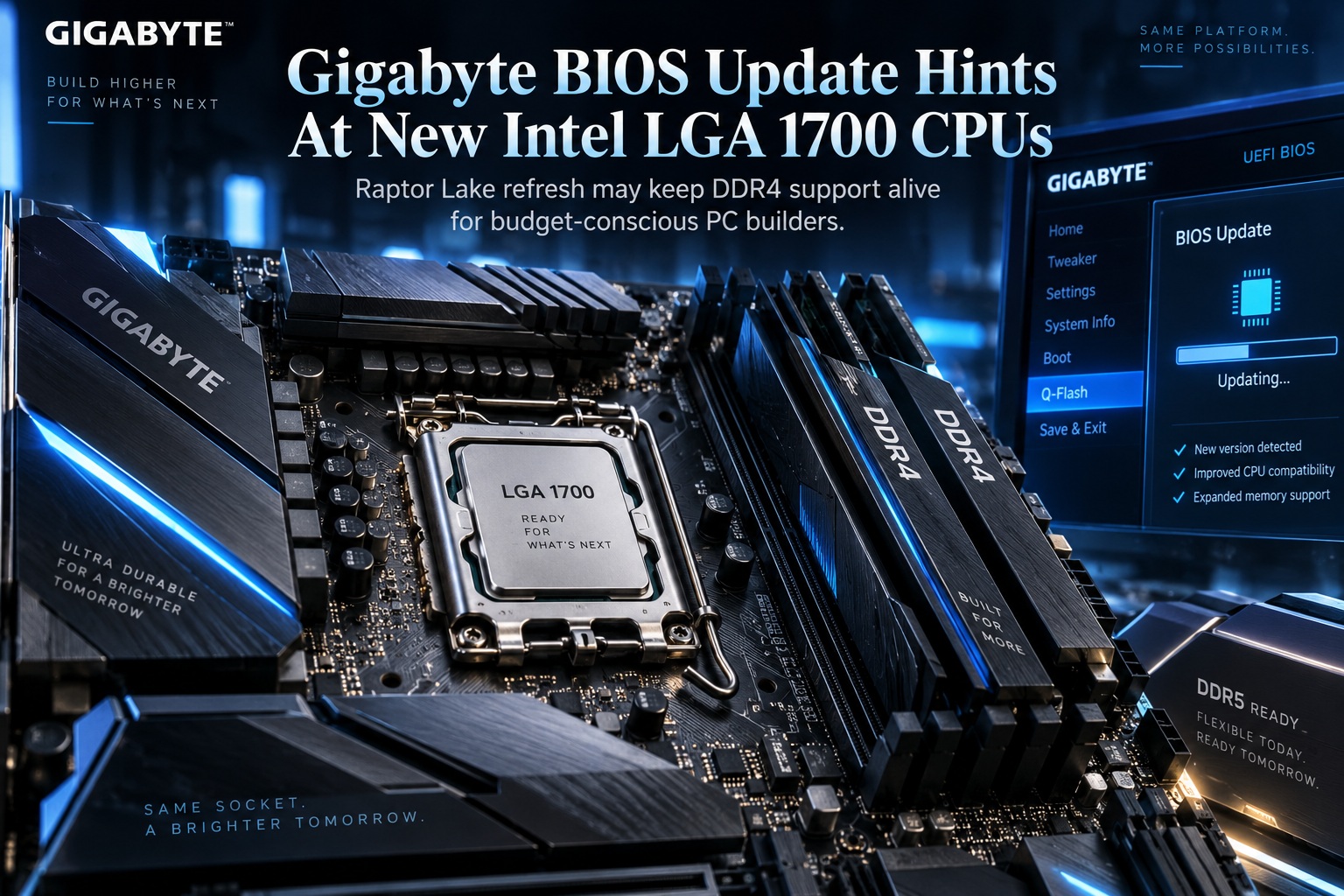
Gigabyte has released a new BIOS update for several Intel B760 and H610 motherboards, strongly suggesting that another round of processors for the ageing LGA 1700 platform is on the way. The update specifically adds support for upcoming CPUs, allowing owners of compatible motherboards to prepare their systems ahead of the new processors' expected arrival. More importantly, Gigabyte is providing the update across both DDR5 and DDR4 motherboard variants, indicating that Intel's next LGA 1700 chips are expected to retain support for both memory standards.
Gigabyte BIOS Update Points To New Intel Raptor Lake Refresh CPUs With DDR4 Support
Gigabyte has released a new BIOS update for several Intel B760 and H610 motherboards, strongly suggesting that another round of processors for the ageing LGA 1700 platform is on the way. The update specifically adds support for upcoming CPUs, allowing owners of compatible motherboards to prepare their systems ahead of the new processors' expected arrival. More importantly, Gigabyte is providing the update across both DDR5 and DDR4 motherboard variants, indicating that Intel's next LGA 1700 chips are expected to retain support for both memory standards.
For existing PC owners, this could provide an unusually affordable upgrade route in 2027. Instead of replacing the motherboard, memory and processor simultaneously, users may be able to update the BIOS, install one of the new CPUs and continue using much of their existing hardware.
LGA 1700 May Not Be Finished Yet
Intel's LGA 1700 platform originally arrived alongside the 12th-generation Alder Lake processors and subsequently supported the 13th-generation Raptor Lake and 14th-generation Raptor Lake Refresh families. Given its age, many users might reasonably have expected Intel to leave the socket behind entirely as newer platforms took over.
Gigabyte's latest BIOS update suggests otherwise. Its B760 and H610 boards are being prepared for another generation of processors, giving LGA 1700 systems potentially one more upgrade cycle.
The update is particularly interesting because these chipsets cover both mainstream and entry-level systems. Rather than restricting compatibility to premium Z-series motherboards, the upcoming processors appear set to work across considerably more affordable hardware.
DDR4 Support Could Be The Biggest Selling Point
Perhaps the most important part of Gigabyte's announcement is that the BIOS update applies to both DDR5 and DDR4 motherboards. This strongly suggests that Intel's upcoming processors will preserve one of Raptor Lake's biggest advantages: flexibility around memory.
DDR5 is technically superior and continues to become more common, but upgrading memory still adds cost to a new PC build. Users who already own perfectly functional DDR4 kits may prefer to reuse them rather than replacing memory simply because they are upgrading the processor.
For gaming in particular, DDR4 remains adequate for a large number of systems. While DDR5 can provide higher bandwidth and stronger performance in certain workloads, the difference is not necessarily large enough to justify replacing an entire platform for every user.
A Potentially Affordable Upgrade Path
The combination of an existing motherboard, existing DDR4 memory and a newer CPU could make the upcoming processors attractive to budget-conscious PC builders. Someone currently using an older Alder Lake or lower-end Raptor Lake processor could potentially perform a relatively simple CPU swap rather than rebuilding the system from scratch.
That matters because platform upgrades can become expensive quickly. Replacing a processor often leads to a new motherboard, which may then require new memory and potentially other components. Keeping LGA 1700 alive allows users to extend the useful life of systems they already own.
For people building lower-cost gaming PCs, mature DDR4 platforms could also provide an alternative to newer systems where motherboard and memory prices remain higher.
Intel Has Already Suggested Raptor Lake Is Staying Around
The possibility of another Raptor Lake refresh does not appear entirely unexpected. Robert Hallock, Intel's Vice President and General Manager of its Enthusiast Channel, previously said that the Raptor Lake platform "is not going away anytime soon".
One of the reasons for its continued usefulness is the platform's ability to work with both DDR4 and DDR5 memory. This gives system builders considerably more flexibility than platforms that force users into a newer memory standard.
Hallock has also acknowledged continuing demand for DDR4 and indicated that Intel intends to keep supporting it. Gigabyte's BIOS update now provides further evidence that this strategy may extend into another CPU release.
The New Lineup May Be Called Raptor Lake Next
Intel has not officially announced the upcoming processors, and Gigabyte's BIOS release does not reveal their specifications or branding. Previous leaks, however, have referred to a refreshed lineup under the codename Raptor Lake Next.
The processors are expected to arrive sometime in early 2027. Rather than using the traditional 14th-generation naming convention, the new chips may adopt Intel's newer Core 200 branding.
If accurate, that would place them within Intel's newer naming structure while still using architecture and platform foundations derived from Raptor Lake. This could make the lineup somewhat unusual: new branding paired with an established socket and memory ecosystem.
Several Core 7, Core 5 And Core 3 Models Are Rumoured
Leaks have also pointed towards several possible CPU configurations. At the upper end of the lineup, a Core 7 model may feature an 8+12 core configuration, combining eight performance cores with 12 efficiency cores.
Two Core 5 processors have also been mentioned. One may feature an 8+8 configuration, while another could use a more modest 6+4 setup. These configurations would allow Intel to target different performance and pricing tiers without introducing an entirely new architecture.
At the entry level, reports point towards a four-core Core 3 processor. Such a chip could be especially interesting for affordable office PCs, home systems and entry-level gaming builds where platform cost matters more than maximum multi-core performance.
Mature Hardware Can Still Have Advantages
Using an older platform is not necessarily a disadvantage for every buyer. LGA 1700 motherboards have been on the market for several years, meaning BIOS maturity, memory compatibility and general platform behaviour are well understood.
There is also an enormous selection of motherboards across different price categories. Buyers can choose everything from inexpensive H610 boards to more feature-rich B760 models, while existing users may not need to purchase a motherboard at all.
A mature platform also has a substantial second-hand ecosystem. If Intel introduces competitively priced processors for LGA 1700, they could make older motherboards and DDR4 kits considerably more attractive to budget builders.
Not Everyone Needs To Move To DDR5 Immediately
Much of the PC industry has naturally moved towards DDR5, and future platforms will increasingly treat it as the standard. However, the existence of faster technology does not automatically make older hardware unusable.
For many everyday applications and games, a well-configured DDR4 system remains perfectly capable. Users prioritising maximum frame rates or memory-intensive workloads may still benefit from DDR5, but someone upgrading an existing PC may achieve better value by investing more of their budget into the CPU or graphics card instead.
Keeping DDR4 support available gives users that choice rather than forcing a complete platform transition.
The BIOS Update Is Important For Existing Gigabyte Owners
Owners of supported Gigabyte B760 and H610 motherboards should eventually be able to prepare for the new processors simply by installing the appropriate BIOS update. However, users should always confirm their exact motherboard model and supported BIOS version before attempting a future CPU upgrade.
Updating the BIOS while the current processor is still installed is generally the safest approach. Waiting until after purchasing a new unsupported CPU can create unnecessary complications, particularly on motherboards without a dedicated BIOS flashback feature.
Once Intel officially announces the processors, Gigabyte is likely to provide clearer CPU compatibility lists for individual motherboard models.
Intel Could Be Targeting Value Rather Than Maximum Performance
A renewed Raptor Lake lineup would probably not be intended to compete directly with Intel's latest architectures at the very top of the performance market. Its strongest appeal may instead be affordability, platform compatibility and the ability to reuse existing components.
That could give Intel a useful option in the mainstream and entry-level segments. Instead of forcing every buyer onto the newest socket, the company can continue serving users who value lower system costs over having the newest architecture.
For PC builders facing expensive memory and motherboard upgrades, that strategy could make considerable sense.
Final Thoughts
Gigabyte's latest BIOS update provides one of the clearest signs yet that Intel is preparing another CPU lineup for the LGA 1700 platform. Support across both DDR5 and DDR4 versions of B760 and H610 motherboards is particularly significant because it suggests existing systems may be able to upgrade without replacing their memory or motherboard.
The rumoured Raptor Lake Next processors are expected in early 2027 and could include Core 7, Core 5 and Core 3 models under Intel's Core 200 branding. Specifications remain unofficial for now, but the bigger story may be the continued life of LGA 1700 itself.
For users already sitting on a capable DDR4 system, that could be very welcome news. Rather than forcing another complete platform rebuild, Intel may be preparing to give one of its most flexible desktop platforms another generation of useful life.











Comments 0