

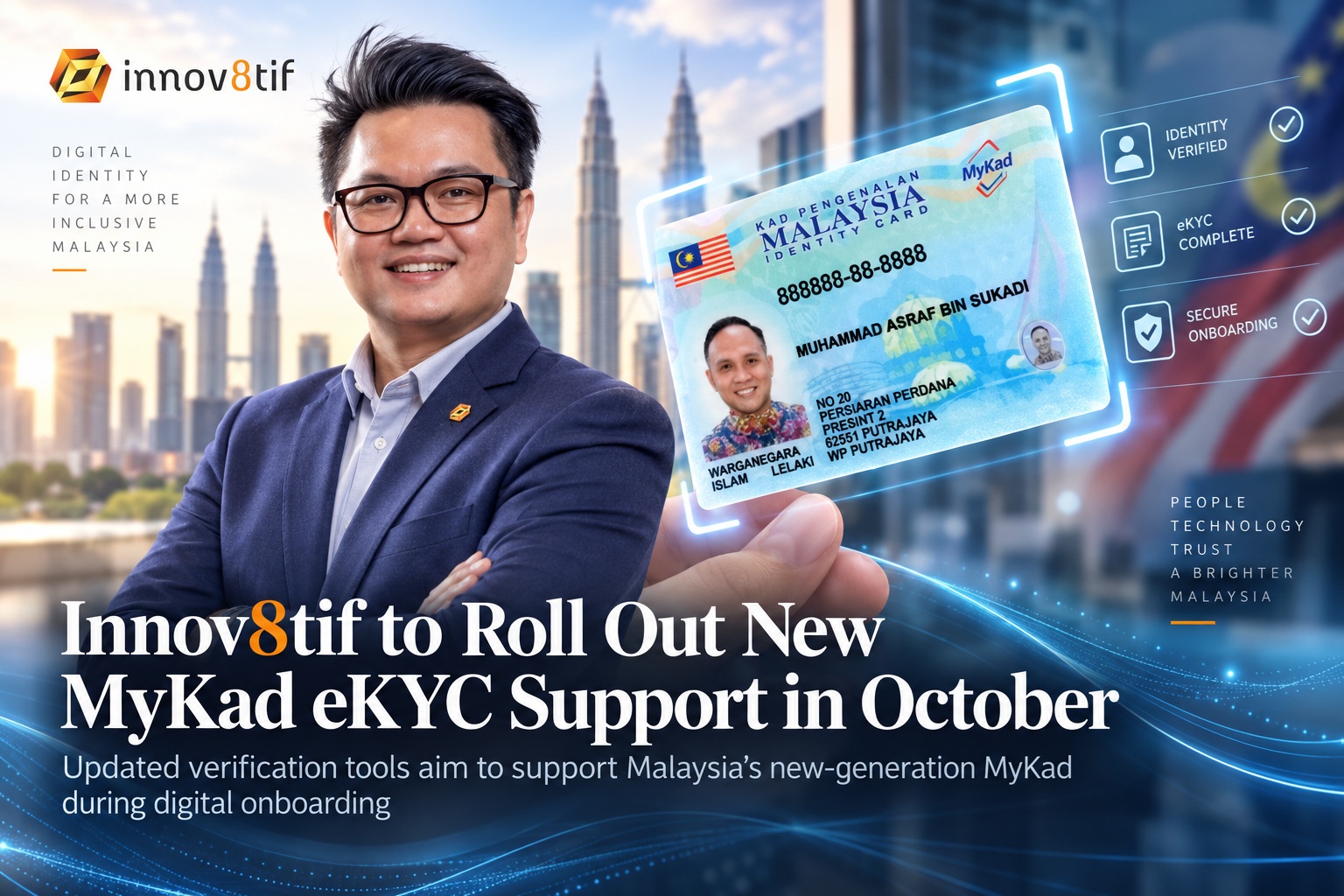
Innov8tif is preparing to update its electronic Know Your Customer, or eKYC, platform to support Malaysia's New Generation MyKad as businesses and financial institutions adapt to the redesigned national identity card. The identity verification provider says the first phase of its updated support is expected to roll out in early October, helping organisations continue digital onboarding without disruption as more Malaysians begin receiving the new card.
The update comes at an important time. The New Generation MyKad introduces significant changes to its physical layout, security features and verification requirements, which means existing eKYC systems designed around the older card may not recognise it correctly without software updates.
New MyKad Design Requires eKYC Systems to Adapt
The redesigned MyKad looks different from the previous generation and incorporates additional security technologies. While those changes are intended to strengthen identity protection, they also create a challenge for systems that rely on document scanning, optical character recognition and automated verification.
Many eKYC platforms are built around known document templates. They expect information such as the cardholder's photograph, identification number and other security elements to appear in specific locations. When those elements move or change appearance, the system may reject a genuine card simply because it no longer matches the expected format.
Innov8tif's upcoming update is intended to address that transition and allow its customers to recognise the new card more reliably during digital onboarding.
Early Compatibility Problems Have Already Appeared
The need for these updates became clear shortly after the new MyKad began rolling out. Earlier tests found that the redesigned card could not initially complete eKYC verification on services including Touch 'n Go eWallet, Ryt Bank, AEON Bank and GXBank.
These failures do not necessarily mean the new MyKad itself has a problem. Instead, they show that some digital services and their underlying identity-verification providers still need to update their recognition systems.
For users, the result can be frustrating. Someone may hold a perfectly valid new MyKad but still be unable to open an account or complete registration because the automated system has not yet been trained or configured to recognise the new format.
eKYC Involves More Than Reading the Card
For regulated financial institutions, identity verification goes far beyond simply extracting text from MyKad using optical character recognition.
A typical eKYC process may include document authenticity checks, facial matching, liveness detection, identity-data validation, fraud screening and other risk controls. This means supporting the new MyKad requires more than updating the visual template alone.
Security features, document structure and verification logic all need to be reviewed so that the new card can be accepted without weakening existing fraud controls.
That is particularly important for banks and other regulated organisations where a false acceptance can create serious compliance and financial risks.
Innov8tif Targets Early October for the First Phase
Innov8tif says its first phase of New Generation MyKad support is scheduled for early October.
Nathan Cheong, Head of Product (AI) at Innov8tif, said the company wants customers and the wider industry to remain confident that digital onboarding can continue securely throughout the transition. He added that the team has been actively preparing its technology so partners can begin receiving enterprise-grade support from early October.
The phased approach suggests additional improvements may continue after the initial release as more cards enter circulation and real-world verification data becomes available.
Working Together With JPN
Innov8tif is also working with the National Registration Department, or JPN, as it updates its MyKad verification capabilities.
That collaboration is important because identity providers need accurate technical information about the redesigned card before they can reliably validate it. Working directly with JPN can help ensure that eKYC systems understand the new layout and security features rather than relying purely on reverse engineering from publicly issued cards.
It also gives service providers a clearer path for updating their systems while maintaining compliance with national identity requirements.
The Wider Industry Is Still Catching Up
Innov8tif is not the only company adapting. Banks, digital wallets, telecommunications providers, government systems and other services that depend on MyKad verification will all need to ensure their platforms understand the new design.
The transition highlights how interconnected Malaysia's identity infrastructure has become. Changing a physical identity card is no longer simply a matter of issuing a new piece of plastic. Every digital service that scans, reads or validates that card also becomes part of the rollout.
The more services move toward fully digital onboarding, the more important that coordination becomes.
A Smooth Transition Matters for Digital Banking
For financial institutions in particular, reliable New Generation MyKad support is essential. Many digital banks and e-wallets rely almost entirely on remote identity verification, meaning there may be no physical counter available when automated onboarding fails.
A user rejected by the eKYC system may therefore be unable to continue at all.
That makes early compatibility particularly important for services built around branchless banking. Identity providers such as Innov8tif sit behind much of that onboarding infrastructure, so their ability to adapt quickly can directly affect the experience customers see in the front-end application.
Final Thoughts
Innov8tif's planned New Generation MyKad support in early October should help ease some of the eKYC compatibility problems that surfaced during the card's initial rollout.
The transition is a reminder that stronger identity security also requires strong coordination between government agencies, verification providers and the organisations using those services. A redesigned MyKad may be more secure, but it only works smoothly when the wider digital ecosystem is ready to recognise it.
Innov8tif's collaboration with JPN and planned phased rollout are therefore important steps toward making the new card work more consistently across digital onboarding platforms.
As more Malaysians receive the New Generation MyKad, the focus now shifts from issuing the card itself to ensuring the systems around it are equally prepared.











Comments 0