

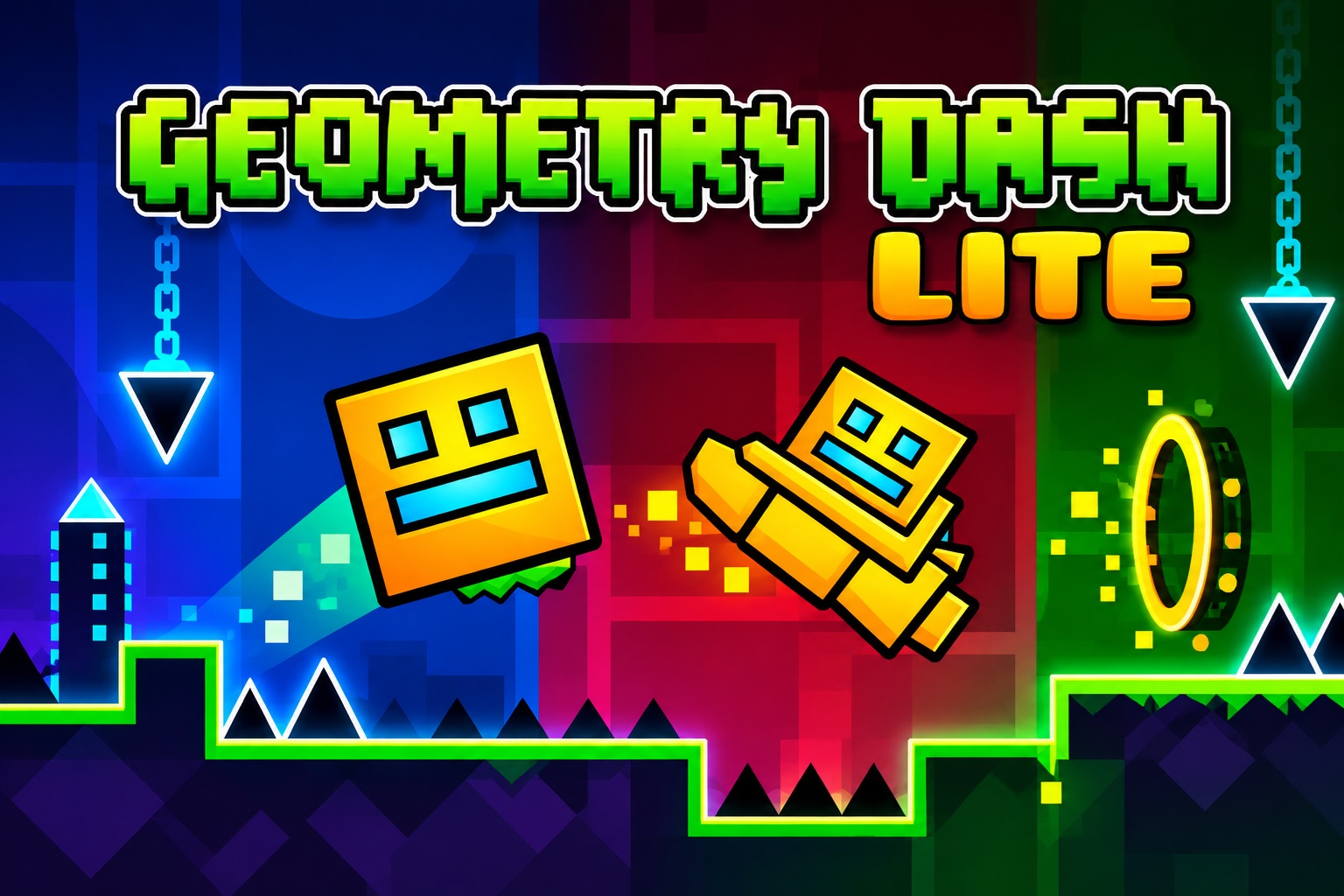
Geometry Dash is a rhythm-based platformer from RobTop Games that turns a remarkably simple control scheme into one of the most demanding precision challenges in modern gaming. Players control a geometric icon that moves forward automatically through levels filled with spikes, platforms, portals, moving hazards, gravity changes, and sudden transformations. Most actions are performed with a single tap or click, but the challenge comes from using that input at exactly the right moment while the level moves continuously. Every failed jump immediately exposes where the timing went wrong and encourages another attempt.
The game is closely connected to its electronic soundtrack, with obstacles and transitions frequently arranged around the rhythm of the music. Successful runs gradually become less about reacting to individual hazards and more about memorizing complete sequences of jumps, gravity changes, and mode transitions. Levels that initially appear impossibly fast can eventually feel almost automatic after enough practice. This constant transformation from confusion into muscle memory is one of the main reasons Geometry Dash remains so addictive.
Now playable online through Lemon Web Games, Geometry Dash brings its rhythm-based platforming, precision jumping, transformation portals, gravity mechanics, Practice Mode, collectibles, and increasingly challenging stages directly into the web browser. Players can learn difficult sections one obstacle at a time, experiment with the different movement modes, and repeatedly attempt full runs until every jump is performed correctly. The controls remain easy enough to understand immediately, but completing harder levels requires concentration, memorization, and consistency. For players who enjoy games where improvement comes almost entirely from practice, Geometry Dash provides a deeply satisfying challenge.
The Cube Introduces the Core Gameplay
The cube is the most recognizable form in Geometry Dash and provides the foundation for everything that follows. It moves forward automatically while the player taps or clicks to jump over spikes, gaps, and other hazards.
Because the cube cannot stop or move backward, players need to commit to every jump. A mistake cannot usually be corrected after leaving the ground.
Early sections teach the rhythm of the game through relatively simple jumps. Later levels combine those same mechanics with faster movement, gravity changes, and far more complicated obstacle arrangements.
One Button Creates Surprisingly Deep Gameplay
Geometry Dash demonstrates how much difficulty can be created from a very small number of controls. Players do not need to manage complicated movement combinations because most interactions depend on pressing and releasing one input.
The complexity comes entirely from timing. A tap that is slightly early may send the icon into one spike, while pressing slightly late may cause it to miss a platform completely.
This simplicity makes failure easy to understand. Players usually know exactly which action went wrong, making another attempt feel immediately worthwhile.
The Music Becomes Part of the Level
Electronic music is deeply connected to Geometry Dash's identity. Jumps, portals, visual effects, and major transitions often align with the beat.
Once players become familiar with a stage, the soundtrack can effectively become another guide. Certain beats begin to signal upcoming jumps or changes in movement.
This connection between sound and gameplay gives successful runs a strong sense of flow. When every input lands at the right moment, playing a level can feel almost like performing along with the music.
Memorization Is Essential
Some obstacles appear too quickly to be handled entirely through reaction speed. Players gradually learn the safest route through repetition.
The first attempt through a difficult section may last only seconds. The next attempt provides slightly more knowledge, and repeated failures slowly reveal the entire sequence.
Eventually, the player no longer needs to consciously analyze every obstacle. The hands begin following patterns already learned through practice.
Practice Mode Makes Difficult Levels Manageable
Practice Mode allows players to place checkpoints and repeatedly attempt difficult sections without restarting from the beginning each time.
This makes it one of the most valuable tools for learning advanced stages. A troublesome sequence can be repeated until its timing becomes familiar.
Once every section has been practiced individually, the real challenge becomes connecting them into one uninterrupted successful run. Practice Mode teaches the level, while Normal Mode tests consistency.
The Ship Completely Changes Movement
Entering a ship portal transforms the icon into a flying vehicle. Instead of jumping, holding the input causes the ship to rise while releasing it causes the ship to fall.
This creates a very different type of precision challenge. Players need to control altitude continuously rather than making individual jumps.
Narrow passages become especially demanding because excessive corrections can send the ship into either the ceiling or floor. Smooth movement is usually more reliable than frantic tapping.
The Ball Introduces Gravity Switching
Ball mode replaces conventional jumping with direct gravity changes. Activating the control switches the ball between the floor and ceiling.
This forces players to think about both sides of the level simultaneously. What appears to be a safe platform may become dangerous after the next gravity switch.
The ball rewards careful timing because every input changes the direction of movement completely. Successful sequences often develop a strong rhythmic pattern.
The UFO Uses Repeated Aerial Jumps
UFO mode gives the player greater control over vertical movement by allowing repeated jumps while airborne.
Each tap produces another upward movement before gravity begins pulling the UFO down again. The result feels somewhere between ordinary jumping and ship flight.
Rapid tapping can easily create too much height, while waiting too long can send the UFO into lower hazards. Maintaining the correct rhythm becomes essential.
Wave Mode Demands Extremely Precise Control
Wave mode is one of the most distinctive transformations in Geometry Dash. Holding the input sends the icon diagonally upward, while releasing sends it diagonally downward.
Because movement changes direction immediately, narrow corridors can become extremely unforgiving. Even tiny timing errors may cause a collision.
Wave sections are particularly impressive once mastered because movement can become fast and perfectly rhythmic. They are also among the modes most associated with the game's harder levels.
Robot Mode Changes Jump Strength
The robot introduces variable jump height depending on how long the player holds the input.
Short presses produce smaller jumps, while longer presses allow the robot to travel higher. This provides more control than the standard cube but also requires greater judgement.
Different obstacles may require completely different jump lengths in rapid succession. Players need to understand not only when to jump but how long each jump should last.
Spider Mode Uses Instant Teleportation
Spider mode switches instantly between the floor and ceiling rather than travelling gradually between them.
This produces extremely rapid transitions and requires players to read upcoming surfaces carefully. A poorly timed input can teleport the spider directly into a hazard.
The mechanic feels unusual at first because movement happens immediately. Once understood, it creates fast sequences that reward accurate rhythm and memorization.
Portals Can Change the Rules Without Warning
Transformation portals are not limited to changing the player's form. Other portals can affect gravity, speed, scale, and additional gameplay properties.
This means a level can completely change its behaviour within seconds. A comfortable cube section may suddenly become a fast ship sequence followed by inverted gravity.
Learning where these transitions occur is essential. Players who anticipate the change can prepare mentally before the controls begin behaving differently.
Gravity Changes Make Familiar Obstacles Dangerous
Gravity portals can flip the entire challenge upside down, placing the player on the ceiling instead of the floor.
The basic mechanics may remain identical, but the reversed perspective can make familiar jump patterns feel surprisingly difficult.
Repeated practice helps players stop thinking of upside-down movement as unusual. Eventually, both orientations become equally readable.
Speed Portals Increase the Pressure
Levels can change speed during a run, making previously comfortable movement suddenly much faster or slower.
Faster sections reduce reaction time and make precise inputs more difficult. Slower sections can also be challenging because players accustomed to rapid timing may press too early.
These transitions help keep levels unpredictable. The same type of obstacle can demand completely different timing depending on current speed.
Jump Orbs Add Mid-Air Interaction
Jump Orbs allow players to activate additional movement while travelling through the air. Different orb types can affect jumping and gravity in different ways.
Because they require active input at the correct moment, Orbs create more complicated sequences than ordinary platforms.
A player may need to jump, hit an Orb, pass through a portal, and immediately prepare for another input. These combinations become increasingly common in advanced levels.
Jump Pads Trigger Movement Automatically
Jump Pads activate when the icon touches them, launching the player without requiring another press.
They can create dramatic transitions and unexpectedly long jumps. Players need to know where the pad will send them before reaching it.
Pads are often combined with other mechanics, making them part of larger movement sequences rather than isolated features.
Spikes Remain the Classic Threat
Despite all the transformations and special mechanics, spikes remain one of the most recognizable hazards in Geometry Dash.
They appear in countless arrangements and can punish even the smallest timing mistake. Single spikes may be easy, while groups require more accurate jumps.
Their simplicity works perfectly with the game's visual design. Players can understand the danger instantly without needing an explanation.
Moving Obstacles Add Another Layer
Later stages introduce platforms and hazards that move while the player approaches them.
This prevents players from relying only on fixed visual positions. They need to understand where the obstacle will be when the icon reaches it.
Moving geometry also makes the soundtrack connection more important. Many moving elements follow predictable timing that becomes easier to understand through repeated runs.
Collectible Coins Encourage Risk
Secret Coins and other collectibles are often placed away from the safest route.
Collecting them may require an additional jump, unusual path, or more difficult timing. This turns optional exploration into another challenge within already demanding levels.
Players interested only in completion can often ignore them, while completionists gain additional objectives. The coins provide replay value after the main route has been mastered.
Customization Rewards Progress
Geometry Dash allows players to customize the appearance of their icon with different forms, colours, and visual options.
Many cosmetics are connected to achievements and progression, giving players visible rewards for continued play.
Customization does not make levels easier, but it allows players to develop a more personal identity. The same difficult stage can be attempted with a completely different visual style.
Failure Happens Instantly
Colliding with a spike or obstacle usually ends the attempt immediately.
There are no health bars allowing several mistakes before failure. Precision needs to remain consistent from the beginning of the level to the end.
This can feel punishing, but the instant restart keeps frustration manageable. A failed attempt becomes another opportunity to perform the sequence better.
Quick Restarts Create the One-More-Try Effect
Geometry Dash rarely wastes time after a mistake. Players can begin another attempt almost immediately.
This fast cycle is one of the main reasons difficult levels become so addictive. The player still remembers exactly what went wrong and can immediately test the correction.
One failed attempt easily becomes ten, especially when each run progresses slightly farther than the previous one.
Progress Percentage Makes Improvement Visible
The game displays how far the player has travelled through the current level.
Reaching 80 percent after previously failing at 60 percent creates a clear sense of improvement even if the level is not yet complete.
The system also increases tension near the end. Once the percentage approaches 100, every obstacle feels more dangerous because so much progress is at stake.
Late-Level Mistakes Are Especially Painful
Crashing near the beginning usually encourages an immediate restart with little frustration. Failing at 95 percent feels very different.
The player knows almost the entire level has already been completed successfully, making one late mistake especially difficult to accept.
Yet these moments often create the strongest motivation to continue. If the player reached 95 percent once, completing the level suddenly feels possible.
Hard Levels Become Exercises in Consistency
Knowing every obstacle is not enough. Players eventually need to perform the entire sequence correctly in one uninterrupted attempt.
This is where Geometry Dash becomes especially demanding. A section that feels easy in Practice Mode can still cause failure when reached during a full run.
The final challenge is therefore consistency rather than discovery. Mastery means executing everything correctly under pressure.
Visual Effects Increase the Intensity
Geometry Dash uses bright colours, pulses, flashes, movement, and other visual effects that synchronize with the music.
These effects make stages feel alive and give different sections their own personality.
They can also increase difficulty by creating additional visual information that players need to process. Staying focused on the actual collision geometry becomes important during especially busy sections.
The Game Rewards Persistence More Than Luck
Geometry Dash provides very little opportunity to blame random chance. The obstacle layout remains consistent, and the same inputs generally create the same result.
If a player fails, there is usually something specific that can be improved.
This makes eventual success extremely satisfying. Completing a difficult level feels like proof that the player genuinely learned it.
Playing Geometry Dash Online Today
Through Lemon Web Games, Geometry Dash can now be played directly in your web browser with no downloads or setup required. Features of the web-based version include:
New players should use Practice Mode whenever a level begins feeling impossible. Breaking a difficult stage into smaller sections is far more effective than repeatedly attempting the entire level without understanding the troublesome parts. Once every sequence becomes familiar, return to Normal Mode and concentrate on consistency.
It is also useful to listen to the music rather than focusing only on the visuals. Many jumps and transitions follow a recognizable rhythm, and learning that rhythm can make complicated sections much easier to remember.
Who Should Play Geometry Dash
Geometry Dash is especially suitable for players who enjoy seeing their own skill improve through repetition. Every failed attempt provides information, and every extra percentage of progress shows that the practice is working.
It should also appeal to players who enjoy games that combine music with mechanical timing. Successful runs eventually feel less like navigating individual obstacles and more like performing one continuous rhythm.
Play Geometry Dash Online Now
Geometry Dash turns a single-button control scheme into a demanding journey through spikes, portals, gravity changes, moving obstacles, transformation modes, and electronic music. Jump as the cube, fly as the ship, switch gravity with the ball, control the wave through narrow corridors, and learn every transition until the entire level becomes one continuous sequence.
Through Lemon Web Games, players can experience Geometry Dash directly in the browser and begin another attempt within moments of failure. Every run teaches something, every percentage gained represents improvement, and every difficult section eventually becomes manageable with enough practice.
Final Thoughts
Geometry Dash remains compelling because it makes improvement incredibly easy to recognize. A section that feels impossible during the first few attempts gradually becomes familiar, then manageable, and eventually almost automatic. The game rarely changes the rules to rescue the player; success comes from learning those rules well enough to perform them consistently.
Its combination of music and movement gives the experience a distinctive identity. Cube jumps, ship flight, Wave movements, gravity changes, and portal transitions all become part of the soundtrack-driven rhythm once a level is properly learned. The simple controls hide an enormous amount of mechanical precision.
Through Lemon Web Games, Geometry Dash can now be enjoyed directly in the browser as one of the most recognizable precision platformers of its era. It is colourful, demanding, frustrating, rhythmic, and enormously satisfying when everything finally comes together. For players who enjoy turning repeated failure into eventual mastery, few games make that journey feel quite as rewarding.











Comments 0